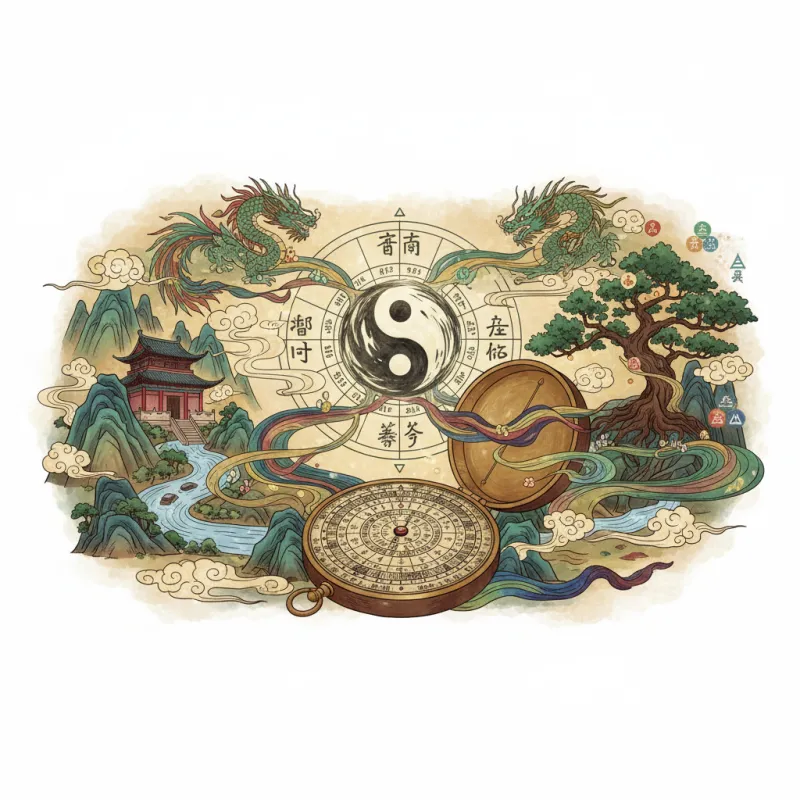
When a Tang Dynasty emperor consulted his court astrologer about the fate of his newborn son, the sage didn't just cast a horoscope—he examined the child's birth chart through Bazi (八字, bāzì), consulted the I Ching's hexagrams, and assessed the palace's Feng Shui alignment. This integrated approach wasn't superstition; it was sophisticated metaphysical science that recognized how cosmic forces, earthly energies, and temporal patterns converge to shape human destiny. Today, practitioners who understand these interconnections unlock insights that single-system analysis simply cannot provide.
The Philosophical Foundation: Yin-Yang and Wu Xing
Before diving into specific practices, we need to grasp the conceptual bedrock underlying all Chinese metaphysical arts. The theory of Yin-Yang (阴阳, yīn yáng) and Wu Xing (五行, wǔ xíng)—the Five Elements—forms the DNA of Feng Shui, I Ching, and Bazi alike. These aren't separate belief systems but different applications of the same fundamental principles.
Yin-Yang represents the dynamic interplay of complementary opposites: darkness and light, receptive and active, earth and heaven. Wu Xing—Wood, Fire, Earth, Metal, and Water—describes how these forces manifest and transform through cyclical patterns. In Bazi, these elements appear in your birth chart's Heavenly Stems and Earthly Branches. In Feng Shui, they govern spatial arrangements and directional energies. In I Ching, they underpin the hexagram transformations. Master one system's elemental logic, and you've learned the language all three speak.
Bazi: The Four Pillars as Your Cosmic Blueprint
Bazi analysis constructs your destiny chart from four pillars—year, month, day, and hour of birth—each containing a Heavenly Stem and Earthly Branch. This creates eight characters (hence "Bazi") that map your elemental constitution at the moment you drew first breath. But here's what most beginners miss: Bazi isn't static fortune-telling. It's a dynamic system showing how your natal elements interact with the changing elements of each year, month, and day you live through.
A person born with strong Fire and weak Water elements might thrive during Metal years (which produce Water through the productive cycle) but struggle during Wood years (which feed Fire, creating imbalance). This is where understanding the Five Elements cycles becomes crucial—the productive, controlling, and weakening relationships between elements determine whether a given period brings opportunity or challenge.
The real power emerges when you layer Bazi insights with environmental adjustments. If your chart shows weak Earth element affecting your health or stability, Feng Shui modifications can introduce Earth energy through your living space—earthenware objects, yellow tones, southwest sector enhancements. You're not fighting your destiny; you're harmonizing with it through multiple channels.
I Ching: The Oracle That Speaks in Patterns
The I Ching (易经, Yìjīng), or Book of Changes, predates both Feng Shui and Bazi by centuries, with origins reaching back to the Western Zhou Dynasty around 1000 BCE. King Wen and his son, the Duke of Zhou, systematized the 64 hexagrams and their interpretations while imprisoned by the Shang Dynasty—a testament to finding cosmic order amid personal chaos.
What makes I Ching relevant to Bazi practice? Both systems recognize that time itself has quality, not just quantity. When you cast an I Ching hexagram, you're capturing the energetic signature of that specific moment—similar to how Bazi captures your birth moment's signature. The hexagram's changing lines show transformation patterns, just as Bazi's Luck Pillars reveal how your elemental balance shifts through life decades.
I've watched practitioners use I Ching to time major decisions revealed through Bazi analysis. Your Four Pillars might indicate a favorable year for career change, but which month? Which day? Consulting the I Ching for that specific question adds precision to Bazi's broader strokes. Hexagram 32, Heng (恒, Constant), might confirm that persistence in your current path aligns with cosmic timing, while Hexagram 49, Ge (革, Revolution), could signal the moment for bold transformation.
Feng Shui: Anchoring Temporal Patterns in Space
While Bazi maps time and I Ching reads moments, Feng Shui governs space—but these aren't separate domains. Classical Feng Shui schools like Xuan Kong Fei Xing (玄空飞星, Xuánkōng Fēixīng), or Flying Stars, explicitly incorporate temporal cycles. The same building has different energetic qualities in Period 8 (2004-2024) versus Period 9 (2024-2044) because cosmic energies shift through 180-year cycles.
Here's where integration becomes practical: suppose your Bazi chart shows you entering a ten-year Luck Pillar dominated by Water element, which happens to be your favorable element. You can amplify this beneficial period by activating the north sector of your home (Water's direction in the Later Heaven Bagua) and placing your desk or bed to face your personal favorable direction calculated from your Gua number. You're essentially creating spatial resonance with your temporal advantage.
The San He (三合, Sānhé) school of Feng Shui takes this further by analyzing how landforms and water flows interact with the Earthly Branches—the same branches appearing in your Bazi chart. A property with water flowing from the Yin direction (northeast) might particularly benefit someone with strong Yin Wood in their Four Pillars. This isn't coincidence; it's systematic correspondence between microcosm (your chart) and macrocosm (your environment).
The Synthesis: Reading Multiple Layers Simultaneously
The most skilled practitioners I've encountered don't compartmentalize these systems—they read them as simultaneous layers of one reality. Consider a consultation scenario: A client's Bazi shows weak Metal element affecting their respiratory health and decision-making clarity. Their current Luck Pillar brings strong Fire, which controls (attacks) Metal, intensifying the problem. The I Ching reading produces Hexagram 56, Lü (旅, The Wanderer), suggesting instability and lack of grounding.
The integrated solution addresses all three levels. Bazi analysis identifies the root imbalance and timing. I Ching confirms the current energetic state and suggests the quality of action needed—in this case, finding stability before making moves. Feng Shui provides the environmental intervention: strengthen the west sector (Metal direction), add Metal element through wind chimes or metal artwork, and ensure the bedroom (personal grounding space) has solid backing and isn't in a Fire-dominant area of the home.
This multi-system approach also prevents the common mistake of over-correcting. Someone might read that they need more Fire element and paint everything red, not realizing their Bazi already has hidden Fire in the Earthly Branches that will emerge during certain years. Proper Bazi chart analysis reveals these hidden elements, while Feng Shui adjustments should complement, not overwhelm, your natal constitution.
Practical Integration for Modern Practitioners
You don't need to master all three systems simultaneously—that's a lifetime pursuit. But understanding their interconnections enhances whatever system you're studying. When learning Bazi, recognize that the Earthly Branches correspond to compass directions used in Feng Shui. When studying I Ching, notice how hexagram transformations mirror the Five Elements' productive and controlling cycles. When practicing Feng Shui, remember that optimal arrangements vary by individual based on their Bazi constitution.
Start with one system as your foundation—most find Bazi most accessible because it's personal and specific—then gradually incorporate insights from the others. Keep a journal tracking how I Ching readings correlate with your Bazi Luck Pillar transitions. Notice whether Feng Shui adjustments feel more effective during favorable Bazi periods. These aren't separate tools; they're different instruments in the same orchestra, and the music improves when they play in harmony.
The Living Tradition: Ancient Wisdom, Contemporary Application
Chinese metaphysics isn't museum knowledge—it's living practice that adapts while maintaining core principles. Modern practitioners use software to calculate Bazi charts that once required manual reference to thousand-page almanacs. We consult I Ching through apps while commuting. We apply Feng Shui principles to apartment layouts that ancient masters never imagined. The forms evolve, but the underlying patterns—those cyclical relationships between elements, the dance of Yin and Yang, the recognition that time and space interpenetrate—remain constant.
What makes these systems endure isn't blind tradition but empirical validation across centuries. When a Bazi prediction proves accurate, when an I Ching reading captures your situation with uncanny precision, when a Feng Shui adjustment shifts your home's energy palpably—these experiences confirm that our ancestors mapped something real about how reality operates. The integration of Feng Shui, I Ching, and Bazi offers not just prediction but participation in the cosmic patterns that shape our lives, giving us tools to navigate destiny with wisdom rather than resignation.
Related Reading
- Unlocking the Mysteries of Feng Shui and the I Ching: A Journey into Chinese Metaphysics
- Feng Shui for Your Home Entrance: First Impressions Matter
- Phone Number Feng Shui: Why Chinese People Pay Thousands for the Right Digits
Explore Chinese Culture
- Explore Daoist philosophy and practice
- Explore traditional Chinese customs
- Explore ancient Chinese cosmology