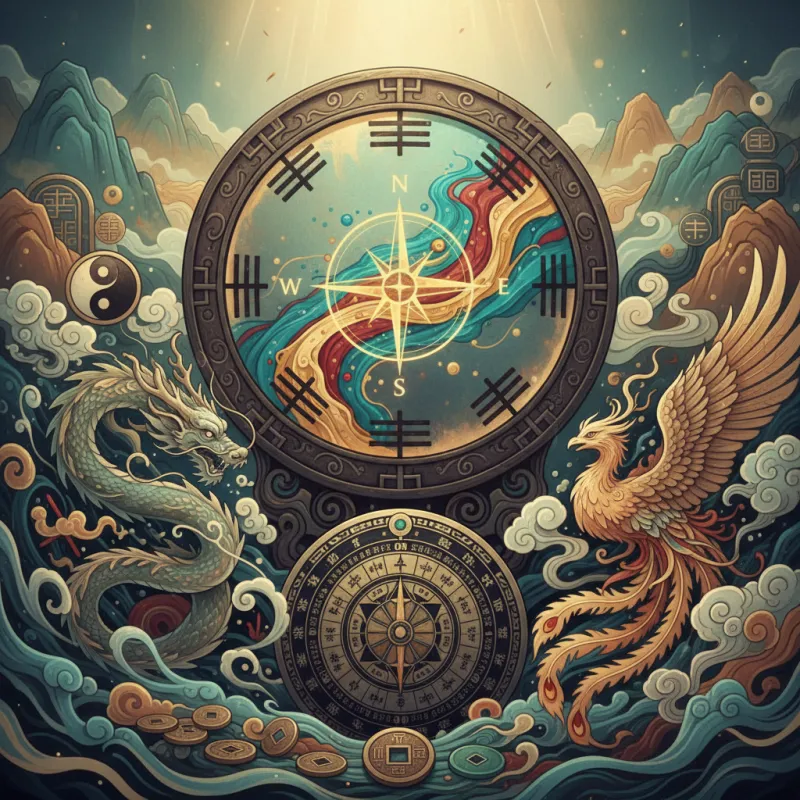
A bronze mirror catches the morning light in a Tang Dynasty palace, its polished surface doing far more than reflecting the empress's face. According to court records, this particular mirror—positioned to face the garden's koi pond—was credited with deflusing three assassination plots and bringing the imperial family two male heirs. Superstition? Perhaps. But in the intricate world of Chinese metaphysics, mirrors occupy a unique position as objects that exist in two realms simultaneously: the physical and the energetic.
The Double Nature of Mirrors in Chinese Thought
Unlike most Feng Shui tools that work with a single principle, mirrors operate on a paradox. They're simultaneously yin and yang—passive receivers and active projectors of qi (氣). This dual nature appears in the Huainanzi (淮南子), a 2nd-century BCE philosophical text, which describes mirrors as "gates between the seen and unseen worlds." The ancient Chinese weren't being poetic; they understood something profound about reflection itself.
When you place a mirror in your home, you're not just hanging a decorative object. You're installing what classical texts call a "qi multiplier" (氣倍增器, qì bèizēng qì). But here's where most modern Feng Shui advice goes wrong: they treat all mirrors the same. A convex bagua mirror (八卦鏡, bāguà jìng) hung above your door works on completely different principles than a flat mirror in your bedroom. The former deflects and scatters energy like a shield; the latter doubles and amplifies it like a lens focusing sunlight.
Mirrors in I Ching Divination: The Reflection Hexagrams
The I Ching (易經, Yìjīng) doesn't explicitly mention mirrors—the text predates their widespread use—but it contains what scholars call "reflection hexagrams" that operate on mirror-like principles. Hexagram 61, Zhōng Fú (中孚, "Inner Truth"), shows a structure that mirrors itself: two solid lines embracing two broken lines, which embrace two more solid lines. This symmetry isn't decorative; it represents how truth reflects itself, how sincerity creates its own echo.
When I consult the I Ching about mirror placement—yes, you can do this—I often receive Hexagram 38, Kuí (睽, "Opposition"). At first, this seems negative. But Kuí teaches that opposition creates clarity through contrast, exactly what a mirror does. It shows you what is by showing you what appears to be. The hexagram's structure places fire above and lake below—elements that reflect each other but never touch, maintaining the necessary distance for clear reflection.
The connection deepens when you consider the I Ching's concept of ying (應, "correspondence"). Certain lines in hexagrams "correspond" with their opposites, creating a kind of energetic reflection across the hexagram's center. Line 2 corresponds with line 5, line 3 with line 4. This isn't just numerology—it's a map of how energy reflects and responds to itself, which is precisely what mirrors do in physical space.
The Bronze Mirror Tradition and Protective Symbolism
Before glass mirrors arrived via the Silk Road around the 1st century CE, Chinese mirrors were cast from bronze alloys, often with elaborate designs on the back. These weren't mere decorations. A mirror from the Han Dynasty (206 BCE - 220 CE) in the Shanghai Museum features the TLV pattern—a cosmological diagram representing heaven, earth, and the four directions. The mirror's owner wasn't just checking their appearance; they were aligning themselves with cosmic order.
The most powerful mirrors bore inscriptions from Daoist texts or protective phrases like "May your descendants be as numerous as stars" (子孫如星, zǐsūn rú xīng). These weren't wishes—they were commands, instructions to the mirror about what to reflect and amplify. The Baopu zi (抱朴子), a 4th-century Daoist text by Ge Hong, describes mirrors as tools for "seeing through illusions" (破幻, pò huàn), capable of revealing demons and spirits in their true forms.
This protective function explains why bagua mirrors remain popular today. The eight trigrams surrounding the mirror's edge aren't decoration—they're a complete cosmological system compressed into a defensive tool. Each trigram corresponds to a direction, element, and type of qi. When properly oriented, the mirror doesn't just reflect negative energy; it processes it through the bagua's transformative framework.
Strategic Placement: Where Mirrors Amplify and Where They Harm
Here's what the classical texts actually say about mirror placement, stripped of modern commercialization: Never place a mirror directly facing your bed. The Yangzhai Sanshu (陽宅三書, "Three Records of Yang Dwellings"), compiled during the Ming Dynasty, states this explicitly. The reasoning isn't about "stealing your soul" while you sleep—that's folk superstition. It's about qi circulation. During sleep, your body releases stale qi and absorbs fresh qi. A mirror facing the bed reflects this stale qi back at you, creating what the text calls "qi stagnation" (氣滯, qì zhì).
The best mirror placement? Perpendicular to windows, not opposite them. This creates what I call a "qi corner"—the incoming energy from the window hits the mirror at an angle and disperses throughout the room rather than bouncing straight back out. The Zangfu (藏府), a Qing Dynasty Feng Shui manual, describes this as "catching and distributing heavenly qi" (接天氣而散之, jiē tiānqì ér sàn zhī).
For wealth enhancement, the traditional placement is in the dining room, positioned to reflect the dining table. This isn't about "doubling your food" as some websites claim. It's about the symbolic association between nourishment and prosperity. When guests see their reflection while eating, it creates a sense of abundance and community—psychological effects that the ancients understood even if they described them in energetic terms. This principle connects to wealth corner activation, though that's a more complex topic.
The Five Elements and Mirror Materials
Modern mirrors are typically glass with silver backing, but classical Feng Shui considers the frame material crucial. A wooden frame connects the mirror to the Wood element (木, mù), making it suitable for eastern or southeastern placements where Wood energy dominates. Metal frames—especially brass or copper—enhance the mirror's natural Metal element properties, ideal for western or northwestern positions.
The I Ching offers guidance here through Hexagram 50, Dǐng (鼎, "The Cauldron"), which discusses transformation through proper vessels. The hexagram's structure shows fire beneath wood—the image of cooking, of transformation. A mirror is also a transformative vessel, changing how we perceive space and energy. The material of this vessel matters because it determines what type of transformation occurs.
Stone or ceramic frames ground the mirror's energy, connecting it to Earth element (土, tǔ). These work well in center positions or in rooms where you want stability rather than movement. I've seen antique mirrors with jade frames—an incredibly powerful combination because jade itself is considered a "stone of heaven" (天石, tiānshí) that purifies qi. Such mirrors don't just reflect; they filter and refine what they reflect.
Mirrors and the Bagua Map: Directional Considerations
The bagua (八卦) isn't just the octagonal symbol on protective mirrors—it's a complete system for mapping space and energy. Each of the eight directions corresponds to a trigram, life aspect, and type of qi. Mirrors interact differently with each sector, and understanding this prevents common mistakes.
In the north sector (associated with Career and the Water element), mirrors can be beneficial because Metal generates Water in the five-element cycle. But in the south (Fame, Fire element), mirrors require caution. Water and Fire oppose each other, and a large mirror in the south can symbolically "extinguish" your reputation and recognition. The Xuankong Feixing (玄空飛星, "Mysterious Void Flying Stars") school of Feng Shui specifically warns against this placement during certain time periods.
The northeast and southwest corners, governed by Earth element, present interesting cases. These are the "ghost gates" (鬼門, guǐmén) in traditional Chinese architecture—transitional zones where energy shifts. Mirrors here can either stabilize or destabilize, depending on the specific flying star configuration of your home's construction year. This is where Feng Shui becomes genuinely complex, requiring calculation rather than generic advice.
Broken Mirrors and Energetic Repair
What happens when a mirror breaks? Western superstition says seven years of bad luck. Chinese metaphysics offers a more nuanced view. A broken mirror represents "scattered qi" (散氣, sànqì)—energy that's fragmented and chaotic. The I Ching's Hexagram 23, Bō (剝, "Splitting Apart"), describes this state: "The mountain rests on the earth. The image of splitting apart."
But here's the crucial part: Hexagram 23 transforms into Hexagram 24, Fù (復, "Return"), which represents renewal and restoration. The ancient wisdom suggests that breaking isn't permanent destruction—it's an opportunity for energetic reset. When a mirror breaks, don't just throw it away. Wrap the pieces in red cloth (red absorbs negative qi), thank the mirror for its service, and dispose of it respectfully. Then wait at least nine days before hanging a new mirror in that location. This allows the space's qi to settle and rebalance.
Some practitioners perform a cleansing ritual using incense and salt water before installing a new mirror, especially if the previous one broke suddenly or mysteriously. This isn't superstition—it's energetic hygiene, clearing residual patterns before establishing new ones.
Practical Integration: Mirrors as Meditation Tools
Beyond placement and protection, mirrors serve as meditation tools in certain Daoist practices. The technique called "mirror gazing" (鏡觀, jìng guān) involves sitting before a mirror in dim light, softening your gaze until your reflection becomes unfamiliar. This practice, described in the Taiqing (太清) texts, aims to separate your true self from your conditioned self-image.
This connects to the I Ching's deeper teaching about reflection and truth. When you consult the oracle, you're essentially looking into a mirror—not of your face, but of your situation's energetic pattern. The hexagrams reflect back the structure of your circumstances, allowing you to see what's actually present rather than what you assume or fear.
In daily life, you can apply this principle by consciously using mirrors as "pause points." Before leaving home, stop at your mirror not just to check your appearance, but to check your energy. Are you carrying tension? Anxiety? Excitement? The mirror won't lie—your reflection shows your energetic state if you know how to look. This simple practice, done consistently, develops what classical texts call "clear seeing" (明見, míng jiàn), the ability to perceive reality without distortion.
The ancient masters understood that mirrors, like the I Ching itself, are tools for truth. They don't create or destroy—they reveal. Used wisely, with respect for their dual nature and proper understanding of their energetic properties, mirrors become allies in the ongoing work of harmonizing your space and your life with the deeper patterns of the cosmos.
Related Reading
- Bagua Mirror: The Most Misunderstood Feng Shui Tool
- Feng Shui for Your Home and Office: Practical Tips That Actually Work
- Address Numerology in Feng Shui
Explore Chinese Culture
- Explore Daoist philosophy and practice
- Explore traditional Chinese customs
- Explore ancient Chinese cosmology