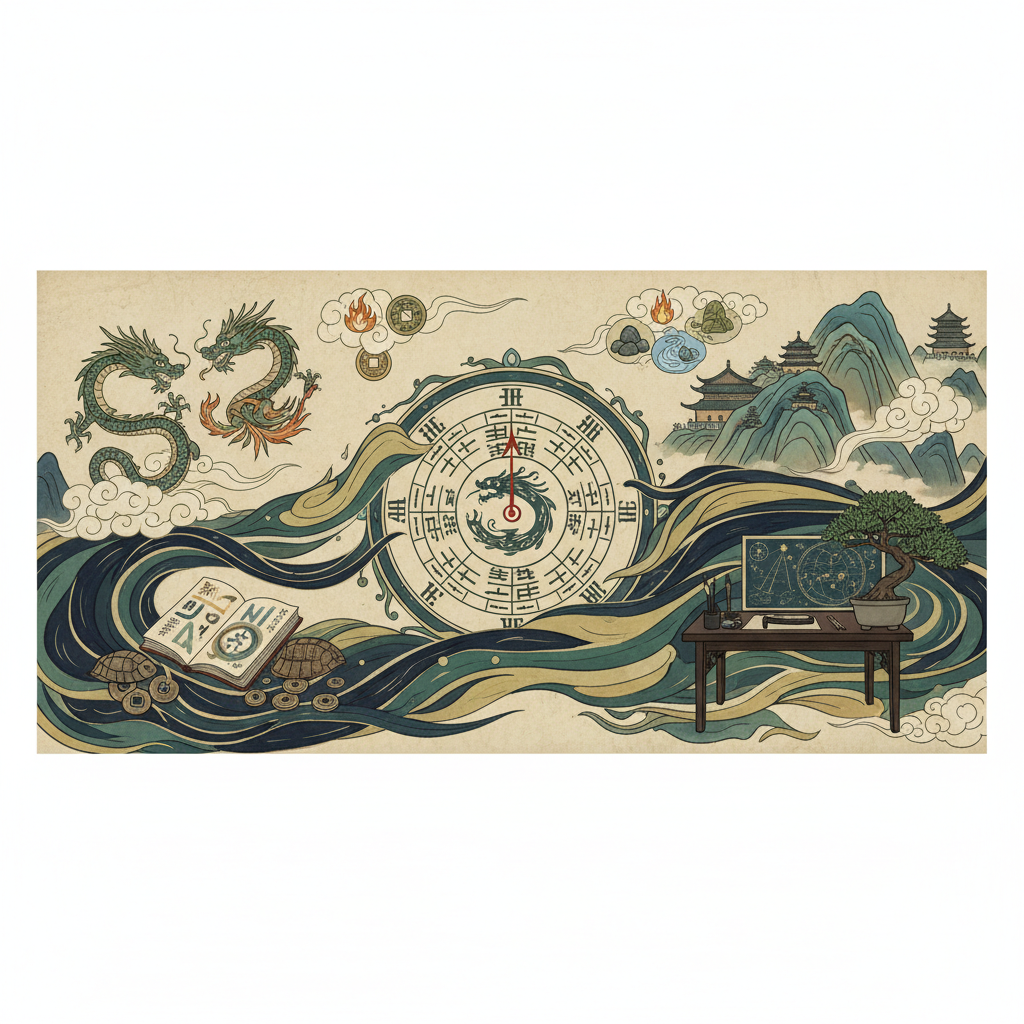
Introduction to Chinese Symbols of Harmony and Divination
Feng Shui, the I Ching, Chinese metaphysics, geomancy, and divination are deeply intertwined traditions rooted in ancient Chinese philosophy and spirituality. These symbolic systems offer guidance on harmony, fate, and the natural world, influencing millions through centuries. Understanding their historical context and cultural significance enhances appreciation for their profound yet accessible wisdom, especially in how ancient symbols communicate universal truths through metaphysical practices.
The Historical Roots of Feng Shui and Chinese Geomancy
Feng Shui, literally meaning "wind-water," dates back over 3,000 years to the early Zhou dynasty (c. 1046–256 BCE). Originally a method for positioning tombs and dwellings, Feng Shui evolved into an art of harmonizing human environments with natural forces. Chinese geomancy, closely related to Feng Shui, interprets landforms and spatial arrangements via symbolic charts and compass readings to enhance energy flow or qi. Both practices reflect a deep reverence for nature and cosmos, rooted in Taoist and Confucian philosophies emphasizing balance and order.
I Ching: The Book of Changes and Its Symbolic Language
The I Ching, or Book of Changes, is one of the world’s oldest divination texts, traditionally attributed to King Wen and the Duke of Zhou around 1000 BCE. It consists of 64 hexagrams—symbols formed by stacks of broken and unbroken lines—each representing a dynamic state of change and transformation. The I Ching transcends simple fortune-telling; it operates as a philosophical guide that encourages reflection on natural cycles, human behavior, and decision-making. The hexagrams rely on the yin-yang duality, integral to Chinese metaphysics, depicting the fluid interplay of opposites in the universe.
Chinese Metaphysics: The Framework Behind Symbolic Systems
Chinese metaphysics encompasses a broad spectrum of knowledge systems including astrology, numerology, and cosmology that are interwoven with Feng Shui and the I Ching. Central to metaphysics are concepts such as Yin and Yang (dual forces), Wu Xing (Five Elements theory: Wood, Fire, Earth, Metal, Water), and the notion of qi (life energy). These elements serve as symbolic frameworks to interpret natural phenomena and human affairs, enabling practitioners to assess personality, predict outcomes, or optimize environments. This integrated worldview reflects a holistic understanding of the human relationship with nature and time.
Geomancy and Divination: Tools for Spatial and Spiritual Guidance
In the Chinese tradition, geomancy is not limited to land and buildings but also integrates divinatory aspects to guide life decisions. Divination methods including oracle bones, lunar calendars, and Feng Shui compasses (luopan) have long been employed to align individual destiny with cosmic rhythms. Symbols such as the Bagua—a set of eight trigrams derived from the I Ching—function as spatial maps indicating natural energies and directional influences. Divination practices utilize these symbolic structures, often combined with numerology and astronomy, to unlock insight into the past, present, and future, reinforcing the interconnectedness of all things.
Cultural Significance and Contemporary Influence
These symbolic systems historically shaped not only spiritual and philosophical thought but also architecture, medicine, governance, and daily life in East Asia. Feng Shui principles guided imperial city design, while the I Ching influenced Confucian ethics and Chinese literature. Today, these ancient metaphysical tools experience a resurgence worldwide within wellness, interior design, and personal development sectors. As global interest grows, appreciating their origins and symbolic richness prevents cultural oversimplification and fosters respectful integration of this knowledge.
Conclusion: Symbols as a Bridge Between Cosmos and Human Experience
Feng Shui, I Ching, Chinese metaphysics, geomancy, and divination collectively represent a symbolic language created millennia ago to understand and harmonize with universal forces. Their enduring relevance lies in offering frameworks for cultivating balance, insight, and connectivity amidst life's uncertainties. Exploring these traditions reveals not only historical legacies but living systems that continue to inspire cross-cultural dialogue and spiritual exploration through their profound symbolic expressions.