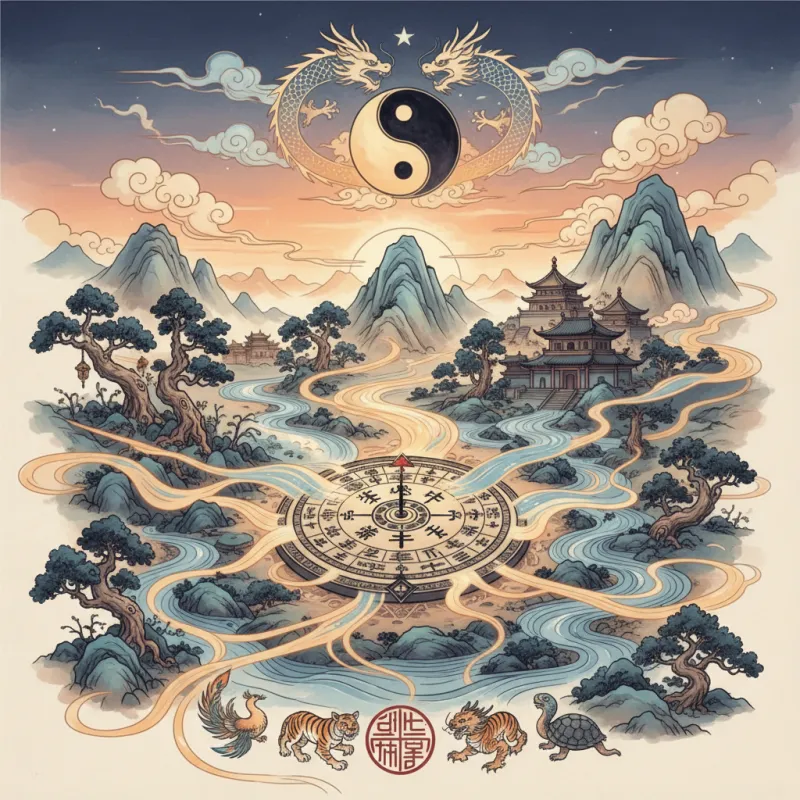
Qi Energy Explained: The Life Force Behind Feng Shui
Understanding the Foundation of Chinese Metaphysics
At the heart of Feng Shui, Traditional Chinese Medicine, martial arts, and virtually every aspect of Chinese metaphysical thought lies a single, profound concept: Qi (氣, qì). Often translated as "energy," "life force," or "vital breath," Qi represents far more than these simple definitions suggest. It is the fundamental substance that animates all existence, flows through every living being, and connects the microcosm of human experience to the macrocosm of the universe.
To truly understand Feng Shui, one must first grasp the nature of Qi. Without this foundational knowledge, Feng Shui becomes merely a collection of superstitious rules about furniture placement and color choices. With it, Feng Shui reveals itself as a sophisticated system for harmonizing human life with the natural rhythms and energies of the cosmos.
The Nature of Qi: More Than Just Energy
The Chinese character for Qi (氣) is remarkably instructive. In its traditional form, it depicts steam rising from cooking rice—a perfect metaphor for something simultaneously substantial and ethereal, visible yet intangible. This dual nature is essential to understanding Qi.
Qi is not merely abstract energy in the Western scientific sense. It possesses qualities, directions, and characteristics. It can be:
- Dense or dispersed (凝聚 níng jù or 散漫 sàn màn)
- Rising or sinking (上升 shàng shēng or 下沉 xià chén)
- Fast-moving or stagnant (流動 liú dòng or 停滯 tíng zhì)
- Harmonious or chaotic (和諧 hé xié or 混亂 hùn luàn)
Ancient Chinese philosophers understood that Qi manifests in countless forms. The air we breathe is Qi. The blood flowing through our veins carries Qi. The warmth of sunlight, the force of wind, the fertility of soil—all are expressions of Qi in different states and concentrations.
The Three Primary Types of Qi
Classical Chinese metaphysics identifies three fundamental categories of Qi that directly influence human existence:
1. Tian Qi (天氣, tiān qì) - Heaven Qi
Tian Qi refers to the cosmic or celestial energies that descend from above. This includes:
- Solar and lunar influences
- Seasonal changes and weather patterns
- Astrological forces
- The passage of time itself
In Feng Shui practice, Tian Qi is considered largely beyond human control. We cannot change when the sun rises or alter the seasons. However, we can align ourselves with these natural rhythms. For example, a Feng Shui master might recommend positioning a meditation room to receive gentle morning sunlight (陽氣 yáng qì), which carries fresh, ascending energy perfect for spiritual practice, while suggesting a bedroom face away from harsh afternoon sun, which carries overly aggressive Yang energy that disrupts rest.
2. Di Qi (地氣, dì qì) - Earth Qi
Di Qi represents the energies emanating from the land itself. This is the primary focus of Feng Shui practice. Earth Qi is influenced by:
- Topography and landforms (mountains, valleys, rivers)
- Soil quality and geological composition
- Underground water sources
- The arrangement of buildings and structures
The ancient practice of Xing Shi (形勢, xíng shì), or "Form School" Feng Shui, developed sophisticated methods for reading the landscape to identify areas where Di Qi accumulates beneficially. Masters would look for the ideal Ming Tang (明堂, míng táng)—a "bright hall" or open space where Qi naturally gathers and pools, protected by surrounding landforms.
Consider a valley nestled between gently rolling hills, with a meandering river flowing through it. The hills provide protection from harsh winds (which scatter Qi too rapidly), while the curving river allows Qi to accumulate without stagnating. This is an example of excellent Di Qi—the kind of location where ancient Chinese cities were often established.
3. Ren Qi (人氣, rén qì) - Human Qi
Ren Qi is the vital energy within human beings themselves. This is the Qi that:
- Animates our bodies and minds
- Determines our health and vitality
- Influences our emotional states
- Connects us to our environment
Traditional Chinese Medicine focuses primarily on cultivating and balancing Ren Qi through acupuncture, herbal medicine, and practices like Qi Gong (氣功, qì gōng). In Feng Shui, we recognize that Ren Qi is constantly interacting with and being influenced by both Tian Qi and Di Qi. A person with strong, balanced Ren Qi can better withstand challenging environmental energies, while someone with depleted Ren Qi becomes more vulnerable to negative influences in their surroundings.
Yin and Yang: The Two Faces of Qi
Qi never exists in isolation—it always manifests as either Yin (陰, yīn) or Yang (陽, yáng), or more accurately, as a dynamic balance between these two complementary forces.
Yang Qi is:
- Active, bright, warm
- Rising, expanding, moving outward
- Associated with day, summer, fire, and heaven
- Masculine in quality (though not exclusively male)
Yin Qi is:
- Passive, dark, cool
- Sinking, contracting, moving inward
- Associated with night, winter, water, and earth
- Feminine in quality (though not exclusively female)
In Feng Shui practice, creating harmony means balancing Yin and Yang energies appropriately for each space's function. A home office requires more Yang Qi—bright lighting, active colors, upward-moving energy—to support productivity and mental clarity. A bedroom requires more Yin Qi—softer lighting, calming colors, settled energy—to facilitate rest and restoration.
The mistake many beginners make is thinking one is "good" and the other "bad." In reality, both are essential. A space with excessive Yang becomes agitated, harsh, and exhausting. A space with excessive Yin becomes stagnant, depressing, and draining. The goal is Tai Ji (太極, tài jí)—the supreme ultimate balance where Yin and Yang dance in perfect harmony.
How Qi Moves: The Principles of Flow
Understanding how Qi moves through space is crucial for effective Feng Shui practice. Qi behaves somewhat like water, following certain natural principles:
Qi Follows Pathways
Just as water flows along riverbeds, Qi travels along specific routes called Qi Mai (氣脈, qì mài) or "Qi veins." In the landscape, these might be valleys, ridgelines, or waterways. In buildings, they are hallways, doorways, and sight lines.
Sha Qi (煞氣, shà qì), or "killing Qi," occurs when Qi moves too quickly and directly, becoming sharp and aggressive. A long, straight hallway pointing directly at your front door creates Sha Qi—the energy rushes in too forcefully, bringing instability rather than nourishment. This is why traditional Chinese architecture often features curved pathways and strategically placed screens to slow and redirect Qi flow.
Qi Accumulates in Open Spaces
When Qi encounters an open area, it naturally slows down and pools, much like water forming a pond. These accumulation points are highly desirable in Feng Shui. The Ming Tang mentioned earlier is the ideal outdoor accumulation space, while indoors, a well-proportioned living room with balanced furniture arrangement creates a beneficial Qi reservoir.
However, if a space is too enclosed or cluttered, Qi cannot circulate properly and becomes Si Qi (死氣, sǐ qì)—"dead Qi" or stagnant energy. This manifests as stuffiness, mustiness, and a general feeling of heaviness. Regular cleaning, decluttering, and allowing fresh air circulation are essential Feng Shui practices for preventing Si Qi accumulation.
Qi Responds to Intention and Attention
One of the most profound yet often overlooked aspects of Qi is its responsiveness to human consciousness. Where we place our attention, Qi follows. This is why the Ba Gua (八卦, bā guà) system in Feng Shui works—by consciously designating areas of our home for specific life aspects (wealth, relationships, career, etc.), we direct Qi accordingly.
This principle also explains why a home filled with beloved objects and happy memories feels energetically different from one filled with unwanted clutter and negative associations. The Qi literally absorbs and reflects the emotional and mental energy we invest in our surroundings.
The Five Elements: Qi in Transformation
Qi doesn't remain static—it constantly transforms through the cycle of the Wu Xing (五行, wǔ xíng), commonly translated as the "Five Elements" but more accurately understood as "Five Phases" or "Five Movements":
- Wood (木, mù) - Growing, expanding Qi
- Fire (火, huǒ) - Rising, radiating Qi
- Earth (土, tǔ) - Stabilizing, centering Qi
- Metal (金, jīn) - Contracting, condensing Qi
- Water (水, shuǐ) - Descending, flowing Qi
These five phases represent different states and qualities of Qi as it moves through natural cycles. They interact through two primary relationships:
The Sheng Cycle (生, shēng) or "Generating Cycle":
- Wood feeds Fire
- Fire creates Earth (ash)
- Earth bears Metal
- Metal collects Water (condensation)
- Water nourishes Wood
The Ke Cycle (克, kè) or "Controlling Cycle":
- Wood parts Earth
- Earth dams Water
- Water extinguishes Fire
- Fire melts Metal
- Metal cuts Wood
In practical Feng Shui, we use these relationships to balance spaces. If a room feels too aggressive (excess Fire Qi), we might introduce Water element features—a fountain, dark colors, or flowing shapes—to moderate the energy. If a space feels stagnant (excess Earth Qi), we might add Wood element features—plants, vertical lines, or green colors—to introduce movement and growth.
Practical Applications: Working with Qi in Daily Life
Understanding Qi theory transforms from abstract philosophy to practical wisdom when we apply it to our living spaces:
Enhancing Qi Flow in Your Home
At the entrance: Your front door is the Qi Kou (氣口, qì kǒu) or "Qi mouth"—the primary point where external Qi enters your home. Ensure it opens fully without obstruction, is well-lit, and leads to a welcoming space. Avoid having the door directly aligned with a back door or large window, which creates a "Qi highway" where energy rushes through without nourishing the space.
In living areas: Arrange furniture to create gentle, meandering pathways rather than straight lines. Position seating with solid walls behind (providing Xuan Wu 玄武, xuán wǔ, or "Black Tortoise" support) and open space in front (creating Ming Tang for Qi accumulation). Avoid placing furniture directly under exposed beams, which create oppressive downward Qi pressure called Liang Ya (梁壓, liáng yā).
In bedrooms: Position the bed in the Command Position—diagonally opposite the door with a solid wall behind, allowing you to see the entrance while lying down. This arrangement allows your personal Qi to remain stable and protected during sleep. Minimize electronic devices, which generate chaotic electromagnetic Qi that disrupts rest.
Cultivating Personal Qi
Feng Shui works best when combined with practices that strengthen your own Ren Qi:
-
Breathwork: Conscious breathing directly cultivates Qi. The practice of Tu Na (吐納, tǔ nà)—"expelling the old, taking in the new"—involves deep, intentional breathing to refresh your internal Qi.
-
Movement: Practices like Tai Ji Quan (太極拳, tài jí quán) and Qi Gong specifically work with Qi circulation through gentle, flowing movements.
-
Mindfulness: Mental clarity and emotional balance directly affect Qi quality. Meditation, particularly in a well-arranged space, amplifies both environmental and personal Qi.
The Temporal Dimension: Qi Changes with Time
Advanced Feng Shui recognizes that Qi is not static but changes according to temporal cycles. The Xuan Kong Fei Xing (玄空飛星, xuán kōng fēi xīng) or "Flying Stars" system tracks how different types of Qi move through space over time, following patterns based on the Luo Shu (洛書, luò shū) magic square and the cycles of the Jiu Gong (九宮, jiǔ gōng) or "Nine Palaces."
Each 20-year period, called a Yun (運, yùn), brings different dominant Qi patterns. We are currently in Period 9 (2024-2043), which emphasizes Fire element energy—innovation, technology, visibility, and transformation. Understanding these temporal shifts allows practitioners to adjust their environments to harmonize with prevailing cosmic Qi patterns.
Conclusion: Living in Harmony with Qi
Qi is not a mystical concept requiring blind faith—it is an observable phenomenon that ancient Chinese sages studied with the same rigor modern scientists apply to their fields. The difference lies in methodology: where Western science tends to reduce phenomena to measurable components, Chinese metaphysics observes holistic patterns and relationships.
When you understand Qi—its nature, its movements, its transformations—Feng Shui becomes not a collection of superstitious rules but a sophisticated system for creating environments that support human flourishing. You begin to feel the difference between spaces where Qi flows harmoniously and those where it stagnates or rushes chaotically. You develop sensitivity to the subtle energies that influence your mood, health, and fortune.
The ultimate goal of Feng Shui is to position yourself within the flow of beneficial Qi—to live in harmony with the natural rhythms of Tian (heaven), Di (earth), and Ren (humanity). When these three forces align, we experience what the ancient texts call Tian Ren He Yi (天人合一, tiān rén hé yī)—the unity of heaven and humanity, where our personal energy resonates perfectly with the cosmic dance of Qi that animates all existence.
This is the true promise of understanding Qi: not supernatural powers or guaranteed wealth, but the profound peace and vitality that comes from living in alignment with the fundamental life force of the universe.