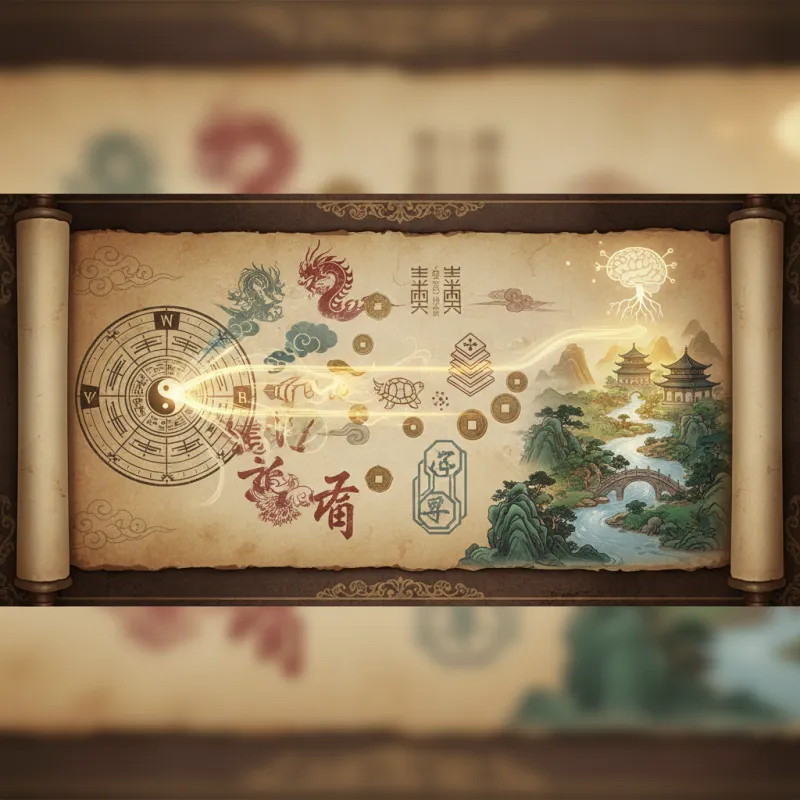
Picture this: A Tang Dynasty emperor stands before his geomancer, demanding to know why his newly built palace brings nothing but misfortune. The geomancer traces invisible lines across a silk map, consulting a bronze compass marked with cryptic symbols, then delivers his verdict—the palace entrance faces the "death gate." Within months, the structure is demolished and rebuilt. This scene, repeated countless times across Chinese history, reveals a truth that modern skeptics often miss: Feng Shui (風水, fēng shuǐ) and the I Ching (易經, Yì Jīng) weren't parlor tricks or superstitions—they were sophisticated systems of environmental psychology and decision-making that shaped empires.
The Forgotten Origins: When Metaphysics Met Survival
Most introductions to Chinese metaphysics gloss over a crucial fact: these systems emerged from desperation, not mysticism. Around 1000 BCE, during the Western Zhou Dynasty, Chinese civilization faced a crisis. Floods destroyed settlements, droughts decimated crops, and military campaigns failed spectacularly. The ruling class needed predictive tools, and fast. Enter the I Ching, initially a divination manual created by King Wen while imprisoned by the Shang Dynasty. He had nothing but time and yarrow stalks, so he systematized 64 hexagrams (卦, guà) representing every possible life situation.
Feng Shui emerged from similar pragmatism. Early practitioners were essentially environmental engineers who noticed patterns—villages built on south-facing slopes with mountain backing thrived, while those in wind-exposed valleys suffered. They codified these observations into the concept of qi (氣, qì), the life force that flows through landscapes and structures. The term "wind and water" isn't poetic—it's literal. Wind disperses qi; water contains it. Build where these elements balance, and you prosper. Ignore them, and you're fighting nature itself.
What's remarkable is how these systems interconnected. The I Ching's eight trigrams (八卦, bā guà) became the foundation of the Feng Shui compass, or luopan (羅盤, luó pán). The Five Elements theory (五行, wǔ xíng)—wood, fire, earth, metal, water—provided the grammar for both systems. This wasn't coincidence; it was deliberate integration by scholars like Guo Pu (276-324 CE), who wrote the Zangshu (葬書, "Book of Burial"), the first comprehensive Feng Shui text. He understood that Chinese metaphysics worked best as an ecosystem of interlocking principles, not isolated practices.
The I Ching: More Than Fortune Cookies
Here's where most Western interpretations go wrong: they treat the I Ching as a mystical oracle, when it's actually a decision-making framework disguised as divination. Each of the 64 hexagrams contains a judgment, an image, and line texts—essentially a case study in strategic thinking. Take Hexagram 3, Zhun (屯, zhūn, "Difficulty at the Beginning"). Its judgment reads: "Difficulty at the beginning works supreme success, furthering through perseverance." This isn't mystical—it's practical advice about startup challenges that any entrepreneur would recognize.
The genius lies in the consultation process. You don't just flip to a random page. Traditional methods involve casting yarrow stalks 18 times or tossing three coins six times, building your hexagram line by line. This ritual forces you to slow down, articulate your question precisely, and engage your intuition. The hexagram you receive isn't predicting the future—it's reflecting your unconscious understanding of the situation back at you. Confucius himself, in his Ten Wings commentary, emphasized this psychological dimension: "The I Ching does not predict; it reveals."
Modern applications prove this point. In the 1960s, composer John Cage used the I Ching to generate aleatory music, creating compositions where chance operations determined structure. He wasn't being mystical—he was using the hexagrams as a randomization algorithm to break creative blocks. Similarly, psychologist Carl Jung collaborated with sinologist Richard Wilhelm on the I Ching's German translation, recognizing it as a tool for accessing what he called the "collective unconscious." The book's wisdom isn't supernatural; it's the accumulated pattern recognition of thousands of years of human experience, compressed into 64 archetypal situations.
Feng Shui's Two Souls: Form School vs. Compass School
Most people don't realize that Feng Shui split into two competing traditions around the Song Dynasty (960-1279 CE), and the tension between them persists today. The Form School (巒頭派, luán tóu pài), dominant in southern China, focuses on visible landscape features—mountains, rivers, building shapes. Its practitioners are essentially geomancers who read terrain like a text. The Compass School (理氣派, lǐ qì pài), popular in flatter northern regions, relies on the luopan to calculate invisible energy flows based on directions, time, and mathematical formulas.
I'll be blunt: Form School makes more intuitive sense. When a practitioner says your house shouldn't face a T-junction because it creates "poison arrow" energy, they're describing what traffic engineers call "visual terminus stress"—the psychological discomfort of having a road aim directly at your home. When they recommend a mountain behind your property for "turtle protection," they're talking about windbreaks and psychological security. These principles align with modern environmental psychology research on prospect-refuge theory and biophilic design.
Compass School gets trickier because it introduces time-based calculations like Flying Stars (飛星, fēi xīng), which change energy patterns every 20 years. Skeptics dismiss this as numerology, but there's a logic to it: environments do change over time as neighborhoods develop, trees grow, and buildings rise. What worked in 2004 might not work in 2024. The problem is that Compass School formulas became increasingly complex, with some practitioners using calculations that would make a NASA engineer weep. This complexity opened the door to charlatans who could bamboozle clients with impressive-sounding but meaningless calculations.
The best modern practitioners blend both schools, using Form School for macro-level site selection and Compass School for fine-tuning interior arrangements. This hybrid approach, sometimes called Classical Feng Shui, strips away New Age additions like crystal placements and focuses on the original environmental principles.
The Five Elements: Nature's Operating System
If Chinese metaphysics has a central algorithm, it's the Five Elements cycle. Unlike Western four-element systems (earth, air, fire, water), the Chinese version includes wood and metal while excluding air, creating a dynamic system of generation and control. Wood feeds fire, fire creates earth (ash), earth bears metal, metal collects water, water nourishes wood—that's the productive cycle (生, shēng). But there's also a controlling cycle (克, kè): wood parts earth, earth dams water, water quenches fire, fire melts metal, metal cuts wood.
This isn't primitive science—it's a metaphorical framework for understanding relationships and change. In Feng Shui, each element corresponds to colors, shapes, directions, and life areas. A home office in the north (water sector) benefits from metal elements (filing cabinets, white colors) because metal generates water, but suffers from earth elements (pottery, yellow tones) because earth controls water. In the I Ching, elements help interpret hexagram transformations. In Bazi (八字, bā zì) astrology, your birth chart's elemental balance supposedly determines personality and destiny.
What makes this system powerful is its flexibility. Unlike rigid Western astrology, Chinese metaphysics assumes you can rebalance elements through environmental changes. Born with too much fire and not enough water? Add water features to your home, wear black clothing, pursue water-element careers (communication, travel). This interventionist philosophy reflects a fundamentally different worldview—fate isn't fixed; it's negotiable through conscious action.
The Five Elements also appear in unexpected places. Traditional Chinese Medicine uses them to categorize organs, emotions, and treatments. Martial arts styles align with elements—Tai Chi (water), Xing Yi (metal), Bagua (wood). Even Chinese cuisine balances elements through ingredients and cooking methods. This pervasiveness reveals something crucial: Chinese metaphysics isn't a separate "spiritual" domain—it's an integrated worldview where the same principles govern health, architecture, combat, and cooking.
The Bagua Map: Sacred Geometry or Spatial Psychology?
The Bagua (八卦, bā guà), or eight trigrams, forms the foundation of both I Ching and Feng Shui. Each trigram represents a natural force: Heaven (乾, qián), Earth (坤, kūn), Thunder (震, zhèn), Wind (巽, xùn), Water (坎, kǎn), Fire (離, lí), Mountain (艮, gèn), and Lake (兌, duì). In Feng Shui, these map onto eight life areas—career, knowledge, family, wealth, fame, relationships, children, and helpful people—creating what's called the Bagua map.
Here's where things get controversial. Western Feng Shui popularizers like the Black Hat Sect overlay this map onto floor plans regardless of compass directions, claiming your wealth corner is always the far left from your entrance. Traditional practitioners consider this heresy—the real Bagua map must align with actual compass directions, with south at the top (yes, Chinese maps traditionally face south, not north). I side with the traditionalists here. The directional Bagua connects to solar patterns, seasonal changes, and magnetic fields—real environmental factors. The Black Hat approach is essentially interior decorating with Chinese characteristics.
That said, even the directional Bagua works partly through psychological priming. If you designate your southeast corner as your "wealth area" and place symbols of prosperity there, you're creating a daily reminder of financial goals. This isn't magic—it's environmental psychology and the power of intention. The Bagua map functions like a vision board integrated into your living space, constantly reinforcing priorities through spatial organization.
The I Ching uses Bagua differently, combining two trigrams to create each hexagram. Heaven over Heaven creates Hexagram 1 (乾, qián, "The Creative"), representing pure yang energy and initiative. Earth over Earth creates Hexagram 2 (坤, kūn, "The Receptive"), representing pure yin energy and acceptance. The 62 other hexagrams represent various combinations and tensions between these forces. This combinatorial approach mirrors how Yin Yang philosophy generates complexity from simple binary oppositions.
Practical Applications: Beyond Bamboo Flutes and Lucky Coins
Let's cut through the kitsch. Real Chinese metaphysics applications don't involve hanging crystal balls or placing three-legged toads by your door. They involve strategic environmental design based on centuries of observation. Here's what actually works:
Site selection: Before buying property, assess the surrounding landforms. Ideally, you want elevation behind (protection), open space in front (opportunity), and gentle slopes on sides (support). This "armchair" configuration appears in Feng Shui texts and modern real estate psychology research—humans instinctively prefer these settings because they offered survival advantages to our ancestors.
Entrance optimization: Your main door should open to a spacious, well-lit area, not face a wall, staircase, or bathroom. This isn't mystical—it's about first impressions and traffic flow. The I Ching's Hexagram 34, "Great Power," emphasizes the importance of strong, clear entry points in any endeavor.
Workspace positioning: Place your desk where you can see the door without being directly in line with it—the "command position." This reduces subconscious stress from potential threats approaching unseen. Pair this with I Ching consultation when making major career decisions, using the hexagrams as a structured reflection tool rather than fortune-telling.
Elemental balancing: Assess your space's dominant elements through colors, shapes, and materials, then add missing elements strategically. A stark, white office (metal-heavy) benefits from plants (wood) and warm lighting (fire). This creates visual and psychological balance that affects mood and productivity.
Temporal awareness: Compass School's Flying Stars system tracks how energy patterns shift over time. While the calculations are complex, the principle is sound—environments change, and what worked five years ago might need adjustment. Regular reassessment beats static arrangements.
The key is approaching these practices as environmental optimization, not supernatural intervention. When a Feng Shui adjustment "works," it's usually because you've improved lighting, fixed traffic flow, reduced visual clutter, or created psychological anchors for your goals—all evidence-based environmental psychology principles that Chinese practitioners discovered empirically centuries before Western science validated them.
Integration: Building Your Personal Practice
Chinese metaphysics works best as an integrated system, not isolated techniques. Start with the I Ching as your decision-making framework—consult it when facing major choices, using the hexagrams to structure your thinking rather than dictate answers. Keep a journal of consultations and outcomes to develop pattern recognition.
Layer in Feng Shui by auditing your primary spaces—home and workspace—using Form School principles first. Fix obvious issues: blocked entrances, harsh lighting, chaotic layouts. Then apply Bagua mapping to ensure each life area has appropriate spatial representation. Finally, if you're drawn to deeper study, explore Compass School calculations or Bazi astrology for personality insights.
The goal isn't rigid adherence to ancient rules—it's developing environmental awareness and strategic thinking. Chinese metaphysics offers a vocabulary for discussing how spaces affect psychology, how timing influences outcomes, and how small adjustments create cascading changes. Whether you believe in qi or not, these systems provide frameworks for intentional living that modern life often lacks.
What makes Chinese metaphysics enduring isn't supernatural power—it's sophisticated pattern recognition compressed into memorable principles. The ancients couldn't run double-blind studies, but they could observe what worked across thousands of cases and codify those patterns. We can now explain many of their insights through psychology, biology, and environmental science, but that doesn't diminish their practical value. Sometimes ancient wisdom and modern science arrive at the same conclusions through different paths, and that convergence is where real understanding begins.
Related Reading
- Office Feng Shui: Design for Career Success
- The History of Feng Shui: From Ancient China to Your Living Room
- Harmonizing Your Kitchen: The Role of Feng Shui and I Ching in Culinary Spaces
Explore Chinese Culture
- Explore Daoist philosophy and practice
- Explore traditional Chinese customs
- Explore ancient Chinese cosmology