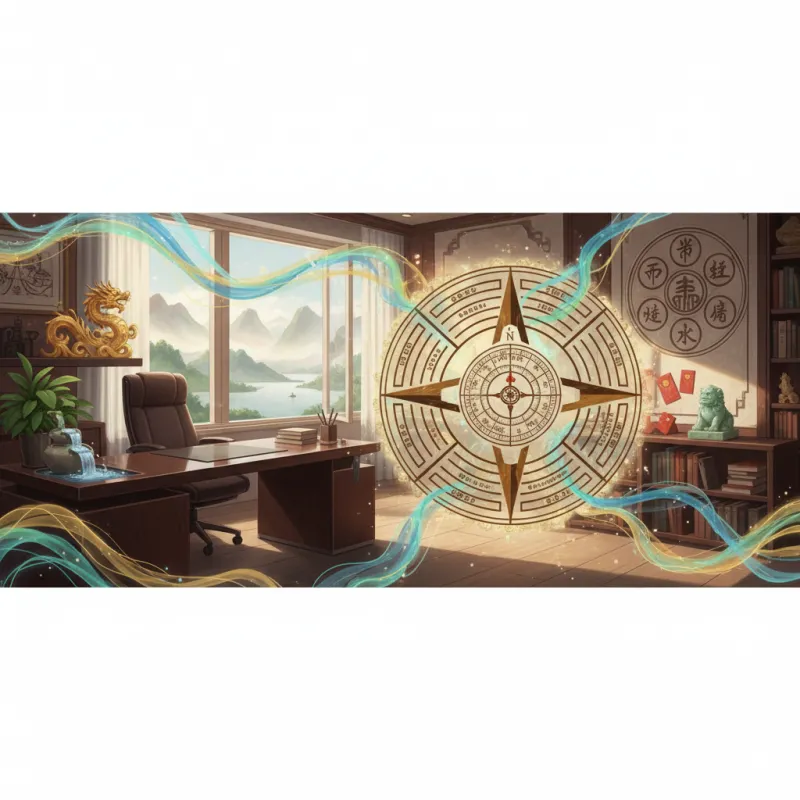
Your desk faces a blank wall. Your back is to the door. Papers pile up in the northeast corner of your office, and that dying plant by the window has been there since 2019. You wonder why promotions pass you by, why clients ghost you, why every workday feels like pushing a boulder uphill. The answer might not be your resume—it might be your room.
Feng shui (風水, fēng shuǐ) isn't interior decorating with lucky bamboo. It's a 3,000-year-old system for manipulating qi (氣, qì)—the life force that flows through everything—to create environments that support specific goals. When the Tang Dynasty scholar Guo Pu compiled the Zangshu (葬書, Book of Burial) in the 4th century, he wasn't writing about office cubicles, but his principles about landforms, water flow, and energy accumulation apply just as powerfully to your workspace. The difference between a career that stagnates and one that soars often comes down to whether your environment is working with you or against you.
The Command Position: Your Career Power Spot
In classical feng shui texts, the concept of the "commanding position" appears repeatedly in discussions of military strategy and imperial palace design. The emperor always sat facing the entrance, back protected by a solid wall, with a clear view of anyone approaching. This wasn't paranoia—it was energetic strategy.
Your desk placement determines your professional power. The ideal configuration puts you diagonally across from the door (not directly in line with it, which creates "attacking qi"), with a solid wall behind you and an expansive view ahead. This is called the "mountain-water" formation: the wall represents the mountain providing support and stability, while the open space before you represents water—opportunity, flow, and incoming resources.
I've consulted for executives who moved their desks from facing walls to commanding positions and reported immediate shifts: more confident decision-making, better meeting outcomes, unexpected opportunities. One CEO in Shanghai moved his desk according to his bazi (八字, eight characters) birth chart and the office's sitting-facing direction, and within three months, closed a deal that had been stalled for two years. Coincidence? Maybe. But feng shui practitioners have been observing these patterns since the Song Dynasty.
If you can't move your desk, place a small mirror on your desk angled to reflect the door behind you. It's not as powerful as the full commanding position, but it addresses the vulnerability of having your back exposed. The Yangzhai Sanyao (陽宅三要, Three Essentials of Yang Dwellings) from the Qing Dynasty emphasizes that awareness of your surroundings is fundamental to harnessing beneficial qi.
The Five Elements: Balancing Your Office Ecosystem
The Wu Xing (五行, wǔ xíng) or Five Elements theory predates feng shui itself, appearing in texts like the Shujing (書經, Book of Documents) from the Western Zhou period. Wood, Fire, Earth, Metal, and Water don't just represent materials—they represent phases of energy transformation, each supporting and controlling the others in specific cycles.
Your office needs elemental balance tailored to your career goals and personal energy. Wood (木, mù) represents growth, creativity, and upward movement—essential for entrepreneurs and creatives. Introduce it through living plants (not fake ones, which represent stagnant qi), wooden furniture, or vertical elements like tall bookcases. The east and southeast sectors of your office correspond to Wood energy and career advancement.
Fire (火, huǒ) brings recognition, passion, and transformation. It's your reputation element. A lamp in the south sector of your office activates fame and acknowledgment. Red accents, triangular shapes, or even images of sunrise support Fire energy. But too much Fire creates burnout—I've seen offices with red walls, multiple monitors, and harsh lighting where employees couldn't think straight.
Earth (土, tǔ) provides stability and nourishment. Ceramic items, square shapes, and earth-tone colors in the center and southwest areas ground scattered energy. Metal (金, jīn) in the west and northwest brings precision, clarity, and helpful people—crucial for networking and mentorship. Metal filing cabinets, white or metallic colors, and circular shapes enhance this element.
Water (水, shuǐ) in the north sector governs career itself. A small fountain (with water flowing toward you, not away) or images of water activate career opportunities. But Water must be clean and moving—stagnant water or leaky faucets drain career energy. The Xuankong Feixing (玄空飛星, Mysterious Void Flying Stars) system, developed during the Qing Dynasty, provides precise calculations for when Water placements become auspicious or harmful based on time cycles.
For personalized element balancing, consult your bazi chart. If you're a weak Water day master, adding Water elements supports you. If you're strong Fire with too much Wood feeding it, you need Earth to drain excess energy. Generic feng shui advice ignores these individual differences—it's like prescribing the same medicine to everyone regardless of their condition.
Decluttering: The Qi Circulation Principle
The Huangdi Neijing (黃帝內經, Yellow Emperor's Classic of Internal Medicine), though focused on health, establishes a principle that feng shui adopted: blockages create disease. In your office, clutter is blockage. It doesn't just look messy—it literally obstructs qi flow, creating stagnant pools of energy that breed procrastination, confusion, and missed opportunities.
The northeast sector, governed by the Gen (艮) trigram in the Bagua (八卦, bā guà), represents knowledge, clarity, and new beginnings. Piles of papers here cloud your thinking and block fresh opportunities. The northwest, representing helpful people and mentors, should be clear and organized—clutter here sabotages networking and support systems.
Clear your desk at the end of each day. This isn't just tidiness; it's an energetic reset. The Japanese concept of ma (間)—negative space—aligns with feng shui's understanding that emptiness isn't void but potential. A clear desk invites new projects, ideas, and opportunities. A cluttered desk tells the universe you're too busy for anything new.
Digital clutter counts too. Overflowing email inboxes, chaotic desktop files, and browser tabs numbering in the dozens create mental fog that affects your physical space's energy. The Yijing (易經, I Ching) hexagram 3, Zhun (屯, Difficulty at the Beginning), describes chaos before order—but it emphasizes that progress requires clearing obstacles, not accumulating them.
Lighting and Air: The Invisible Feng Shui Factors
Feng shui literally means "wind-water," and both elements relate to how energy moves through space. Wind represents air circulation; water represents flow and nourishment. Your office's air quality and lighting directly impact these fundamental forces.
Stale air equals stale qi. Open windows regularly, even in winter. If you're in a sealed office building, add air-purifying plants like snake plants or pothos. The Bencao Gangmu (本草綱目, Compendium of Materia Medica) by Li Shizhen in the Ming Dynasty documented how certain plants affect environmental energy—knowledge that modern science confirms through studies on air purification and negative ion generation.
Natural light is yang (陽) energy—active, creative, energizing. Fluorescent lighting is harsh, depleting qi that creates fatigue and eye strain. If you're stuck with overhead fluorescents, add a full-spectrum desk lamp and turn off the overheads when possible. The south-facing window is most auspicious for natural light, but any natural light beats artificial.
Darkness in corners creates yin (陰) pockets where energy stagnates. Add lighting to dark corners, especially in the wealth corner (southeast) and career corner (north). But avoid harsh spotlights—feng shui favors gentle, diffused light that mimics natural illumination patterns.
Color Psychology Meets Five Element Theory
The Shuowen Jiezi (說文解字), the Han Dynasty dictionary, explains that colors weren't just aesthetic choices but carried specific energetic properties. Modern color psychology confirms what feng shui practitioners knew: colors affect mood, productivity, and behavior.
Blue and black (Water colors) in the north sector support career focus and depth of thought. Green (Wood) in the east promotes growth and new projects. Red (Fire) in the south brings recognition but should be used sparingly—too much creates agitation. White and metallic tones (Metal) in the west enhance clarity and completion. Yellow and earth tones (Earth) in the center and southwest provide stability.
Your personal favorable colors from bazi analysis override general recommendations. If Metal is your favorable element, white, gold, and silver support you regardless of sector. If Fire harms you, avoid red even in the south sector. This is where feng shui becomes personalized medicine rather than generic advice.
I've seen offices painted entirely in "power red" that created hostile, aggressive environments. I've seen all-white minimalist offices that felt sterile and uninspiring. Balance is key. Use your favorable element colors as accents—a throw pillow, desk accessories, artwork—rather than overwhelming entire walls.
The Bagua Map: Activating Specific Career Goals
The Bagua, derived from the Yijing, maps eight life areas onto your office space. Each sector corresponds to a trigram, element, and life aspect. Understanding this map lets you activate specific career goals with precision.
The north sector (Kan 坎 trigram, Water element) governs career path and life journey. Activate it with a small water feature, black or dark blue items, or images of flowing water. This isn't about "attracting" a career—it's about aligning your space's energy with career momentum.
The southeast (Xun 巽 trigram, Wood element) represents wealth and abundance. Healthy plants, purple accents, or a small wealth bowl (coins in a decorative container) activate financial growth. The Zengbu Yangzhai Cuoyao (增補陽宅撮要, Essentials of Yang Dwellings Supplemented) from the Qing Dynasty provides detailed instructions for wealth sector activation that remain relevant today.
The northwest (Qian 乾 trigram, Metal element) governs helpful people, mentors, and travel. Place photos of mentors, business cards of valuable contacts, or metal items here. If you're seeking promotion, this sector is crucial—advancement rarely happens without support from above.
The southwest (Kun 坤 trigram, Earth element) relates to relationships and partnerships. For business partnerships or team leadership, activate this area with paired objects, earth-tone colors, or images representing collaboration.
Don't try to activate everything at once. Choose one or two priority areas based on your current career goals. Trying to enhance all eight sectors simultaneously scatters your intention and dilutes effectiveness. The Yijing teaches focused action over scattered effort.
Technology Placement: Modern Challenges in Ancient Practice
The Ming Dynasty feng shui masters never dealt with computers, printers, or Wi-Fi routers, but the principles still apply. Electronic devices generate electromagnetic fields that disrupt natural qi flow—what some practitioners call "electronic sha qi" (煞氣, harmful energy).
Your computer should be in your personal favorable direction based on your Kua number (calculated from your birth year). If you're an East Group person (Kua 1, 3, 4, 9), face east, southeast, north, or south while working. West Group people (Kua 2, 6, 7, 8) should face west, northwest, southwest, or northeast. This aligns your personal energy field with beneficial directional qi.
Printers and other noisy equipment belong in the west or northwest—Metal sectors that can handle their aggressive energy. Don't place them in the east (Wood) or south (Fire) where they create elemental conflict. Routers and modems should be as far from your desk as practical, especially avoiding placement directly behind your head.
Multiple monitors create excessive Fire energy. Balance them with a small plant (Wood feeds Fire but also controls it through the generation cycle) or a clear quartz crystal (Earth drains Fire). Unplug devices when not in use—even in standby mode, they emit disruptive fields.
The charging cables snaking across your desk aren't just unsightly—they represent tangled energy that creates confusion and miscommunication. Use cable management solutions to keep cords organized and hidden. This simple change often produces immediate clarity in thinking and communication.
Timing Your Office Changes: Xuan Kong Feng Shui
The most sophisticated feng shui systems incorporate time as a variable. Xuan Kong Feixing (玄空飛星, Mysterious Void Flying Stars), developed during the Qing Dynasty, calculates how energy patterns shift through 20-year periods, annual cycles, and monthly changes.
We're currently in Period 9 (2024-2043), where the Li (離) trigram governs. Fire element becomes increasingly important, and south-facing offices gain advantage. The annual Flying Stars shift each February 4th (Chinese solar calendar), changing which sectors are auspicious or afflicted.
In 2024, the 8 Wealth Star flies to the southwest, making this sector particularly powerful for financial growth. The 5 Yellow (misfortune star) sits in the north—avoid renovations or major changes in your office's north sector this year. The 2 Illness Star in the east suggests avoiding red or Fire elements there.
These annual shifts explain why feng shui isn't "set it and forget it." What worked last year might need adjustment this year. Serious practitioners consult annual Flying Star charts before making office changes, just as Song Dynasty architects consulted almanacs before breaking ground on buildings.
For major career moves—job changes, business launches, office relocations—select auspicious dates using the Tong Shu (通書, Chinese almanac). The Xieji Bianfang Shu (協紀辨方書), compiled in 1741 by imperial order, remains the authoritative source for date selection. While you can't always control timing perfectly, avoiding obviously inauspicious dates (like days that clash with your birth year) prevents unnecessary obstacles.
Your office isn't just where you work—it's an energetic ecosystem that either supports or undermines your career goals. The difference between feng shui decoration and feng shui practice is the difference between hanging a lucky charm and understanding the complex interplay of elements, directions, time cycles, and personal energy that creates genuine transformation. Start with commanding position and decluttering. Add elemental balance based on your bazi chart. Activate specific Bagua sectors for targeted goals. Adjust annually for Flying Star changes. This isn't superstition—it's environmental strategy refined over three millennia, and it works when applied with knowledge and intention. For more insights on creating harmonious spaces, explore bedroom feng shui principles and feng shui for wealth corners.
Related Reading
- Kitchen Feng Shui: Cooking Up Prosperity
- Bedroom Feng Shui: Better Sleep Through Design
- Flying Stars Feng Shui: Time-Based Energy Analysis
- Five Elements in Body and Home
- Exploring Feng Shui, I Ching, and Chinese Metaphysics in Bazi Practice
Explore Chinese Culture
- Explore Daoist philosophy and practice
- Explore traditional Chinese customs
- Explore ancient Chinese cosmology