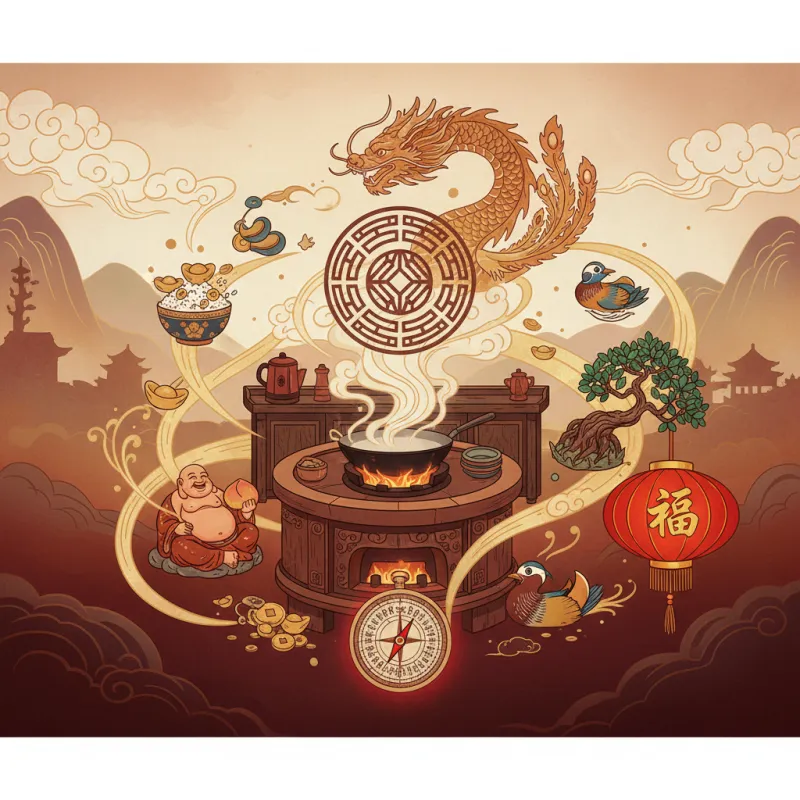
The smell of simmering ginger and garlic hits you the moment you step through the door—not just because dinner's cooking, but because your kitchen sits in the wealth corner of your home, its stove facing the right direction, its colors balanced between fire and water. In traditional Chinese households, grandmothers knew what modern homeowners are just discovering: the kitchen isn't merely where you cook; it's where you literally generate prosperity. Get the Feng Shui wrong here, and you're not just burning rice—you're burning money.
The Kitchen as Wealth Generator: Why This Room Matters Most
Walk into any classical Feng Shui text—the Yang Zhai San Yao (阳宅三要, Yángzhái Sān Yào, "Three Essentials of Yang Dwellings") from the Qing Dynasty, for instance—and you'll find the kitchen ranked alongside the main door and master bedroom as one of the three critical areas determining a household's fortune. This isn't superstition; it's systematic observation spanning centuries.
The logic is straightforward: the kitchen represents the fire element (火, huǒ), which in Five Elements theory transforms raw ingredients into nourishment. This transformation mirrors wealth creation—taking resources and multiplying their value. The stove specifically symbolizes the family's financial capacity. A well-positioned, clean, functional stove suggests money flows easily into the household. A neglected, broken, or poorly placed one? You're essentially telling the universe you don't care about prosperity.
Master Feng Shui practitioners in Hong Kong during the 1980s property boom would refuse to approve apartment purchases if the kitchen violated certain principles, regardless of how perfect everything else appeared. They understood what Western real estate agents are only now learning: kitchen energy affects the bottom line.
The Stove Placement Doctrine: Where Fire Meets Fortune
Your stove's position determines whether you're cooking up wealth or watching it evaporate. The classical rule states the stove should allow the cook to see the kitchen entrance while working—the "commanding position" (主导位, zhǔdǎo wèi). This isn't about paranoia; it's about psychological ease translating to energetic openness. When you feel secure, you create better energy, which attracts better circumstances.
But here's where it gets specific: the stove should never directly face the kitchen door. This creates a "fire rushing out" configuration where wealth energy escapes before it can accumulate. Similarly, placing your stove directly opposite the sink or refrigerator sets up a fire-water clash (水火相冲, shuǐhuǒ xiāngchōng)—the elements literally fighting each other. In practical terms, this manifests as financial instability, money coming in but immediately flowing out.
The ideal setup? Position your stove so it faces your personal wealth direction based on your Kua number, while maintaining visual access to the entrance. If you're working with a fixed layout, place a small mirror behind the stove to symbolically allow the cook to "see" the door. Some practitioners argue this doubles your wealth—the mirror reflecting the burners suggests doubling your resources.
One crucial point often missed: the stove must be used regularly. An unused stove is dead energy, suggesting dormant wealth potential. Even if you don't cook elaborate meals, turn on each burner weekly. Rotate through all of them—each burner represents a different income stream.
The Water-Fire Balance: Sink and Stove Dynamics
The relationship between your sink and stove embodies one of Feng Shui's core principles: elemental balance. Water (sink, dishwasher, refrigerator) and fire (stove, oven, microwave) must coexist without overwhelming each other. The I Ching hexagram 63, Ji Ji (既济, Jì Jì, "Already Fulfilled"), shows fire below water—a stable configuration where water doesn't extinguish fire, and fire doesn't evaporate water. This is your kitchen's ideal state.
Practically speaking, maintain at least three to four feet between your stove and sink. If your layout forces them closer, place a wooden cutting board or green plant between them—wood mediates between water and fire in the productive cycle of elements. Some modern designers use wooden countertops or bamboo accessories specifically for this purpose, though they may not realize they're applying ancient Feng Shui principles.
The refrigerator deserves special attention. It's a water element appliance that many people thoughtlessly place next to the stove. This creates what classical texts call "water and fire not settled" (水火不济, shuǐhuǒ bù jì), a direct inversion of hexagram 63. The result? Financial arguments, money stress, resources that seem to disappear mysteriously. If you're stuck with this layout, place a wooden element between them—even a wooden spoon holder or cutting board helps.
Color Strategy: Painting Prosperity
Kitchen colors aren't about matching your dishes; they're about balancing elemental energy. The traditional approach favors earth tones—yellows, browns, terracottas—because earth mediates between fire and water while representing stability and nourishment. The Huangdi Neijing (黄帝内经, Huángdì Nèijīng, "Yellow Emperor's Classic of Internal Medicine"), though primarily a medical text, established color-element correspondences that Feng Shui practitioners still reference.
White kitchens, currently fashionable in Western design, present a challenge. White represents metal element, which water strengthens but fire weakens. An all-white kitchen can feel cold, sterile—not conducive to the warm, abundant energy you want. If you're committed to white, introduce earth tones through accessories: wooden utensils, terracotta pots, yellow dish towels. These small additions shift the elemental balance significantly.
Avoid excessive blue or black—pure water colors that can "drown" your fire element and suppress wealth energy. Similarly, too much red or orange overstimulates fire, creating financial impulsiveness and instability. The goal is balance, not dominance of any single element.
One sophisticated approach: use your personal favorable element (determined by your bazi birth chart) as an accent color. If earth strengthens your chart, incorporate more yellows and browns. If you need metal, add white or gold accents. This personalizes the space to support your specific energetic needs, much like how bedroom Feng Shui should reflect individual relationship goals.
The Clutter-Prosperity Connection: Why Clean Kitchens Make Money
Here's something every successful Feng Shui consultant will tell you: they can predict a client's financial situation within minutes of seeing their kitchen. Cluttered counters, overflowing cabinets, expired food in the pantry—these aren't just hygiene issues; they're energetic blockages preventing new wealth from entering.
The principle is simple: stagnant energy (滞气, zhìqì) accumulates around unused items and disorder. In a kitchen, where you're literally creating the energy that nourishes your body and, symbolically, your wealth, stagnation is particularly damaging. That drawer full of takeout menus and broken utensils? It's not just junk—it's a dam blocking your prosperity flow.
Implement a monthly kitchen clearing ritual. Discard expired food, donate unused appliances, organize your pantry so you can see what you have. This isn't about minimalism for its own sake; it's about creating space for new energy to enter. In I Ching terms, you're moving from hexagram 12, Pi (否, Pǐ, "Standstill"), to hexagram 11, Tai (泰, Tài, "Peace")—from blocked to flowing.
Pay special attention to your stove. Clean burners regularly, fix any broken elements immediately, and keep the area around it clear. A dirty stove with caked-on grease tells the universe you're careless with your resources. Would you trust someone who treats their wealth generator that way? Neither will the energy of prosperity.
Kitchen Location Within the Home: Sector Matters
The kitchen's location within your home's bagua (八卦, bāguà, the eight-trigram map) significantly impacts its effectiveness as a wealth generator. Ideally, the kitchen occupies the south or southeast sectors—south because it's the natural fire direction, southeast because it's the traditional wealth corner. A kitchen in the southeast, with proper stove placement, creates a powerful wealth-generating configuration.
Avoid kitchens in the northwest (representing the patriarch and helpful people) or directly in the center of the home. A center kitchen places fire at the heart of your dwelling, which classical texts warn can "burn the heart of the house," leading to health issues and financial instability. If you're stuck with this layout, emphasize earth elements heavily to ground the fire energy—stone countertops, ceramic tiles, earth-tone colors.
The worst position? A kitchen in the north sector, which is governed by water element. This creates a fundamental fire-water clash at the directional level, not just between appliances. If this is your situation, you'll need to work harder to balance the space: use abundant wood elements (which water nourishes and which feeds fire), maintain impeccable cleanliness, and consider consulting a professional for personalized remedies.
Understanding your kitchen's sector also helps you optimize it for specific goals. A southeast kitchen naturally supports wealth accumulation. A south kitchen enhances reputation and recognition, which can translate to career advancement and income growth. Work with your kitchen's natural tendencies rather than against them, similar to how living room Feng Shui should align with the room's sector energy.
The Prosperity Pantry: What You Store and How
Your pantry isn't just storage; it's a symbol of abundance and preparedness. In traditional Chinese households, a well-stocked pantry demonstrated the family's prosperity and the matriarch's competence. This symbolism remains energetically relevant today.
Keep your pantry organized with clearly visible, fresh ingredients. Rice, a wealth symbol in Chinese culture, should be stored in a clean, sealed container—never let your rice container become completely empty. This practice, common in traditional homes, symbolizes ensuring your wealth never runs out. When the container gets low, refill it before it's empty.
Avoid storing cleaning supplies, trash, or broken items in the pantry. These create negative energy in a space that should represent nourishment and abundance. If you must store cleaning products in the kitchen, keep them in a separate cabinet, preferably below the sink where water element naturally governs.
The refrigerator deserves similar attention. A refrigerator packed with expired food or so full you can't find anything represents blocked abundance—you have resources but can't access them. Conversely, an empty refrigerator suggests scarcity consciousness. Maintain a middle path: keep it reasonably stocked with fresh, usable food, organized so you can see what you have.
Activating Kitchen Wealth Energy: Practical Enhancements
Beyond layout and cleanliness, specific enhancements can amplify your kitchen's wealth-generating capacity. Place a bowl of fresh fruit—particularly oranges or apples—on the counter. Fruit represents abundance and the sweet rewards of prosperity. Replace the fruit regularly; rotting fruit creates the opposite energy.
Herbs growing in the kitchen window combine wood element (growth), green color (wealth), and the practical benefit of fresh ingredients. Basil, mint, and rosemary are particularly auspicious. They represent wealth that regenerates itself—you harvest, and it grows back.
Consider the symbolism of your kitchen art and decorations. Images of abundant harvests, fruit, or prosperous scenes reinforce wealth energy. Avoid images of empty vessels, wilting plants, or desolate landscapes—these program scarcity consciousness into your space.
Lighting matters more than most people realize. A well-lit kitchen activates yang energy, encouraging activity and prosperity. Dark corners accumulate stagnant energy. If you have dim areas, add lighting or place mirrors to reflect light into those spaces. The kitchen should feel bright and welcoming, not cave-like.
Finally, cook regularly and with intention. The act of cooking—transforming raw ingredients into nourishment—is itself a prosperity ritual. When you cook, you're practicing alchemy, demonstrating your ability to create value from resources. Approach cooking as a mindful practice rather than a chore, and you'll notice the shift in your kitchen's energy and, eventually, your financial circumstances.
Related Reading
- Office Feng Shui: Design for Career Success
- Bedroom Feng Shui: Better Sleep Through Design
- Harmonizing Life Through Feng Shui, I Ching, and Geomancy: A Cultural Exploration
- Chinese Face Reading: What Your Face Reveals
- Rainwater Collection and Feng Shui: Catching Wealth from the Sky
Explore Chinese Culture
- Explore Daoist philosophy and practice
- Explore traditional Chinese customs
- Explore ancient Chinese cosmology