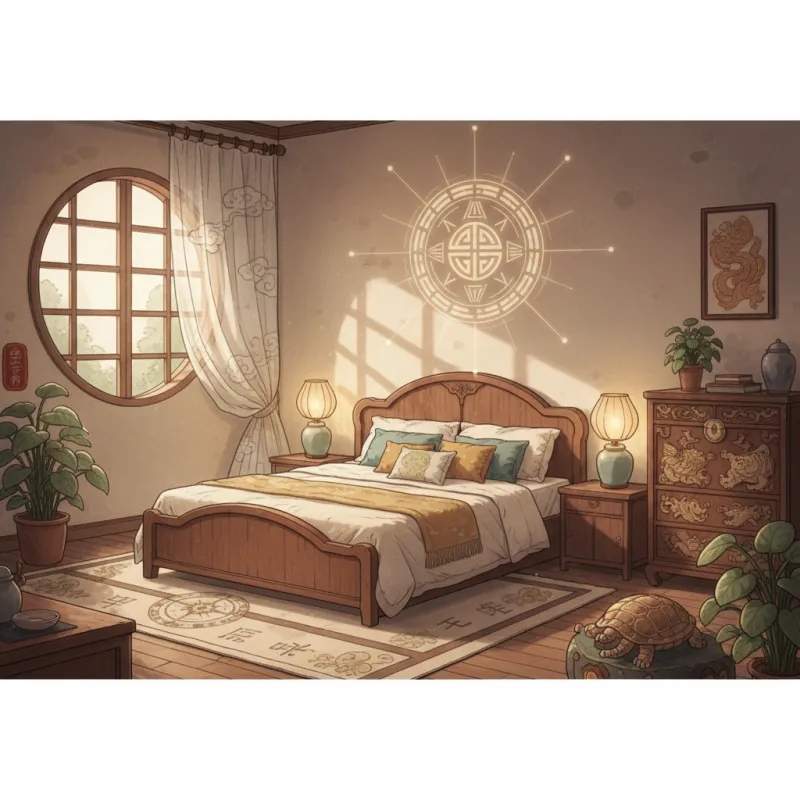
You spend a third of your life in bed, yet your bedroom might be sabotaging every hour of it. While you're obsessing over thread count and mattress firmness, the ancient masters of feng shui (風水, fēng shuǐ) would tell you that the invisible currents of qi (氣, qì) flowing through your bedroom matter far more than your pillow's loft. They weren't wrong—modern sleep science is finally catching up to what Taoist practitioners understood 3,000 years ago: your environment shapes your rest at a level most people never consider.
The Bedroom as Energy Container
Feng shui treats your bedroom as more than four walls and a ceiling—it's a vessel that either nourishes or depletes your vital energy while you sleep. The concept comes directly from the Zang Shu (葬書, Zàng Shū), the "Book of Burial" written by Guo Pu during the Jin Dynasty (276-324 CE), which established the foundational principle that qi accumulates where wind stops and water gathers. Your bedroom should function the same way: a protected space where beneficial energy pools and stagnant energy disperses.
The masters distinguished between sheng qi (生氣, shēng qì)—living, vibrant energy—and sha qi (煞氣, shà qì), the harsh, cutting energy that disrupts rest. Walk into your bedroom right now and notice what hits you first. Sharp corners pointing at your bed? That's sha qi in the form of "poison arrows." A mirror reflecting your sleeping body? You're bouncing your own energy back at yourself all night, which traditional texts warn prevents the spirit from properly settling. The Yellow Emperor's Classic of Internal Medicine, compiled around 100 BCE, specifically notes that the shen (神, shén)—your spirit—needs to "return to the liver" during sleep, a process that requires stillness and protection.
Bed Placement: The Commanding Position
If you only implement one feng shui principle, make it this: position your bed in the "commanding position" (主位, zhǔ wèi). This means you can see the bedroom door while lying down, but you're not directly in line with it. The principle comes from military strategy texts like Sun Tzu's Art of War (孫子兵法, Sūn Zǐ Bīng Fǎ), written around 500 BCE, which emphasized that a general must always see approaching threats while maintaining a protected rear.
Your hindbrain agrees completely. When your bed faces away from the door or sits directly aligned with it, your nervous system stays on low-level alert all night. You might not consciously register it, but your body never fully releases into deep sleep. I've seen people report dramatic improvements in sleep quality within days of simply rotating their bed—no other changes needed.
The ideal setup places your bed diagonally across from the door with a solid wall behind the headboard. This wall represents the Black Tortoise (玄武, xuán wǔ) from the Four Celestial Animals system, providing support and protection. Avoid placing your bed under a window, which the classical texts describe as having "no mountain at your back"—you're exposed to fluctuating energy all night. If you have no choice, use a substantial headboard and keep the window covered while sleeping.
The Five Elements in Bedroom Design
The Wu Xing (五行, wǔ xíng) or Five Elements system offers a sophisticated framework for bedroom design that goes far beyond "add a plant for wood energy." Each element corresponds to specific colors, shapes, materials, and directions, and they interact through productive and destructive cycles that the I Ching (易經, Yì Jīng) maps in detail.
For sleep, you want to emphasize earth and metal elements, which provide stability and clarity. Earth (土, tǔ) manifests through square shapes, earthy tones like terracotta and ochre, and ceramic materials. Metal (金, jīn) appears in white, gray, circular shapes, and actual metal fixtures. These elements support the water element (水, shuǐ), which governs rest, dreams, and the kidneys—the organ system Chinese medicine associates with deep restorative sleep.
Minimize fire element (火, huǒ) in the bedroom, especially near the bed. This means limiting red colors, triangular shapes, and electronics that generate heat and electromagnetic fields. The ancient texts specifically warn against "fire at the head," which includes overhead lighting directly above where you sleep. Fire agitates the heart and spirit, exactly what you don't want when trying to rest. If you're struggling with insomnia or restless sleep, look at how much fire energy dominates your bedroom—you might be sleeping in what feng shui calls a "bright hall" (明堂, míng táng), which is excellent for active spaces but terrible for rest.
Wood element (木, mù) requires careful consideration. While plants can improve air quality, too much wood energy in the bedroom creates excessive growth and movement. The classical texts recommend keeping plants minimal and avoiding anything with sharp, spiky leaves like cacti or snake plants near the bed. If you love plants, place them across the room from your bed, not on nightstands where they're actively growing right next to your head all night.
Color Psychology Meets Ancient Wisdom
The Taoist color system for bedrooms differs significantly from modern interior design trends. While contemporary designers might push bold accent walls and vibrant patterns, feng shui practitioners from the Tang Dynasty (618-907 CE) onward recommended what they called "skin colors" (膚色, fū sè) for sleeping spaces—the soft tones that appear in human skin across all ethnicities.
These include warm beiges, soft taupes, gentle creams, and muted earth tones. The reasoning connects to the concept of yin and yang (陰陽, yīn yáng): bedrooms should be predominantly yin—quiet, dark, cool, and restful. Bright colors are yang—active, stimulating, and energizing. You want just enough yang to prevent the space from feeling dead or depressing, but the balance should tip heavily toward yin.
Blue and green, while calming to Western sensibilities, can be problematic in feng shui bedroom design. Blue represents water element, which in excess can lead to feelings of coldness and isolation. Green is wood element, which as mentioned earlier, creates too much active growth energy. If you love these colors, use them in artwork or accessories rather than as dominant wall colors. For more on balancing elements throughout your home, see Five Elements in Home Design.
Clearing Clutter and Stagnant Energy
The Tao Te Ching (道德經, Dào Dé Jīng), attributed to Laozi around the 6th century BCE, contains a principle that feng shui practitioners apply directly to bedroom organization: "The usefulness of a pot comes from its emptiness." Your bedroom's power to restore you comes from what you remove, not what you add.
Clutter under the bed is particularly problematic. Traditional feng shui views the space beneath your bed as directly affecting your subconscious mind and dreams. Storing items there—especially old belongings, broken things, or items with negative associations—means you're literally sleeping on top of stagnant energy every night. The only acceptable items under the bed are soft linens in breathable containers, and even then, the classical texts prefer complete emptiness.
Closets with doors that don't close properly, drawers stuffed so full they won't shut, piles of clothes on chairs—these all represent incomplete cycles and unfinished business. Your subconscious registers every one of them, creating a subtle background anxiety that prevents deep rest. The Ming Dynasty text "The Classic of the Bright Hall" (明堂經, Míng Táng Jīng) specifically warns that "disorder in the sleeping chamber creates disorder in the heart-mind."
Electronics and Electromagnetic Fields
While ancient feng shui masters didn't deal with smartphones and WiFi routers, their principles about energy flow apply perfectly to modern electromagnetic concerns. The classical texts warn against "invisible arrows" (無形煞, wú xíng shà)—harmful influences you cannot see but can definitely feel. EMFs qualify completely.
Your phone charging on your nightstand emits a measurable electromagnetic field all night. Your TV, even when off, draws phantom power and emits low-level radiation. Smart home devices, WiFi routers, and electric alarm clocks all contribute to what feng shui would classify as chaotic, disruptive qi. The solution isn't complicated: remove all electronics from the bedroom, or at minimum, keep them at least six feet from your bed and turn them completely off at night.
This aligns with the feng shui principle of "quiet yin" (靜陰, jìng yīn) for sleeping spaces. Electronics represent active yang energy—they're designed to capture attention and stimulate engagement. Even when powered down, they carry that energetic signature. Replace your phone alarm with a battery-operated clock. Move your TV to another room. Charge devices in the hallway. Your sleep quality will likely improve within a week.
Mirrors: The Double-Edged Sword
No feng shui element generates more debate than bedroom mirrors. The traditional prohibition is absolute: no mirrors reflecting the bed, period. The reasoning comes from multiple sources. First, mirrors are considered portals that allow energy—including potentially harmful spirits—to move between realms. The Taoist text "Secret Essentials of the Most High" (太上秘要, Tài Shàng Mì Yào) from the 5th century warns that mirrors in bedrooms can "invite wandering souls" and disturb the sleeper's spirit.
More practically, mirrors double and bounce energy around the room, creating restlessness. They also reflect your image back at you all night, which classical texts say prevents your spirit from fully leaving the body to restore itself. Whether you believe in the spiritual explanation or not, many people report better sleep after covering or removing bedroom mirrors.
If you must have a mirror in your bedroom—perhaps it's built into a closet door—cover it at night with a cloth or position it so it doesn't reflect the bed. The same applies to reflective surfaces like TV screens and glossy furniture. For more on using mirrors strategically throughout your home, check out Mirror Placement in Feng Shui.
Windows, Doors, and Energy Flow
The Feng Shui classic "Water Dragon Classic" (水龍經, Shuǐ Lóng Jīng) from the Song Dynasty describes how qi flows through buildings like water through channels. In your bedroom, windows and doors are the primary entry and exit points for this energy. The ideal bedroom has one door and one or two windows, creating a gentle flow without excessive drafts or stagnation.
Avoid bedrooms with doors directly aligned—energy rushes straight through without nourishing the space. If your bedroom door aligns with a bathroom door, you're dealing with what feng shui calls "water draining wealth and health," as the bathroom's downward energy pulls vitality from the sleeping space. Solutions include keeping bathroom doors closed, hanging a crystal between the doors, or placing a small rug or barrier to slow the energy flow.
Too many windows create what's called "qi dispersion" (氣散, qì sàn)—energy enters but doesn't accumulate. You wake up feeling depleted rather than restored. Use substantial window treatments that you can close completely at night, creating the cave-like darkness that both feng shui and modern sleep science recommend for optimal rest.
Implementing Changes Gradually
The I Ching teaches that sustainable change happens through gradual accumulation, not dramatic upheaval. Hexagram 53, "Gradual Progress" (漸, jiàn), specifically addresses this: "The tree on the mountain develops slowly according to the law of its being and consequently stands firmly rooted." Apply this wisdom to your bedroom transformation.
Start with the commanding position for your bed—this single change often produces the most dramatic results. Then address clutter and remove electronics. Add appropriate colors and elements gradually, observing how each change affects your sleep quality. The goal isn't to create a museum of feng shui principles, but a bedroom that genuinely supports your rest and restoration.
Pay attention to your own experience rather than rigidly following rules. Feng shui is ultimately about harmonizing your personal energy with your environment. What works for someone else might not work for you. The classical masters always emphasized observation and adjustment over dogmatic application. Your bedroom should feel like a sanctuary the moment you enter—if it doesn't, keep refining until it does.
Related Reading
- Kitchen Feng Shui: Cooking Up Prosperity
- Office Feng Shui: Design for Career Success
- Discover the Secrets of Feng Shui: Transforming Your Garden with I Ching and Chinese Metaphysics
- The Chinese Zodiac: What Your Animal Sign Actually Means
- Discovering the Colors of Feng Shui and I Ching: Their Power and Symbolism
Explore Chinese Culture
- Explore Daoist philosophy and practice
- Explore traditional Chinese customs
- Explore ancient Chinese cosmology