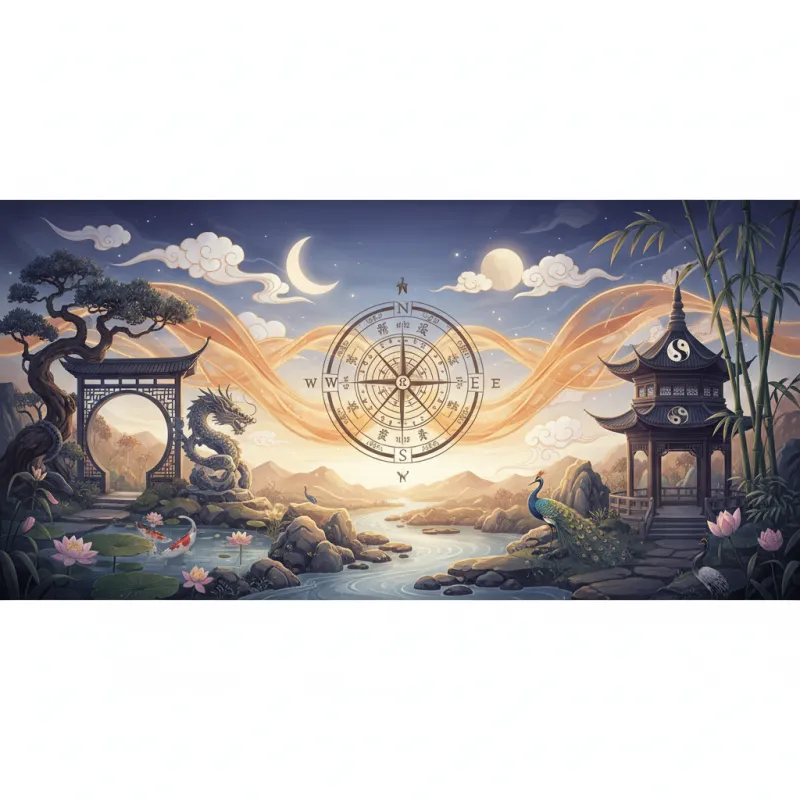
Picture this: You're standing in a garden where every stone seems to whisper ancient wisdom, where water flows in patterns that mirror the cosmos, and where plants aren't just decorative—they're strategic allies in channeling cosmic energy. This isn't fantasy. It's what happens when you merge feng shui (風水, fēng shuǐ) principles with the profound divination system of the I Ching (易經, Yì Jīng) and the elemental wisdom of Chinese metaphysics. Your garden becomes more than a pretty space—it transforms into a living, breathing manifestation of universal harmony.
The I Ching Foundation: Your Garden as a Hexagram
Most people think feng shui is about placing a fountain here or a rock there. They're missing the deeper architecture. The I Ching, compiled during the Western Zhou Dynasty (1046-771 BCE), offers 64 hexagrams that represent every possible state of change in the universe. Your garden should embody this dynamic principle. When the Song Dynasty scholar Shao Yong (邵雍, Shào Yōng, 1011-1077 CE) developed his "先天圖" (xiān tiān tú, Pre-Heaven Diagram), he wasn't just creating abstract philosophy—he was mapping how energy moves through space.
Consider hexagram 11, Tai (泰, tài)—Peace. It shows heaven below earth, the ideal state where lighter energy rises and heavier energy descends, creating perfect circulation. Your garden should mirror this: open sky above, solid earth below, with pathways that allow qi (氣, qì) to circulate without stagnating. I've seen gardens where designers ignored this principle, creating enclosed spaces with heavy overhead structures. The energy felt oppressive, trapped. The plants struggled despite perfect soil conditions.
The bagua (八卦, bā guà)—the eight trigrams—should inform your garden's layout. Each direction corresponds to a trigram, an element, and a life aspect. The south (Li trigram, 離, lí) governs fire and recognition. Plant red flowering plants here—peonies, roses, or hibiscus. The north (Kan trigram, 坎, kǎn) rules water and career. This is where your water feature belongs, but not just any water feature. It must flow toward your home, not away from it, symbolizing wealth and opportunities flowing into your life.
Five Elements: The Chemical Equation of Garden Design
The wu xing (五行, wǔ xíng) theory isn't decorative philosophy—it's the operating system of Chinese metaphysics. Wood feeds fire, fire creates earth, earth bears metal, metal collects water, water nourishes wood. This productive cycle (生, shēng) must flow through your garden like blood through veins. But there's also the controlling cycle (克, kè): wood parts earth, earth dams water, water quenches fire, fire melts metal, metal chops wood. Master both, and your garden becomes a self-regulating ecosystem.
Let's get specific. The east sector belongs to wood element and governs health and family. Plant tall, upward-growing trees here—bamboo (竹, zhú) is traditional, but any columnar evergreen works. Add a wooden bench or trellis. Avoid metal sculptures or white flowers in this zone—metal cuts wood in the controlling cycle, creating energetic conflict. I once consulted on a garden where the owner had installed a large metal wind chime in the east sector. Despite loving plants and proper care, nothing thrived there until we relocated that chime to the west (metal's home sector).
The center of your garden represents earth element and affects overall stability. This should be relatively open, perhaps with a flat stone patio or a low, spreading groundcover. Yellow or earth-tone flowers work beautifully here—chrysanthemums (菊花, jú huā) are traditional. Avoid water features in the center; water controls earth, creating instability in your garden's energetic foundation.
Water Placement: The Difference Between Fortune and Disaster
Here's where most garden feng shui goes catastrophically wrong. People read that water brings wealth and install a fountain anywhere. But water is the most powerful and dangerous element in feng shui. The Tang Dynasty master Yang Yunsong (楊筠松, Yáng Yúnsōng, 834-900 CE) wrote extensively about water placement in his "撼龍經" (Hàn Lóng Jīng, "Shaking Dragon Classic"). Get it right, and prosperity flows. Get it wrong, and you're literally draining your fortune away.
Water should enter your property from the east or southeast and exit toward the west or northwest, following the sun's path. The water should be visible from your main living areas but shouldn't flow directly away from your home's front door—that's wealth leaving. The ideal water feature curves gently, mimicking natural streams. Sharp angles or straight channels create "sha qi" (煞氣, shà qì)—attacking energy that disrupts harmony.
Size matters tremendously. A pond or fountain should be proportional to your garden. Too large, and water element overwhelms the space, potentially causing emotional instability or financial loss. Too small, and it's ineffective. The water should be clean and moving—stagnant water breeds stagnant energy and, practically speaking, mosquitoes. I recommend a small recirculating pump even for ponds. The gentle sound of moving water also activates the space aurally, engaging another sensory dimension of feng shui.
Plant Selection: Beyond Aesthetics to Energetic Function
Every plant carries specific energetic properties in Chinese metaphysics. The "four gentlemen" (四君子, sì jūn zǐ)—plum blossom, orchid, bamboo, and chrysanthemum—aren't just pretty. They represent resilience, refinement, integrity, and longevity respectively. These should form the backbone of any feng shui garden, but their placement requires thought.
Plum blossoms (梅花, méi huā) bloom in late winter, symbolizing perseverance. Plant them in the northeast sector, which governs knowledge and self-cultivation. Orchids (蘭花, lán huā) prefer the east or southeast, aligning with wood element and growth energy. Bamboo belongs in the east for health or southeast for wealth—its hollow stems allow qi to rise freely. Chrysanthemums, blooming in autumn, suit the west sector, which corresponds to metal element and completion.
Avoid plants with thorns or spiky leaves near main pathways or seating areas—they create "poison arrows" of sha qi. This doesn't mean you can't grow roses; just position them where their thorns don't point toward spaces where people gather. Similarly, dead or dying plants must be removed immediately. They're not just unsightly; they're broadcasting decay energy throughout your garden. For more on how plant energy affects indoor spaces, see Feng Shui Plants for Your Home.
Pathways and Structures: Directing the Invisible River
Qi moves through your garden like water through a streambed. Straight pathways create rushing qi that's too aggressive—it can't nourish the space. Curved paths slow and guide energy, allowing it to meander and accumulate. The ideal garden path curves gently, revealing new views gradually, creating a sense of discovery and depth even in small spaces.
The Ming Dynasty garden designers understood this profoundly. Visit the Humble Administrator's Garden (拙政園, Zhuō Zhèng Yuán) in Suzhou, and you'll see how pathways never reveal the entire garden at once. Each turn presents a new composition, a new relationship between rock, water, and plant. This isn't just aesthetic—it's energetic strategy. The qi explores the space fully, touching every corner, rather than rushing through and out.
Garden structures—pavilions, arbors, bridges—should serve as qi gathering points. A small pavilion in the south sector (fire element) painted red or purple becomes a focal point that activates recognition and fame energy. A stone bridge over your water feature shouldn't just be functional; its arch shape represents heaven, creating a symbolic connection between earthly water and celestial energy. For guidance on applying these principles to your home's interior, explore Feng Shui Room Layout Principles.
Seasonal Alignment: Your Garden as a Living Calendar
Chinese metaphysics recognizes that energy shifts with seasons, following the solar terms (節氣, jié qì) that divide the year into 24 periods. Your garden should reflect and harmonize with these changes, not fight them. Spring belongs to wood element—this is when growth energy peaks. Summer is fire—expansion and flowering. Late summer is earth—ripening and stabilization. Autumn is metal—harvest and contraction. Winter is water—rest and storage.
Plant your garden so something is always in harmony with the current season. Spring bulbs in the east, summer perennials in the south, autumn-blooming plants in the west, evergreens in the north. This creates a rotating activation of your garden's bagua sectors, keeping energy fresh and dynamic throughout the year.
Don't fight your climate's natural patterns. A feng shui garden in Minnesota will look different from one in Arizona, and that's correct. The goal isn't to impose an idealized Chinese garden template but to work with your local environment's natural qi. Use native plants when possible—they're already in harmony with your location's energetic signature.
The Maintenance Practice: Feng Shui as Ongoing Cultivation
Here's what the books don't tell you: creating a feng shui garden is the easy part. Maintaining it is where the real practice begins. Every time you prune, weed, or water, you're not just doing garden chores—you're actively cultivating qi. The Daoist concept of "wu wei" (無為, wú wéi)—effortless action—applies perfectly here. Work with your garden's natural tendencies rather than imposing rigid control.
Observe how water naturally flows through your space after rain. Where does it pool? Where does it rush? These patterns reveal your land's inherent qi channels. Enhance them rather than fighting them. Notice which plants thrive without much intervention—they're telling you something about your garden's energetic nature.
Keep a garden journal noting what blooms when, where animals visit, how light moves through the space across seasons. You're not just recording data; you're developing a relationship with your garden's qi. Over time, you'll develop intuition about what your garden needs, when it needs it. This intuitive knowledge, grounded in observation and aligned with metaphysical principles, is the highest form of feng shui practice.
Your garden isn't a static arrangement to be perfected and left alone. It's a living mandala, constantly changing, constantly teaching. Every season brings new lessons about balance, harmony, and the eternal dance of yin and yang. Tend it with awareness, and it becomes more than a beautiful space—it becomes a daily meditation on the principles that govern all existence.
Related Reading
- Feng Shui Color Symbolism: The Hidden Meanings Behind Every Hue
- The Twelve Chinese Zodiac Animals: Complete Guide
- Feng Shui Annual Forecast: How the Year's Energy Affects Your Home
Explore Chinese Culture
- Explore Daoist philosophy and practice
- Explore traditional Chinese customs
- Explore ancient Chinese cosmology