Your grandmother refuses to wear white to the wedding. Your business partner insists the contract folder must be red. Your feng shui consultant vetoes the beautiful blue tiles you picked for the kitchen. To an outsider, these seem like superstitions. To anyone who understands Chinese color symbolism, these are matters of basic communication—like knowing that a red traffic light means stop.
The Five Elements: Color as Cosmic Force
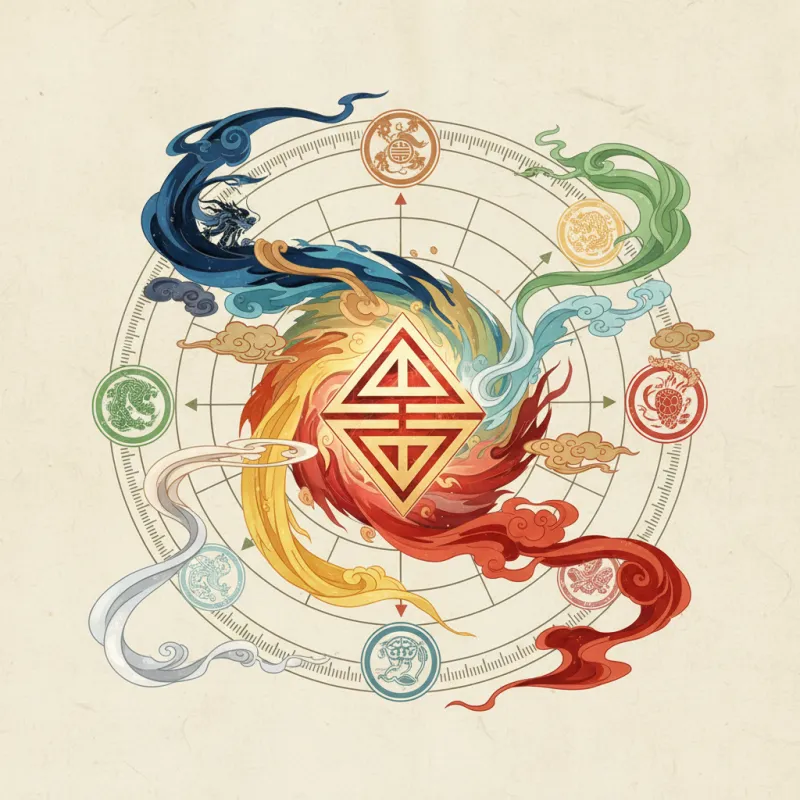
Feng shui doesn't treat color as decoration. It treats color as energy made visible. The entire system rests on the Five Elements (五行, wǔxíng)—Wood, Fire, Earth, Metal, and Water—each expressing itself through specific colors that carry distinct energetic signatures.
Wood (木, mù) manifests as green and represents growth, expansion, and upward movement. This is the energy of spring, of bamboo shoots breaking through earth, of new ventures and fresh starts. Green in a space activates the Wood element, supporting health, vitality, and family harmony.
Fire (火, huǒ) appears as red, the most potent color in Chinese culture. Fire energy is celebration, recognition, passion, and fame. Red envelopes (红包, hóngbāo) contain money gifts because Fire transforms and multiplies. Red doors invite prosperity. Red wedding dresses announce joy. This isn't metaphor—it's energetic fact.
Earth (土, tǔ) expresses through yellow, brown, and terracotta tones. Earth is the center, the stabilizer, the nourisher. Yellow was reserved for emperors during the Ming and Qing dynasties because Earth element represents ultimate authority and centralized power. In homes, Earth tones ground chaotic energy and create emotional stability.
Metal (金, jīn) takes the colors white, gold, and silver. Metal energy is precision, clarity, efficiency, and wealth accumulation. Gold specifically represents refined Metal—treasure that has been purified through fire. This is why gold and red together create the ultimate prosperity combination, as explored in Gold and Red: The Power Combination in Feng Shui.
Water (水, shuǐ) flows through black and deep blue. Water is wisdom, depth, mystery, and career luck. Black in Chinese culture is not morbid—it's the color of the profound, the unknowable, the source of all things. The Daoist sage Laozi wrote of the "mysterious dark" (玄, xuán) as the gateway to understanding.
Red: The Color That Demands Respect
Red (红色, hóngsè) dominates Chinese color symbolism for one simple reason: it works. For thousands of years, red has been empirically observed to shift energy in measurable ways. Wear red to a negotiation and people take you more seriously. Paint your door red and opportunities increase. Give red envelopes at New Year and relationships strengthen.
The power of red comes from its Fire element nature. Fire transforms, purifies, and broadcasts. Red is yang energy at maximum intensity—active, visible, impossible to ignore. This is why brides wear red, why festival decorations are red, why important documents are sealed with red stamps (印章, yìnzhāng).
But red has boundaries. You don't wear red to funerals. You don't write names in red ink—that's reserved for death notices and severing relationships. You don't give red clocks as gifts because "giving a clock" (送钟, sòng zhōng) sounds identical to "attending a funeral" (送终, sòng zhōng). Red's power cuts both ways.
White: The Mourning Color Westerners Miss
Westerners see white as purity, innocence, weddings. Chinese culture sees white (白色, báisè) as death, mourning, and endings. This isn't arbitrary symbolism—it's rooted in funeral practices going back millennia. Mourners wear white hemp cloth. Funeral banners are white. White flowers are for graves.
This creates real cross-cultural disasters. Western companies give white flowers as congratulations gifts in China, accidentally sending condolences. Brides who insist on white wedding dresses face genuine family distress—they're symbolically dressing for their own funeral.
White's association with death comes from its Metal element nature. Metal is the energy of autumn, harvest, completion, and letting go. White is the color of bones, of ashes, of things reduced to their essential form. In the Five Element cycle, Metal cuts Wood—it's the energy that prunes, that ends growth, that brings things to conclusion.
Yet white isn't universally negative. In Daoist practice, white represents purity and spiritual refinement. White jade is treasured. The distinction is context: white for spiritual matters is elevating; white for social occasions is insulting.
Black: Depth, Not Darkness
Black (黑色, hēisè) confuses Westerners who expect it to symbolize evil or death. In Chinese metaphysics, black is the color of Water element—deep, mysterious, powerful, and essential. Black is the color of the night sky that contains all stars, the deep ocean that holds all life, the ink that captures all wisdom.
During the Qing dynasty (1644-1912), officials wore black silk robes embroidered with rank badges. Black wasn't somber—it was authoritative. Black represented the depth of knowledge required to govern. Even today, black cars signal executive power, black suits convey professional competence.
Black's Water element nature makes it the color of career and life path. In feng shui, black objects in the north sector of a home activate career luck. Black crystals enhance focus and determination. Black is not absence—it's potential waiting to manifest.
The one caution with black: too much creates stagnation. Water that doesn't flow becomes stagnant. Black spaces without color accents feel oppressive. The solution is balance—black combined with Metal colors (white, gold) or Wood colors (green) maintains flow while preserving depth.
Yellow: The Emperor's Exclusive
Yellow (黄色, huángsè) was so powerful in imperial China that commoners were forbidden to wear it. Only the emperor could wear bright yellow (明黄, míng huáng) because only the emperor embodied Earth element's central authority. Violating this law meant execution.
This wasn't vanity—it was cosmology. The emperor was the "Son of Heaven" (天子, tiānzǐ), the human axis connecting heaven and earth. Yellow represented his role as the stabilizing center of civilization. The Forbidden City's roof tiles were yellow. Imperial robes were yellow. Even the emperor's sedan chair was yellow.
After the fall of the Qing dynasty in 1912, yellow became available to everyone, but its Earth element associations remain. Yellow in homes creates stability, nourishment, and grounding. Yellow in offices promotes collaboration and steady productivity. Yellow in children's rooms supports learning and concentration.
The key is choosing the right yellow. Bright imperial yellow is still aggressive—it demands attention and authority. Soft butter yellow or warm ochre tones provide Earth element benefits without the imperial baggage. For more on how Earth element colors interact with other elements, see Five Elements Color Theory in Practice.
Green: Growth Without Guarantee
Green (绿色, lǜsè) represents Wood element—growth, health, family, and new beginnings. Bamboo green, jade green, spring leaf green—these are colors of vitality and expansion. Green in the east sector of a home activates family harmony. Green in offices stimulates creativity and innovation.
But green carries a warning that Westerners often miss: in Chinese slang, "wearing a green hat" (戴绿帽子, dài lǜ màozi) means your spouse is unfaithful. This idiom dates back centuries and remains potent. Green hats are never given as gifts. Green headwear is avoided at weddings.
This doesn't negate green's positive associations—it just adds nuance. Green clothing is fine. Green decor is beneficial. Green accessories are welcome. Just not green hats. This specificity is typical of Chinese color symbolism: context determines meaning.
Green's Wood element nature makes it the color of spring and renewal. After harsh winters, green's return signals survival and continuation. In feng shui practice, green plants are preferred over green paint because living green carries active qi (气, qì), while painted green is static.
Purple: The Spiritual Outlier
Purple (紫色, zǐsè) occupies a unique position in Chinese color symbolism. It's not one of the Five Element colors, yet it carries tremendous spiritual significance. Purple represents the "Purple Star" (紫微星, zǐwēi xīng), the North Star around which all other stars revolve. The Forbidden City's original name was the "Purple Forbidden City" (紫禁城, zǐjìn chéng), linking imperial power to cosmic order.
Purple combines red's Fire energy with blue's Water depth, creating a color of spiritual authority and mystical knowledge. Daoist immortals wear purple robes. High-ranking Buddhist monks wear purple kasayas. Purple jade is rarer and more valued than green jade.
In contemporary feng shui, purple activates wealth luck—specifically the kind of wealth that comes from wisdom and spiritual alignment rather than mere hustle. Purple in meditation spaces enhances spiritual practice. Purple in wealth corners attracts opportunities that align with your higher purpose.
Color Combinations: The Real Mastery
Understanding individual colors is basic. Mastering color combinations is advanced feng shui. Colors interact through the Five Element cycles—the productive cycle (生, shēng) where elements support each other, and the controlling cycle (克, kè) where elements regulate each other.
Red and gold together multiply prosperity because Fire (red) refines Metal (gold), creating the productive cycle. Green and red together create tension because Wood (green) feeds Fire (red), depleting Wood energy. Blue and red together clash because Water (blue) extinguishes Fire (red).
The most harmonious combinations follow the productive cycle: green with red, red with yellow, yellow with white, white with black, black with green. These combinations feel naturally balanced because they mirror cosmic patterns.
The most dynamic combinations use the controlling cycle strategically: red with black (Fire controls Metal through Water), white with green (Metal cuts Wood), yellow with blue (Earth dams Water). These create tension that can be harnessed for specific purposes—motivation, focus, transformation.
Practical Application: Reading the Room
Walk into any traditional Chinese home and you can read the family's priorities through color choices. Red accents in the south? They're activating fame and recognition. Yellow tones in the center? They're prioritizing stability and family unity. Black water features in the north? They're focusing on career advancement.
This isn't superstition—it's intentional environmental design based on thousands of years of observation. Colors affect mood, behavior, and outcomes in measurable ways. Chinese culture simply codified these effects into a systematic framework.
The mistake Westerners make is treating Chinese color symbolism as quaint folklore. The mistake modern Chinese make is abandoning it as outdated tradition. The truth is that color symbolism remains a living language—one that communicates across generations and continues to shape decisions in business, design, and daily life.
Understanding this language doesn't require belief in metaphysics. It requires recognizing that colors carry cultural meaning as surely as words do, and that ignoring these meanings creates the same confusion as speaking the wrong language. Your grandmother knows this. Your business partner knows this. Now you know it too.
Related Reading
- Color Theory in Feng Shui: Why Red Means Luck and White Means Death
- Feng Shui Color Guide by Room
- Black in Feng Shui: Power, Depth, and When to Use It
- Feng Shui for Shops and Restaurants: Attract More Customers
- Exploring Feng Shui, I Ching, and Chinese Metaphysics: Symbols of Ancient Divination and Geomancy
- What Is the I Ching? A Complete Guide to the Book of Changes
Explore Chinese Culture
- Explore Daoist philosophy and practice
- Explore traditional Chinese customs
- Explore ancient Chinese cosmology