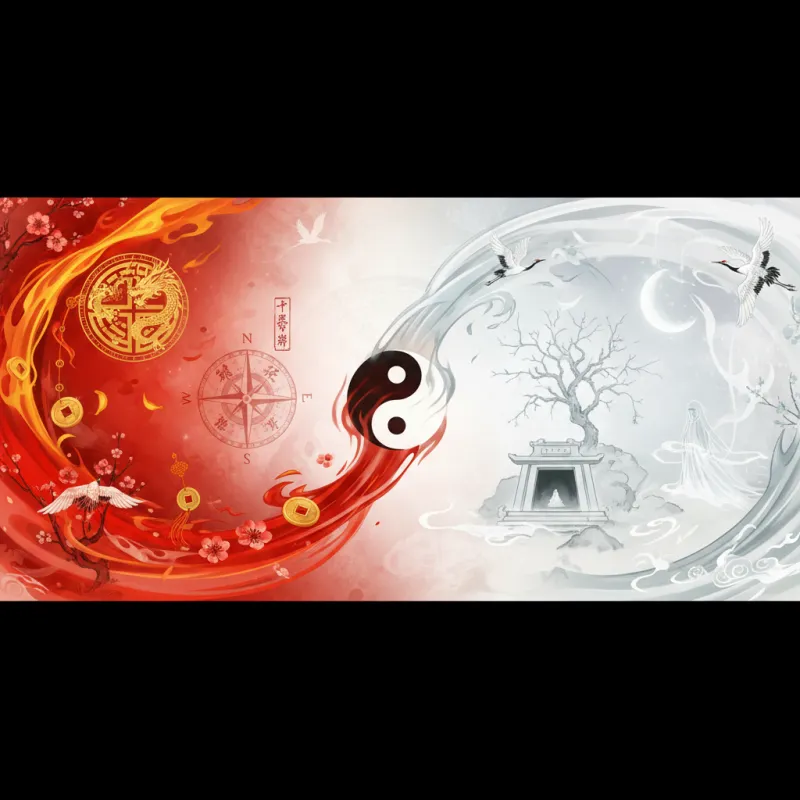
Picture this: A Western guest arrives at a Chinese wedding wearing an elegant white suit, thinking they look sharp and respectful. The room goes quiet. They've just dressed for a funeral. Meanwhile, across town, an expat sends white flowers to congratulate a Chinese friend's new business opening—flowers that symbolize death and misfortune. These aren't minor faux pas. They're cultural collisions rooted in fundamentally different color languages that have evolved over thousands of years.
The Great Color Reversal
The most jarring difference between Chinese and Western color symbolism isn't subtle—it's a complete inversion. What the West considers the color of purity and new beginnings, China associates with death and endings. What the West uses to signal danger, China celebrates as the ultimate symbol of good fortune.
In traditional Chinese culture, red (红, hóng) dominates celebrations. Brides wear red qipao or wedding gowns. Red envelopes (红包, hóngbāo) contain monetary gifts. Red couplets frame doorways during Spring Festival. Red lanterns illuminate festivals. The color saturates every joyous occasion because it represents fire, vitality, and the life force itself.
White (白, bái), conversely, is the color of mourning. Traditional Chinese funerals feature white clothing, white flowers, and white banners. When someone dies, family members wear white hemp cloth as a sign of grief. This association runs so deep that giving white flowers—chrysanthemums especially—is essentially wishing death upon someone. The symbolism isn't metaphorical; it's literal and visceral.
This reversal has practical implications. International companies have stumbled badly by using white packaging in Chinese markets for products meant to convey luxury or celebration. Wedding planners serving Chinese clients know that white roses, white lilies, and white table settings can torpedo an entire event. Understanding this isn't cultural trivia—it's essential literacy for anyone engaging with Chinese contexts.
The Five Elements Framework
Chinese color theory doesn't exist in isolation. It's embedded within the five elements system (五行, wǔxíng), which organizes the universe into wood, fire, earth, metal, and water. Each element corresponds to a color, direction, season, organ, emotion, and countless other phenomena. This isn't arbitrary symbolism—it's a comprehensive cosmological framework that's influenced Chinese thought since at least the Warring States period (475-221 BCE).
Red (红, hóng) — Fire (火, huǒ): Associated with summer, the south, the heart, and joy. Fire represents transformation, passion, and upward movement. Red's auspiciousness comes from fire's life-giving warmth and its ability to ward off evil spirits. The tradition of setting off firecrackers during New Year originated from the belief that loud noises and red light would scare away the monster Nian (年兽, niánshòu).
White (白, bái) — Metal (金, jīn): Linked to autumn, the west, the lungs, and grief. Metal represents contraction, harvest, and the cutting away of excess. White's association with death stems from metal's connection to autumn—the season when things die back—and the white color of bones and ash. In the five elements cycle, metal cuts and shapes, which metaphorically relates to the severing of life.
Black (黑, hēi) — Water (水, shuǐ): Connected to winter, the north, the kidneys, and fear. Despite Western associations with evil, black in Chinese culture represents depth, mystery, and the primordial. It's not inherently negative, though it can symbolize the unknown.
Green/Blue (青, qīng) — Wood (木, mù): Tied to spring, the east, the liver, and anger. The character 青 encompasses both green and blue, reflecting a different color categorization than Western languages use. Wood represents growth, expansion, and new beginnings.
Yellow (黄, huáng) — Earth (土, tǔ): Associated with the center, the spleen, and contemplation. Yellow, particularly golden yellow, was the imperial color during many Chinese dynasties. The Forbidden City's golden roofs weren't just decorative—they symbolized the emperor's position as the earthly center of the universe.
Historical Roots of Red's Supremacy
Red's dominance in Chinese culture predates the five elements theory. Archaeological evidence from the Yangshao culture (5000-3000 BCE) shows red pottery and red pigments used in burial goods, suggesting early associations with vitality and protection. The color comes from cinnabar (朱砂, zhūshā), a mercury sulfide mineral that ancient Chinese believed had protective and life-extending properties.
During the Han Dynasty (206 BCE - 220 CE), red became increasingly associated with official power and celebration. The Han court wore red robes for ceremonies. Red seals authenticated imperial documents. This wasn't arbitrary—red ink was difficult to forge because cinnabar was expensive and had distinctive properties. The phrase "red-headed document" (红头文件, hóngtóu wénjiàn) still refers to official government papers in modern China.
The Tang Dynasty (618-907 CE) solidified red's connection to weddings. Historical records describe elaborate red wedding processions, with brides carried in red sedan chairs while wearing red veils. This tradition intensified during the Ming (1368-1644) and Qing (1644-1912) dynasties, becoming the standard that persists today. The practice wasn't universal across all Chinese ethnic groups, but Han Chinese wedding customs heavily influenced broader cultural norms.
White's Death Connection
White's association with death and mourning has equally ancient roots. In early Chinese cosmology, white represented the west—the direction where the sun sets and dies each day. This directional symbolism merged with the five elements framework, where white/metal/west/autumn formed a conceptual cluster around endings and death.
Confucian mourning rituals, codified in texts like the Book of Rites (礼记, Lǐjì), specified white hemp clothing for mourners. The coarser and plainer the fabric, the deeper the mourning. This wasn't about aesthetics—it was about demonstrating grief through the rejection of color, decoration, and comfort. Wearing white signaled that you were in a liminal state, separated from normal social life by loss.
The contrast with Western white wedding dresses couldn't be starker. When Christian missionaries arrived in China during the Ming and Qing dynasties, the white vestments and altar cloths initially confused Chinese observers. Some historical accounts describe Chinese converts being uncomfortable with white church decorations because they evoked funeral associations. This cultural disconnect persists—modern Chinese weddings sometimes incorporate white elements due to Western influence, but traditional families often resist, and white is never the dominant color.
Practical Applications in Feng Shui
Understanding color symbolism becomes crucial when applying feng shui (风水, fēngshuǐ) principles to living spaces. Feng shui practitioners don't just randomly assign colors—they consider the five elements, the specific room's function, the occupant's birth chart (八字, bāzì), and the building's orientation.
For example, a feng shui consultant might recommend red accents in a home's south-facing areas because south corresponds to fire in the five elements system. But they'd avoid excessive red in bedrooms, where fire energy could create restlessness and conflict. The goal isn't to maximize red everywhere—it's to create elemental balance.
White, despite its mourning associations, isn't forbidden in feng shui. Metal element energy can be beneficial in certain contexts, particularly in west-facing rooms or for people whose birth charts need metal element support. The key is intentionality and balance. A completely white room might feel cold and lifeless (too much metal energy), but white accents can create clarity and precision.
This is where feng shui diverges from simple superstition. A skilled practitioner doesn't just say "red good, white bad." They analyze the specific situation, considering factors like the occupant's personal element needs, the room's purpose, and the existing energy flow. Someone born in a fire-heavy year might actually need more water or metal elements (black, white, gray) to create balance, even though red is generally auspicious.
Modern Adaptations and Global Influence
Contemporary Chinese culture navigates between traditional color symbolism and global influences. Urban Chinese weddings now sometimes feature white wedding dresses for photo sessions, though the ceremony itself typically involves red. International brands have learned to adapt—Apple releases special red iPhones for the Chinese market, and luxury brands create red-themed collections for Chinese New Year.
The diaspora experience complicates these traditions further. Second and third-generation Chinese Americans or Chinese Australians might understand the symbolism intellectually but not feel it viscerally. They might wear white to Chinese weddings without thinking twice, creating generational tensions. These aren't failures of cultural preservation—they're natural evolutions as cultures interact and merge.
Interestingly, Chinese color symbolism is influencing global design. Red envelopes have become recognizable worldwide, even among non-Chinese populations. The color red appears in Lunar New Year marketing across Asia and beyond. This isn't cultural appropriation—it's cultural exchange, though it works best when people understand the deeper meanings rather than treating red as a generic "Asian" aesthetic.
Beyond Binary Thinking
The red-means-luck, white-means-death framework is useful for beginners, but it oversimplifies a complex system. Chinese color theory is contextual, not absolute. Red can be excessive or inappropriate in certain situations. White has uses beyond mourning. The five elements interact in cycles of generation and destruction, meaning colors can support or conflict with each other depending on arrangement and proportion.
Consider the color combinations in classical Chinese painting. Artists didn't just splash red everywhere because it was lucky. They used subtle gradations of ink (black/water element), touches of mineral green (wood element), and occasional red seals (fire element) to create balanced compositions. The aesthetic principle wasn't "more auspicious colors equals better"—it was harmony, balance, and appropriate expression.
This sophistication appears in traditional architecture too. The Forbidden City uses red walls and golden roofs, but also incorporates white marble, green glazed tiles, and dark wood. Each color serves a purpose within the overall design, creating a hierarchy of elements that reflects cosmic order. The emperor's throne room wasn't just decorated with lucky colors—it was a three-dimensional representation of the universe's structure.
Understanding Chinese color theory means moving beyond memorizing associations to grasping the underlying logic. Why does red represent luck? Because it embodies fire's transformative, life-giving energy. Why does white represent death? Because it connects to metal's cutting, contracting nature and autumn's dying back. These aren't arbitrary cultural quirks—they're expressions of a coherent worldview that's shaped Chinese civilization for millennia.
For anyone working across cultures, studying color meanings in different traditions reveals how deeply color perception is culturally constructed. What seems natural and obvious in one system can be completely inverted in another. The Chinese-Western color reversal is just one example of how human societies create different symbolic languages from the same visual spectrum.
The practical lesson? When engaging with Chinese contexts—whether attending a wedding, decorating a space, or designing products—take color seriously. It's not just aesthetics. It's communication, and getting it wrong sends messages you didn't intend. A white gift box might seem elegant to you, but to your Chinese colleague, it might signal death and misfortune. That's not superstition—it's a different symbolic vocabulary, and learning it shows respect and cultural intelligence.
Related Reading
- Feng Shui Color Guide by Room
- Black in Feng Shui: Power, Depth, and When to Use It
- Gold and Red: The Power Combination in Feng Shui
- Feng Shui Color Symbolism: The Hidden Meanings Behind Every Hue
- Unlocking the Secrets of Feng Shui and I Ching: A Journey Through Chinese Metaphysics
- Rainwater Collection and Feng Shui: Catching Wealth from the Sky
- Exploring Feng Shui, I Ching, and Chinese Metaphysics: Symbols of Ancient Divination and Geomancy
Explore Chinese Culture
- Explore Daoist philosophy and practice
- Explore traditional Chinese customs
- Explore ancient Chinese cosmology