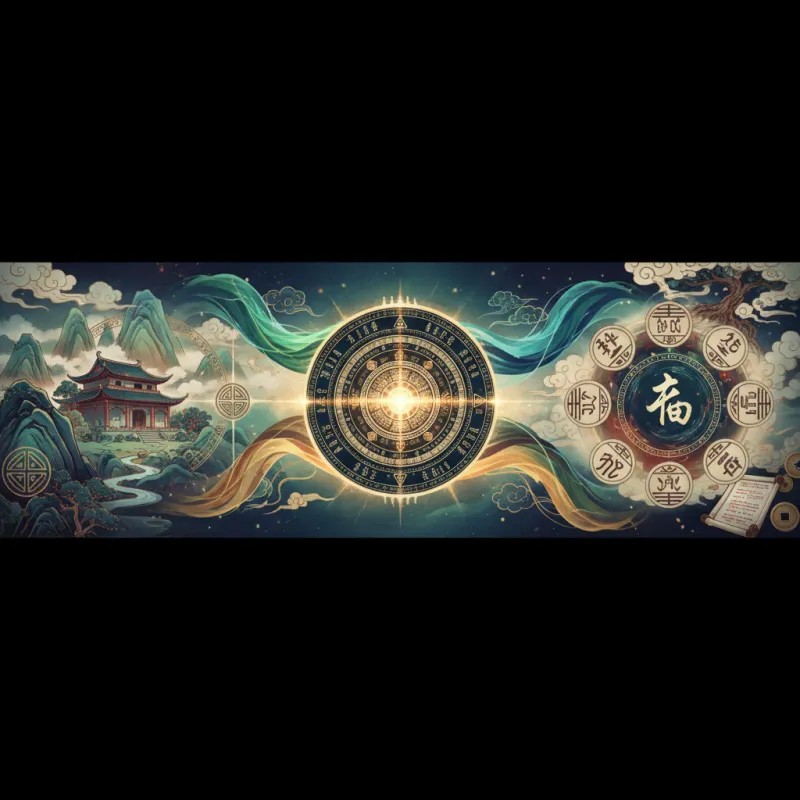
Picture this: A Tang Dynasty scholar sits before a tortoise shell, watching cracks form as heat touches its surface. These aren't random fractures—they're messages from the cosmos itself, patterns that would eventually evolve into the 64 hexagrams we know today. Meanwhile, across the imperial palace, another advisor studies the flow of water around the Forbidden City's foundations, calculating how invisible forces might shape the emperor's fate. These weren't separate practices. They were two languages describing the same reality.
The Cosmic Operating System
Feng Shui (風水, fēng shuǐ) and the I Ching (易經, Yì Jīng) aren't mystical mumbo-jumbo—they're sophisticated frameworks for understanding pattern and change. Think of them as ancient China's attempt at a unified field theory, centuries before Einstein picked up a pencil. The I Ching emerged during the Western Zhou Dynasty (1046-771 BCE), crystallizing from even older oracle bone divination practices. Feng Shui developed later, reaching its mature form during the Han Dynasty (206 BCE-220 CE) when scholars like Guo Pu began systematizing geomantic principles.
What connects them? Both operate on the principle that everything—absolutely everything—is Qi (氣, qì). Not some vague "energy," but the fundamental substance-process of reality itself. The I Ching tracks how Qi transforms through time. Feng Shui maps how Qi moves through space. Master one, and you're reading half the book. Master both, and you're fluent in the language the universe speaks.
Hexagrams: The Universe in 64 Configurations
The I Ching's 64 hexagrams aren't fortune cookie wisdom—they're a binary code predating Leibniz by three millennia. Each hexagram consists of six lines, either broken (yin) or unbroken (yang), creating 64 possible combinations. Hexagram 1, Qián (乾), is six unbroken lines—pure creative yang, the dragon ascending. Hexagram 2, Kūn (坤), is six broken lines—pure receptive yin, the mare's endurance. Between these poles, 62 other configurations map every possible state of transformation.
Here's what most people miss: the hexagrams aren't static symbols. They're snapshots of processes in motion. When you consult the I Ching using yarrow stalks or coins, you're not asking "what will happen?" You're asking "what's happening right now, and where is this pattern heading?" The changing lines—those that flip from yin to yang or vice versa—show you the pivot points, the moments where intervention matters most.
The King Wen sequence, the traditional arrangement of hexagrams, follows a logic that scholars still debate. Some see it as a cosmological map. Others argue it's a political text disguised as divination, written when King Wen was imprisoned by the Shang Dynasty tyrant Zhou Xin. The truth? Probably both. The best Chinese metaphysical texts work on multiple levels simultaneously, like those optical illusions where you see either a vase or two faces depending on how you look.
The Feng Shui Compass: Navigating Invisible Currents
The Luopan (羅盤, luópán), or Feng Shui compass, looks like something from a steampunk novel—concentric rings of Chinese characters surrounding a magnetic needle. But this isn't decorative. Each ring represents a different layer of analysis: the 24 Mountains (compass directions), the 64 hexagrams (yes, the same ones from the I Ching), the 28 Lunar Mansions, the Nine Palaces, and more. A master practitioner can read these rings like a symphony score, seeing how different forces harmonize or clash at a specific location.
The Flying Stars (飛星, fēi xīng) method, which gained prominence during the Qing Dynasty, adds a temporal dimension to spatial analysis. Nine stars—actually representing different Qi qualities—"fly" through the nine sectors of a building according to time cycles. Star 8, the wealth star, brings prosperity wherever it lands during Period 8 (2004-2024). But come Period 9 (2024-2044), Star 9 takes the throne. This isn't superstition—it's a sophisticated system for tracking how environmental influences shift over time, similar to how understanding the five elements helps predict seasonal changes and their effects on human affairs.
Where Divination Meets Geography
Here's where it gets interesting: the I Ching and Feng Shui share the same fundamental architecture. Both use the Eight Trigrams (八卦, bā guà)—Qián (Heaven), Kūn (Earth), Zhèn (Thunder), Xùn (Wind), Kǎn (Water), Lí (Fire), Gèn (Mountain), and Duì (Lake). In the I Ching, these trigrams stack to form hexagrams. In Feng Shui, they map onto the eight cardinal and intercardinal directions, creating the Bagua (八卦, bā guà) template used to analyze spaces.
The Later Heaven Bagua arrangement, attributed to King Wen, places Lí (Fire) in the south and Kǎn (Water) in the north—matching the natural world where the sun peaks in the southern sky and cold comes from the north. This isn't arbitrary symbolism. It's observational science encoded in symbolic language. The ancient Chinese were master pattern-recognizers, and they noticed that certain spatial arrangements consistently produced certain outcomes.
Consider the ideal Feng Shui site: mountains behind (Xuanwu, the Black Tortoise), open space in front (Zhuque, the Red Phoenix), with protective hills on the left (Qinglong, the Azure Dragon) and right (Baihu, the White Tiger). This configuration appears throughout Chinese history—from the Ming Tombs to the Forbidden City. Why? Because it works. The mountains block harsh northern winds. The open southern exposure maximizes sunlight. The side hills channel water flow and create microclimates. What looks like mysticism is actually sophisticated environmental design, much like how bazi analysis reveals patterns in temporal cycles.
The Mathematics of Change
Both systems operate on cyclical mathematics. The I Ching uses the number 6 (six lines per hexagram, 6×6=36, 36+28=64 when you account for the mathematical structure). Feng Shui loves the number 9 (nine palaces, nine stars, nine periods of 20 years each). These aren't random. Six represents the maximum yin number (even numbers are yin), while nine represents the maximum yang number (odd numbers are yang). Together, they create a numerical language for describing transformation.
The Hetu (河圖, hé tú) and Luoshu (洛書, luò shū) diagrams—legendary patterns said to have appeared on the back of a dragon-horse and a turtle shell respectively—provide the mathematical foundation for both practices. The Luoshu, a 3×3 magic square where every row, column, and diagonal sums to 15, becomes the template for Flying Stars analysis. The Hetu, with its arrangement of numbers in cross formation, underlies the Five Elements (五行, wǔ xíng) theory that permeates all Chinese metaphysics.
Practical Application: Reading the Present Moment
Let's get concrete. Say you're facing a major career decision. You consult the I Ching and receive Hexagram 3, Zhūn (屯), "Difficulty at the Beginning," with a changing line in the fourth position. The hexagram shows Thunder below Water—energy trying to emerge but meeting resistance. The changing line transforms it into Hexagram 8, Bǐ (比), "Holding Together." The message? Initial obstacles are natural. Don't force it. Seek allies. Build coalitions. The transformation shows that persistence through difficulty leads to union and support.
Now you examine your office using Feng Shui principles. Your desk faces a wall—you're literally staring at obstacles. The door is behind you—you can't see opportunities approaching. The northwest sector (representing helpful people and mentors) is cluttered with old files. The southeast (wealth and abundance) has a dying plant. These aren't metaphors. They're environmental factors affecting your psychology and, consequently, your decisions and actions.
You make changes: rotate the desk to face the door with a solid wall behind you (command position). Clear the northwest sector and place a photo of a mentor there. Replace the dying plant with a healthy one or a small water feature in the southeast. You don't just consult the oracle—you align your environment with the pattern you want to manifest. This is where understanding elemental interactions becomes crucial for creating harmonious spaces.
The Modern Relevance Question
Skeptics dismiss this as ancient superstition. But consider: the I Ching influenced Carl Jung's theory of synchronicity and his concept of archetypes. Feng Shui principles align remarkably well with modern environmental psychology research on how spatial design affects mood, productivity, and decision-making. The Chinese weren't measuring Qi with instruments—they were observing correlations between environmental factors and human outcomes over centuries, then encoding their findings in symbolic language.
The real question isn't whether these systems are "true" in some absolute sense. It's whether they're useful. Do they help you notice patterns you'd otherwise miss? Do they provide frameworks for making better decisions? Do they encourage you to pay attention to your environment and its effects on your life? If yes, then they're working exactly as intended.
The ancient Chinese weren't trying to predict the future—they were trying to understand the present so deeply that the future became obvious. That's still the most practical magic there is.
Related Reading
- Feng Shui for Business: Attract Customers and Wealth
- Famous Tombs and Their Feng Shui
- Unlocking the Wisdom of Feng Shui and I Ching: A Journey Through Chinese Metaphysics
Explore Chinese Culture
- Explore Daoist philosophy and practice
- Explore traditional Chinese customs
- Explore ancient Chinese cosmology