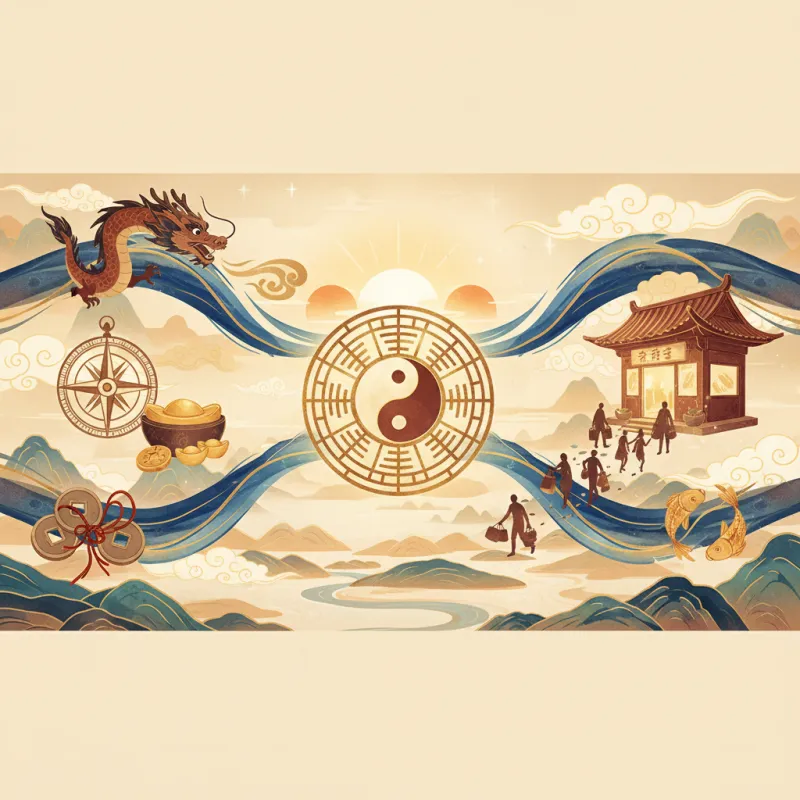
Your storefront faces north, your cash register sits in the corner gathering dust, and despite your best marketing efforts, customers trickle in like water through a cracked vessel. Meanwhile, the restaurant three doors down—with mediocre food and terrible parking—has lines out the door every night. What do they know that you don't? The answer might lie in principles that predate modern business theory by three millennia.
The Bagua Map: Your Business Blueprint
Feng Shui (風水, fēng shuǐ) practitioners don't just rearrange furniture—they work with the Bagua (八卦, bā guà), an octagonal energy map derived directly from the I Ching's eight trigrams. Each section governs a specific aspect of your business life. The southeast corner? That's your wealth sector, ruled by the Wood element and the Xun (巽) trigram. Place your cash register anywhere else, and you're literally turning your back on prosperity.
I've seen business owners obsess over their logo colors while their accounting desk sits in the relationship corner (southwest). No wonder their finances feel like a bad marriage. The Bagua isn't superstition—it's a diagnostic tool that reveals where your space supports or sabotages your goals. Map it over your floor plan with a compass, not guesswork. The front door determines your orientation, and yes, it matters whether you're off by fifteen degrees.
The Qi Flow: Why Customers Walk Past Your Door
Qi (氣, qì) moves through your business like water through a streambed. Block it, and you create stagnation. Rush it, and nothing settles long enough to take root—including customers and their money. The Ming Dynasty text "Yangzhai Shishu" (陽宅十書, "Ten Books on Yang Dwellings") from 1588 CE describes this principle with surgical precision: "Where qi gathers, wealth accumulates. Where qi disperses, people scatter."
Your entrance should invite qi inward with a clear, well-lit path. Those trendy narrow doorways flanked by display cases? They're choking your business's breath. The ideal entrance opens wide, with a slight curve or meander before reaching the main space—think of traditional Chinese gardens where paths never run straight. This slows qi to a nourishing pace while preventing it from shooting straight through your back door, taking potential profits with it.
Sharp corners pointing at your entrance, cash register, or desk create "poison arrows" (煞氣, shà qì)—aggressive energy that repels customers and creates conflict. That modern architectural column aimed at your reception desk? It's a spear. Soften it with plants, fabric, or strategic repositioning of furniture.
The Five Elements: Balancing Your Business Energy
The Wu Xing (五行, wǔ xíng) cycle governs how energy transforms in your space. Wood feeds Fire, Fire creates Earth, Earth bears Metal, Metal collects Water, Water nourishes Wood. But the destructive cycle matters just as much: Metal chops Wood, Wood depletes Earth, Earth dams Water, Water extinguishes Fire, Fire melts Metal.
A tech startup (Metal industry) decorated entirely in red (Fire element) is literally melting its own energy. A restaurant (Fire business) with excessive blue and black décor (Water) is dousing its own flames. I've watched a financial consulting firm (Water industry) transform their client acquisition after removing the massive stone fountain (Water) from their wealth corner and replacing it with a healthy jade plant (Wood). Water in the wealth sector can drain money away rather than accumulate it—unless you're in a Water-element industry where it amplifies your natural energy.
Your industry determines your primary element. Finance and communication? Water. Restaurants and energy? Fire. Real estate and wellness? Earth. Technology and law? Metal. Fashion and education? Wood. Build your space to support, not fight, your elemental nature. For deeper understanding of how elements interact in your personal energy blueprint, explore Bazi and the Five Elements.
Strategic Placement: Where Everything Belongs
The commanding position (靠山, kào shān, literally "mountain backing") is non-negotiable. Your desk, reception area, and point-of-sale should face the entrance with a solid wall behind. Sitting with your back to the door places you in a vulnerable position—your nervous system knows it even if your conscious mind doesn't. Customers sense this anxiety and mirror it back.
The wealth corner (southeast) should contain living, thriving elements—healthy plants with rounded leaves, moving water features (if appropriate for your element), or symbols of abundance. Dead plants, trash cans, or bathrooms in this sector are financial suicide. One retail client moved their bathroom entrance (which opened directly into the wealth corner) and saw a 40% revenue increase within three months. They changed nothing else.
Your reception or greeting area should be in the mouth of qi—the space immediately visible and accessible from the entrance. Hiding it around corners or behind barriers tells customers they're not welcome. The Tang Dynasty master Yang Yunsong (楊筠松, 834-900 CE) wrote extensively about "bright hall" (明堂, míng táng) theory—the open space before your entrance and inside your threshold that allows qi to gather and settle. Keep it clear, bright, and inviting.
The I Ching Influence: Timing Your Business Moves
The I Ching (易經, yì jīng) isn't just philosophy—it's a timing system. The 64 hexagrams describe every possible situation and its natural evolution. Hexagram 11, Tai (泰, Peace), represents the ideal business condition: heaven and earth in harmony, with energy flowing freely. Hexagram 12, Pi (否, Standstill), shows the opposite—blockage and stagnation.
Smart business owners consult the I Ching before major decisions: signing leases, launching products, hiring key personnel. Not because it predicts the future, but because it reveals the energetic quality of the present moment. Forcing action during a Pi hexagram is like planting seeds in frozen ground. Waiting for Tai conditions—or understanding how to work with the current hexagram's energy—dramatically improves outcomes.
The hexagram Sheng (升, Pushing Upward, #46) indicates ideal timing for expansion and growth. Kun (困, Oppression, #47) suggests consolidation and patience. I've seen entrepreneurs save themselves from disastrous expansions by recognizing they were in a Kun phase, not a Sheng phase. For more on applying I Ching wisdom to decision-making, see I Ching Hexagrams in Daily Life.
Color, Light, and Symbolic Cures
Colors aren't decoration—they're elemental medicine. Red (Fire) activates and energizes but can create aggression in excess. Blue and black (Water) calm and deepen but can dampen enthusiasm. Green (Wood) promotes growth and creativity. White and metallics (Metal) bring clarity and precision. Earth tones (Earth) stabilize and ground.
Your industry element should dominate, with supporting elements in the productive cycle. A law firm (Metal) benefits from earth tones (Earth produces Metal) with white and gray accents. A marketing agency (Wood) thrives with green and blue (Water nourishes Wood) with touches of black.
Lighting is qi made visible. Dark corners accumulate stagnant energy—and stagnant energy repels money. Every corner should be illuminated, especially the wealth sector. Natural light is ideal, but full-spectrum bulbs work when windows aren't available. Flickering fluorescents create sha qi; replace them immediately.
Symbolic cures work because intention directs qi. A three-legged money frog (金蟾, jīn chán) facing inward from your entrance invites wealth inside. A pair of fu dogs (石獅, shí shī) flanking your door provides protection. Chinese coins tied with red string activate metal and fire energy for wealth. But symbols without understanding are empty gestures—know why you're placing each item and in which sector.
Maintenance: Feng Shui Isn't One-and-Done
Energy shifts constantly. What worked last year might block you now. Quarterly reviews of your space keep qi flowing freely. Dead plants? Remove them immediately—they broadcast decay. Broken items? Fix or discard them—they represent broken opportunities. Clutter? It's stagnant qi made physical, especially in the wealth corner.
The annual Flying Stars (飛星, fēi xīng) system, based on the I Ching's temporal cycles, shows how energy moves through your space each year. The wealth star (#8) and misfortune star (#5) change locations annually. Activating last year's wealth corner this year might activate this year's conflict sector instead. Serious practitioners track these shifts and adjust accordingly.
Water features require special attention. Stagnant water breeds stagnant energy. Moving water should flow toward your building, not away from it—you're inviting wealth in, not washing it out. The water should be clean, well-maintained, and proportional to your space. A massive fountain in a small office overwhelms rather than enhances.
Your business space is a living system, not a static arrangement. Feng Shui for business isn't about following rigid rules—it's about understanding how energy moves and creating conditions where customers, opportunities, and wealth naturally flow toward you. The ancient masters knew what modern neuroscience is just discovering: our environment shapes our success far more than we consciously realize. Arrange it wisely.
Related Reading
- Four Pillars of Destiny: Your Birth Chart Decoded
- Flying Stars Feng Shui: Time-Based Energy Analysis
- Reflecting Harmony: The Role of Mirrors in Feng Shui and I Ching Divination
- Eight Mansions vs Flying Stars: Which System Should You Use?
- Unlocking the Secrets of Feng Shui: Water Features in Chinese Metaphysics
Explore Chinese Culture
- Explore Daoist philosophy and practice
- Explore traditional Chinese customs
- Explore ancient Chinese cosmology