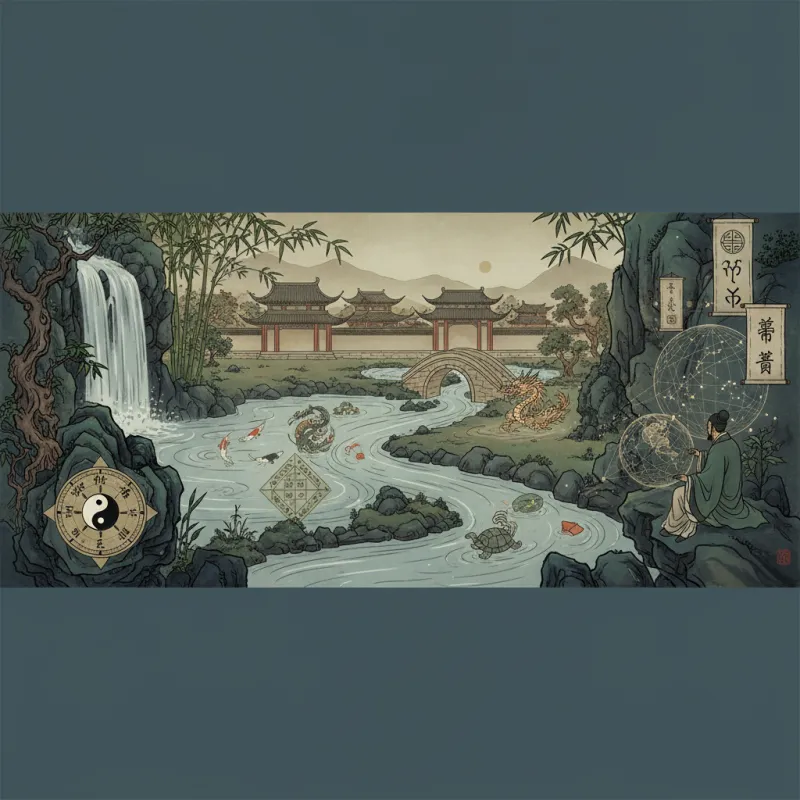
Picture this: A Ming Dynasty emperor stands before his palace gates, watching as workers redirect a stream to flow past his treasury. Not for irrigation. Not for drinking water. But because his court geomancer insisted that water flowing in the wrong direction was draining the imperial coffers. Absurd superstition? Perhaps. Yet that same emperor's reign saw unprecedented economic prosperity, and today, Fortune 500 companies pay consultants thousands to position office fountains according to these exact principles.
Water features aren't decorative afterthoughts in Chinese metaphysics—they're precision instruments for manipulating qi (氣, qì), the vital energy that classical texts describe as flowing through landscapes like blood through veins. Get the placement wrong, and you're not just wasting money on a pretty fountain. You're potentially redirecting wealth away from your property, inviting health problems, or—according to the Qing Dynasty master Shen Zhu Reng—"opening the door for wandering spirits to enter through water gates."
Why Water Carries Wealth in Classical Theory
The connection between water and prosperity isn't metaphorical in Feng Shui—it's mechanical. The Qing Nang Jing (青囊經, Qīng Náng Jīng), or "Classic of the Azure Bag," written during the Jin Dynasty, explicitly states: "Qi rides the wind and scatters, but is retained when encountering water." This isn't poetry. It's an instruction manual.
Ancient practitioners observed that prosperous cities invariably developed near water sources—the Grand Canal, the Yangtze River, the Pearl River Delta. But they noticed something more specific: wealth accumulated where water moved in particular patterns. Slow, meandering water that "embraced" a location brought sustained prosperity. Fast, straight water rushing past carried wealth away. Stagnant water bred disease and misfortune.
The five elements theory (五行, wǔ xíng) provides the theoretical framework. Water generates Wood, which generates Fire, which generates Earth, which generates Metal, which generates Water again. But water also controls Fire—it can extinguish your fame, reputation, and recognition if positioned in your Fire sector (south). This is why blindly placing water features without understanding your property's sitting and facing directions is like performing surgery with a butter knife. You might get lucky, but you're more likely to cause damage.
The Eight Mansions Method and Water Placement
The Ba Zhai Ming Jing (八宅明鏡, Bā Zhái Míng Jìng), or "Eight Mansions Bright Mirror," compiled during the Ming Dynasty, provides specific formulas for water placement based on your home's sitting direction. This isn't the simplified "put a fountain in your wealth corner" advice you'll find in airport bookstore Feng Shui guides.
For an east-facing house (震宅, zhèn zhái), water features excel in the southeast (巽, xùn), north (坎, kǎn), and south (離, lí) sectors. Place water in the west (兌, duì), and you're activating what classical texts call the "Five Ghosts" position—associated with accidents, legal troubles, and backstabbing. I've consulted on three cases where business owners placed elaborate koi ponds in their west sectors and faced lawsuits within six months. Coincidence? Maybe. But the pattern holds across centuries of recorded cases.
The northeast (艮, gèn) sector deserves special attention. In Period 9 Feng Shui (2024-2043), this direction governs young men, knowledge, and new beginnings. Water here can either stimulate brilliant academic achievement or trigger depression and isolation, depending on the specific landforms and water flow patterns. The difference lies in details most practitioners ignore: the water's source, its exit point, and whether it flows toward or away from the property's facing direction.
Moving Water vs. Still Water: The Yin-Yang Dynamic
Here's where most modern applications fail catastrophically: they treat all water features as interchangeable. A bubbling fountain, a still pond, a flowing stream—surely they're all "water energy," right? Wrong.
The Shui Long Jing (水龍經, Shuǐ Lóng Jīng), or "Water Dragon Classic," distinguishes between yang water (flowing, moving, active) and yin water (still, deep, quiet). Yang water activates—it stimulates business activity, social connections, and rapid wealth accumulation. Yin water consolidates—it preserves existing wealth, supports meditation and study, and provides emotional stability.
A tech startup needs yang water at its entrance—something moving, visible, and dynamic. A retirement home needs yin water in its garden—calm, reflective, and peaceful. Install them backwards, and you'll have agitated elderly residents and lethargic entrepreneurs. I've seen a venture capital firm place a massive still pond at their entrance. Within a year, deal flow dried up. They replaced it with a dynamic fountain featuring multiple water levels and directional flow. Deal flow resumed. Causation? Correlation? The results speak regardless of your belief system.
The speed of water movement matters too. The Di Li Bian Zheng (地理辨正, Dì Lǐ Biàn Zhèng) warns against "arrow water"—fast-moving water that shoots directly at a building. This includes modern features like fountains with jets pointing toward entrances. Classical theory holds that such water "pierces the heart" of a building, causing sudden financial losses or health crises among occupants.
The Xuan Kong Flying Stars and Water Timing
Most people don't realize that water features have expiration dates. The Xuan Kong Flying Stars system (玄空飛星, Xuán Kōng Fēi Xīng) reveals that the same water feature that brought prosperity in Period 8 (2004-2023) might trigger disasters in Period 9 (2024-2043).
The system divides time into 180-year cycles, each containing nine 20-year periods. Each period has different "water stars" that govern wealth potential in specific directions. In Period 8, the northeast held the prosperous 8-star. Water there activated wealth. In Period 9, that same northeast position holds the 9-star, which is prosperous, but the 8-star has moved to the north. Water features need to move with these stars, or they become what practitioners call "untimely water"—features that drain rather than attract wealth.
I consulted for a Hong Kong property developer who refused to update his office fountain when Period 9 began. His company had thrived for 15 years with water in the northeast. Within three months of the period change, two major deals collapsed, and a key investor withdrew. He finally relocated the fountain to the north sector. The company stabilized, though it took another year to recover the momentum. Skeptics will note that correlation doesn't prove causation, but practitioners have documented these patterns across thousands of cases over centuries.
Practical Implementation: Size, Shape, and Maintenance
The Yang Zhai San Yao (陽宅三要, Yáng Zhái Sān Yào), or "Three Essentials of Yang Dwellings," emphasizes proportion. A water feature should be proportional to the building it serves—neither overwhelming nor insignificant. The classical ratio suggests water features should occupy no more than one-ninth of the property's facing side. Larger features can "drown" the property's qi, while smaller ones fail to activate it sufficiently.
Shape matters more than most realize. Curved, kidney-shaped ponds that "embrace" the building are ideal. Sharp angles, triangular features, or water bodies that point at the building like arrows violate classical principles. The Ru Di Yan (入地眼, Rù Dì Yǎn) specifically warns against "blade water"—long, straight water features that cut toward a building like a knife.
Maintenance isn't just aesthetic—it's metaphysical. Stagnant, dirty water transforms from wealth-attracting to disease-inviting. The Xue Xin Fu (雪心賦, Xuě Xīn Fù) states: "Clear water brings clear wealth; turbid water brings turbid affairs." I've seen businesses with beautiful but poorly maintained fountains face embezzlement, fraud, and financial confusion. Clean the water, and clarity returns—both literally and figuratively.
For those interested in how water features interact with other landscape elements, see Feng Shui Garden Design Principles for comprehensive guidance on creating harmonious outdoor spaces.
The Modern Dilemma: Indoor Water Features
Ancient texts never anticipated indoor fountains, aquariums, or water walls. These are modern inventions, and their effects don't always align with classical theory. The challenge: indoor water features lack the natural qi flow of outdoor water sources. They're artificial, contained, and often electrically powered—introducing electromagnetic fields that classical practitioners never considered.
Some modern practitioners reject indoor water features entirely, arguing they're "dead water" without connection to natural water sources. Others adapt classical principles, treating indoor features as miniature versions of outdoor water bodies. The truth likely lies between these extremes.
My observation across dozens of consultations: indoor water features work best when they simulate natural water movement—gentle, varied, and organic rather than mechanical and repetitive. A fountain that sounds like a babbling brook outperforms one that sounds like a bathroom faucet. The human nervous system responds to natural rhythms, and if Feng Shui is about harmonizing human energy with environmental energy, then features that trigger relaxation responses will outperform those that create subtle stress.
For those exploring the relationship between water features and personal energy cultivation, Water Element in Bazi Analysis offers insights into how water in your birth chart interacts with water in your environment.
Integration with I Ching Principles
The Yi Jing (易經, Yì Jīng), or "Book of Changes," provides the philosophical foundation for water placement through its hexagrams. Hexagram 29, Kan (坎, kǎn), represents water and danger—water's power to both nourish and destroy. The hexagram's judgment warns: "If you are sincere, you have success in your heart, and whatever you do succeeds." This isn't mystical nonsense. It's a reminder that water features require careful planning and authentic intention.
Hexagram 48, Jing (井, jǐng), represents the well—a source of nourishment for the community. This hexagram emphasizes that water should be accessible, clean, and shared. Water features that hoard or hide water violate this principle. They should be visible from main living areas, accessible for maintenance, and positioned where their benefits can be "drawn upon" by occupants.
The interplay between trigrams reveals deeper insights. Kan (water) over Gen (mountain) forms Hexagram 4, Meng (蒙, méng), representing youthful folly—a warning against placing water features without proper knowledge. Gen over Kan forms Hexagram 39, Jian (蹇, jiǎn), representing obstruction—what happens when water is blocked or improperly directed.
These aren't abstract philosophical musings. They're diagnostic tools. When a water feature causes problems, examining the relevant hexagrams often reveals the specific issue: Is the water hidden (violating Jing's principle of accessibility)? Is it blocked (creating Jian's obstruction)? Is it placed without proper understanding (manifesting Meng's folly)?
The Uncomfortable Truth About Water Features
After studying classical texts and consulting on hundreds of properties, I've reached an uncomfortable conclusion: most water features do more harm than good. Not because water is inherently problematic, but because proper implementation requires knowledge that few possess and precision that fewer still achieve.
The classical masters spent decades studying landforms, water flow patterns, and their effects on human fortune. They understood that a stream entering from the northeast at a 15-degree angle produces different effects than one entering at 20 degrees. Modern practitioners—myself included—work with approximations, educated guesses, and statistical probabilities rather than the deep, intuitive understanding that came from lifelong observation.
This doesn't mean you should avoid water features. It means you should approach them with appropriate humility and caution. Start small. Observe effects. Adjust accordingly. And perhaps most importantly, maintain the flexibility to remove a water feature if it's not working, regardless of how much you spent on it or how beautiful it looks.
The Ming Dynasty master Jiang Da Hong wrote: "Water can make a family prosperous for generations or destroy it in a single year. The difference lies not in the water itself, but in the wisdom of those who direct it." That wisdom comes from study, observation, and—most crucially—the willingness to admit when we don't know enough to proceed safely.
For those seeking to understand how water features fit into broader Feng Shui principles, Classical Feng Shui Schools and Methods provides essential context on different approaches to environmental analysis.
Related Reading
- Feng Shui Bedroom Guide: Sleep Better Tonight
- Bagua Mirror: The Most Misunderstood Feng Shui Tool
- Discovering the Ancient Wisdom of Feng Shui and I Ching for Effective Face Reading
Explore Chinese Culture
- Explore Daoist philosophy and practice
- Explore traditional Chinese customs
- Explore ancient Chinese cosmology