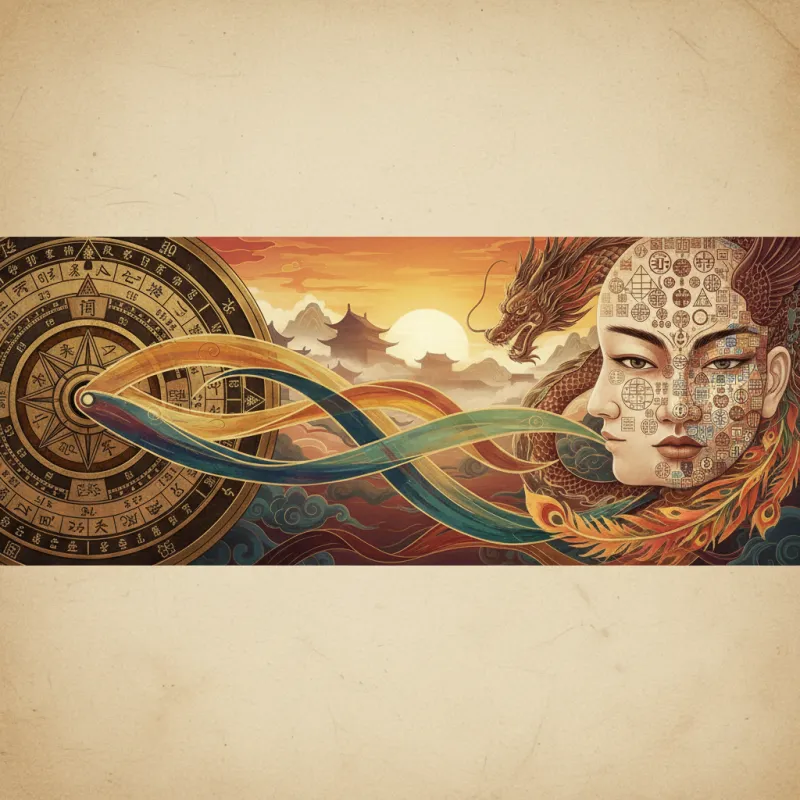
When a Tang Dynasty physiognomist named Yuan Tiangang (袁天罡, Yuán Tiāngāng) first examined the infant Wu Zetian's face in 624 CE, he reportedly gasped and declared that if this child were a boy, they would rule the empire. History proved him right—she became China's only female emperor. This wasn't lucky guessing. Yuan Tiangang was applying a sophisticated system that merged Feng Shui's environmental awareness with the I Ching's pattern recognition, reading faces as living landscapes where destiny reveals itself through bone structure, flesh distribution, and the flow of qi (氣, qì).
The Metaphysical Foundation: Why Faces Are Microcosmic Maps
Face reading—or mian xiang (面相, miàn xiàng)—operates on a principle that sounds mystical but follows rigorous logic within Chinese metaphysics: the human face is a miniature replica of the cosmos itself. Just as Feng Shui practitioners read mountains as dragons and rivers as veins of energy, face readers interpret the forehead as heaven, the chin as earth, and the nose as the central mountain connecting both realms.
The I Ching (易經, Yì Jīng), or Book of Changes, provides the theoretical backbone. Its 64 hexagrams don't just predict fortune—they map the fundamental patterns of transformation in nature. When applied to face reading, these patterns help practitioners understand how a person's features reflect their relationship with the five elements (五行, wǔ xíng): Wood, Fire, Earth, Metal, and Water. A prominent, fleshy nose suggests strong Earth element, indicating reliability and material success. Sharp, angular features point to Metal, suggesting precision but potential rigidity.
This isn't arbitrary symbolism. The same diagnostic principles that Feng Shui uses to assess a building's energy flow apply to facial topography. A balanced face, like a well-designed home, allows qi to circulate smoothly. Blockages—a crooked nose, asymmetrical eyes, harsh lines—indicate where energy stagnates, just as a cramped hallway or misplaced mirror disrupts a room's harmony.
The Thirteen Positions: Reading Life's Timeline on the Face
Classical face reading divides the face into thirteen critical positions (十三部位, shísān bùwèi), each corresponding to a seven-year period of life. This system, refined during the Song Dynasty, treats the face as a biographical map where past, present, and future are simultaneously visible.
The forehead governs ages 15-30, revealing early life circumstances and inherited fortune. A broad, smooth forehead indicates favorable youth and strong family support—what Feng Shui would call good "ancestral qi." The area between the eyebrows, called the Life Palace (命宮, mìng gōng), corresponds to ages 28-29 and reflects one's core vitality and decision-making capacity. When this area is narrow or marked with vertical lines, it suggests obstacles during these crucial years, similar to how a constricted entrance in Feng Shui limits opportunities entering a home.
The nose occupies the central position for ages 41-50, the peak earning years. Its shape, size, and flesh quality directly correlate with wealth accumulation—not because of superstition, but because the nose represents the Earth element's manifestation in the body. In Five Elements theory, Earth governs stability and material resources. A nose that's too small, too sharp, or poorly formed suggests weak Earth element, which manifests as financial instability during middle age.
The chin and jaw govern the later years, ages 60 and beyond. A strong, well-formed chin indicates enduring vitality and comfortable old age, while a receding or weak chin suggests declining energy—the same principle Feng Shui applies when assessing a property's "backing" or support from rear mountains.
I Ching Trigrams and Facial Zones: The Eight Palace System
Advanced practitioners overlay the I Ching's eight trigrams (八卦, bā guà) onto the face, creating what's called the Eight Palace system. Each trigram governs a specific facial region and life domain, connecting face reading directly to the I Ching's cosmological framework.
Qian (乾), the Heaven trigram, rules the upper forehead and represents father, authority, and leadership capacity. A person with a prominent, well-formed upper forehead carries strong Qian energy—they naturally assume leadership roles and command respect. Kun (坤), the Earth trigram, governs the lower face and chin, representing mother, receptivity, and nurturing capacity. Together, these create the fundamental Heaven-Earth axis that runs vertically through every face.
Kan (坎), the Water trigram, rules the ears and relates to wisdom, adaptability, and one's relationship with risk. Large, well-formed ears with thick lobes indicate strong Kan energy—these individuals navigate uncertainty skillfully and often accumulate wealth through calculated risks. Li (離), the Fire trigram, governs the eyes and forehead's middle section, representing clarity, passion, and social recognition. Bright, clear eyes with good spirit (神, shén) show strong Li energy, suggesting success in public-facing careers.
The remaining four trigrams—Zhen (震, Thunder), Xun (巽, Wind), Gen (艮, Mountain), and Dui (兌, Lake)—map to the face's remaining zones, each revealing specific capacities and life challenges. This system transforms face reading from simple feature analysis into a sophisticated diagnostic tool that reads the I Ching's patterns directly from human flesh.
Feng Shui Principles Applied to Facial Landscapes
The most profound connection between Feng Shui and face reading lies in their shared vocabulary of landscape analysis. Both disciplines read topography—one external, one embodied—using identical principles.
In Feng Shui, the ideal site features a protective mountain behind (玄武, xuán wǔ), open space in front (朱雀, zhū què), and gentle hills on both sides (青龍白虎, qīng lóng bái hǔ). The same pattern appears in facial analysis. The forehead serves as the protective mountain, providing backing and ancestral support. The area below the nose—the philtrum and upper lip—should be open and well-defined, like the bright hall (明堂, míng táng) in front of a building where opportunities gather. The cheekbones function as the Azure Dragon and White Tiger, providing lateral support and protection.
When these features are properly proportioned and positioned, qi flows smoothly across the face, just as it would through a well-designed property. A receding forehead offers no backing—like a house built without rear mountain protection, the person faces life without ancestral support or early advantages. Flat, undefined cheekbones provide no lateral containment—energy dissipates sideways, manifesting as difficulty maintaining wealth or relationships.
The concept of sha qi (煞氣, shà qì)—harmful energy in Feng Shui—also applies to faces. Sharp angles, harsh lines, and abrupt transitions create energetic "poison arrows" that disrupt flow. A sharply pointed chin shoots energy downward and outward, preventing accumulation in later life. Deep vertical lines between the eyebrows act like cutting qi, indicating chronic stress and blocked decision-making capacity.
The Five Elements and Facial Morphology
Every face expresses a dominant elemental signature that shapes both appearance and destiny. This isn't metaphor—it's a diagnostic system as precise as understanding facial features through elemental balance.
Wood faces are rectangular with prominent foreheads, strong jaws, and greenish undertones. These individuals embody Wood's expansive, ambitious nature—they're natural entrepreneurs and pioneers but can become rigid when their Wood energy stagnates. Think of a tree: flexible when young, increasingly brittle with age. Wood faces must cultivate Metal element (through discipline and structure) to prune their growth and Fire element (through passion and expression) to channel their drive productively.
Fire faces are pointed or triangular, with sharp features, reddish complexions, and intense eyes. They burn bright but risk burning out. Fire types achieve early success through charisma and intensity but must develop Water element (through reflection and rest) to sustain their flame and Earth element (through grounding practices) to prevent their energy from consuming them.
Earth faces are square and fleshy, with broad features, yellowish undertones, and substantial builds. They're reliable, stable, and materially successful but can become stagnant. Earth types need Wood element (through growth and change) to prevent stagnation and Metal element (through refinement and letting go) to avoid accumulating excess.
Metal faces are oval or round with refined features, pale complexions, and clear definition. They're precise, principled, and aesthetically sensitive but can become cold and isolated. Metal types require Fire element (through warmth and connection) to soften their edges and Water element (through flexibility and flow) to prevent brittleness.
Water faces are round with soft features, dark complexions, and fluid expressions. They're adaptable, intuitive, and emotionally intelligent but can lack direction. Water types need Earth element (through structure and boundaries) to contain their flow and Wood element (through purpose and growth) to channel their potential.
Practical Application: Reading Transformation Through Time
The most sophisticated aspect of combining Feng Shui and I Ching with face reading is understanding that faces change—and these changes reveal how a person navigates their destiny. The I Ching is, after all, the Book of Changes, not the Book of Fixed States.
When someone's forehead develops new lines or their complexion shifts, these aren't merely signs of aging—they're readable transformations indicating how life's pressures are reshaping their energy. A previously smooth Life Palace that develops vertical lines shows increasing stress and blocked decision-making. In Feng Shui terms, the entrance has become obstructed. The remedy isn't cosmetic—it's addressing the underlying energy blockage through lifestyle changes, just as you'd remedy a Feng Shui problem by adjusting the environment.
Similarly, when someone's nose flesh increases during middle age, it indicates growing Earth element and material accumulation. When it thins, it suggests wealth dissipation or health challenges affecting the digestive system (which Earth governs). These observations aren't fortune-telling—they're pattern recognition based on how elemental energies manifest physically.
The most skilled practitioners read faces dynamically, understanding that today's reading reveals current energy patterns, not fixed fate. Just as Feng Shui adjustments can redirect a building's energy flow, conscious cultivation can reshape facial features over time. This is why meditation practitioners often develop smoother foreheads and brighter eyes—they're literally restructuring their energy, which manifests physically.
Beyond Prediction: Face Reading as Self-Cultivation Tool
The ultimate purpose of integrating Feng Shui and I Ching wisdom into face reading isn't predicting the future—it's understanding the present so completely that you can consciously participate in shaping what comes next. Your face reveals your current relationship with the five elements, your energetic blockages, and your developmental trajectory. This information becomes a mirror for self-cultivation.
When you understand that your sharp Metal features make you prone to isolation, you can consciously cultivate Fire element through social connection and creative expression. When you recognize that your weak chin indicates insufficient Earth element for your later years, you can begin building stability and savings now. This is the practical wisdom that made face reading valuable to emperors and merchants alike—not as fortune-telling, but as strategic self-knowledge.
The ancient masters who developed these systems understood something modern psychology is only beginning to grasp: the body and face are not separate from consciousness or destiny. They're the visible manifestation of how energy moves through your life. By learning to read this manifestation through the combined lens of Feng Shui's environmental wisdom and the I Ching's pattern recognition, you gain a diagnostic tool for understanding not just who you are, but who you're becoming—and more importantly, who you might consciously choose to become.
Related Reading
- Face Reading: The Ancient Chinese Art of Judging Character by Appearance
- Chinese Palm Reading: What Your Hands Reveal
- Chinese Numerology: Lucky and Unlucky Numbers
- Chinese Face Reading: What Your Face Reveals
- What Your Face Reveals: Advanced Chinese Face Reading
- The Bagua Map: Your Home's Energy Blueprint
- Harmonizing Life Through Feng Shui, I Ching, and Geomancy: A Cultural Exploration
- Exploring the Interconnections of Feng Shui, I Ching, and Chinese Metaphysics
Explore Chinese Culture
- Explore Daoist philosophy and practice
- Explore traditional Chinese customs
- Explore ancient Chinese cosmology