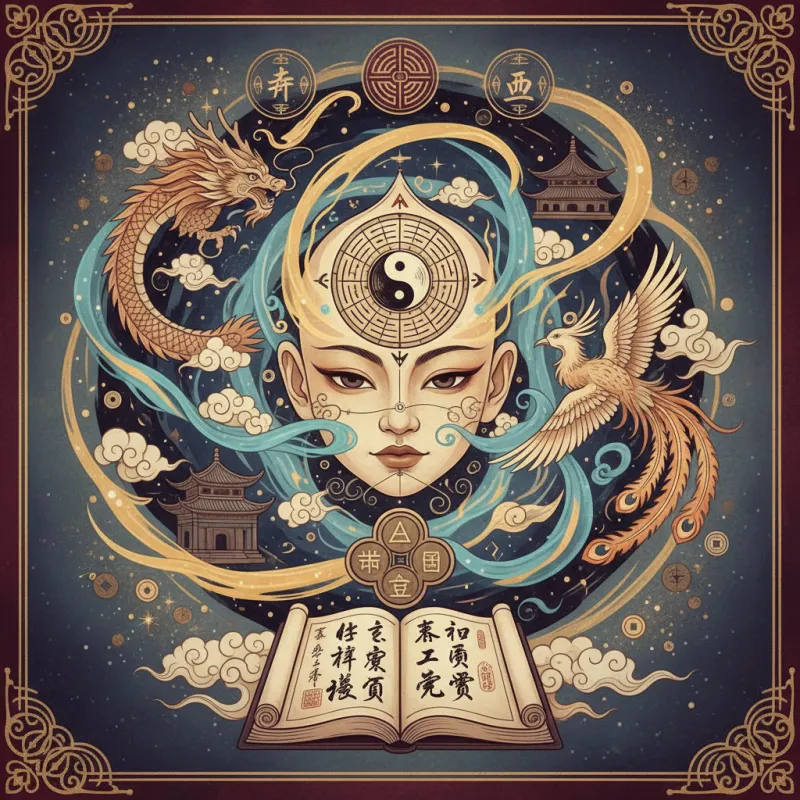
Your grandmother was right — she could tell you were lying just by looking at your face. But what she probably didn't know was that she was practicing a 3,000-year-old diagnostic art that Chinese physicians, strategists, and fortune-tellers have refined into something far more sophisticated than "you look guilty." Advanced face reading (面相 miànxiàng) treats your face like a topographical map where every hill, valley, color shift, and asymmetry broadcasts information about your health, personality, and the specific decade of life you're currently navigating.
The Face as Living Territory
When a feng shui master walks a property, they're not just looking at where the front door is. They're reading elevation changes, water flow, the quality of light, the condition of boundaries. Face reading works the same way. Your face isn't a static mask — it's dynamic terrain that shifts with your qi (气 qì), your emotional weather, your organ health, and your life circumstances.
The Qing dynasty text Shenxiang Quanbian (神相全編, "Complete Compilation of Spiritual Physiognomy") describes the face as having 100 positions, each corresponding to a specific age, life domain, or internal organ. A skilled reader doesn't just glance at your nose and declare "you'll be rich." They examine the mountain root (山根 shāngēn) between your eyebrows for signs of digestive weakness, check the color of your cheekbones for kidney function, and note whether your philtrum (人中 rénzhōng) has deepened or faded compared to last year.
This is why face reading was never just fortune-telling. It was diagnostic medicine. The Huangdi Neijing (黃帝內經, "Yellow Emperor's Inner Canon"), compiled around 100 BCE, explicitly connects facial features to the five organs (五臟 wǔzàng). Redness around the nose? Heart fire. Darkness under the eyes? Kidney depletion. A sudden vertical line between the brows? Liver qi stagnation, probably from suppressed anger.
The Age Map: Reading Your Decade
Here's where face reading gets specific in a way that makes Western physiognomy look like child's play. Your face is divided into age zones, and each zone "activates" during its corresponding life period. The forehead governs ages 15-30. The middle face (eyebrows to nose tip) covers 30-50. The lower face (mouth to chin) represents 50 onward.
But it's more granular than that. The area between your eyebrows, called the Life Palace (命宮 mìnggōng), corresponds to age 28. The tip of your nose represents age 48-50, your prime earning years. Your philtrum shows ages 51-60. When a face reader examines you at age 35, they're not just looking at your whole face — they're focusing on the specific zones that should be "speaking" at your current life stage.
This is why the same feature can mean different things at different ages. A mark on your forehead at 20 suggests early career obstacles. The same mark appearing at 45 wouldn't register in that zone at all — the reader would be examining your nose bridge and cheekbones instead, the territories active during middle age.
The Mayi Xiangfa (麻衣相法, "Hemp-Robed Daoist's Physiognomy Method"), attributed to the Tang dynasty master Chen Tuan, maps this out with precision that would impress a cartographer. Age 19 sits at the top center of your forehead. Age 25 is at your left temple. Age 41 is the left eye corner. This isn't mystical — it's a systematic framework for tracking how life experience literally writes itself onto your face over time.
The Five Mountains and Four Rivers
Traditional face reading divides the face into five mountains (五岳 wǔyuè) and four rivers (四渎 sìdú), borrowing directly from landscape feng shui terminology. Your forehead is Mount Heng (南岳 Nányuè), representing your early fortune and ancestral blessing. Your chin is Mount Heng (北岳 Běiyuè, yes, same name, different character), showing your late-life stability. Your nose is Mount Song (中岳 Zhōngyuè), the central peak that governs your middle years and wealth capacity.
The four rivers are your ears (representing wisdom flow) and eyes (representing emotional and spiritual clarity). A face reader examines whether these mountains are balanced, whether the rivers run clear, whether the central peak rises appropriately from the surrounding terrain.
I once watched a traditional Chinese medicine doctor diagnose a patient's spleen deficiency just by noting that her nose bridge was slightly collapsed and her cheeks had a grayish tint. She hadn't mentioned digestive issues. He prescribed herbs for spleen qi before she even described her symptoms. Two weeks later, her face had literally changed — the bridge lifted slightly, the color warmed. This is what advanced face reading looks like in practice: reading the body's internal landscape through its external topography.
Color Theory: The Five Elements on Your Face
Western face reading might note that someone "looks pale" or "seems flushed." Chinese face reading has a entire color diagnostic system based on the five elements (五行 wǔxíng). Each element has a corresponding color, organ system, and emotional pattern:
Wood (木 mù) shows as green or blue-green, particularly around the temples and eyes. It indicates liver issues, often from anger or frustration. Metal (金 jīn) appears as white or pale gray, especially on the cheeks and nose, signaling lung or large intestine problems, often linked to grief. Water (水 shuǐ) manifests as dark blue or black, typically under the eyes or around the ears, pointing to kidney depletion from fear or overwork. Fire (火 huǒ) is red, most visible on the nose tip, forehead, or cheeks, revealing heart excess from anxiety or overstimulation. Earth (土 tǔ) shows as yellow or sallow, particularly in the central face, indicating spleen-stomach weakness from worry or overthinking.
These aren't metaphors. A skilled reader can look at your face and tell you which organ system is under stress right now, today, based on subtle color shifts you probably haven't noticed yourself. The Shenxiang Quanbian describes 120 different color variations and their meanings. A bright, clear yellow around the nose? Digestive qi is strong. A murky, dark yellow? Spleen dampness, probably from too much rich food or mental rumination.
This connects directly to Chinese medicine diagnosis, where facial observation is one of the four pillars of assessment. Your face is constantly broadcasting your internal state. Most people just don't know the language.
The Twelve Palaces: Mapping Life Domains
Beyond age zones and elemental colors, advanced face reading divides the face into twelve palaces (十二宮 shí'èr gōng), each governing a specific life domain. This is where face reading becomes genuinely predictive — not in a fortune-cookie way, but in reading your constitutional strengths and vulnerabilities.
The Life Palace (命宮 mìnggōng) sits between your eyebrows. A smooth, clear, slightly raised area here suggests strong vitality and smooth life flow. Vertical lines, darkness, or a collapsed bridge indicates obstacles, health challenges, or a tendency toward worry that blocks your path. The Wealth Palace (財帛宮 cáibó gōng) is your nose — its size, shape, straightness, and the flesh quality all reveal your capacity to generate and hold resources. A fleshy, well-formed nose with a rounded tip suggests strong wealth luck. A bony, thin, or crooked nose indicates financial instability or difficulty accumulating.
The Marriage Palace (夫妻宮 fūqī gōng) is located at the outer corners of your eyes, in the area called "fish tails" (魚尾 yúwěi). Smooth, full, and free of lines? Harmonious relationships. Crow's feet, darkness, or moles? Relationship challenges, often from emotional volatility or choosing incompatible partners. The Children Palace (子女宮 zǐnǚ gōng) sits in the area under your eyes, above the cheekbones. Fullness here indicates strong fertility and good relationships with children. Darkness, bags, or hollowness suggests reproductive challenges or difficult parent-child dynamics.
The Career Palace (官祿宮 guānlù gōng) occupies the center of your forehead. A broad, smooth, slightly rounded forehead indicates leadership capacity and career success. A narrow, lined, or uneven forehead suggests career obstacles or difficulty with authority. The Travel Palace (遷移宮 qiānyí gōng) is at your temples. Full, smooth temples indicate beneficial travel and smooth life transitions. Sunken or dark temples suggest travel difficulties or problems when relocating.
Each palace has dozens of specific markers. A mole in the Wealth Palace might indicate money coming through unexpected channels. A scar in the Marriage Palace could point to a significant relationship wound. A vertical line in the Life Palace often appears during periods of intense stress or health crisis — and sometimes fades when the crisis resolves.
Dynamic Reading: Your Face Changes
Here's what separates advanced face reading from the simplified "big ears mean long life" versions: a skilled reader knows your face is constantly changing. The face you have at 25 is not the face you'll have at 45. The face you have when you're healthy is not the face you have when you're depleted. The face you have in a good relationship is not the face you have after a divorce.
I've seen this personally. A friend developed a deep vertical line between her eyebrows during a brutal two-year legal battle. The line appeared within months and deepened as the stress continued. Six months after the case settled, the line had faded by half. Her face literally relaxed back toward its original structure once the liver qi stagnation (that's what the line indicated) resolved.
This is why traditional face readers would examine someone multiple times, in different lighting, at different times of day, even in different seasons. They were reading the dynamic expression of qi, not just fixed bone structure. The Mayi Xiangfa explicitly states that bone structure shows your constitutional foundation (what you're born with), but flesh, color, and lines show your current state and near-future trajectory (what you're doing with what you were given).
This connects to bazi analysis — your birth chart shows your constitutional blueprint, but your face shows how you're actually living that blueprint. Two people with similar bazi charts might have very different faces because they've made different choices, cultivated different habits, experienced different emotional patterns.
Reading Asymmetry: The Left-Right Split
Advanced face reading pays close attention to left-right asymmetry. In Chinese physiognomic theory, the left side of your face (from your perspective) represents your inner world, your private self, your relationship with family and intimate partners. The right side represents your outer world, your public persona, your career and social relationships.
Asymmetry between the two sides reveals internal-external splits. Someone whose left eye is noticeably smaller or more tired than their right might be depleted in their private life while maintaining a strong public front. Someone with more lines or darkness on the right side might be experiencing career stress while their home life remains stable.
The Shenxiang Quanbian describes this as yin-yang balance on the face. Perfect symmetry is rare and not necessarily ideal — some asymmetry shows healthy differentiation between public and private selves. But extreme asymmetry, especially if it develops suddenly, indicates imbalance that needs attention.
Gender also plays a role in traditional interpretation. For men, the left side is considered more important for ages 1-35, the right side for 36-70. For women, it's reversed. This reflects traditional Chinese views about life stages and social roles, though modern readers often adapt these frameworks.
Practical Application: What to Actually Look For
If you want to start reading faces beyond the superficial level, here's what to observe:
Overall balance and proportion. Does the face divide into three roughly equal sections (forehead, mid-face, lower face)? Imbalance suggests life stage challenges — a small forehead indicates difficult early years, a weak chin suggests unstable late life.
The quality of the five mountains. Is the forehead broad and smooth? Is the nose well-formed and proportional? Are the cheekbones visible but not protruding? Is the chin neither too sharp nor too receding? These indicate constitutional strength in different life domains.
Color and luster. Healthy faces have a subtle glow, what Chinese medicine calls "spirit light" (神光 shénguāng). Dullness, grayness, or uneven color indicates qi depletion or organ imbalance. Look for the specific colors of the five elements to identify which system is affected.
Lines and markings. Not all lines are bad — smile lines around the eyes (when genuine) indicate emotional warmth. But vertical lines between the brows, deep nasolabial folds appearing early, or horizontal forehead lines in young people all signal specific patterns of stress or constitutional weakness.
The eyes. Chinese face reading considers the eyes the "windows of the spirit" (神之窗 shén zhī chuāng). Clear, bright eyes with visible white around the iris indicate strong vitality. Dull, clouded, or bloodshot eyes suggest depletion. The shape, size, and spacing of eyes reveal personality patterns and relationship capacity.
Changes over time. This is the most important. A face reader isn't just looking at you once — they're tracking how your face changes with seasons, stress levels, health conditions, and life circumstances. Your face is a living document, constantly being written and rewritten by your choices and experiences.
The goal isn't to judge faces as "good" or "bad." It's to read the information your face is broadcasting about your current state, your constitutional patterns, and the life domains that need attention. Advanced face reading is ultimately a tool for self-knowledge and course correction — seeing yourself clearly so you can make better choices about health, relationships, career, and life direction.
Related Reading
- Discovering the Ancient Wisdom of Feng Shui and I Ching for Effective Face Reading
- Chinese Palm Reading: What Your Hands Reveal
- Face Reading: The Ancient Chinese Art of Judging Character by Appearance
- Chinese Numerology: Lucky and Unlucky Numbers
- Chinese Face Reading: What Your Face Reveals
- Harmonizing Your Kitchen: The Role of Feng Shui and I Ching in Culinary Spaces
- Office Feng Shui: Design for Career Success
- Chinese Numerology: Why 8 Is Lucky, 4 Is Death, and 9 Is Forever
Explore Chinese Culture
- Explore Daoist philosophy and practice
- Explore traditional Chinese customs
- Explore ancient Chinese cosmology