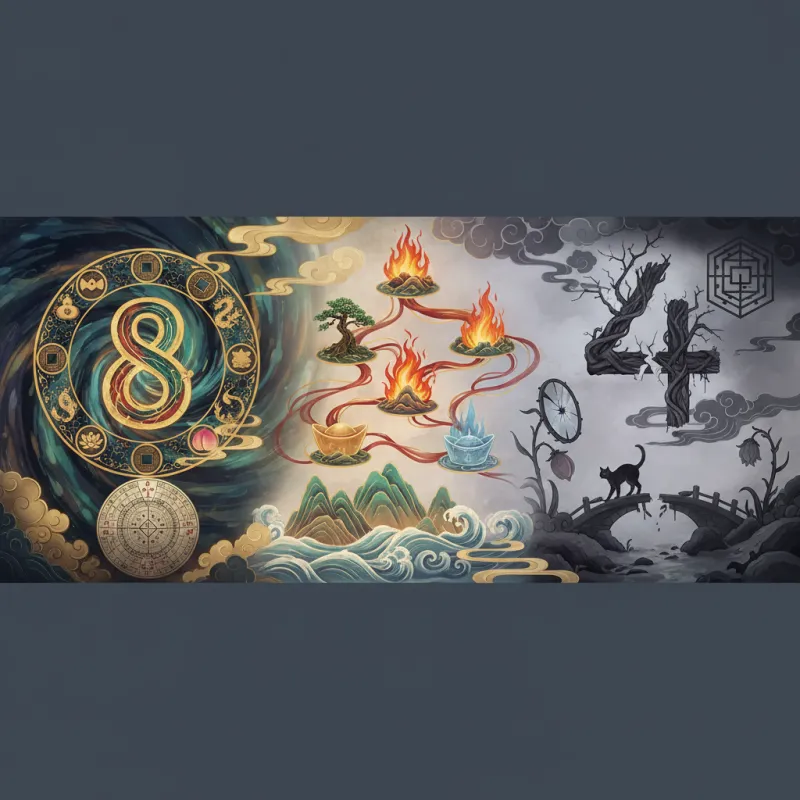
A Beijing businessman once paid $280,000 for a phone number consisting entirely of eights. Not a vanity word, not a memorable pattern — just eights. To Western eyes, this looks like madness. To anyone versed in Chinese numerology (数字命理学 shùzì mìnglǐxué), it's a calculated investment in energetic advantage. Numbers in Chinese culture aren't abstract symbols — they're living forces that carry sound, meaning, and the power to shape fortune itself.
The Phonetic Foundation of Number Power
Chinese numerology operates on a principle that Western mathematics ignores entirely: sound creates meaning, and meaning generates energy. Unlike alphabetic languages where numbers are arbitrary labels, Chinese numbers are homophones — they sound like other words, and this sonic resonance transfers their qualities.
The number 8 (八 bā) sounds nearly identical to 发 (fā), meaning "to prosper" or "to generate wealth." This isn't a loose association — the tonal similarity is so close that when you say "eight" in Mandarin, you're essentially invoking prosperity. The 2008 Beijing Olympics opened on 08/08/08 at 8:08 PM for precisely this reason. The organizers weren't being cute; they were harnessing what they believed to be genuine energetic momentum.
The number 6 (六 liù) resonates with 流 (liú), meaning "flow" or "smooth." In business contexts, 6 represents operations running without friction, deals closing effortlessly, relationships developing naturally. You'll find 6 prominently featured in Chinese business feng shui arrangements, particularly in phone numbers and addresses for companies that depend on smooth transactions.
The number 9 (九 jiǔ) sounds like 久 (jiǔ), meaning "long-lasting" or "eternal." This makes it the supreme number for relationships, marriages, and anything requiring longevity. Traditional Chinese weddings favor dates containing 9, and gift-giving often involves amounts or quantities in multiples of nine to wish enduring happiness.
The Numbers You Avoid at All Costs
The number 4 (四 sì) sounds disturbingly similar to 死 (sǐ) — death. This isn't a subtle resemblance you need a trained ear to catch. Say them out loud, and the phonetic overlap is immediate and unsettling. The cultural aversion to 4 runs so deep that it affects architecture, urban planning, and commerce across Asia.
Many buildings in Hong Kong, Singapore, and mainland Chinese cities have no fourth floor. The elevator buttons jump from 3 to 5, or sometimes use alternative labeling systems. Luxury apartment buildings sometimes skip all floors containing the digit 4 — no 4th, 14th, 24th, 34th, or 40-49th floors. This isn't just about superstitious residents; it's about property values. A unit on the fourth floor can sell for 10-20% less than an identical unit on the fifth floor.
The number 7 (七 qī) occupies ambiguous territory. In Mandarin, it sounds somewhat like 欺 (qī), meaning "to cheat" or "to deceive," giving it negative associations in business contexts. However, 7 also connects to 起 (qǐ), meaning "to rise" or "to begin," which can be positive. During the seventh month of the lunar calendar — Ghost Month — 7 takes on particularly ominous qualities, as this is when the gates of the underworld open and spirits roam the earth.
Compound Numbers and Energetic Combinations
Single digits are just the beginning. Chinese numerology becomes exponentially more complex when numbers combine, creating new meanings through their interactions. This is where the system reveals its sophistication and its connection to deeper metaphysical principles found in I Ching divination and bazi (八字 bāzì) analysis.
The combination 168 (一六八 yī liù bā) is considered supremely auspicious because it sounds like "prosperity all the way" (一路发 yī lù fā). You'll see this number sequence in business names, product pricing, and real estate addresses throughout Chinese communities. A shop selling items for $16.80 or $168 isn't using random pricing — they're embedding fortunate energy into every transaction.
The number 88 doubles the prosperity energy of 8, but 888 or 8888 creates what practitioners call "continuous wealth flow" — prosperity that doesn't just arrive once but keeps regenerating. This is why that license plate sold for $270,000. The buyer wasn't purchasing metal and paint; they were acquiring a mobile prosperity generator that would precede them everywhere they drove.
Conversely, 14 (十四 shí sì) sounds like "certain death" (实死 shí sǐ) and is avoided even more aggressively than 4 alone. The number 24 can sound like "easy to die" (二死 èr sǐ). Buildings that skip the fourth floor often skip the fourteenth and twenty-fourth as well. In some luxury developments, any floor number containing 4 is eliminated entirely.
The number 250 (二百五 èr bǎi wǔ) is an insult in Chinese culture, roughly equivalent to calling someone a fool or half-wit. The origin traces to ancient currency systems where 500 coins made a full string, so 250 represented "half a string" — someone incomplete or deficient. You would never give a gift of 250 yuan or price something at $2.50 in a Chinese context without causing offense.
The Five Elements and Numerical Correspondence
Deeper numerological practice connects numbers to the five elements (五行 wǔxíng) — wood, fire, earth, metal, and water — creating another layer of meaning that intersects with feng shui principles and personal bazi charts. This system, rooted in Han Dynasty cosmology, assigns elemental qualities to numbers based on their energetic characteristics.
Numbers 1 and 2 correspond to wood — growth, expansion, new beginnings. Number 3 and 4 connect to fire — transformation, passion, rapid change (though 4's death association usually overrides its elemental quality in practice). Numbers 5 and 6 belong to earth — stability, nourishment, grounding. Numbers 7 and 8 align with metal — precision, wealth, harvest. Numbers 9 and 0 resonate with water — flow, wisdom, depth.
When selecting numbers for important purposes — business names, phone numbers, addresses, wedding dates — sophisticated practitioners consider both the phonetic associations and the elemental balance. Someone with too much fire in their bazi chart might avoid numbers 3 and 7, instead emphasizing water numbers (9, 0) to create balance. A business requiring steady growth might favor wood numbers (1, 2) combined with earth numbers (5, 6) for nourishment.
This elemental framework explains why number selection isn't one-size-fits-all. The "luckiest" number depends on your personal energetic constitution, your current life phase, and what you're trying to accomplish. A number that brings fortune to one person might create imbalance for another.
Modern Applications and Market Impact
Chinese numerology isn't a relic of ancient superstition — it's a living system that actively shapes modern markets, particularly in real estate, telecommunications, and luxury goods. The economic impact is measurable and substantial.
In Hong Kong's property market, units with auspicious numbers command premium prices while those with unlucky numbers sell at significant discounts. A 2018 study found that apartments on floors containing 8 sold for an average of 3-5% more than comparable units on neutral floors, while units on floors containing 4 sold for 7-10% less. In a market where apartments cost millions, these percentage differences represent hundreds of thousands of dollars.
Telecommunications companies in China, Hong Kong, and Singapore auction premium phone numbers containing lucky digit sequences. Numbers with multiple 8s regularly sell for tens of thousands of dollars. In 2017, a phone number consisting of all 8s sold at auction in Chengdu for 2.25 million yuan (approximately $330,000). The buyer wasn't a collector — they were a business owner who believed the number would generate more value than its purchase price through the opportunities it would attract.
Even Western companies operating in Chinese markets adapt to these principles. When Coca-Cola launched campaigns in China, they priced promotional items at 8.88 yuan. Luxury brands schedule product launches on dates containing 8 or 9. International hotels in Asia often eliminate fourth floors and avoid room numbers containing 4, recognizing that ignoring these preferences means losing customers.
Personal Practice and Selection Strategy
Understanding Chinese numerology intellectually is different from applying it effectively in your own life. The system offers practical frameworks for making decisions about numbers you encounter or select, but it requires discernment rather than rigid rule-following.
When choosing phone numbers, addresses, or important dates, start with the phonetic associations. Favor numbers that sound like positive qualities you want to cultivate — 8 for prosperity, 6 for smooth flow, 9 for longevity. Avoid 4 unless you have specific metaphysical reasons to work with its transformative death-and-rebirth energy (some advanced practitioners deliberately use 4 for endings that need to happen).
Consider compound meanings. The sequence 168 works for business prosperity. The combination 99 or 999 suits relationships and long-term commitments. For personal phone numbers, some practitioners recommend including your birth year or numbers from your bazi chart to create resonance with your individual energetic signature.
Pay attention to context and intention. A number that's auspicious for wealth might not suit a healing practice or spiritual endeavor. The number 7, despite its ambiguous reputation, connects strongly to spiritual seeking and inner development — making it potentially valuable for meditation spaces or contemplative work, even if you'd avoid it in business contexts.
Balance phonetic associations with elemental considerations if you know your bazi chart. Someone with excess metal energy might benefit from water numbers (9, 0) even if they're not traditionally considered the "luckiest." The goal isn't to chase universal lucky numbers but to find numbers that create harmony with your specific energetic constitution and current needs.
The Skeptic's Question and the Practitioner's Answer
Does any of this actually work, or is it elaborate confirmation bias dressed in cultural tradition? The honest answer is: it depends on what you mean by "work."
If you're asking whether the number 8 contains objective, measurable prosperity energy that a laboratory could detect, the answer is probably no. But if you're asking whether believing in and acting on these principles creates real-world effects, the answer is demonstrably yes.
When you choose a phone number with 8s because you believe it will attract prosperity, you're more likely to use that number confidently in business contexts, to follow up on opportunities, to project success. This isn't delusion — it's applied psychology through cultural framework. The number becomes a constant reminder of your intention, a trigger for prosperity-oriented thinking and behavior.
Similarly, avoiding 4 isn't just about superstition. In markets where most people avoid 4, choosing it means accepting a property or phone number that will be harder to sell later, that will make some clients uncomfortable, that carries negative associations for a large percentage of your potential network. The "bad luck" becomes self-fulfilling through market dynamics and social perception.
Chinese numerology works the way all symbolic systems work — by organizing attention, shaping behavior, and creating shared meaning within a cultural context. Whether the numbers themselves contain inherent energy or whether the energy comes from collective belief and individual psychology is, in practical terms, irrelevant. The effects are real either way.
What matters is understanding the system well enough to use it intentionally rather than being unconsciously influenced by it. Know why 8 is considered lucky, recognize when you're paying a premium for auspicious numbers, understand the cultural logic behind building layouts that skip the fourth floor. Then decide consciously whether to participate in these practices or not — but make that decision from knowledge rather than ignorance.
Related Reading
- Chinese Palm Reading: What Your Hands Reveal
- Discovering the Ancient Wisdom of Feng Shui and I Ching for Effective Face Reading
- Chinese Face Reading: What Your Face Reveals
- Face Reading: The Ancient Chinese Art of Judging Character by Appearance
- What Your Face Reveals: Advanced Chinese Face Reading
- The Wood Element: Growth, Creativity, and Spring
- Chinese Zodiac Compatibility: Who Gets Along and Who Doesn't
- Water Feng Shui for Wealth: Fountains, Aquariums, and Flow
Explore Chinese Culture
- Explore Daoist philosophy and practice
- Explore traditional Chinese customs
- Explore ancient Chinese cosmology