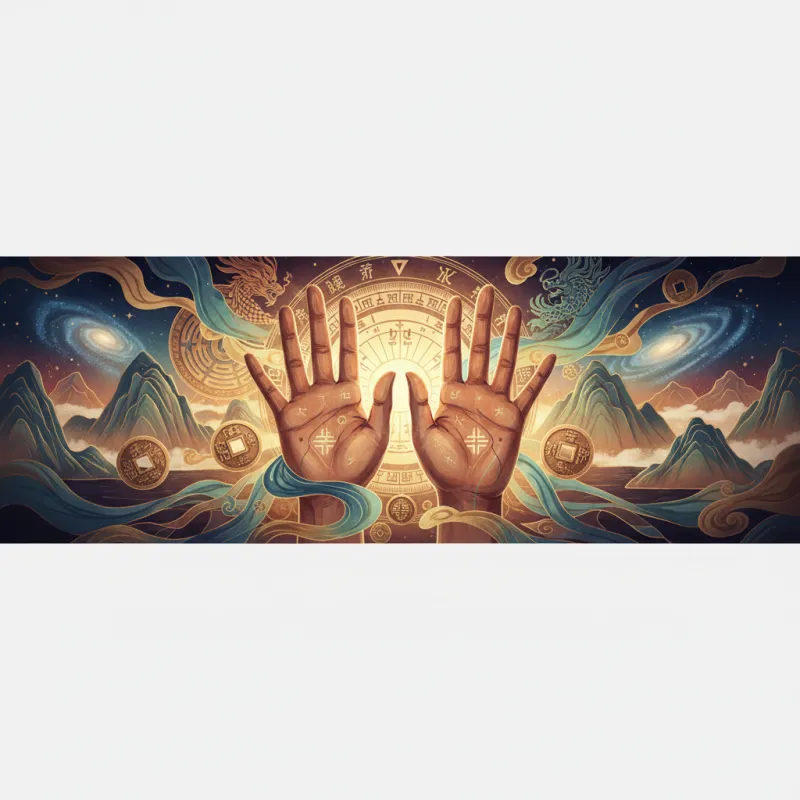
Your grandmother extends her hand across the dim sum table, and without asking, the elderly woman seated beside her glances down and says, "Ah, wood hand — you've worked hard your whole life, haven't you?" Your grandmother nods, surprised. The woman hasn't asked about her career, her childhood, or her struggles. She simply looked at the shape, the texture, the proportion of palm to fingers. This is 手相 (shǒuxiàng) — Chinese palm reading — and it begins not with lines, but with the hand itself as a living map of your constitutional qi.
The Five Element Hand Types: Your Constitutional Blueprint
Before a Chinese palm reader examines a single line, they classify your hand according to the five elements (五行 wǔxíng): wood, fire, earth, metal, and water. This isn't metaphorical. The shape of your hand — its proportions, texture, flexibility, and temperature — reveals which element dominates your constitution, and therefore how qi moves through your body, how you process emotion, and where your vitality concentrates or depletes across your lifetime.
Wood hands (木手 mùshǒu) are long and rectangular, with prominent knuckles and veins. The palm is firm but not rigid, the fingers straight and well-defined. People with wood hands tend toward ambition, growth-oriented thinking, and a certain inflexibility when stressed. Their qi rises easily — they're prone to anger, liver stagnation, and tension headaches. But they're also resilient, capable of sustained effort, and naturally drawn to leadership roles. The wood hand works hard and expects results.
Fire hands (火手 huǒshǒu) are shorter than wood hands, with a square or slightly rectangular palm and fingers shorter than the palm length. The skin often appears flushed or warm to the touch. Fire hand people are energetic, charismatic, and impulsive. Their qi burns hot and fast — they're passionate in relationships, quick to enthusiasm, but equally quick to burnout. They need to guard against heart issues, insomnia, and the tendency to scatter their energy across too many projects. The fire hand ignites easily but must learn to sustain the flame.
Earth hands (土手 tǔshǒu) are square and solid, with thick palms and short, sturdy fingers. The skin texture is often coarse or rough. These are the hands of builders, caretakers, and people who value stability above novelty. Earth hand people have steady, grounded qi — they're reliable, practical, and resistant to change. Their challenge is stagnation: too much earth energy creates stubbornness, digestive issues, and a tendency to hold onto relationships or situations long past their expiration date. The earth hand endures, sometimes to its own detriment.
Metal hands (金手 jīnshǒu) are square like earth hands, but with longer, more elegant fingers and pale, refined skin. The palm is firm and cool to the touch. Metal hand people are precise, analytical, and drawn to beauty and order. Their qi is contracting and refining — they're excellent at editing, organizing, and seeing patterns others miss. But metal energy can become too sharp: these individuals may struggle with grief, lung issues, and a critical inner voice that never rests. The metal hand cuts through confusion but must avoid cutting too deep.
Water hands (水手 shuǐshǒu) are long and narrow, with a rectangular palm and long, tapering fingers. The skin is soft, often cool and slightly moist. Water hand people are intuitive, adaptable, and emotionally sensitive. Their qi flows and shifts — they're natural empaths, drawn to healing work, but vulnerable to anxiety, kidney weakness, and the tendency to absorb others' emotional states. The water hand feels everything, which is both its gift and its burden.
Understanding your element hand type is the foundation of Chinese palm reading. The lines tell you what is happening in your life; the hand type tells you why it's happening that way. A heart line that shows emotional intensity means something different on a fire hand (passion that burns out) than on a water hand (depth that overwhelms) or an earth hand (loyalty that becomes possessiveness).
The Three Major Lines: Heaven, Earth, and Human
Chinese palm reading recognizes three primary lines, each corresponding to one of the 三才 (sāncái) — the three powers that govern existence: heaven, earth, and humanity.
The heaven line (天纹 tiānwén), known in Western palmistry as the heart line, runs horizontally across the upper palm beneath the fingers. It reveals your emotional constitution, your capacity for connection, and the quality of your 心气 (xīnqì) — heart qi. A deep, clear heaven line suggests strong emotional vitality and the ability to form lasting bonds. A faint or broken heaven line indicates emotional vulnerability, difficulty trusting, or a tendency to guard the heart. When the heaven line curves upward toward the index finger, it shows idealism in love; when it runs straight across, it suggests a more pragmatic approach to relationships.
The earth line (地纹 dìwén), or life line in Western terms, curves around the base of the thumb, encircling the mount of Venus. Despite popular belief, this line doesn't predict lifespan — it maps your physical vitality, your connection to your body, and the strength of your 元气 (yuánqì) — original qi inherited from your parents. A wide, sweeping earth line indicates robust physical energy and strong constitutional health. A line that hugs close to the thumb suggests more delicate health or a tendency to conserve energy. Breaks or islands in the earth line mark periods of physical depletion or illness, not death, but times when your body's resources are strained.
The human line (人纹 rénwén), called the head line in Western palmistry, runs horizontally across the middle of the palm. It reveals your mental constitution, your thinking style, and the quality of your 神 (shén) — spirit or consciousness. A straight human line indicates logical, linear thinking; a curved line suggests intuitive, creative mental processes. The length matters: a short human line shows focused, practical thinking; a long line that extends across the entire palm indicates complex, philosophical mental activity. When the human line and heaven line are joined at their starting point, it suggests someone whose emotions and thoughts are deeply intertwined — they can't separate feeling from thinking, which creates both empathy and anxiety.
These three lines form the basic framework. But Chinese palm reading goes deeper, examining secondary lines, mounts, and specific markers that reveal constitutional patterns Western palmistry often misses.
The Marriage Lines and Relationship Patterns
The 婚姻线 (hūnyīnxiàn) — marriage lines — appear as short horizontal lines on the outer edge of the palm, between the base of the little finger and the heart line. Western palmistry counts these lines to predict the number of marriages or significant relationships. Chinese palm reading interprets them differently: they reveal your constitutional approach to intimate partnership and the quality of qi exchange in close relationships.
Multiple faint marriage lines suggest someone who forms many connections but struggles to deepen them — their relationship qi disperses rather than concentrates. A single deep marriage line indicates the capacity for profound, sustained intimacy with one person. When the marriage line curves upward toward the little finger, it shows optimism and growth in partnership; when it curves downward, it suggests relationships that drain rather than nourish.
The most telling feature is where the marriage line intersects with other lines. If it crosses the sun line (太阳线 tàiyángxiàn), which runs vertically beneath the ring finger, marriage brings public recognition or career advancement. If it intersects the fate line (命运线 mìngyùnxiàn), which runs vertically up the center of the palm, partnership becomes central to your life's trajectory. These aren't predictions — they're constitutional patterns showing how your qi naturally organizes around relationship.
The Health Markers: Reading Constitutional Vulnerabilities
Chinese palm reading excels at identifying constitutional health patterns long before symptoms appear. This aligns with the preventive focus of Chinese medicine: if you can see where qi is likely to stagnate or deplete, you can adjust your lifestyle before illness manifests.
The liver line (肝线 gānxiàn) appears as a short vertical line between the ring and middle fingers. When present and deeply marked, it indicates liver qi stagnation — the person is prone to anger, frustration, tension headaches, and menstrual irregularities in women. This isn't a disease diagnosis; it's a constitutional tendency. Someone with a prominent liver line needs to prioritize stress management, avoid excessive alcohol, and practice qi-moving exercises like tai chi or brisk walking.
The stomach line (胃线 wèixiàn) runs diagonally from the base of the thumb toward the center of the palm. A pronounced stomach line suggests digestive sensitivity and a tendency toward worry. These individuals often have earth element imbalances — they overthink, hold tension in the abdomen, and may develop digestive issues when stressed. The prescription is simple: regular meals, warm foods, and practices that calm the mind.
Islands (岛纹 dǎowén) — small oval formations within lines — mark periods of qi depletion or stagnation. An island in the earth line indicates a time of physical weakness or illness. An island in the heaven line suggests emotional crisis or heartbreak. An island in the human line marks mental stress, anxiety, or a period of confusion. These aren't permanent conditions; they're constitutional vulnerabilities during specific life phases.
The texture and color of the palm itself reveals current qi status. A palm that's too red indicates excess heat — inflammation, stress, or overwork. A pale palm suggests qi deficiency — fatigue, poor circulation, or blood deficiency. A yellowish tint points to dampness accumulation, often related to digestive weakness or lymphatic stagnation. A skilled practitioner reads these signs instantly, the way a mechanic hears an engine problem before opening the hood.
The Fate Line and Life Trajectory
The 命运线 (mìngyùnxiàn) — fate line — is perhaps the most misunderstood feature in palm reading. Western palmistry treats it as a predictor of career success or life purpose. Chinese palm reading sees it as a map of how your constitutional qi organizes around external structure and direction.
Not everyone has a fate line. Its absence doesn't indicate a lack of purpose or success — it suggests someone whose life path is self-directed rather than shaped by external circumstances or social structures. People without fate lines are often entrepreneurs, artists, or individuals who create their own frameworks rather than working within existing systems.
When present, the fate line runs vertically up the center of the palm, from the wrist toward the middle finger. A fate line that starts at the wrist and runs clear and deep to the base of the middle finger indicates someone whose life path is established early and followed consistently. These individuals often enter family businesses, pursue traditional career paths, or find their direction young and stick with it.
A fate line that begins higher in the palm, starting in the middle rather than at the wrist, suggests a life path that clarifies later — often after a period of exploration or uncertainty. This is common in people who change careers mid-life or discover their true calling after years of searching.
When the fate line intersects the human line (head line), it marks a period when mental clarity or a significant decision shapes life direction. When it intersects the heaven line (heart line), emotional relationships or matters of the heart redirect the life path. These intersection points aren't random — they show how different aspects of your constitutional qi interact to create turning points.
Comparing Hands: The Past and Future Self
One of the most sophisticated aspects of Chinese palm reading is the practice of comparing both hands. The non-dominant hand (left for right-handed people, right for left-handed people) represents your inherited constitution — the qi patterns you were born with, your original nature. The dominant hand shows your current constitution — how life experience, choices, and cultivation have shaped your qi over time.
Significant differences between hands reveal personal evolution. If your non-dominant hand shows a faint earth line but your dominant hand shows a strong, clear earth line, you've strengthened your physical constitution through cultivation — perhaps through qigong practice, improved diet, or lifestyle changes. If the pattern reverses — a strong earth line in the non-dominant hand but a weakened line in the dominant hand — it suggests constitutional depletion, often from overwork, chronic stress, or neglect of physical health.
The same principle applies to all lines and features. A heaven line that deepens from non-dominant to dominant hand shows emotional maturation and increased capacity for intimacy. A human line that becomes clearer indicates mental development and refined thinking. Changes in hand shape are rare but possible: a fire hand that develops more earth qualities through years of steady practice, or a water hand that gains metal characteristics through disciplined study.
This comparative reading aligns with the Daoist principle of 修炼 (xiūliàn) — cultivation or refinement. Your constitution isn't fixed. Through conscious practice, you can shift your qi patterns, strengthen weak areas, and balance excess. Your hands record this transformation. They're not just a map of who you are — they're a map of who you're becoming.
The Practical Application: What to Do With This Information
Chinese palm reading isn't fortune-telling — it's constitutional assessment. The question isn't "What will happen to me?" but rather "Given my constitutional patterns, how should I live to maintain balance and vitality?"
If you have a fire hand with a prominent liver line, you know you're prone to burning hot and fast, with a tendency toward anger and liver qi stagnation. The prescription: regular physical activity to move qi, practices that calm the mind like meditation or face reading techniques that increase self-awareness, and careful attention to work-life balance. You need to build in recovery time, or your constitution will force it through illness or burnout.
If you have a water hand with islands in the heaven line, you're constitutionally sensitive to emotional overwhelm and prone to absorbing others' feelings. The prescription: strong boundaries, regular solitude to discharge accumulated emotional qi, and practices that ground and stabilize like understanding your bazi chart to know when you're in vulnerable periods. You need to protect your emotional energy the way others protect their physical energy.
If you have an earth hand with a weak fate line, you're constitutionally stable and reliable but may struggle with direction or purpose. The prescription: structured exploration, working with mentors or frameworks that provide external guidance, and patience with your own process. Your strength is endurance, not speed — you need time to find your path, but once you do, you'll follow it with remarkable consistency.
The beauty of Chinese palm reading is its integration with the broader system of Chinese metaphysics. Your hand type correlates with your five element constitution, which influences everything from your ideal career to your compatible relationship partners to your vulnerable health patterns. It's not isolated information — it's part of a comprehensive map of your constitutional nature.
Your hands change as you change. The lines deepen or fade, new lines appear, old lines shift. Every few years, look again. Notice what's different. Your hands are telling you a story about how your qi is moving, where it's blocked, where it's flowing freely. Listen to them. They know things about you that your conscious mind hasn't yet recognized.
Related Reading
- Chinese Face Reading: What Your Face Reveals
- Chinese Numerology: Lucky and Unlucky Numbers
- Face Reading: The Ancient Chinese Art of Judging Character by Appearance
- What Your Face Reveals: Advanced Chinese Face Reading
- Discovering the Ancient Wisdom of Feng Shui and I Ching for Effective Face Reading
- Bedroom Feng Shui for Better Sleep
- Unlocking the Secrets of Feng Shui: Water Features in Chinese Metaphysics
- How to Choose a Burial Site
Explore Chinese Culture
- Explore Daoist philosophy and practice
- Explore traditional Chinese customs
- Explore ancient Chinese cosmology