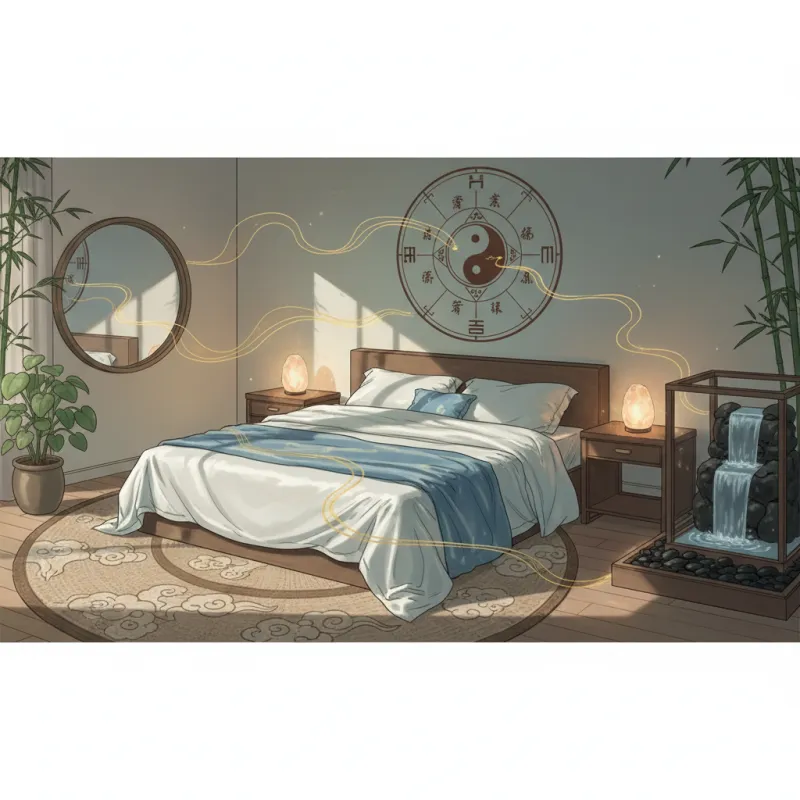
You wake up exhausted even after eight hours of sleep. Your mind races the moment your head hits the pillow. You're cold all night despite blankets, or you wake up sweating. Before you blame stress or your mattress, look at where your bed is pointing.
There's a reason feng shui masters spend more time analyzing bedrooms than any other room. You're unconscious in there for roughly eight hours a night. Your defenses are down. Whatever energy surrounds you during sleep seeps in without resistance.
The Chinese term for this is 受气 (Shòu Qì) — literally "receiving qi." When you're awake, you're actively engaging with energy, directing it, responding to it. When you sleep, you're passive. You absorb whatever's there. This is why bedroom feng shui isn't about decoration — it's about creating an environment where the energy you absorb actually helps you.
I spent years watching people rearrange their bedrooms based on generic advice — "put your bed here, hang a mirror there" — without understanding why. The ones who actually improved their sleep weren't following rules. They were reading the energy patterns in their specific room and responding to them. That's what this article teaches you to do.
The Command Position Isn't What You Think
Every feng shui article tells you to put your bed in the "command position" — diagonal from the door, headboard against a solid wall, able to see the entrance without being directly in line with it. That's correct, but incomplete.
The command position comes from military strategy during the Warring States period (475-221 BCE). Generals positioned their sleeping quarters where they could see approaching threats while remaining protected from direct attack. The principle is 藏风聚气 (Cáng Fēng Jù Qì) — "hide from wind, gather qi." You want to be sheltered but aware.
But here's what most people miss: the command position only works if the qi entering your room is beneficial. If your bedroom door opens to a long, narrow hallway, you're in the direct path of 冲煞 (Chōng Shà) — rushing, aggressive energy. No amount of diagonal positioning fixes that. You need to slow that energy down first.
I learned this from a practitioner in Hangzhou who worked with a client suffering from chronic insomnia. The bed was perfectly positioned according to standard command position rules. But the bedroom door opened directly across from the bathroom door, creating a straight line of draining energy. They moved the bed to what technically wasn't the ideal command position, but it broke the alignment with the bathroom. The client slept through the night for the first time in months.
The real principle: your bed should be positioned where you feel instinctively safe and where the energy in the room naturally settles, not rushes. Sometimes that's the textbook command position. Sometimes it's not.
Your Bed Direction Affects Which Organs Regenerate
Traditional feng shui texts, particularly the 阳宅三要 (Yáng Zhái Sān Yào) — "Three Essentials of Yang Dwellings" written during the Ming Dynasty — specify that the direction your head points while sleeping influences which organ systems receive the most qi during rest.
This isn't mystical. It's based on the Earth's magnetic field and how your body aligns with it. Modern studies on magnetic field therapy have found that north-south alignment affects melatonin production and REM sleep cycles, though Western science is still catching up to what Chinese medicine has observed for centuries.
North (子 Zǐ): Head pointing north aligns you with the Earth's magnetic flow. This direction is associated with the Water element and the Kidneys in Chinese medicine. If you're dealing with anxiety, insomnia from an overactive mind, or night sweats, north can be grounding. But if you're already low energy or prone to depression, north might make you feel heavier.
South (午 Wǔ): This is Fire element territory, associated with the Heart. Sleeping with your head to the south can increase circulation and warmth, but it can also make you restless if you're already a hot sleeper or dealing with high blood pressure. I've seen people with cold constitutions transform their sleep by switching to south, and I've seen anxious people make their insomnia worse with the same change.
East (卯 Mǎo): The direction of rising sun and Wood element, connected to the Liver. East is generally considered the best direction for growth, recovery, and children. If you're recovering from illness or trying to build energy, east supports that. It's the direction of spring — new beginnings, fresh qi.
West (酉 Yǒu): Metal element, associated with the Lungs. West is the direction of completion, harvest, settling. It's often recommended for older people or those who need help winding down. If you have trouble transitioning from day to night, west can help. But for young people or those trying to build momentum in life, west can feel stagnant.
The intermediate directions (northeast, southeast, southwest, northwest) combine these qualities and relate to specific trigrams in the 八卦 (Bā Guà) system, but that's a deeper layer most people don't need to worry about initially.
Here's the practical approach: if you're sleeping poorly, try a different direction for two weeks. Your body will tell you if it's right. One client in Beijing switched from west to east and said it felt like "waking up before the alarm became possible again." Another switched from south to north and finally stopped waking up at 3 AM with racing thoughts.
The Five Elements in Your Bedroom Aren't Balanced — They're Competing
Most feng shui advice tells you to "balance the five elements" in your bedroom. That's not how the 五行 (Wǔ Xíng) system actually works. The five elements aren't meant to be equal. They're meant to be in productive relationship.
The five elements cycle through each other in two patterns: the 生 (Shēng) cycle where each element generates the next (Wood feeds Fire, Fire creates Earth, Earth bears Metal, Metal collects Water, Water nourishes Wood), and the 克 (Kè) cycle where each element controls another (Wood parts Earth, Earth dams Water, Water quenches Fire, Fire melts Metal, Metal chops Wood).
Your bedroom should emphasize the elements that support sleep, not display all five equally. Sleep is a Water and Earth activity — it's about settling, sinking, releasing. You want to support those elements and gently control the ones that activate you.
Too much Wood (green colors, vertical lines, plants, wooden furniture): Wood energy rises and expands. It's morning energy. A bedroom dominated by Wood element keeps you in growth mode when you should be in rest mode. I've seen bedrooms that looked like indoor gardens — beautiful, but the occupants couldn't sleep past 5 AM. Their bodies were responding to all that rising Wood qi.
Too much Fire (red colors, triangular shapes, electronics, bright lights): Fire is pure yang — active, hot, ascending. A bedroom with red walls, multiple screens, and bright lighting is basically telling your nervous system to stay alert. One client had chronic insomnia and a bedroom with red accent walls, a large TV, and three lamps with red shades. We didn't "balance" the Fire. We removed most of it. She was asleep within twenty minutes of lying down for the first time in years.
Too much Metal (white/gray colors, metal furniture, circular shapes): Metal energy is contracting and sharp. A bedroom that's all white with metal bed frames and furniture can feel cold and unwelcoming. Metal cuts Wood, which means it can suppress the gentle growth and renewal that should happen during sleep. But a little Metal is useful — it helps contain and define the space.
Earth and Water should dominate your bedroom. Earth (browns, yellows, square shapes, ceramics, low furniture) provides stability and grounding. Water (blacks, blues, wavy shapes, actual water features if done carefully) provides the deep, quiet, downward energy that sleep requires.
The mistake people make is thinking they need a plant (Wood), a candle (Fire), a metal frame (Metal), earth-tone bedding (Earth), and a water fountain (Water) all in one room. That's not balance. That's chaos. Your bedroom should be primarily Earth and Water with just enough Metal to provide structure and minimal Wood and Fire.
Mirrors in Bedrooms Are Dangerous — But Not for the Reason You Think
Every feng shui guide warns against mirrors in bedrooms. The usual explanation is that mirrors are too yang, too active, or that they'll reflect your spirit while you sleep and disturb it. That's the folk version. The actual mechanism is more interesting.
Mirrors don't just reflect light — they reflect and multiply qi. In feng shui theory, a mirror creates a 虚空间 (Xū Kōngjiān) — a "false space." Your subconscious mind registers this false space as real, which means you're never fully at rest. Part of your awareness is tracking that doubled space, even while you sleep.
The 八宅明镜 (Bā Zhái Míng Jìng), an 18th-century feng shui text, specifically warns against mirrors that reflect the bed, saying they create 阴阳失调 (Yīn Yáng Shī Tiáo) — yin-yang imbalance. When you're sleeping, you're in a yin state. A mirror reflecting you creates a false yang presence, like someone watching you. Your nervous system never fully relaxes.
I worked with a couple who kept waking up at the same time every night — 2:47 AM, like clockwork. Their bedroom had a large mirror on the closet door directly across from the bed. We covered it with a curtain. The nighttime waking stopped within three days. They didn't believe it would work, but their bodies responded immediately to the removal of that false space.
The exception: mirrors that don't reflect the bed are generally fine. A mirror on the inside of a closet door that you only see when the door is open, or a small mirror on a dresser that doesn't catch the bed's reflection, won't cause problems. The issue is specifically about mirrors that reflect you while you're sleeping.
If you absolutely must have a mirror in your bedroom (small apartments sometimes require it), cover it at night. A cloth draped over it is enough. Your subconscious needs to know that false space is closed.
Electronics Are Stealing Your Sleep — But Not Because of EMFs
Yes, electromagnetic fields from electronics can disrupt sleep. But the bigger issue in feng shui terms is that electronics are concentrated 火气 (Huǒ Qì) — Fire qi. They're active, hot, and yang even when turned off.
Think about what electronics do: they process, transmit, calculate, display. All of that is Fire element activity. A bedroom full of electronics is a bedroom full of Fire qi, which directly opposes the Water and Earth qi you need for deep sleep.
The 宅经 (Zhái Jīng), one of the oldest feng shui texts dating to the Han Dynasty, talks about keeping "active objects" out of sleeping spaces. They didn't have smartphones in 200 CE, but they understood that objects associated with work, communication, and mental activity don't belong where you rest.
Here's what I tell people: your bedroom should have nothing that requires electricity except maybe a simple lamp. No TV. No computer. No phone charging on the nightstand. Definitely no exercise equipment (that's yang activity in a yin space).
One client was a tech executive who slept with his phone, tablet, and laptop all within arm's reach of his bed. He wore a fitness tracker, had a smart speaker, and kept his TV on for "background noise." He was sleeping four hours a night and wondered why. We removed everything electronic except a simple alarm clock. He fought me on it — "I need to be reachable" — but agreed to try it for one week. By day three, he was sleeping six hours. By week two, he was sleeping seven and a half. He stopped wearing the fitness tracker to bed when he realized it was tracking terrible sleep that improved the moment he took it off.
If you must have your phone in the bedroom, keep it across the room, not on your nightstand. Better yet, keep it outside the bedroom entirely. Your sleep is more important than being immediately available to every notification.
The Bed Itself Matters More Than Where You Put It
You can have perfect bed placement and still sleep terribly if the bed itself is wrong. Feng shui isn't just about position — it's about the objects themselves and what qi they carry.
Bed height: Your bed should be high enough that qi can flow underneath it, but not so high that you feel ungrounded. The traditional measurement is about 18-24 inches from floor to mattress top. Too low (mattress on the floor) and you're sleeping in stagnant qi that settles at ground level. Too high (some modern platform beds) and you lack Earth element grounding.
I've seen people with anxiety sleep on very low beds thinking it would make them feel more grounded. It did the opposite. They were sleeping in the heaviest, most stagnant layer of qi in the room. Raising the bed 20 inches made them feel more secure, not less.
Under-bed storage: This is controversial in feng shui. Some practitioners say never store anything under the bed. I'm more nuanced about it. The issue isn't storage itself — it's what you're storing and how.
Storing clean linens, out-of-season clothes, or soft items under the bed is generally fine. These items don't carry strong qi and don't block flow significantly. Storing old papers, broken items, exercise equipment, or anything associated with work or stress is terrible. You're literally sleeping on top of that energy.
One client stored old tax documents and work files under her bed. She had nightmares about work every night. We moved those boxes to a closet in another room. The nightmares stopped. She thought I was crazy until it worked.
Bed frame material: Wood is ideal — it's alive, it breathes, it has natural qi. Metal frames can work but they're colder, more contracting. Avoid metal frames if you're already a cold sleeper or prone to feeling isolated. Upholstered frames are fine but make sure they're not trapping dust and stagnant qi in the fabric.
Mattress age and history: This is where feng shui gets uncomfortable. Your mattress absorbs your qi — your emotions, your health, your relationship energy if you share the bed. A mattress that's been through a divorce, a long illness, or years of terrible sleep carries that imprint.
The traditional recommendation is to replace your mattress every seven to eight years. That's not just about physical wear — it's about energetic accumulation. If you've been through major life changes (divorce, death of a partner, serious illness), consider replacing the mattress even if it's relatively new. You're trying to sleep on top of all that absorbed energy.
I know someone who bought a used mattress from an estate sale. Great deal, barely used. She started having nightmares and waking up with unexplained sadness. Turned out the previous owner had died in hospice care at home. The mattress had absorbed months of illness and dying energy. She replaced it and the nightmares stopped immediately.
What Actually Works: The Bedroom Audit
Here's how to audit your bedroom's feng shui for sleep without getting lost in theory:
Stand in your doorway. What's the first thing you see? If it's clutter, electronics, or anything associated with work or stress, that's what your subconscious associates with this room. The first thing you should see is something restful — your bed with calming colors, a piece of art that makes you feel peaceful, nothing.
Lie in your bed. What do you see from sleeping position? Clutter on top of dressers? Piles of clothes? Electronics with little lights? Your ceiling should be clear (no beams directly overhead, no sloped ceilings pressing down). Your sightlines should be calm.
Check your bed position. Can you see the door without being directly in line with it? Is your headboard against a solid wall? Are you under a window? (Windows behind the bed create instability — you're not fully protected.) Are you between the door and a window? (This creates a qi highway that flows right over you.)
Count your electronics. How many devices are in your bedroom? Each one is a source of Fire qi. Aim for zero or as close to zero as possible.
Assess your colors. Is your bedroom dominated by Earth and Water tones (browns, beiges, soft blues, grays, blacks) or by Fire and Wood tones (reds, bright greens, oranges)? Your walls, bedding, curtains, and furniture should create a predominantly Earth-Water environment.
Look at your mirrors. Do any of them reflect your bed? Cover them or remove them.
Check under your bed. What's stored there? Is qi able to flow freely underneath?
Evaluate your window treatments. Can you make the room completely dark at night? Light pollution is a feng shui issue — it's Fire element (light) invading a space that should be Water element (dark, quiet, still). Heavy curtains or blackout shades aren't just practical — they're energetically necessary.
Notice the temperature. Is your bedroom cooler than the rest of your home? It should be. Heat is yang and activating. Cool (not cold) is yin and settling. The ideal sleeping temperature in feng shui terms is around 65-68°F (18-20°C).
Pay attention to smell. Stale air carries stagnant qi. Your bedroom should smell fresh. Open windows regularly, even in winter. Moving air carries fresh qi. Stagnant air accumulates whatever energy has been sitting in the room.
The Real Test: How You Feel
Feng shui isn't about following rules perfectly. It's about creating an environment where your body can do what it's designed to do — rest, repair, regenerate. The real test of your bedroom's feng shui is simple: do you sleep well?
Not "do you eventually fall asleep after an hour of tossing." Do you fall asleep within 20-30 minutes of lying down? Do you sleep through the night or wake up once at most? Do you wake up feeling rested, not like you've been fighting something all night?
If the answer is no, something in your bedroom's energy is working against you. Start with the basics: bed position, remove electronics, cover mirrors, clear clutter. Make one change at a time and give it at least a week. Your body needs time to adjust to new energy patterns.
The bedroom feng shui principles I've outlined here aren't about superstition. They're about understanding how your environment affects your nervous system, your subconscious mind, and your body's natural rhythms. When you align your sleeping space with the kind of energy that supports rest — stable, quiet, dark, cool, protected — your body responds. It's not magic. It's just working with your biology instead of against it.
Your bedroom should be a sanctuary, not just another room in your house. It should be the place where the world's demands can't reach you, where your defenses can come down, where you can be completely vulnerable because the space itself is holding you. That's what good bedroom feng shui creates. Everything else is just decoration.
Related Reading
- Feng Shui Bed Placement: The Rules That Actually Matter
- Feng Shui Bedroom Layout Mistakes
- Mirrors in the Bedroom: Feng Shui Rules and Reasons
- Creating Bedroom Harmony Using Feng Shui, I Ching, and Chinese Metaphysics
- Chinese Numerology: The Lucky, the Deadly, and the Powerful
- Chinese Palm Reading: What Your Hands Reveal
- Unlocking the Secrets of Feng Shui and I Ching: A Journey Through Chinese Metaphysics
Explore Chinese Culture
- Explore Daoist philosophy and practice
- Explore traditional Chinese customs
- Explore ancient Chinese cosmology