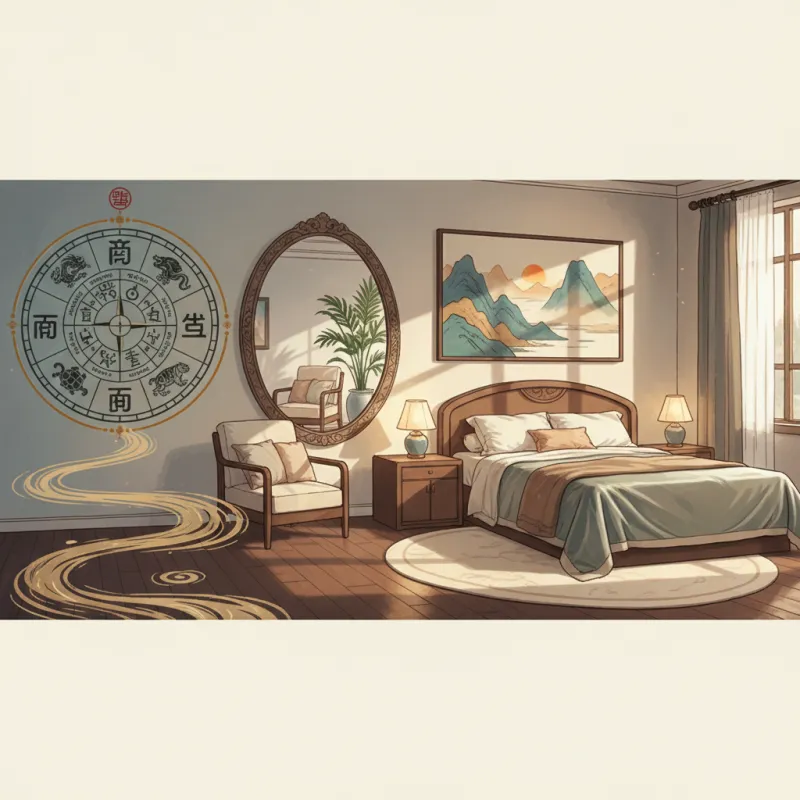
You wake at 3 AM for no reason. Your heart races. You feel watched. You blame stress, caffeine, the neighbor's cat — but you never suspect the full-length mirror propped against the wall, reflecting your sleeping form back at you all night long. Your body knows what your conscious mind doesn't: that mirror is turning your bedroom into an energetic battleground.
Why Mirrors Disrupt Sleep (And It's Not About Ghosts)
The traditional explanation — that mirrors trap wandering souls or reflect your spirit while it travels during sleep — makes for good folklore. But the actual feng shui principle is more grounded in observable reality. Mirrors are yang (阳 yáng) by nature. They're reflective, active, multiplying. They take whatever energy exists in a space and bounce it back, amplifying it. This quality makes them invaluable in entryways, dining rooms, and living spaces where you want qi to circulate and expand.
Bedrooms require the opposite. Sleep demands yin (阴 yīn) energy — quiet, still, absorbing. When you place a mirror where it reflects the bed, you're essentially installing an energetic amplifier in a space that needs a dampener. Every small movement, every shift in light, every fluctuation in the room's energy gets doubled and sent back. Your nervous system registers this constant activity even when you're unconscious. The result: restless sleep, frequent waking, that vague sense of unease you can't quite name.
The classical feng shui text Yangzhai Sanshi (阳宅三十 Yángzhái Sānshí, "Thirty Principles of Yang Dwellings") from the Qing Dynasty specifically warns against mirrors facing the bed, noting they create "restless qi" that prevents the shen (神 shén, spirit) from settling. Modern sleep research accidentally validates this ancient observation — studies show that even subtle environmental stimuli we don't consciously perceive can fragment sleep architecture and prevent deep restorative cycles.
The Specific Mirror Placements That Cause Problems
Not all bedroom mirrors are created equal in terms of feng shui disruption. A mirror tucked inside a closet door causes zero issues — it's contained, directional, and only active when you're awake and using it. But certain placements create specific problems worth understanding.
Mirrors directly facing the bed are the primary offender. This includes mirrors on the wall opposite the foot of the bed, mirrors on closet doors that face the bed when open, and especially mirrors on the ceiling (which, beyond feng shui concerns, suggest other lifestyle choices entirely). The classical reasoning states that when your shen leaves your body during sleep to process the day's experiences — a concept that appears in both Daoist inner alchemy and traditional Chinese medicine — it can become confused or startled by its own reflection, causing nightmares and disrupted sleep.
Mirrors reflecting the bedroom door create a secondary problem. In feng shui, doors are the mouth of qi (气口 qìkǒu). Fresh qi enters through the door, circulates through the room, and should settle into the space. A mirror bouncing that incoming energy right back out the door means your bedroom never fully receives the nourishing qi it needs. You end up sleeping in an energetically depleted space, which manifests as difficulty falling asleep or waking up feeling unrested despite adequate hours.
Mirrors positioned where they reflect windows can be problematic depending on what's outside. If the window faces a pleasant garden or water feature, the mirror might amplify beneficial qi. But if it reflects a busy street, sharp building corners (形煞 xíngshà, form afflictions), or other negative features, you're doubling the sha qi (煞气 shàqì, harmful energy) entering your bedroom. This is particularly relevant for urban apartments where controlling the external environment is impossible — at minimum, you can control what gets amplified inside.
Where Mirrors Actually Work in Bedrooms
The blanket rule "no mirrors in bedrooms" oversimplifies. Mirrors serve legitimate functions — checking your appearance, making small rooms feel larger, reflecting natural light. The key is strategic placement that serves these functions without creating energetic chaos.
Inside closet doors is the ideal solution for most bedrooms. The mirror remains functional for dressing but stays contained when not in use. When the closet door closes, the mirror's reflective quality is neutralized. This follows the feng shui principle of concealment (藏 cáng) — powerful elements should be revealed only when needed and hidden otherwise.
On walls perpendicular to the bed works if the mirror doesn't catch any part of the bed in its reflection. A mirror on the wall beside your headboard, positioned so it reflects the side wall or a piece of furniture rather than the sleeping area, maintains the room's sense of space without creating the energetic ping-pong effect. Test this by lying in bed and ensuring you can't see yourself in the mirror from any sleeping position.
Dressing table mirrors get a pass in classical feng shui texts, provided they're positioned away from direct bed reflection and covered at night. The traditional solution involved a silk cloth draped over the mirror before sleep — a practice that sounds quaint but effectively neutralizes the mirror's yang quality. Modern equivalents include folding tri-fold mirrors closed or using a decorative screen to block the reflection during sleep hours.
The Bazi (八字 bāzì, Eight Characters) system of Chinese astrology adds another layer of nuance. Individuals with strong fire elements in their natal chart may be more sensitive to mirrors' amplifying effects, while those with dominant water elements might tolerate them better. This explains why some people report no issues sleeping with mirrors while others experience immediate disruption — constitutional differences matter.
The Mirror-Relationship Connection
One of feng shui's more controversial claims is that mirrors in bedrooms can damage romantic relationships. The traditional explanation states that mirrors "invite third parties" into the relationship by symbolically creating additional people in the intimate space. Skeptics dismiss this as superstition, but there's a psychological mechanism worth considering.
Bedrooms serve as private sanctuaries where couples can be vulnerable, unguarded, authentic. A mirror introduces an element of self-observation and performance. You become aware of how you look, how you're positioned, whether your hair is doing that weird thing. This self-consciousness, however subtle, creates psychological distance between partners. The bedroom stops being a space of pure intimacy and becomes partially a space of self-presentation.
The feng shui master Yang Yun-song (杨筠松 Yáng Yúnsōng, 834-900 CE), whose Qing Nang Ao Yu (青囊奥语 Qīngnáng Àoyǔ, "Secret Language of the Blue Bag") remains influential today, wrote that bedrooms should contain "nothing that divides attention from rest and union." Mirrors, by their nature, divide attention. They create a third point of focus in a space that should contain only two.
Modern relationship therapists, working from entirely different frameworks, sometimes recommend removing televisions and mirrors from bedrooms for similar reasons — these objects fragment attention and prevent the deep presence that intimacy requires. The feng shui tradition arrived at this conclusion 1,000 years earlier through different reasoning but similar observation.
Remedies When You Can't Remove the Mirror
Real-world constraints often prevent ideal feng shui solutions. Rental agreements, built-in fixtures, shared living situations, or simple practicality may mean you're stuck with a mirror you can't remove. Several remedies can minimize the disruption without requiring major renovations.
Covering the mirror at night is the simplest and most effective solution. A decorative cloth, a folding screen, or even a large piece of artwork on a hinge that swings over the mirror transforms it from an active yang element to a neutral covered surface. This practice appears in multiple feng shui lineages and requires no special materials — any opaque covering works. The key is consistency; the mirror needs to be covered every night to establish the yin quality your bedroom requires.
Repositioning the bed may be easier than moving the mirror. If you can angle the bed so it's no longer directly reflected, you solve the primary problem. This might mean placing the bed on a different wall or shifting it a few feet to one side. Use the lying-in-bed test: if you can't see yourself reflected from any sleeping position, the mirror's disruptive effect is largely neutralized.
Plants between the mirror and bed create an energetic buffer. Living plants absorb and transform qi, acting as a filter between the mirror's reflective energy and your sleeping space. The Zhu Lin (竹林 zhúlín, bamboo grove) principle from classical feng shui suggests that living elements can moderate harsh energies. A tall plant or small indoor tree positioned to break the sight line between mirror and bed serves this function. Avoid spiky plants like cacti or plants with aggressive growth patterns — choose soft, rounded foliage that embodies yin qualities.
Adjusting lighting can reduce a mirror's impact. Mirrors amplify whatever they reflect, including light. If your bedroom has bright overhead lighting or strong morning sun that hits the mirror, you're amplifying yang energy at times when you need yin. Blackout curtains, dimmer switches, and softer bedside lamps reduce what the mirror has to work with. A mirror reflecting gentle lamplight is far less disruptive than one reflecting harsh overhead fluorescents.
When Mirrors Might Actually Help
Feng shui isn't about rigid rules but about understanding energy flow and making strategic choices. Certain bedroom situations actually benefit from carefully placed mirrors.
Small, dark bedrooms can use mirrors to amplify limited natural light and create a sense of space, provided the mirror doesn't reflect the bed. A mirror positioned to reflect a window (assuming the view is pleasant) brings more light and the visual sense of nature into a confined space. This follows the feng shui principle of "borrowing scenery" (借景 jièjǐng) — using reflections to incorporate beneficial external elements.
Bedrooms with missing corners or irregular shapes sometimes benefit from mirrors that visually complete the space. If your bedroom has an awkward alcove or a corner cut away by building structure, a mirror on the recessed wall can create the illusion of a complete rectangle, which feng shui considers the most stable and restful shape. This is advanced application and requires careful positioning to avoid reflecting the bed.
Dressing areas within bedrooms need mirrors for practical function. The solution is creating a distinct zone — a corner or alcove that functions as a dressing space separate from the sleeping area. A mirror in this zone serves its purpose without disrupting the bed's energy field. This zoning approach appears in traditional Chinese architecture, where bedrooms often included separate areas for sleeping, dressing, and studying, each with appropriate furnishings.
The key distinction is intentionality. A mirror placed thoughtfully to serve a specific function while avoiding bed reflection follows feng shui principles. A mirror positioned randomly or purely for decoration without considering its energetic impact does not.
The Bigger Picture: Bedroom as Sanctuary
The mirror question is really a subset of a larger feng shui principle: bedrooms should be sanctuaries optimized for rest, intimacy, and restoration. Every element in the bedroom either supports or undermines this function. Mirrors are simply one of the more obvious disruptors because their effects are relatively immediate and noticeable.
Classical feng shui texts describe the bedroom as a "yin palace" (阴宫 yīngōng) — a space that should embody stillness, darkness, quiet, and enclosure. This contrasts with living areas, which should be yang — bright, active, social, and open. Modern life blurs these boundaries. We work in bedrooms, watch television in bed, scroll phones until we fall asleep. Each of these activities imports yang energy into a space that needs to remain predominantly yin.
Mirrors amplify whatever energy exists in a space. In a bedroom that's already compromised by electronics, clutter, work materials, and other yang elements, a mirror multiplies the problem. In a bedroom that's carefully maintained as a true sanctuary — minimal electronics, calming colors, organized space, appropriate lighting — a small mirror in a non-disruptive position might cause no issues at all.
The Huangdi Neijing (黄帝内经 Huángdì Nèijīng, "Yellow Emperor's Classic of Internal Medicine"), compiled around 100 BCE, emphasizes that health depends on aligning with natural rhythms — activity during yang hours (day), rest during yin hours (night). Your bedroom's design should support this alignment. Mirrors, being inherently yang, work against it unless carefully managed.
This connects to broader questions about bedroom layout and energy flow and the importance of creating proper yin-yang balance in sleeping spaces. The mirror is one piece of a larger puzzle, but it's a piece that's relatively easy to address and often produces noticeable results quickly.
Your grandmother's warning about mirrors facing the bed wasn't superstition. It was compressed wisdom from a tradition that spent centuries observing how environments affect human wellbeing. The explanation she gave you might have involved ghosts or bad luck, but the underlying principle remains sound: some objects belong in bedrooms, and some don't. Mirrors, unless carefully positioned and managed, fall into the latter category. Your sleep quality will tell you whether you've gotten the placement right.
Related Reading
- Feng Shui Bed Placement: The Rules That Actually Matter
- Feng Shui Bedroom Layout Mistakes
- Creating Bedroom Harmony Using Feng Shui, I Ching, and Chinese Metaphysics
- Bedroom Feng Shui for Better Sleep
- Feng Shui Bedroom Guide: Sleep Better Tonight
- Bagua Mirror: The Most Misunderstood Feng Shui Tool
- Unlocking Office Harmony: The Role of Feng Shui and I Ching in Modern Workspaces
- Yin and Yang in Health: The Balance That Keeps You Well
Explore Chinese Culture
- Explore Daoist philosophy and practice
- Explore traditional Chinese customs
- Explore ancient Chinese cosmology