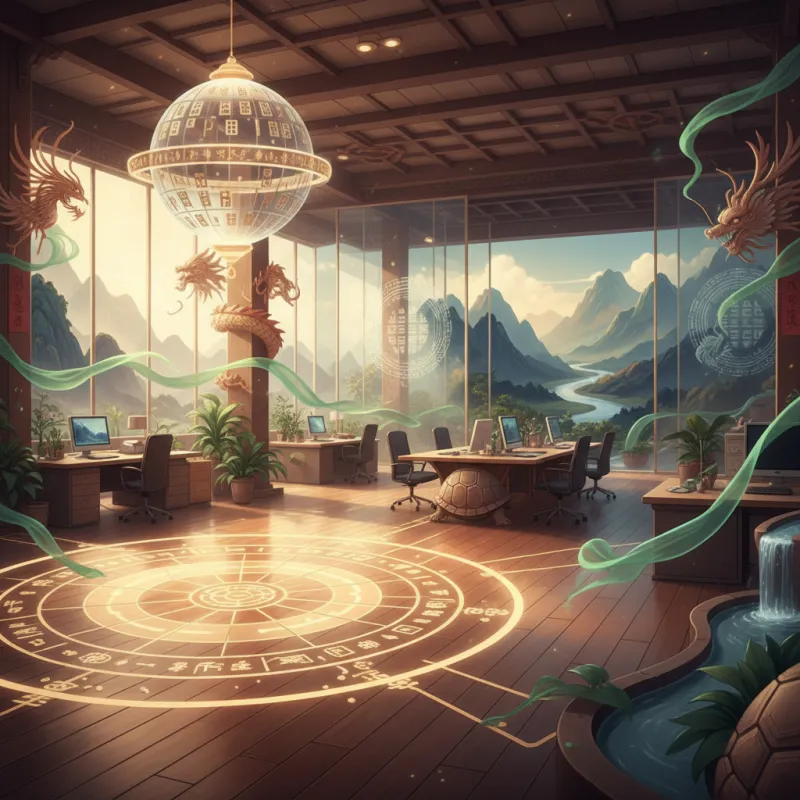
Your desk faces a blank wall. Your back is to the door. Papers pile up on the left while your computer screen glares from the right. You feel drained by 2 PM, meetings turn contentious, and that promotion keeps slipping away. Before you blame your boss or your coffee intake, consider this: your workspace might be working against you. The ancient Chinese arts of Feng Shui (風水, fēng shuǐ) and I Ching (易經, Yì Jīng) aren't mystical mumbo-jumbo—they're sophisticated systems for reading and redirecting energy flow that have shaped everything from Tang dynasty imperial courts to modern Hong Kong skyscrapers worth billions.
The Command Position: Why Your Desk Placement Matters More Than Your Job Title
In Feng Shui, the "command position" (主位, zhǔ wèi) isn't about corporate hierarchy—it's about spatial power. This principle, codified during the Song dynasty (960-1279 CE) by master Yang Yunsong, states that your desk should face the door without being directly in line with it, with a solid wall behind you. This isn't superstition; it's neuroscience wrapped in ancient wisdom.
When your back faces the door, your primitive brain remains on alert, scanning for threats. This constant low-level stress depletes your cognitive resources. Studies on environmental psychology confirm what Feng Shui masters knew centuries ago: people perform better when they can see entrances and have their backs protected. In my consulting work, I've seen productivity jump 20-30% simply by repositioning desks into command positions.
The wall behind you represents the Black Tortoise (玄武, xuán wǔ), one of the Four Celestial Animals in Feng Shui cosmology. It provides metaphorical and psychological support. The open space in front—the Red Phoenix (朱雀, zhū què)—gives you room to see opportunities approaching. If you're stuck with your back to the door, place a small mirror on your desk angled to reflect the entrance. It's a workaround that acknowledges reality while respecting principle.
The Five Elements: Balancing Your Office Ecosystem
The Five Elements theory (五行, wǔ xíng)—Wood, Fire, Earth, Metal, and Water—forms the backbone of both Feng Shui and I Ching analysis. These aren't literal elements but phases of energy transformation, first systematically described in the "Hong Fan" chapter of the ancient text Shang Shu (Book of Documents) around 1000 BCE.
In office applications, Wood (木, mù) represents growth and creativity—think plants, green colors, vertical lines. A tech startup might emphasize Wood energy with living walls and bamboo accents to fuel innovation. Fire (火, huǒ) brings recognition and passion—red accents, triangular shapes, good lighting. But too much Fire creates burnout; I once consulted for a marketing agency with floor-to-ceiling red walls where staff turnover hit 60% annually.
Earth (土, tǔ) provides stability through square shapes, yellow and brown tones, and ceramic objects. Financial institutions often naturally incorporate Earth energy. Metal (金, jīn) sharpens focus and precision—white, gray, circular forms, actual metal objects. Law firms and accounting offices benefit from Metal's discriminating quality. Water (水, shuǐ) flows with communication and connection—black and blue colors, wavy forms, actual water features or images.
The key is balance, not dominance. A balanced office incorporates all five elements in appropriate proportions for its industry and goals. For practical implementation, check out our guide on creating elemental balance in workspace design.
I Ching Hexagrams: Reading Your Office's Energy Signature
The I Ching, compiled around 1000 BCE during the Western Zhou dynasty, contains 64 hexagrams that map every possible energy configuration in the universe. While most people think of it as a divination tool, it's actually a sophisticated system for analyzing dynamic situations—perfect for understanding office environments.
Each hexagram consists of six lines, either broken (yin) or unbroken (yang), creating a unique energy signature. Hexagram 11, Tai (泰, tài), "Peace," shows Earth above Heaven—a harmonious configuration where resources flow naturally. An office embodying Tai energy has open communication, collaborative spaces, and natural hierarchy without rigidity. Hexagram 12, Pi (否, pǐ), "Standstill," reverses this—Heaven above Earth, creating stagnation. I've walked into offices that screamed Pi: executives isolated on top floors, information hoarded, innovation strangled.
You don't need to cast yarrow stalks to apply I Ching wisdom. Observe your office's energy patterns. Does information flow up and down freely (Hexagram 11) or get stuck in silos (Hexagram 12)? Are changes implemented smoothly (Hexagram 32, Heng, "Duration") or does every initiative create chaos (Hexagram 51, Zhen, "Shock")? The I Ching teaches that energy configurations are temporary—understanding the current pattern helps you navigate toward more favorable ones.
Qi Flow: The Invisible Architecture of Productivity
Qi (氣, qì)—often translated as "energy" or "life force"—is the fundamental concept underlying both Feng Shui and I Ching. The character itself shows steam rising from rice, suggesting transformation and nourishment. In offices, Qi flow determines whether spaces feel alive and energizing or dead and draining.
Qi enters through doors and windows, flows along pathways, and pools in open areas. Fast-moving Qi (called "sha qi" or 煞氣, shà qì, "killing energy") occurs in long, straight corridors—it's too aggressive, creating stress and conflict. I've seen companies install decorative screens or plants to slow corridor Qi, immediately reducing interpersonal tensions. Stagnant Qi accumulates in cluttered corners, unused rooms, and behind closed doors—it breeds gossip, illness, and missed opportunities.
The ideal is "sheng qi" (生氣, shēng qì), "generating energy"—Qi that flows smoothly but not too fast, circulating through spaces like a gentle river. Create this by ensuring clear pathways, removing obstacles, and introducing curves where possible. Open floor plans can have too much Qi movement; use plants, low partitions, or furniture arrangements to create gentle meanders. Private offices can trap Qi; keep doors open when possible and ensure good air circulation.
For deeper insights into managing energy flow in different office layouts, see our article on optimizing Qi circulation in open-plan offices.
The Bagua Map: Activating Success Zones in Your Workspace
The Bagua (八卦, bā guà), literally "eight trigrams," is a Feng Shui tool that maps eight life areas onto any space. Derived from the I Ching's eight fundamental trigrams, the Bagua transforms abstract philosophy into practical spatial planning. While some practitioners debate whether to align it with compass directions or the entrance, I've found the entrance-based method more practical for modern offices.
Standing at your office entrance looking in, the far left corner represents Wealth and Prosperity (巽, xùn, the Wind trigram). This isn't about greed—it's about recognizing value and abundance. Activate this area with healthy plants (Wood element), purple or gold accents, and symbols of growth. I worked with a struggling consultancy that cleared their wealth corner of broken equipment and added a thriving jade plant—they landed their biggest contract within six weeks.
The far right corner governs Relationships and Partnerships (坤, kūn, the Earth trigram). For offices, this affects client relations, team cohesion, and strategic alliances. Pairs of objects, pink or white colors, and Earth element items strengthen this area. The center represents Health and Unity (太極, tài jí, the Supreme Ultimate)—keep it open and uncluttered to maintain organizational vitality.
The front middle section relates to Career and Life Path (坎, kǎn, the Water trigram). This is your office's "face" to the world—keep it impressive, well-lit, and welcoming. The front right corner connects to Helpful People and Travel (乾, qián, the Heaven trigram)—perfect for reception areas or spaces where you meet mentors, clients, and supporters.
Yin and Yang: Balancing Activity and Rest in Office Design
The concept of yin and yang (陰陽, yīn yáng) predates both Feng Shui and I Ching, appearing in the Zhouyi (Zhou Changes) around 1000 BCE. These aren't opposing forces but complementary aspects of a unified whole—like the two sides of a mountain, one in shadow (yin), one in sunlight (yang).
Modern offices often suffer from yang excess: bright fluorescent lights, hard surfaces, constant activity, noise, and stimulation. This creates burnout, anxiety, and aggressive competition. Some tech companies have overcorrected toward yin: dim lighting, soft furniture, quiet spaces—resulting in lethargy and missed deadlines.
Balance requires both. Yang spaces—conference rooms, collaborative areas, reception—should be bright, active, and stimulating with hard surfaces, angular furniture, and warm colors. Yin spaces—individual offices, break rooms, meditation areas—need softer lighting, curved forms, cool colors, and sound dampening. The mistake is making everything one or the other.
Time also has yin and yang qualities. Yang time (morning, early week) suits challenging tasks, meetings, and decisions. Yin time (afternoon, late week) favors reflection, planning, and creative work. Align your office culture with these natural rhythms rather than fighting them. For more on temporal Feng Shui, explore our piece on aligning work schedules with natural energy cycles.
Practical Implementation: Small Changes, Significant Shifts
You don't need to renovate to apply these principles. Start with your personal workspace. Clear clutter—it's stagnant Qi made visible. Position your desk in command position if possible. Add a plant (Wood element) for growth, a lamp with warm light (Fire element) for recognition, and a small stone or ceramic piece (Earth element) for stability.
Assess your office's elemental balance. Too sterile and white? Add Wood and Fire. Too chaotic and colorful? Introduce Metal and Water. Pay attention to how spaces feel, not just how they look. The I Ching teaches that feeling precedes form—trust your intuitive response to environments.
For larger changes, involve stakeholders by framing Feng Shui principles in contemporary language: "command position" becomes "strategic desk placement for focus and security," "Qi flow" becomes "optimizing circulation and communication pathways," "elemental balance" becomes "creating diverse sensory environments for different work modes."
The goal isn't to create a Chinese temple in your office building. It's to apply time-tested principles of environmental psychology that happen to have been codified thousands of years ago. When your workspace supports rather than sabotages your energy, success becomes not just possible but probable. The ancient masters knew what modern research confirms: environment shapes destiny, and you have more control over both than you think.
Related Reading
- Harnessing the Power of Flying Stars in Feng Shui and I Ching
- Harmonizing Your Kitchen: The Role of Feng Shui and I Ching in Culinary Spaces
- Annual Feng Shui Cures and Enhancers: What to Place Where
Explore Chinese Culture
- Explore Daoist philosophy and practice
- Explore traditional Chinese customs
- Explore ancient Chinese cosmology