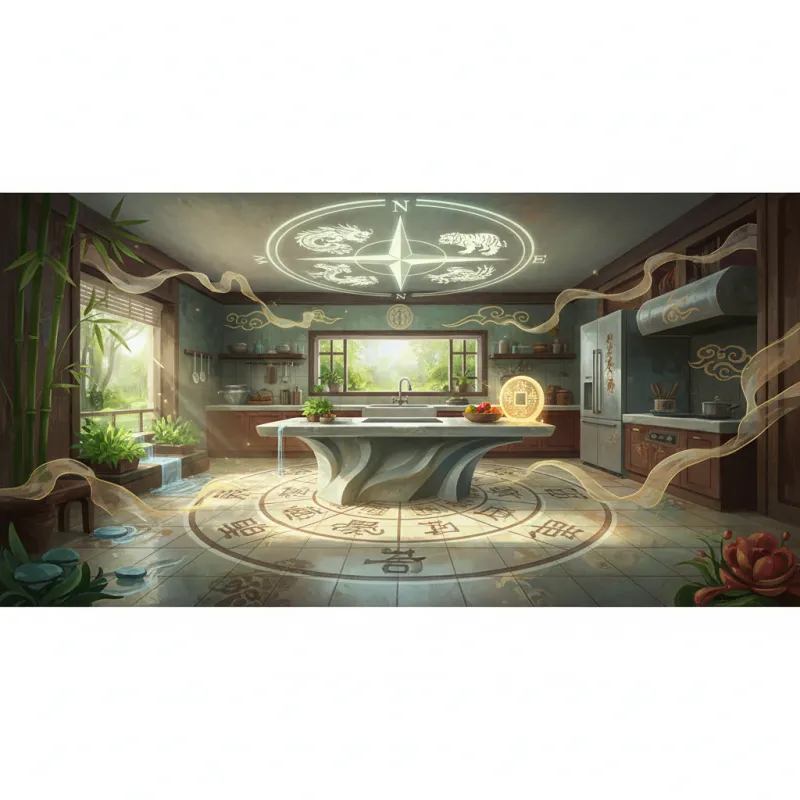
The moment you step into a kitchen where the stove faces the sink, you've entered a battlefield of elements—fire confronting water in an eternal clash that drains wealth and disrupts health. This isn't superstition; it's the practical wisdom encoded in Feng Shui (風水, fēng shuǐ) and amplified through the I Ching's (易經, Yì Jīng) 64 hexagrams, a system that's been guiding Chinese households for over three millennia. Your kitchen isn't just where you cook—it's where the Five Elements dance, where family wealth accumulates or dissipates, and where the ancient Book of Changes offers surprisingly specific guidance for modern culinary spaces.
The Kitchen as the Wealth Palace
During the Song Dynasty (960-1279 CE), the kitchen god Zao Jun (灶君, Zào Jūn) held such importance that families would smear honey on his paper image before burning it, hoping he'd report sweet words to the Jade Emperor about their household. This wasn't mere folklore—it reflected the deep understanding that the kitchen, specifically the stove, represented the family's financial fortune and health. The stove is associated with the Li trigram (離, lí) in the I Ching, representing fire, clarity, and the middle daughter. When positioned correctly, Li brings illumination and prosperity; when misaligned, it creates what practitioners call "fire at heaven's gate," a configuration that can lead to arguments, health issues, and financial drain.
The wealth connection runs deeper than symbolism. In Feng Shui, the kitchen represents transformation—raw ingredients become nourishment, just as opportunities become prosperity. The Zao Wei (灶位, zào wèi), or stove position, should ideally face the family's auspicious directions based on their Kua number (卦數, guà shù), calculated from birth year and gender. A stove facing south activates the Li position naturally, enhancing recognition and fame, while an east-facing stove taps into the Zhen trigram (震, zhèn), bringing growth and new beginnings. But here's where most modern kitchens fail: they prioritize aesthetics over energetic function, placing islands and ranges wherever the designer thinks they look best, completely ignoring the elemental balance that governs prosperity.
I Ching Hexagrams and Kitchen Layout
The I Ching offers 64 hexagrams, each a combination of broken (yin) and unbroken (yang) lines, and several speak directly to kitchen arrangement. Hexagram 50, Ding (鼎, dǐng), literally means "The Cauldron" and represents nourishment, transformation, and the vessel that holds family fortune. When you consult the I Ching about kitchen renovations—yes, people actually do this—Ding appearing suggests your kitchen serves as a proper vessel for family energy. The judgment reads: "The Ding brings supreme good fortune and success." But the changing lines matter: a six in the fourth place warns against a broken leg on the cauldron, which translates practically to ensuring your stove has stable support and isn't positioned where it might be bumped or damaged.
Hexagram 27, Yi (頤, yí), "Providing Nourishment," addresses what and how we eat, but also the kitchen's role in family care. The image states: "At the foot of the mountain, thunder: the image of Providing Nourishment. Thus the superior man is careful of his words and temperate in eating and drinking." This hexagram appearing in a kitchen consultation suggests examining not just layout but the quality of nourishment provided—are you cooking with fresh ingredients? Is the kitchen organized for healthy meal preparation? The I Ching doesn't separate physical space from behavior; they're interconnected.
Here's a specific application: if your kitchen falls in the northwest sector of your home, you're dealing with the Qian trigram (乾, qián), representing heaven, the father, and metal element. Placing a fire-dominant stove here creates a conflict—fire melts metal—potentially affecting the household patriarch's health or authority. The I Ching's Hexagram 13, Tong Ren (同人, tóng rén), "Fellowship with Men," often appears in readings about northwest kitchens, suggesting the solution lies in creating harmony through proper element mediation. Add earth element colors (yellows, browns) or objects (ceramics, crystals) to bridge fire and metal, since fire produces earth and earth produces metal in the productive cycle.
The Five Elements in Culinary Spaces
Every kitchen contains all Five Elements—Wood (木, mù), Fire (火, huǒ), Earth (土, tǔ), Metal (金, jīn), and Water (水, shuǐ)—but the proportions and relationships determine whether they cooperate or clash. The stove embodies fire, the sink and refrigerator represent water, wooden cabinets and cutting boards bring wood, metal appears in appliances and cookware, and earth manifests in ceramic tiles and stone countertops. The problem? Most kitchens arrange these elements in destructive relationships without realizing it.
The destructive cycle works like this: water extinguishes fire, fire melts metal, metal chops wood, wood depletes earth, earth dams water. When your sink (water) sits directly opposite or adjacent to your stove (fire), you've created a destructive relationship that, according to traditional Feng Shui masters, can lead to family arguments, digestive issues, and financial instability. I've seen kitchens where the refrigerator (water) was placed immediately next to the stove (fire)—a configuration that not only wastes energy as each appliance works harder, but also creates what's called "water-fire clash" (水火相沖, shuǐ huǒ xiāng chōng).
The productive cycle offers solutions: wood feeds fire, fire creates earth (ash), earth bears metal (ore), metal collects water (condensation), water nourishes wood. To mediate a water-fire clash, introduce wood element between them—a wooden cart, green plants, or even a wooden cutting board station. The wood takes water's energy and transforms it into fuel for fire, creating harmony. For a kitchen in the south (fire sector), adding earth elements like terracotta pots or yellow accents strengthens fire through the productive cycle while grounding its intensity. This isn't decorating advice—it's energetic engineering based on observations refined over centuries.
Practical Hexagram Consultations for Kitchen Decisions
When facing major kitchen decisions—renovation, appliance replacement, or layout changes—consulting the I Ching provides specific guidance that generic Feng Shui rules miss. The traditional method uses three coins tossed six times, building a hexagram from bottom to top, but yarrow stalk divination offers deeper accuracy for significant decisions. I've consulted the I Ching before every major kitchen change in my own home, and the results have been remarkably practical.
Before relocating a stove, I received Hexagram 56, Lu (旅, lǚ), "The Wanderer," with a changing line in the third position. The judgment warns: "The wanderer's inn burns down. He loses the steadfastness of his young servant." This clearly advised against the move—the stove (inn) would lose its stable position, and the kitchen's function (young servant) would be disrupted. I waited six months, and when I consulted again, I received Hexagram 37, Jia Ren (家人, jiā rén), "The Family," which states: "The perseverance of the woman brings good fortune." The timing was right, and the renovation proceeded smoothly, with my wife leading the design decisions.
For choosing between gas and induction cooktops, Hexagram 30, Li (離, lí), "The Clinging, Fire," appearing twice in succession suggested staying with visible flame (gas) rather than hidden electromagnetic fields (induction). The image reads: "That which is bright rises twice: the image of Fire. Thus the great man, by perpetuating this brightness, illuminates the four quarters of the world." Real fire provides visible energy transformation, connecting the cook to the element directly. This doesn't mean induction is wrong—it means for that specific household, at that time, maintaining the fire element's visibility served their needs better.
The Stove Position and Family Harmony
The person cooking should face an auspicious direction while standing at the stove, but they should also see the kitchen entrance without turning completely around. This "command position" prevents being startled while handling fire and sharp objects, but it also ensures the cook—traditionally the mother—maintains awareness of family dynamics. In Feng Shui, the stove represents the mother's health and the family's wealth, making its position doubly important.
A stove positioned so the cook faces a wall creates what's called "facing the void" (面壁, miàn bì), limiting opportunities and making the cook feel isolated. Installing a mirror above the stove seems like an obvious solution—it reflects the room, giving the cook awareness—but traditional practitioners warn against this. Mirrors above stoves are said to "double the fire," potentially doubling arguments and health issues. Instead, position the stove so the cook naturally faces into the room, or at least has a 45-degree angle view of the entrance.
The stove should never sit directly under a bathroom on the floor above—this places water (toilet, shower) above fire, creating oppressive energy and potential health issues, particularly digestive problems. Similarly, avoid positioning the stove under a beam, which creates "pressing chi" (壓氣, yā qì), making the cook feel burdened and potentially affecting the quality of meals prepared. If beams are unavoidable, hang two bamboo flutes at 45-degree angles on the beam to "lift" the oppressive energy, or paint the beam the same color as the ceiling to minimize its visual impact.
Integrating Modern Appliances with Ancient Wisdom
Microwaves, dishwashers, and smart refrigerators didn't exist when Feng Shui principles were codified, but the elemental logic still applies. A microwave represents intense, concentrated fire energy—position it away from the sink and refrigerator, ideally in the south or southwest sectors. Dishwashers combine water and fire (heating element), creating internal conflict; place them in the northwest (metal sector) where metal can mediate the water-fire relationship, or in the north (water sector) where the water element dominates naturally.
Smart appliances with constant electromagnetic fields (EMF) add a layer of complexity traditional Feng Shui doesn't address directly, but the I Ching's emphasis on balance suggests moderation. Hexagram 15, Qian (謙, qiān), "Modesty," reminds us that excess in any direction creates imbalance. A kitchen filled with every smart appliance, all connected and constantly communicating, may be technologically impressive but energetically chaotic. Choose technology that genuinely serves your cooking practice rather than accumulating devices for their own sake.
The refrigerator, as the largest water element in most kitchens, should ideally sit in the north (water sector) or east (wood sector, since water nourishes wood). Avoid placing it in the south (fire sector) where water and fire clash, or in the southwest (earth sector) where water and earth create muddy, stagnant energy. If your kitchen layout forces a south-positioned refrigerator, add wood element between the refrigerator and the room's fire energy—a wooden panel on the refrigerator's side, or a tall plant nearby—to mediate the clash through the productive cycle.
Colors, Materials, and Elemental Balance
Kitchen colors should balance the sector's inherent element with the activities performed there. A kitchen in the east (wood sector) benefits from green and brown tones, supporting the wood element naturally, with touches of blue (water) to nourish wood. But add red accents (fire) sparingly—while fire is necessary for cooking, too much fire in a wood sector can create excessive yang energy, leading to impulsive decisions and family arguments.
For a west-facing kitchen (metal sector), whites, grays, and metallic finishes support the inherent element, while yellow and earth tones (earth produces metal) strengthen it further. Avoid excessive red or orange (fire melts metal) unless you're deliberately trying to reduce metal's sharp, cutting energy—useful if family members are overly critical or argumentative. The color choices in your kitchen aren't just aesthetic; they're energetic adjustments that affect mood, health, and family dynamics daily.
Materials matter as much as colors. Granite countertops bring earth element—grounding and stable, but potentially heavy if overused. Marble, despite being stone, has water-like veining and cooler energy, making it suitable for baking areas but potentially too yin for the main prep space. Butcher block counters provide wood element, warm and nourishing, perfect for food preparation but requiring maintenance to prevent water damage. Stainless steel offers metal element—clean and precise, ideal for professional-style cooking but potentially too yang (harsh, cold) for family-centered kitchens. Mix materials to create elemental balance rather than choosing one throughout.
Seasonal Adjustments and the I Ching Calendar
The I Ching isn't static—it acknowledges that energy shifts with seasons, and your kitchen should adapt accordingly. During summer (fire season), reduce fire element intensity by adding water features (a small fountain, blue accents) or earth elements (ceramic bowls, yellow flowers) to ground the excess heat. In winter (water season), enhance fire and wood elements—keep the stove area well-lit, add wooden utensils on display, use warm colors in dish towels and decorations.
The Chinese solar calendar divides the year into 24 solar terms, each lasting about 15 days, and each term has associated I Ching hexagrams. During Li Chun (立春, lì chūn), "Beginning of Spring" (around February 4), Hexagram 24, Fu (復, fù), "Return," governs—this is the time to refresh your kitchen, clear out old ingredients, and prepare for the growing season's energy. During Da Shu (大暑, dà shǔ), "Great Heat" (around July 23), Hexagram 44, Gou (姤, gòu), "Coming to Meet," suggests being receptive to cooling influences—serve more raw foods, use the stove less, and add water element decorations.
This seasonal approach extends to what you cook and how you arrange your kitchen workspace. Spring calls for fresh greens and sprouts, supporting the wood element's growth energy—keep these visible in bowls on the counter. Summer demands cooling foods and lighter cooking methods—make your salad prep area prominent. Autumn brings harvest and preservation—set up canning stations and storage systems. Winter requires warming stews and longer cooking times—ensure your slow cooker and soup pots are easily accessible. The I Ching teaches that harmony comes from aligning with natural cycles, not fighting them, and your kitchen should reflect this wisdom throughout the year.
Related Reading
- Feng Shui for Business: Attract Customers and Wealth
- Feng Shui Crystals: Which Ones to Use and Where to Place Them
- Harnessing the Power of Flying Stars in Feng Shui and I Ching
Explore Chinese Culture
- Explore Daoist philosophy and practice
- Explore traditional Chinese customs
- Explore ancient Chinese cosmology