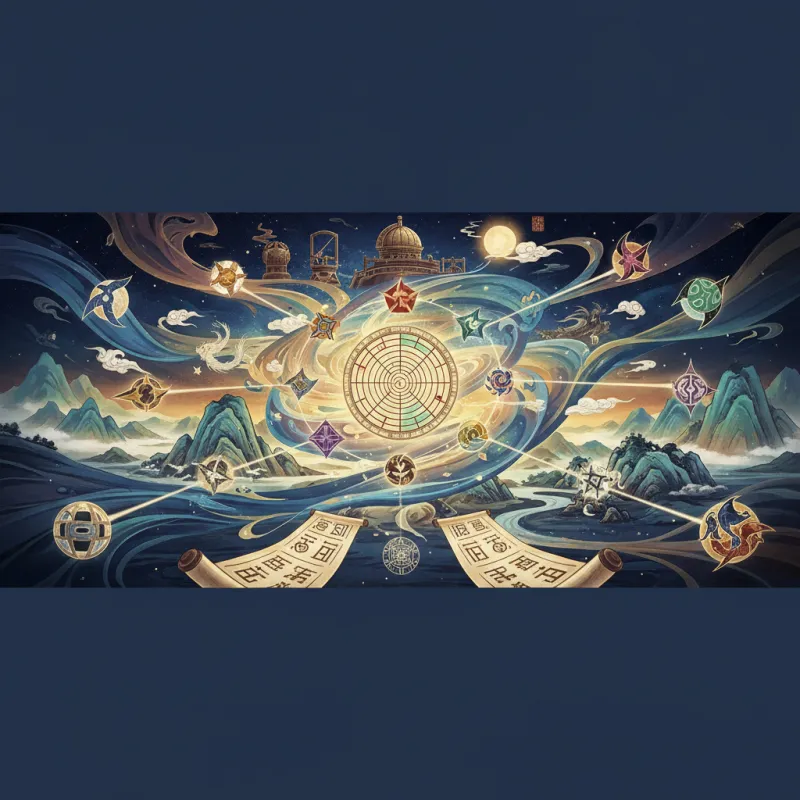
Picture this: You walk into a home where the owner complains of constant financial setbacks, only to discover their main entrance sits in the sector governed by the Five Yellow star this year. Move to the bedroom, and you find the couple sleeping under the influence of the Quarrelsome Star. This isn't coincidence—it's the Flying Stars system revealing itself in real time, a sophisticated feng shui technique that treats your living space like a living, breathing organism whose energy shifts with the passage of time.
The Mechanics Behind Flying Stars
Flying Stars (飛星, fēi xīng) operates on a principle that baffles many Western practitioners: your home's energy isn't static. Unlike the more familiar Eight Mansions system that assigns permanent directions based on your birth year, Flying Stars acknowledges that cosmic energy moves through your space in predictable patterns, changing annually, monthly, and even daily. The system emerged during the Qing Dynasty (1644-1912), though its roots trace back to the Tang Dynasty master Yang Yun-song, who first codified the relationship between time and spatial energy.
The foundation rests on nine numbers, each representing a different star with distinct characteristics. These numbers aren't arbitrary—they correspond to the nine palaces of the Luo Shu magic square (洛書, luò shū), that legendary diagram supposedly revealed on the back of a turtle emerging from the Luo River around 2800 BCE. Each number carries the energy of one of the five elements and manifests specific outcomes in your life. The One White star brings career advancement and scholarly success. The Two Black star, conversely, signals illness and obstacles. The system's genius lies in how these stars "fly" through your home's nine sectors following a precise mathematical pattern based on the sitting and facing directions of your building.
When Flying Stars Meet the I Ching
Here's where it gets interesting: Flying Stars doesn't exist in isolation from I Ching (易經, yì jīng) principles. Both systems share the fundamental belief that change is the only constant. The I Ching's 64 hexagrams describe transformations in natural and human affairs, while Flying Stars tracks how these transformations manifest spatially. When you cast an I Ching reading about your home or business, you're essentially asking the same question Flying Stars answers through calculation: what energies are at play, and how should I respond?
The connection runs deeper than philosophy. The Later Heaven Bagua (後天八卦, hòu tiān bā guà), which forms the directional framework for Flying Stars analysis, derives directly from King Wen's arrangement of the I Ching trigrams around 1150 BCE. Each of the eight directions in your home corresponds to a trigram, and therefore to specific I Ching hexagrams. When a Flying Star lands in a particular sector, it interacts with that sector's inherent trigram energy, creating combinations that experienced practitioners can read like sentences in a cosmic language.
The Period System: Time as the Fourth Dimension
Most people grasp that Flying Stars change yearly—the annual stars that feng shui enthusiasts scramble to remedy each February. But the system's true sophistication emerges in its Period structure. We're currently in Period 9 (2024-2043), and this twenty-year cycle fundamentally alters which stars bring fortune and which bring calamity. The Eight White star, a wealth star in Period 8 (2004-2023), loses some of its luster in Period 9, while the Nine Purple star ascends to become the reigning prosperity star.
This Period system connects directly to the Chinese calendar and cosmic cycles that govern all Chinese metaphysical arts. Each Period corresponds to one of the nine stars, and during its reign, that star's energy dominates global and personal affairs. Buildings constructed during different Periods carry the energetic signature of their birth time—a concept that parallels how bazi (八字, bā zì) practitioners analyze a person's birth chart. Your home has a "birth chart" too, determined by when it was built and which direction it faces.
Reading the Star Combinations
The real art of Flying Stars emerges when you interpret star combinations. A single star means little; it's the interaction between the sitting star, facing star, and annual/monthly stars that tells the story. Take the combination of Two Black and Five Yellow—both earth element stars associated with illness and misfortune. When they meet in the same sector, practitioners call this "double earth" or "earth killing earth," a configuration that demands immediate remediation with metal element cures (since metal drains earth in the five element cycle).
Conversely, some combinations create what we call "sum of ten" partnerships. When One White and Nine Purple occupy the same palace, their numbers sum to ten, creating a harmonious relationship that enhances both stars' positive attributes. The One White's water element feeds the Nine Purple's fire element in a productive cycle, generating opportunities for recognition, celebration, and joyful events. These aren't superstitions—they're applications of five element theory (五行, wǔ xíng) that you can verify through observation.
Practical Application: Beyond Hanging Wind Chimes
Let's be honest: the typical feng shui advice of "hang a wind chime here" or "place a water fountain there" often misses the mark because it ignores the diagnostic precision Flying Stars offers. When the Three Jade star (associated with conflicts and legal disputes) flies into your home's northwest sector—the area governing the patriarch and helpful people—you don't just toss up a red decoration and hope for the best. You need to understand why the Three Jade causes problems (it's a wood element star in a metal element sector, creating a destructive cycle), and then apply remedies that make elemental sense.
The most effective practitioners I've encountered treat Flying Stars like a diagnostic tool rather than a prescription pad. They calculate the natal chart of the building, overlay the annual and monthly stars, identify which sectors contain problematic combinations, and then—crucially—they observe. Does the resident actually experience the predicted issues? If the Five Yellow occupies the bedroom but the occupant enjoys perfect health, perhaps the room's existing features (metal bed frame, white color scheme) already provide sufficient remediation. This empirical approach separates Flying Stars mastery from rote formula application.
The Skeptic's Question: Does It Actually Work?
I've watched enough "coincidences" to take Flying Stars seriously. A client once insisted on keeping her home office in the northeast sector despite my warning that the annual Two Black star would land there. Three months later, she developed chronic back pain that vanished when she relocated to the southeast. Another client experienced a dramatic upturn in business after we identified and activated his wealth star positions using the Eight White star's location in his Period 8 building.
But here's the nuance: Flying Stars works best when integrated with other feng shui systems and common sense. The form school principles (峦头, luán tóu) that analyze physical landforms and structures matter enormously. A perfectly calculated Flying Stars remedy won't overcome a home built at the bottom of a T-junction with a massive tree blocking the front door. Similarly, no amount of star activation compensates for a business with a terrible product or a person who refuses to take action. Flying Stars reveals opportunities and obstacles in your environment's energy field—you still have to do the work.
Integrating Flying Stars with Your Practice
If you're already working with I Ching divination or other Chinese metaphysical systems, Flying Stars offers a complementary perspective. When you receive a hexagram suggesting upcoming challenges (say, Hexagram 12, Standstill), checking your Flying Stars chart might reveal that the annual Five Yellow has just entered your career sector. The I Ching provides the philosophical framework; Flying Stars shows you where in your physical space the energy manifests.
The learning curve is steep—calculating natal charts requires understanding the 24 Mountains compass system, the Xuan Kong (玄空, xuán kōng) formulas, and the interaction patterns between stars. But start simple: learn the basic characteristics of the nine stars, track the annual stars each year, and observe how they manifest in your own space. Keep a journal noting when you enter different rooms and how you feel. Over time, you'll develop an intuitive sense for how these invisible energies shape your daily experience, and you'll understand why Chinese metaphysics treats time and space as inseparable dimensions of the same reality.
Related Reading
- The History of Feng Shui: From Ancient China to Your Living Room
- Discovering the Colors of Feng Shui and I Ching: Their Power and Symbolism
- Chinese Meditation: A Guide to Daoist and Buddhist Practices
Explore Chinese Culture
- Explore Daoist philosophy and practice
- Explore traditional Chinese customs
- Explore ancient Chinese cosmology