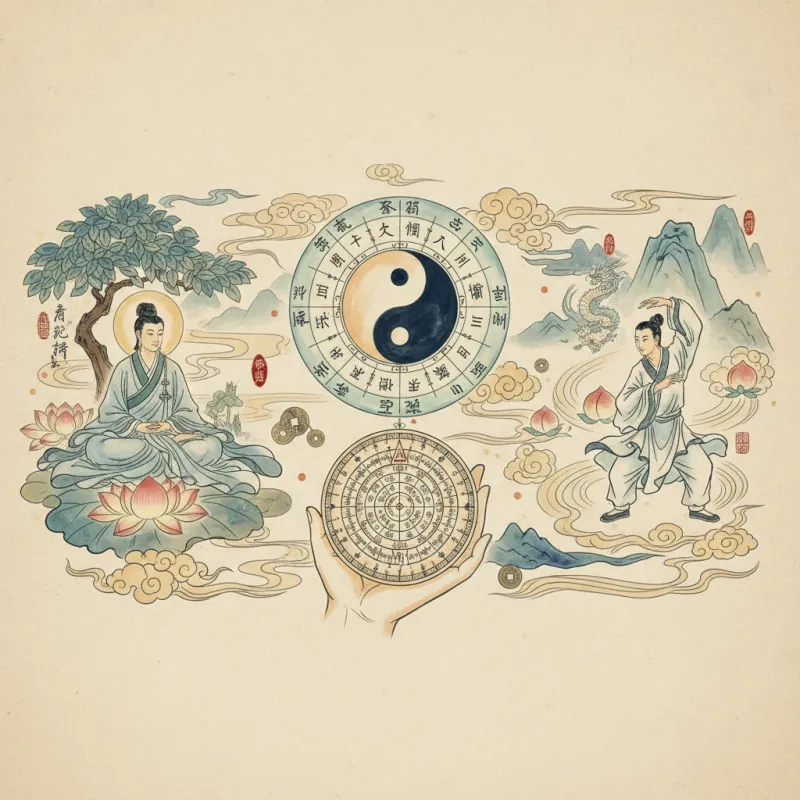
You're sitting cross-legged on a meditation cushion, following a guided app that promises "ancient wisdom," when a thought strikes you: what did Chinese practitioners actually do before someone packaged their techniques into 10-minute sessions? The answer is far stranger and more specific than the generic "mindfulness" sold today. Chinese meditation traditions — spanning Daoist inner alchemy, Chan Buddhist sitting, and Confucian quiet sitting — developed over two millennia into precise maps of consciousness that treated the body as a laboratory and the mind as an experimental subject.
The Feng Shui Connection: Why Your Environment Matters Before You Sit
Before we dive into techniques, understand this: Chinese meditation masters never separated inner practice from outer environment. The same principles governing feng shui arrangements apply to your meditation space. When a Tang Dynasty (618-907 CE) monk chose a cave for retreat, he wasn't being romantic — he was selecting a location where earth qi (地气 dìqì) supported deep practice.
Your meditation corner should face south or east when possible, avoiding direct alignment with doors or sharp corners that create "poison arrows" (煞气 shàqì). The Daoist text Huangting Jing (黄庭经 Yellow Court Classic) explicitly states that external disorder disrupts internal cultivation. This isn't superstition — it's recognition that your nervous system responds to spatial arrangement. A cluttered, chaotic room makes settling the mind exponentially harder, while a clean space with proper qi flow creates natural support for concentration.
Place your cushion where you won't face a mirror (which scatters attention) or sit directly under a beam (which creates oppressive downward pressure). If you're serious about practice, consider the five elements in your space: wood for growth, water for depth, earth for stability. A small plant (wood), a bowl of water, and earthen colors create elemental balance that supports meditation without you consciously thinking about it.
Daoist Meditation: The Inner Alchemy Laboratory
Daoist meditation (道家冥想 dàojiā míngxiǎng) treats your body as a cosmic microcosm containing the same forces that animate the universe. The goal isn't relaxation — it's transformation. Specifically, Daoist inner alchemy (内丹 nèidān) aims to refine jing (精 essence) into qi (气 vital energy), then qi into shen (神 spirit), ultimately returning to the Dao itself.
The foundational practice is "guarding the one" (守一 shǒuyī), mentioned in the Daodejing but elaborated in later texts like the Taiping Jing (太平经 Scripture of Great Peace). You sit in natural posture — not rigidly upright but aligned, as if suspended from above. The tongue touches the upper palate, creating what Daoists call the "magpie bridge" (鹊桥 quèqiáo) that connects the governing and conception meridians into a complete circuit.
Then you focus on the lower dantian (下丹田 xià dāntián), located about three finger-widths below your navel. This isn't visualization — you're directing awareness to an actual energetic center that corresponds to the body's physical center of gravity. Breathe naturally, allowing the lower abdomen to expand on inhale, contract on exhale. The Xingming Guizhi (性命圭旨 Principles of Nature and Life) describes this as "breathing like a fetus," returning to the pre-birth state when you received qi directly through the umbilical cord.
Advanced practitioners work with the microcosmic orbit (小周天 xiǎo zhōutiān), circulating qi up the spine (du meridian) and down the front (ren meridian). But here's what modern teachers often miss: this isn't imagination. You're working with actual sensations — warmth, tingling, pressure — that arise when attention concentrates qi. The 16th-century master Zhang Sanfeng warned against forcing circulation; the orbit opens naturally when the lower dantian fills sufficiently, like water overflowing a vessel.
Chan Buddhist Sitting: The Practice That Became Zen
When Bodhidharma supposedly sat facing a wall at Shaolin Temple for nine years, he established what became Chan Buddhism (禅宗 chánzōng) — later exported to Japan as Zen. Chan meditation is radically different from Daoist practice. There's no energy cultivation, no visualization, no technique at all in the conventional sense.
The practice is called zuochan (坐禅 zuòchán) — "sitting meditation" — but the sitting itself isn't the point. You're not trying to achieve anything, cultivate anything, or become anything. The Platform Sutra of the Sixth Patriarch Huineng states clearly: "Meditation is not about sitting. Sitting is not about meditation." This sounds like a riddle, but Huineng meant it literally. Meditation is seeing your original nature (见性 jiànxìng), which has nothing to do with posture.
So why sit? Because the body-mind settles more readily when still. You sit in full lotus if possible (legs crossed, each foot on the opposite thigh), half lotus (one foot on thigh, one underneath), or Burmese position (both legs folded in front). The key is stability — you shouldn't need to adjust position constantly. Eyes remain half-open, gazing downward at about 45 degrees. Closed eyes invite drowsiness; fully open eyes invite distraction.
Then what? This is where Chan gets interesting. In the Caodong (曹洞 Cáodòng) school — Soto Zen in Japanese — you practice "silent illumination" (默照 mòzhào). You just sit. Thoughts arise, you don't follow them. Sensations appear, you don't engage them. You're not concentrating on anything, not trying to empty the mind, not cultivating anything. You're simply present with whatever is, without preference.
The Linji (临济 Línjì) school — Rinzai in Japanese — uses gongan (公案 gōng'àn), paradoxical questions like "What is the sound of one hand clapping?" You don't solve these intellectually. You sit with the question until conceptual thinking exhausts itself and something else emerges. The 12th-century master Dahui Zonggao called this "great doubt" (大疑 dàyí) — the questioning becomes so intense that the usual subject-object split collapses.
Confucian Quiet Sitting: The Scholar's Practice
Confucian meditation (儒家静坐 rújiā jìngzuò) gets overlooked in Western discussions, but it was the primary practice of Chinese intellectuals for centuries. The Neo-Confucian philosopher Zhu Xi (朱熹 1130-1200) prescribed "quiet sitting" (静坐 jìngzuò) as essential for cultivating ren (仁 humaneness) and investigating principle (理 lǐ).
Unlike Daoist energy work or Chan's radical non-doing, Confucian meditation aims to clarify the mind so you can perceive moral principles clearly and act on them effectively. You sit upright, composed, and focus on "preserving the mind" (存心 cúnxīn). This means maintaining awareness of your moral nature without letting it be obscured by selfish desires or emotional turbulence.
The practice connects directly to I Ching philosophy. Hexagram 52, Gen (艮 Keeping Still), describes the mountain — still on the outside, solid within. This is the Confucian ideal: external composure reflecting internal clarity. Wang Yangming (王阳明 1472-1529), who developed the "learning of the mind" (心学 xīnxué) school, practiced quiet sitting daily and taught that meditation without action is incomplete, while action without meditation is blind.
Practical Integration: Building Your Practice
Here's what two decades of studying these traditions taught me: don't try to practice all three simultaneously. They have different goals and can interfere with each other. Daoist practice cultivates energy, Chan practice releases all cultivation, and Confucian practice refines moral awareness. Mixing them creates confusion.
Start with one tradition based on your temperament. If you're drawn to embodied practice, energy work, and tangible results, begin with Daoist lower dantian meditation. Practice 20-30 minutes daily, same time and place. The Yinfu Jing (阴符经 Scripture of Unconscious Unification) says "the natural timing of heaven" matters — dawn is ideal when yang qi rises, but consistency trumps perfect timing.
If you're intellectually oriented and want to cut through conceptual confusion, try Chan sitting. Start with 15 minutes and gradually extend. Don't expect dramatic experiences. The Song Dynasty master Hongzhi Zhengjue wrote that silent illumination is "subtle, vast, and without edges" — not exciting, just increasingly clear.
If you're interested in ethical development and practical wisdom, explore Confucian quiet sitting. Combine it with reading classical texts — the Analects, Mencius, Doctrine of the Mean. The meditation clarifies what you read; the reading gives content to your meditation.
Common Mistakes and How to Avoid Them
The biggest error is treating Chinese meditation as generic relaxation. These are specific technologies with specific purposes. Daoist practice can generate intense energetic experiences — heat, spontaneous movements, vivid internal imagery. If you're not prepared for this, it's disturbing. The Zhong Lü Chuan Dao Ji (钟吕传道集 Anthology of the Transmission of the Dao from Zhongli Quan to Lü Dongbin) warns that improper practice can "reverse the flow" and cause illness.
Don't force the breath. Every tradition emphasizes natural breathing. The moment you strain or control artificially, you're working against the practice. The Zhuangzi describes the true person's breathing as reaching to their heels — deep, effortless, complete.
Don't expect linear progress. Chinese meditation traditions understand development as cyclical, with periods of clarity followed by confusion, breakthrough followed by plateau. The Lengyan Jing (楞严经 Śūraṅgama Sūtra) describes fifty "skandha-demon" states — experiences that seem like attainment but are actually obstacles. Feeling blissful doesn't mean you're enlightened; it means you're feeling blissful.
Don't practice in isolation from life. The test of meditation isn't what happens on the cushion but how you respond when someone cuts you off in traffic or your project fails. Zhu Xi wrote that quiet sitting without "extending knowledge through investigating things" (格物致知 géwù zhìzhī) produces empty tranquility, not wisdom.
The Long View: What These Practices Actually Offer
After years of practice, what changes isn't that you become perpetually calm or achieve special powers. What changes is your relationship to your own experience. You notice thoughts arising earlier, before they hook you. You feel emotions without being overwhelmed by them. You recognize patterns — how anger always starts with a particular tension in your chest, how anxiety manifests as shallow breathing.
This is what Chinese meditation traditions offer: not escape from life but deeper engagement with it. The Daoist becomes more sensitive to qi flow in themselves and their environment. The Chan practitioner sees through conceptual overlays to what's actually present. The Confucian acts from clarity rather than confusion.
These aren't mystical attainments. They're the natural result of sustained attention to how consciousness actually works. The Chinese mapped this territory with remarkable precision over centuries. Their maps remain useful today — not as exotic wisdom to appropriate, but as tested methods for investigating your own mind.
Start simple. Sit down, shut up, and pay attention. Everything else is commentary.
Related Reading
- Chinese Breathing Techniques for Energy and Calm
- Qigong for Beginners: Start Your Energy Practice
- Designing Feng Shui Meditation Spaces
- Qi Gong and Feng Shui: Cultivating Energy Inside and Out
- Feng Shui for Shops and Restaurants: Attract More Customers
- The Feng Shui Money Frog: History, Placement, and Meaning
- Annual Feng Shui Cures and Enhancers: What to Place Where
Explore Chinese Culture
- Explore Daoist philosophy and practice
- Explore traditional Chinese customs
- Explore ancient Chinese cosmology