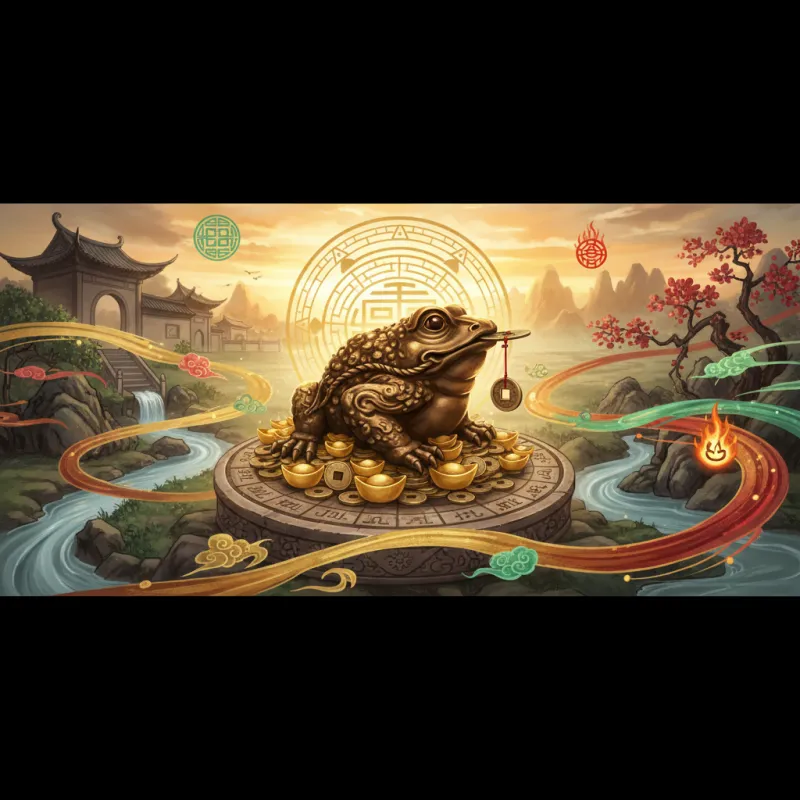
You walk into a dim sum restaurant in San Francisco's Chinatown, and there it is by the cash register: a bloated, bug-eyed toad squatting on a mountain of coins, one leg missing, mouth clamped around a golden disc. Your first thought? "That's the ugliest good luck charm I've ever seen." Your second thought, if you know anything about Chinese business culture: "And it's probably doing more for this restaurant's bottom line than the Yelp reviews."
The three-legged money frog — Jin Chan (金蟾 jīnchán) or Chan Chu (蟾蜍 chánchú) — is feng shui's most paradoxical symbol. It's simultaneously ubiquitous and mysterious, ancient and commercialized, revered and kitsch. Walk through any Chinatown from Vancouver to Singapore, and you'll spot dozens. But ask most shop owners about the toad's actual story, and you'll get vague hand-waving about "good luck" and "prosperity." The real history is far stranger — and far more specific — than most people realize.
The Immortal, The Toad, and The Missing Leg
The money frog's origin story centers on Liu Hai (刘海 Liú Hǎi), a figure who straddles history and mythology so thoroughly that scholars still debate whether he was a real 10th-century official or pure Daoist invention. What we know: Liu Hai appears in texts from the Song Dynasty (960-1279 CE) as a minister who abandoned court life to pursue immortality. What we suspect: his legend absorbed elements from earlier toad-worship traditions and alchemical symbolism that date back to the Han Dynasty.
The canonical version goes like this: Liu Hai kept a three-legged toad as a companion — not a pet, but a spiritual equal. This toad was actually a greedy, malevolent spirit that Liu Hai had subdued and reformed. In some versions, the toad was a demon that had stolen and hoarded wealth from the poor. In others, it was a celestial creature that had been punished (hence the missing leg) for stealing the peaches of immortality from the Queen Mother of the West.
Liu Hai would tie a string of coins to the toad and lower it into wells to retrieve treasures from the underworld. The toad would descend into darkness, fill its mouth with gold, and return to the surface. This image — the toad emerging from depths with wealth clenched in its jaws — became the template for every money frog statue you see today.
But here's what most retellings miss: the toad's missing leg isn't just a quirky detail. In Chinese numerology and five elements theory, three is the number of heaven, growth, and yang energy. A three-legged creature is inherently unstable, always in motion, never at rest — which is exactly what you want from a wealth symbol. Money that sits still stagnates. Money that moves, circulates, and returns (like a toad hopping back from the well) creates prosperity.
What The Toad Actually Represents
Strip away the folk tale, and the money frog embodies several layers of Chinese metaphysical thinking that have nothing to do with "attracting wealth" in the shallow, vision-board sense.
First, it's a yin creature (cold-blooded, nocturnal, associated with water and the moon) that produces yang results (wealth, growth, expansion). This yin-yang reversal is central to Daoist philosophy: true power comes from embracing apparent weakness. The toad is ugly, squat, and missing a leg — yet it controls treasure. It's the ultimate underdog symbol.
Second, the toad's connection to wells and water links it to the ancient Chinese understanding of wealth as flow, not accumulation. Water in feng shui represents money, but only moving water. A stagnant pond breeds mosquitoes; a flowing stream sustains life. The money frog doesn't guard a static hoard like a Western dragon. It dives into the depths and returns, over and over, modeling the circulation that creates lasting prosperity.
Third — and this is where it gets interesting — the toad's three legs mirror the three-legged crow (三足乌 sānzú wū) that lives in the sun in Chinese mythology. The sun crow represents yang, heaven, and imperial power. The moon toad represents yin, earth, and merchant wealth. They're cosmic opposites that balance each other. When you place a money frog in your business, you're not just "attracting money" — you're invoking an entire cosmological system about balance, circulation, and the relationship between celestial and earthly prosperity.
Placement Rules That Actually Matter
Here's where most feng shui advice about money frogs goes off the rails. You'll read that the frog "must face inward" or "should sit diagonally from the door" or "needs to be on a red cloth." Some of this is legitimate. Most of it is modern invention designed to sell more frogs and consultations.
Let's separate signal from noise.
The direction the frog faces actually matters. Traditional placement has the frog facing into the room, toward the center of your home or business, not toward the door. The logic: the toad has just returned from the well with wealth in its mouth, and you want that wealth entering your space, not hopping back out. If the frog faces the door, the symbolism suggests money leaving. This isn't superstition — it's consistent visual metaphor, which is how feng shui actually works.
Height matters more than most people realize. The money frog should never be placed higher than eye level, and definitely not on top of shelves or cabinets where you look up at it. Why? Because the toad is an earth creature, associated with groundedness and the accumulation of tangible wealth. Elevating it too high contradicts its nature. Floor level or low table height is ideal. In businesses, you'll often see the frog on the floor near the cash register or on a low shelf behind the counter.
The wealth corner is optional, not mandatory. Yes, the classical feng shui wealth corner is the far left corner from your entrance (based on the bagua map). But the money frog isn't a crystal grid that needs precise directional alignment. It's a symbolic creature that works through visual reminder and intention. Placing it where you'll see it daily — where it can "watch" the flow of business or household activity — matters more than hitting the exact compass degree.
What you absolutely should avoid: bathrooms (water draining away = wealth draining away), bedrooms (wealth energy is too yang for rest spaces), and kitchens (fire element conflicts with the toad's water nature). Also, don't place the frog directly on the floor in high-traffic areas where people might step over it. That's not feng shui — that's just disrespectful to a symbol you're supposedly honoring.
The Coin In The Mouth: Removable or Fixed?
Walk into ten different Chinese gift shops, and you'll find money frogs with two different designs: some have coins permanently attached in their mouths, others have removable coins that sit loosely in the toad's jaws.
The removable coin version comes with a specific ritual: you're supposed to remove the coin when you leave home or close your business (symbolizing the toad going out to fetch wealth) and replace it when you return (symbolizing the toad bringing wealth back). This creates an active practice, a daily reminder of intention and circulation.
The fixed coin version is simpler — the toad is perpetually in "wealth returned" mode, mouth clamped on treasure. This works better for people who want a passive symbol rather than an active practice.
Neither is "more authentic." The removable coin ritual is probably a 20th-century innovation, but it's not invalid. It creates engagement with the symbol, which is arguably more powerful than a statue you stop noticing after a week. Choose based on your personality: if you're the type who'll actually do a daily ritual, get the removable coin. If you'll forget and feel guilty, get the fixed version.
When The Money Frog Doesn't Work
Let's address the elephant — or rather, the toad — in the room: most people who buy money frogs see zero financial change. They plop the toad on a shelf, wait for wealth to materialize, and end up with nothing but a dusty statue and confirmation that "feng shui is nonsense."
This failure isn't because feng shui doesn't work. It's because people misunderstand what symbols actually do.
The money frog isn't a magic spell. It's a psychological anchor and a visual reminder of specific principles: circulation over hoarding, persistence over passivity, the value of returning to the source (like the toad returning to the well). If you buy a money frog but continue spending impulsively, avoiding financial planning, and treating money as something that "just happens," the toad can't help you. It's not a cosmic vending machine.
But if you place the toad where you see it daily, and let it remind you to check your accounts, follow up on invoices, look for new opportunities, and think about money as something that circulates rather than something you clutch — then yes, the toad "works." Not through magic, but through the same mechanism that makes any symbol powerful: it focuses intention and creates behavioral change.
The Daoists who created the Liu Hai legend understood this. The toad doesn't give Liu Hai wealth. Liu Hai lowers the toad into the well — he does the work. The toad is his tool, his companion, his reminder to keep diving into the depths. That's the real teaching.
Modern Variations and What They Mean
The traditional money frog is jade or gold-colored ceramic, squatting on coins, with red eyes (sometimes made of actual red stones). But modern versions have exploded into countless variations: crystal frogs, resin frogs, frogs holding ingots instead of coins, frogs with exaggerated features, even frogs wearing tiny hats.
Some purists insist only jade or metal frogs have "real" feng shui power. This is nonsense. The material matters less than the form and your relationship to the object. A cheap resin frog that you genuinely connect with will serve you better than an expensive jade frog you bought because someone said you "should."
That said, materials do carry different energetic associations in five elements theory. Jade (earth element) emphasizes stability and accumulation. Metal frogs (obviously metal element) emphasize clarity and precision in financial matters. Resin or ceramic (earth element) is neutral and accessible. Choose based on what you're trying to cultivate, not based on price or "authenticity."
The one variation I'd avoid: cutesy, cartoonish frogs that look more like toys than symbols. The money frog's power comes partly from its slight ugliness, its toad-ness. When you make it too cute, you lose the edge of its symbolism — the idea that wealth comes from diving into uncomfortable depths, from embracing what others find repulsive, from being the underdog that wins.
Living With The Toad
After fifteen years of observing money frogs in businesses and homes across three continents, I've noticed something: the people who get the most from their money frogs aren't the ones who follow placement rules most carefully. They're the ones who develop an actual relationship with the object.
I know a restaurant owner in Taipei who talks to his money frog every morning, telling it about the day's specials and asking it to "bring hungry customers." Superstition? Maybe. But that daily ritual makes him think about his business, his offerings, his customer experience. The toad is his meditation anchor.
I know a freelance designer in Toronto who touches her money frog's head every time she sends an invoice, as a reminder that she's done the work and deserves to be paid. The toad doesn't make clients pay faster, but it makes her more confident about following up, which absolutely does make clients pay faster.
The money frog works best when it's not just décor, but a participant in your financial life. Not because it has magical powers, but because symbols shape behavior, and behavior shapes outcomes. That's not mysticism. That's psychology wearing a toad costume.
Place your money frog where you'll see it. Let it be ugly. Let it remind you that wealth comes from diving deep, returning to the surface, and diving again. Let it teach you that three legs are enough — that you don't need perfect stability to move forward. Let it show you that the mouth that holds treasure is also the mouth that releases it, because circulation, not hoarding, creates prosperity.
And if none of that resonates, if you just think it's a weird little statue that makes your Chinese grandmother happy? That's fine too. Put it on a shelf, let it collect dust, and get back to work. The toad won't judge you. It's missing a leg and looks like it lost a fight with a wok. It's in no position to judge anyone.
Related Reading
- Feng Shui Crystals: Which Ones to Use and Where to Place Them
- Jade in Chinese Culture: More Than a Pretty Stone
- Feng Shui Plants Guide: Which Plants to Use and Where
- Harnessing Chinese Metaphysics: Feng Shui, I Ching, and Divination with Crystals
- Crystals and Jade in Chinese Culture: Why Stones Matter More Than You Think
- Yin and Yang in Health: The Balance That Keeps You Well
- Harmonizing Life Through Feng Shui, I Ching, and Geomancy: A Cultural Exploration
- Swimming Pools and Feng Shui: Wealth Feature or Energy Drain?
Explore Chinese Culture
- Explore Daoist philosophy and practice
- Explore traditional Chinese customs
- Explore ancient Chinese cosmology