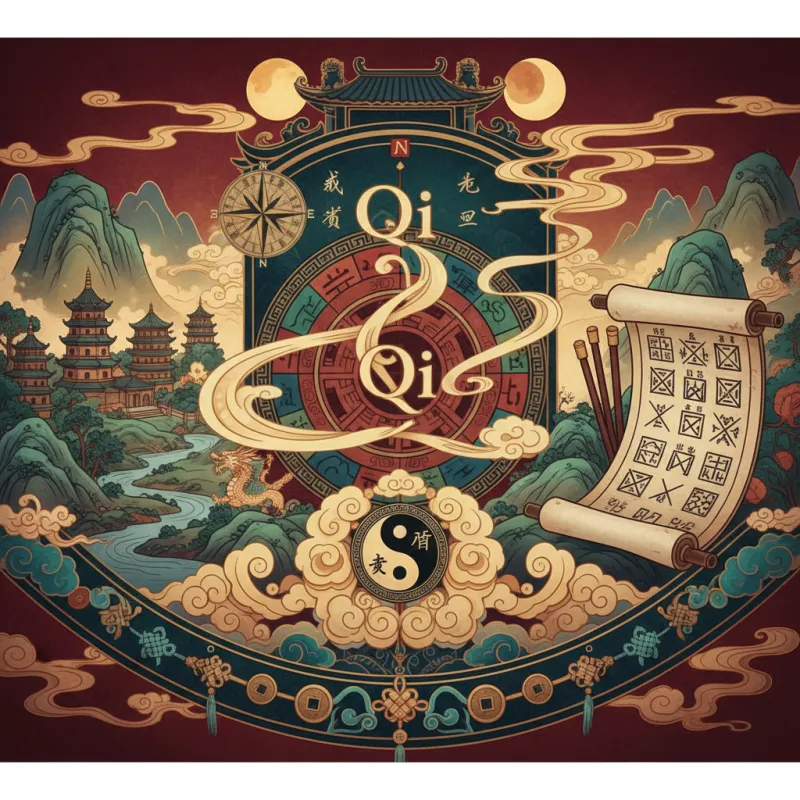
A master geomancer stands at the edge of a construction site in Tang Dynasty Chang'an, compass in one hand, a worn copy of the Yijing (易經, Book of Changes) in the other. He's not just choosing where to build—he's reading the earth's pulse, interpreting hexagrams, and negotiating between heaven, earth, and human intention. This scene, repeated across millennia, reveals something profound: the Chinese never separated space from time, geography from destiny, or the physical from the metaphysical.
When Earth Speaks: The Geomantic Foundation
Feng shui (風水, literally "wind-water") emerged not from philosophical speculation but from survival. During the Warring States period (475-221 BCE), the Zang Shu (葬書, Book of Burial) by Guo Pu established geomancy's core principle: qi (氣, vital energy) rides the wind and stops at water. This wasn't poetry—it was practical wisdom about microclimates, drainage, and protection from harsh northern winds.
The geomancer's art lies in reading long mai (龍脈, dragon veins)—the energetic pathways flowing through mountains and waterways. In traditional practice, an ideal site sits with mountains behind (providing protection and stability) and water in front (bringing prosperity and opportunity). The famous Ming Tombs north of Beijing exemplify this perfectly: thirteen emperors rest in a valley cradled by mountains, with the Wenyu River flowing past. The site wasn't chosen for aesthetics—it was selected because the land's qi accumulation promised ancestral power for generations.
But here's where it gets interesting: geomancy isn't static. The Qing Nang Jing (青囊經, Classic of the Azure Bag) emphasizes that earth's energy shifts with time, which is why understanding the I Ching's temporal wisdom becomes essential for any serious practitioner.
The I Ching: Time's Architecture
While feng shui maps space, the Yijing maps time. Composed during the Western Zhou Dynasty (1046-771 BCE) and expanded with commentaries by Confucius, this text presents 64 hexagrams—each a snapshot of cosmic process, not static state. The genius lies in its recognition that change itself follows patterns.
Consider hexagram 11, Tai (泰, Peace): heaven below, earth above. This "inverted" arrangement represents harmony because heaven's energy naturally rises while earth's descends—they meet in the middle. Contrast this with hexagram 12, Pi (否, Standstill): heaven above, earth below. The energies move apart, creating stagnation. This isn't mysticism—it's a sophisticated model of dynamic equilibrium.
The Yijing entered feng shui practice through the Hou Tian Ba Gua (後天八卦, Later Heaven Arrangement), attributed to King Wen while imprisoned by the Shang Dynasty. This octagonal diagram maps the eight trigrams to compass directions, creating a bridge between spatial orientation and temporal change. When a feng shui master analyzes your home's facing direction, they're not just measuring degrees—they're determining which hexagram energies dominate your space and how they'll transform over time.
The Shi Ying (世應, World-Response) system takes this further, using hexagram positions to predict how environmental changes will affect inhabitants. A home facing southeast (associated with the Xun trigram, representing wind and wood) during a Dui (metal) year faces potential conflict—metal cuts wood. The solution? Introduce water elements to exhaust metal and nourish wood, creating a harmonious cycle.
The Five Elements: Nature's Grammar
Both feng shui and the Yijing operate through wu xing (五行, Five Phases): wood, fire, earth, metal, and water. But calling them "elements" misleads—they're better understood as processes or transformative states. The Shang Shu (尚書, Book of Documents) from the 6th century BCE describes them as dynamic forces in constant interaction.
The productive cycle (sheng) flows naturally: wood feeds fire, fire creates earth (ash), earth bears metal, metal collects water (condensation), water nourishes wood. The controlling cycle (ke) maintains balance: wood parts earth, earth dams water, water quenches fire, fire melts metal, metal cuts wood. Master these relationships, and you understand how to adjust any environment.
Here's a concrete example: A client once complained of constant financial drain despite a successful business. Her office faced west (metal direction) with a large aquarium (water element) directly inside the entrance. Water exhausts metal—her wealth direction was literally flowing away. We relocated the aquarium to the north (water's home position) and added earth elements (ceramics, crystals) in the west to generate metal. Within three months, cash flow stabilized. Coincidence? Perhaps. But the Yijing would call it ying (應)—appropriate response to environmental conditions.
The Luopan: Reading Heaven's Compass
The luopan (羅盤, feng shui compass) represents the culmination of geomantic knowledge. This isn't your hiking compass—it's a sophisticated instrument with up to 40 concentric rings encoding information about directions, elements, hexagrams, stars, and time cycles. The San He (三合, Three Harmonies) school uses it to analyze water flow and mountain formations. The San Yuan (三元, Three Cycles) school adds temporal layers, tracking how qi quality shifts through 180-year cycles.
The compass's center contains the Tianchi (天池, Heaven Pool)—the magnetic needle floating in liquid. Surrounding it, the Hou Tian Ba Gua divides space into eight sectors. Further rings map the 24 mountains (15-degree divisions), the 28 lunar mansions, and the 64 hexagrams. A skilled practitioner can determine not just favorable directions but optimal timing for construction, renovation, or major life decisions.
What fascinates me is how this tool embodies Chinese cosmology's core insight: heaven (time), earth (space), and humanity form an inseparable triad. The compass doesn't just measure—it mediates between these three realms, helping humans find their proper position within cosmic patterns.
Living Practice: Beyond Superstition
Modern skeptics dismiss feng shui as superstition, but this misses the point entirely. The question isn't whether invisible qi exists in some measurable scientific sense—it's whether the system provides a useful framework for environmental awareness and decision-making.
Consider the feng shui principle of ming tang (明堂, bright hall)—the open space in front of a building where qi gathers. Modern urban planning calls this a plaza or courtyard, recognizing that buildings need breathing room. The feng shui prohibition against sleeping with your head toward the door? Basic security instinct. The preference for curved pathways over straight ones? Slows wind, creates visual interest, and prevents erosion.
The Yijing offers similar practical wisdom disguised as divination. Hexagram 15, Qian (謙, Modesty), advises that "the superior person reduces what is excessive and augments what is deficient." This isn't fortune-telling—it's systems thinking about balance and sustainability. When you consult the Yijing about a business decision, you're not accessing supernatural knowledge—you're using a randomization process to break habitual thinking patterns and consider perspectives you might otherwise ignore.
The real power emerges when you combine these systems with understanding your personal bazi elements. Your birth chart reveals your elemental constitution, feng shui adjusts your environment to support it, and the Yijing helps you navigate timing. It's not magic—it's a comprehensive approach to environmental psychology and decision architecture.
The Geomancer's Dilemma: Tradition Meets Modernity
Contemporary practice faces genuine challenges. How do you apply principles developed for single-story courtyard homes to high-rise apartments? What happens when you can't choose your door's facing direction? Does electromagnetic radiation from electronics disrupt qi flow?
Some practitioners adapt creatively. If you can't change your apartment's orientation, adjust internal arrangements to create favorable energy flows. Use mirrors strategically to redirect qi. Introduce elemental corrections through color, material, and form. Others insist on orthodox methods, refusing to work with spaces that violate fundamental principles.
I lean toward pragmatic adaptation while respecting core principles. The Yijing's hexagram 32, Heng (恆, Duration), teaches that true constancy lies in appropriate change—maintaining essence while adapting form. Feng shui's essence is harmonizing human habitation with environmental energies. Whether those energies are called qi, electromagnetic fields, or psychological ambiance matters less than whether the adjustments improve lived experience.
The most sophisticated practitioners I've encountered don't claim supernatural powers—they're keen observers of pattern, skilled at reading landscapes and life situations, and wise enough to know that small environmental changes can trigger significant psychological shifts. They understand that humans are pattern-seeking creatures who thrive on meaning, and that feng shui provides a rich symbolic language for creating intentional, harmonious spaces.
Integration: The Three Treasures United
The true art emerges when feng shui, Yijing, and geomancy work together. Geomancy identifies locations where earth's qi accumulates. Feng shui arranges space to optimize that energy's flow and quality. The Yijing determines optimal timing and helps navigate change as circumstances evolve.
Imagine planning a new home. First, geomantic analysis identifies a site with good long mai—perhaps a gentle slope with mountains behind and water views ahead. Next, feng shui principles orient the building to capture favorable directions based on the occupants' gua numbers (personal trigrams). The Yijing might be consulted to choose an auspicious groundbreaking date when hexagram energies align with the project's intention. Throughout construction and beyond, periodic Yijing consultations help navigate challenges and opportunities as they arise.
This integrated approach recognizes what modern systems theory has rediscovered: everything connects. Your environment shapes your psychology, your psychology influences your decisions, your decisions create your circumstances, and your circumstances feed back into your environment. Feng shui, Yijing, and geomancy provide a traditional framework for managing these feedback loops consciously and skillfully.
The ancient geomancer standing at that construction site wasn't practicing superstition—he was engaging in sophisticated environmental analysis, using tools refined over millennia to help humans find their place in the world. We might use different language now, but the fundamental challenge remains: how do we create spaces and make decisions that support human flourishing? The old methods still have much to teach us, if we're willing to look past surface exoticism to the practical wisdom beneath.
Related Reading
- Bedroom Feng Shui for Better Sleep
- Feng Shui for Your Home Entrance: First Impressions Matter
- Feng Shui Annual Forecast: How the Year's Energy Affects Your Home
Explore Chinese Culture
- Explore Daoist philosophy and practice
- Explore traditional Chinese customs
- Explore ancient Chinese cosmology