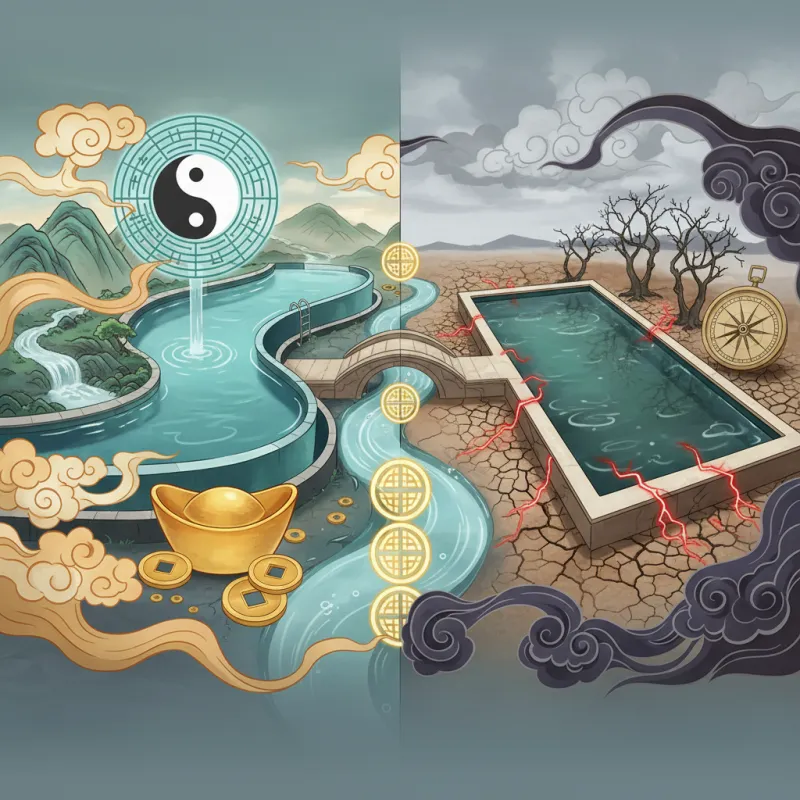
Picture this: A Silicon Valley tech executive spends $200,000 installing a stunning infinity pool that cascades toward the street. Six months later, his company's stock tanks, his marriage crumbles, and he's hemorrhaging cash on legal fees. Coincidence? A feng shui master would say he built himself a wealth evacuation system and then wondered why his fortune drained away.
Swimming pools occupy a peculiar position in feng shui practice. Water is the ultimate wealth symbol in Chinese metaphysics — the character for water (水, shuǐ) appears in countless prosperity-related terms. Yet a pool can just as easily become what classical texts call a "wealth coffin" (財棺, cái guān) if positioned incorrectly. The difference between a fortune-enhancing water feature and a financial black hole often comes down to a few critical factors that most architects and homeowners completely ignore.
The Classical View: Why Ancient Masters Feared Still Water
The Yang Zhai San Yao (陽宅三要, "Three Essentials of Yang Dwellings"), written during the Qing Dynasty, contains a warning that modern pool owners should tattoo on their forearms: "Water that gathers but does not flow becomes yin water — it attracts stagnation, illness, and loss." The text specifically cautions against large bodies of still water positioned in certain sectors of a property.
Here's what the ancients understood that we've forgotten: natural water bodies — rivers, streams, lakes — have ecosystems. They're alive. A swimming pool is essentially a giant bathtub. Without constant circulation and chemical treatment, it becomes a breeding ground for mosquitoes and algae within days. This stagnant quality creates what feng shui calls "dead water" (死水, sǐ shuǐ), which generates sha qi (煞氣, harmful energy) rather than the beneficial sheng qi (生氣, vital energy) associated with flowing water.
The Di Li Wu Jue (地理五訣, "Five Secrets of Earth Principles") goes further, stating that "water in front of the main door that does not move is like a mirror reflecting misfortune back into the home." This isn't mystical nonsense — it's observational wisdom. A pool positioned directly in front of your entrance creates a psychological barrier. Visitors must navigate around it. The reflection can be disorienting. The humidity affects the building's facade. Ancient practitioners didn't have our vocabulary of psychology and building science, but they recognized the problems.
The Directional Dilemma: Where Water Becomes Wealth or Waste
In Flying Star feng shui (飛星風水, fēi xīng fēng shuǐ), water placement depends on the property's facing direction and the current time period. We're currently in Period 9 (2024-2043), where the most auspicious water positions have shifted from Period 8. A pool that was perfectly positioned in 2003 might be draining your wealth in 2024.
The general principle: water should be positioned where it can "collect" the beneficial qi entering your property. For most homes, this means the side or back, not the front. The front of a property is the "bright hall" (明堂, míng táng) — it should be open and clear to allow qi to gather before entering the home. A large pool in the front creates what classical texts call a "water barrier" (水障, shuǐ zhàng).
I once consulted for a family in Bali whose villa had a massive pool between the entrance gate and the front door. The husband's business had collapsed within a year of moving in. The wife developed chronic fatigue. Their teenage daughter became depressed. The pool wasn't the only factor, but it was significant: every time they came home, they had to walk around this body of water, subconsciously reinforcing a sense of obstacle and separation from their own dwelling.
We couldn't move the pool — that would have cost more than the house — but we did three things: installed a powerful circulation system to keep the water constantly moving, added a fountain feature that directed water flow back toward the house, and planted a dense hedge between the pool and the entrance to create a visual and energetic barrier. Within six months, the husband's new venture was profitable, and the family dynamics had noticeably improved.
The Infinity Pool Problem: When Water Disappears, So Does Money
Infinity pools are architectural marvels — water appears to merge with the horizon, creating a stunning visual effect. They're also feng shui disasters in most configurations. The principle is simple: water flowing away from your home represents wealth leaving. An infinity edge where water constantly spills over and disappears? That's wealth in perpetual exodus.
The Shui Long Jing (水龍經, "Water Dragon Classic") states: "Water that arrives is wealth arriving; water that departs is wealth departing." An infinity pool positioned so water flows away from the house violates this fundamental principle. It doesn't matter how beautiful it looks or how much it cost — you've built an expensive metaphor for financial loss.
There's a famous case in Hong Kong's Peak district where a billionaire installed an infinity pool with the edge facing away from his mansion toward the harbor view. Within three years, he'd lost two major business deals, faced a costly divorce, and sold the property at a loss. The new owner, advised by a feng shui master, installed a raised wall at the infinity edge and repositioned the overflow system so water circulated back toward the house. Anecdotal? Sure. But in Chinese business culture, these stories circulate for a reason.
The solution isn't to avoid infinity pools entirely — it's to position them correctly. If the infinity edge faces toward the house or runs parallel to it rather than away from it, the feng shui impact is neutral or even positive. The key is the direction of water flow and visual disappearance.
Shape Matters: Why Kidney Pools Make Feng Shui Masters Cringe
Traditional feng shui favors regular shapes — rectangles, squares, circles, ovals. Irregular shapes, especially those with sharp angles or bizarre curves, create what's called "poison arrows" (毒箭, dú jiàn) or disrupt the smooth flow of qi around the property.
The kidney-shaped pool, popular in 1950s American suburbia and somehow still being built today, is particularly problematic. That concave curve creates a "missing corner" effect in the property's energy field. If the indentation points toward the house, it's like having a bite taken out of your wealth sector. The Ba Zhai Ming Jing (八宅明鏡, "Eight Mansions Bright Mirror") specifically warns against "water bodies with mouths that bite toward the dwelling."
I've seen this play out repeatedly. A couple in Scottsdale had a kidney-shaped pool with the concave side facing their master bedroom. They experienced chronic insomnia, frequent arguments, and the husband developed heart problems. We couldn't change the pool shape, but we installed a row of tall plants along the concave edge to "fill in" the missing section visually and energetically. Combined with other adjustments, their sleep improved within weeks.
Rectangular pools are ideal — they're clean, classical, and create stable energy. Circular or oval pools work well too, especially when positioned in the back or side yard. If you must have an irregular shape, ensure the curves are gentle and flowing, not sharp or aggressive. And never position the pool so a sharp corner or concave section points directly at the house.
The Chemical Conundrum: Chlorine, Salt, and Energetic Purity
Here's where traditional feng shui meets modern pool maintenance in uncomfortable ways. Classical texts assume natural water — from wells, springs, or rainwater collection. They don't account for water so heavily treated with chemicals that it would kill fish instantly.
Heavily chlorinated water has a harsh, yang quality that can create aggressive energy. I'm not suggesting you skip pool maintenance and let algae take over — that creates the "dead water" problem discussed earlier. But there's a balance. Salt water pools, which use electrolysis to generate chlorine naturally, tend to have a softer energetic quality. Natural pools with biological filtration systems are even better, though they're expensive and require expertise to maintain.
The Qing Nang Ao Yu (青囊奧語, "Secret Language of the Azure Bag") emphasizes that water quality affects the quality of qi it generates. "Pure water generates pure qi; turbid water generates turbid qi." While this text predates modern chemistry by centuries, the principle holds: the energetic quality of your pool water matters.
One practical approach: minimize chemical use through proper circulation, filtration, and regular maintenance. Consider UV or ozone systems that reduce chlorine requirements. Keep the water crystal clear — cloudy or greenish water generates negative psychological and energetic effects regardless of chemical composition.
Integration with the Five Elements: Water's Relationships
In five element theory (五行, wǔ xíng), water has specific relationships with other elements. Water nourishes wood, is controlled by earth, controls fire, and is generated by metal. Understanding these relationships helps integrate a pool into your property's overall feng shui.
A pool surrounded by lush plants (wood element) creates a nourishing cycle — water feeds wood, wood softens water's sometimes harsh energy. This is why landscaping around pools isn't just aesthetic; it's energetically functional. Bamboo, palms, and other water-loving plants create this beneficial relationship naturally.
Conversely, too much earth element around a pool — heavy stone decking, massive boulders, earth-toned tiles — can create a controlling relationship where earth "dams" water's flow. This manifests as stagnation in the residents' lives, particularly in career and financial matters. Balance is key: some stone for structure and safety, but not so much that it overwhelms the water element.
Fire element features near pools — fire pits, outdoor kitchens, red or orange decor — create elemental conflict. Water and fire are natural opponents in five element theory. While a small fire feature might be acceptable if positioned carefully, large fire elements near water create energetic tension that residents often experience as internal conflict or relationship stress.
For more on how water interacts with other elements in your environment, see Water Features in Garden Feng Shui and Aquariums and Water Element Balance.
Practical Guidelines: Making Your Pool Work for You
After two decades of consulting on properties with pools, here are the non-negotiable principles I follow:
Position: Back or side yard, never directly in front of the main entrance. If you have a front-facing pool, create visual and physical barriers between it and the entrance — hedges, walls, or substantial landscaping.
Flow direction: Water should circulate toward the house, not away from it. If you have an infinity edge, it should face toward the house or run parallel to it. Install fountains or features that direct water flow back toward the dwelling.
Shape: Regular geometric shapes — rectangles, squares, ovals, circles. Avoid sharp angles pointing at the house and concave curves facing the dwelling.
Maintenance: Keep water crystal clear and constantly circulating. Dead water is worse than no water. Consider salt systems or natural filtration to reduce harsh chemical energy.
Landscaping: Surround the pool with lush, healthy plants to create a wood element buffer. Avoid excessive stone or earth-toned materials that dam water's energy.
Lighting: Soft, warm lighting around pools creates a welcoming energy. Harsh, bright lights or colored LED displays create aggressive, unstable qi.
Size proportion: The pool should be proportional to the property. An Olympic-sized pool on a small lot overwhelms the space energetically. A tiny plunge pool on a massive estate looks — and feels — inadequate.
The Renovation Question: When to Fix, When to Accept
Not every pool problem requires expensive renovation. Sometimes strategic adjustments — circulation improvements, landscaping changes, lighting modifications — can shift a pool from liability to asset. Other times, the pool's position or configuration is so problematic that no amount of adjustment helps.
I once worked with a family whose pool was positioned in what Flying Star analysis identified as the "five yellow" sector for their property's facing direction — the most inauspicious position possible. We tried everything: fountains, plants, lighting, circulation changes. Nothing helped. Their financial and health problems persisted. Eventually, they filled in the pool and converted the space to a garden. Within a year, their circumstances had dramatically improved.
That's an extreme case, but it illustrates an important point: sometimes the best feng shui solution is removal, not adjustment. If you're considering adding a pool, invest in a proper feng shui consultation first. The few hundred dollars you spend on analysis could save you from building a six-figure mistake.
For existing pools, work with what you have. Most pool problems can be mitigated through thoughtful adjustments. But if you've tried multiple solutions and problems persist, consider whether the pool is truly serving your life or draining it — financially, energetically, and practically.
The ultimate test isn't what ancient texts say or what feng shui theory predicts. It's how you feel when you look at your pool, how your life has unfolded since installing it, and whether it brings genuine joy and vitality to your home. A pool that sits unused, requires constant expensive maintenance, and creates stress isn't good feng shui regardless of its position or shape. Sometimes the best water feature is the one you don't build.
Related Reading
- Water Feng Shui for Wealth: Fountains, Aquariums, and Flow
- Feng Shui Aquarium Fish: Types, Numbers, and Placement Rules
- Rainwater Collection and Feng Shui: Catching Wealth from the Sky
- Water in Feng Shui: Ponds, Fountains, and Aquariums
- ** Exploring the Harmonious Relationship Between Feng Shui and Plants in Chinese Metaphysics
- Five Element Compatibility: The Productive and Destructive Cycles
- Unlocking the Ancient Arts: Feng Shui, I Ching, and the Mysteries of Chinese Metaphysics
Explore Chinese Culture
- Explore Daoist philosophy and practice
- Explore traditional Chinese customs
- Explore ancient Chinese cosmology