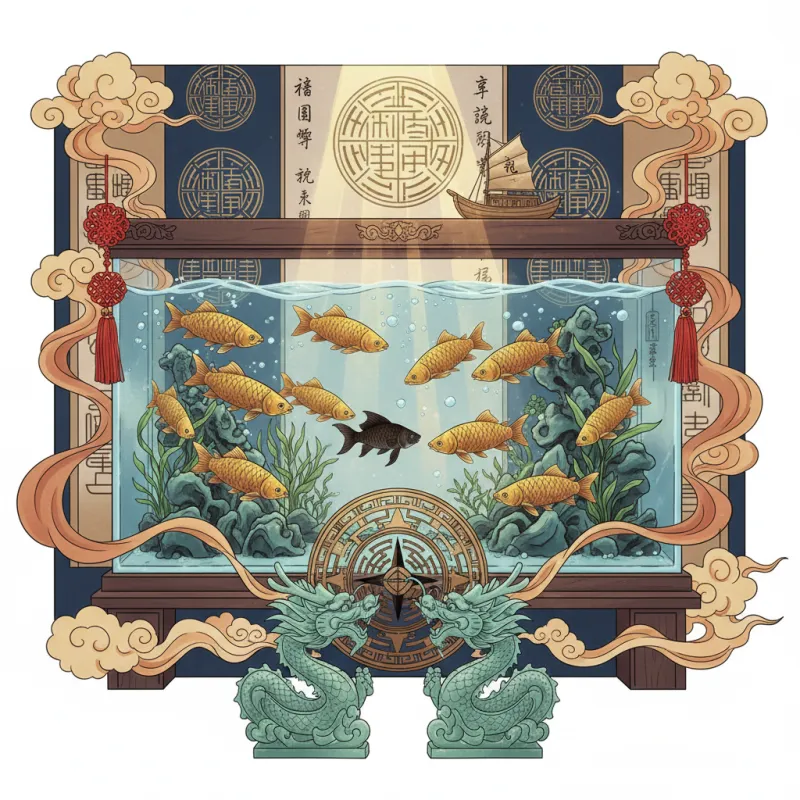
A goldfish died in my uncle's office aquarium on a Tuesday morning. By Wednesday, his accountant had discovered a $50,000 bookkeeping error that would have bankrupted the company if it had gone unnoticed another month. "The fish took the bad luck," he said, replacing it immediately. I rolled my eyes then. I'm less certain now.
The practice of keeping feng shui fish isn't superstition dressed up as interior design — it's a systematic approach to managing environmental energy that's been refined over centuries. The fish aren't decorative. They're active participants in your space's energy circulation, and choosing the wrong species, number, or placement can turn a wealth-attracting feature into an energy drain.
The Core Principle: Why Fish Work in Feng Shui
Water represents wealth in feng shui theory, but stagnant water breeds negative qi (气 Qì). An aquarium solves this elegantly: the filter keeps water moving, the fish keep it alive, and the combination creates what classical texts call 活水生财 (Huó Shuǐ Shēng Cái) — "living water generates wealth."
But here's what most guides miss: the fish themselves are yang energy (阳气 Yáng Qì) moving through yin substance (阴质 Yīn Zhì). This dynamic creates the energetic friction that activates wealth luck. A beautiful aquarium with no fish is just expensive furniture. The fish are the engine.
This is why fish health matters so obsessively in feng shui practice. A sick fish indicates weakening yang energy. A dead fish suggests the aquarium absorbed negative energy that would otherwise have affected the household — which is why practitioners replace dead fish immediately rather than mourning them.
Species Selection: Not All Fish Are Equal
Goldfish: The Foundation Species
Goldfish (金鱼 Jīn Yú, literally "gold fish") are the default recommendation for good reason. They're hardy, visible, and their Chinese name directly invokes metal element and wealth symbolism. The fancy varieties — Orandas, Ryukins, Ranchus — are considered especially auspicious because their elaborate fins create more movement, thus more energy activation.
Red and gold goldfish are standard, but black goldfish serve a specific function: absorbing negative energy. Classical feng shui recommends one black fish among several red/gold ones — the black fish acts as a protective barrier, taking hits meant for the household. When a black goldfish dies, it's considered to have fulfilled its purpose.
Arowana: The Prestige Choice
The Asian Arowana (龙鱼 Lóng Yú, "dragon fish") commands insane prices — $300 to $300,000 depending on coloration — because its scales, whiskers, and swimming motion resemble a Chinese dragon. In feng shui theory, it's the most powerful wealth-attracting fish available.
But Arowanas are also aggressive, territorial, and require massive tanks (minimum 250 gallons). I've seen practitioners keep a single Arowana in an office lobby aquarium, treating it like a corporate mascot. The fish becomes a conversation piece, a status symbol, and a feng shui tool simultaneously. Whether it actually improves business luck or just impresses clients enough to sign contracts is an interesting question.
Koi: Outdoor Specialists
Koi (锦鲤 Jǐn Lǐ) are technically outdoor pond fish, but they appear in feng shui discussions because of their symbolism. The legend of koi swimming upstream and transforming into dragons represents perseverance and transformation. They're associated with career advancement and overcoming obstacles.
In practice, koi need too much space for most indoor aquariums. But if you have a garden pond, nine koi (eight red/gold, one black) is the classic configuration. The number nine (九 Jiǔ) sounds like "long-lasting" (久 Jiǔ) in Chinese, making it the most auspicious number for fish.
Guppies and Mollies: The Multiplication Strategy
These livebearers reproduce constantly, which some practitioners interpret as "multiplying wealth." They're cheap, colorful, and active — all positive traits. The downside is they're small and easily overlooked, which reduces their visual impact and thus their energy activation potential.
I'd recommend them for beginners or small spaces where goldfish would be cramped. A thriving guppy colony creates impressive movement and life energy, even if individual fish lack the symbolic weight of an Arowana.
The Numbers Game: Feng Shui Fish Counting
The number of fish in your aquarium isn't arbitrary — it's based on Luoshu magic square (洛书 Luò Shū) numerology and five element theory. Here's the practical breakdown:
One fish: Represents water element. Enhances career luck and wisdom. Minimalist but effective for small spaces.
Six fish: The most recommended number for wealth. Six corresponds to metal element in Luoshu numerology, and metal generates water in the five element cycle. This creates a self-reinforcing wealth energy loop.
Eight fish: Represents earth element and current period luck (we're in Period 8 until 2024, then Period 9 begins). Eight is considered extremely auspicious for wealth accumulation.
Nine fish: The maximum yang number. Represents completeness and long-lasting fortune. The classic configuration is eight red/gold fish plus one black fish for protection.
Avoid four: The number four (四 Sì) sounds like death (死 Sǐ) in Chinese. No feng shui practitioner will recommend four fish.
Here's the nuance most articles miss: these numbers refer to visible, healthy fish. If you have nine fish but three are constantly hiding, you effectively have six fish from an energy perspective. Fish that don't swim actively don't activate energy.
Color Symbolism: Beyond Red and Gold
Red fish (fire element): Activate fame, recognition, and passionate energy. Good for creative professionals or anyone seeking visibility.
Gold/Yellow fish (earth element): Classic wealth attractors. Earth generates metal, metal generates water — this creates a smooth energy flow toward prosperity.
Black fish (water element): Protection and negative energy absorption. Always include at least one in a multi-fish setup.
White fish (metal element): Enhance clarity, precision, and metal element luck. Good for people in finance, law, or technical fields.
Blue fish (water element): Rare in feng shui recommendations because they're hard to see in water, reducing their energy activation potential. But they can enhance water element for people who need more career and wisdom luck.
The color combinations matter more than individual colors. A tank of all black fish would be oppressively yin. A tank of all red fish might create too much fire energy, leading to conflict and stress. The balanced approach — mostly gold/red with one black — creates harmony while maintaining strong wealth activation.
Placement Rules: Where Your Aquarium Goes
The Wealth Corner
In classical feng shui, the southeast corner of your home or office represents the wealth sector (财位 Cái Wèi). Placing an aquarium here directly activates wealth luck. But this assumes you're using compass directions accurately — most people guess, which makes the placement meaningless.
A more practical approach: place the aquarium in the diagonal corner from your main entrance. This position, called the "bright hall" (明堂 Míng Táng), is where energy accumulates after entering your space. An aquarium here keeps that energy active and circulating rather than stagnating.
The Living Room Default
If you're unsure about compass directions or energy sectors, the living room is the safest placement. It's a yang space (active, social) where the aquarium's energy activation makes sense. Avoid bedrooms — the constant water movement and filter noise create too much yang energy for a yin (restful) space.
Avoid These Locations
Behind the stove: Water and fire elements clash. This placement creates elemental conflict that manifests as family arguments and financial instability.
Under a beam: Overhead beams create oppressive energy (压煞 Yā Shà) that suppresses the aquarium's positive effects.
Directly facing the main door: This is controversial. Some practitioners say it "washes away" incoming wealth. Others say it activates wealth immediately upon entering. I lean toward avoiding it — why risk the negative interpretation?
In the bathroom: Water draining away symbolizes wealth loss. An aquarium here reinforces that symbolism rather than countering it.
Maintenance as Feng Shui Practice
Here's what separates effective feng shui aquariums from decorative failures: consistent maintenance. Dirty water, sick fish, broken filters, algae-covered glass — these don't just look bad, they actively generate negative energy.
The water quality represents your wealth quality. Murky water suggests unclear financial situations. Clean, clear water suggests transparent, flowing prosperity. This isn't metaphor — it's the core principle. If you can't commit to weekly water changes and daily feeding, don't get a feng shui aquarium.
Dead fish must be replaced immediately. Leaving a dead fish in the tank (or worse, not replacing it) creates a "wealth leak" in feng shui terms. The fish absorbed negative energy by dying — honor that by maintaining the aquarium's energy integrity.
I've seen people obsess over getting nine fish in the perfect color combination, then neglect basic maintenance. The numbers and colors matter far less than having healthy, active fish in clean water. A thriving six-fish aquarium beats a neglected nine-fish setup every time.
The Skeptical Perspective: What's Actually Happening
Let's be honest: there's no scientific mechanism by which fish species or numbers affect your financial luck. But there are psychological and practical effects worth considering.
An aquarium requires daily attention. You check the fish, monitor water quality, ensure equipment works. This creates a mindfulness practice around your space. You're more aware of your environment, more attentive to details, more proactive about maintenance. These habits transfer to other areas of life, including business and finance.
The aquarium also serves as a conversation piece and status symbol. That $15,000 Arowana signals success and cultural knowledge. It impresses clients, starts conversations, and creates memorable associations with your business. Is that feng shui or marketing? Does the distinction matter if the results are the same?
And there's the placebo effect of confidence. If you believe your feng shui aquarium attracts wealth, you might take more business risks, negotiate more aggressively, or pursue opportunities more boldly. The aquarium didn't create luck — it created the psychological conditions for you to create your own luck.
I'm not dismissing feng shui fish as pure superstition. I'm suggesting the mechanism might be more subtle and psychological than mystical. The practice works, even if the explanation is incomplete.
Practical Setup Guide
If you're actually setting up a feng shui aquarium (rather than just reading about it), here's the streamlined approach:
Tank size: Minimum 20 gallons for goldfish, 40+ gallons for multiple fish. Bigger is always better — more water volume means more stable conditions and healthier fish.
Equipment: Quality filter (oversized for your tank), heater if needed, air pump for additional oxygenation. The water must stay clean and well-oxygenated.
Fish selection: Start with six goldfish (five red/gold, one black) or eight goldfish (seven red/gold, one black). Choose fancy varieties for more movement and visual impact.
Placement: Southeast corner if you know it accurately, otherwise the diagonal corner from your main entrance. Living room or office, never bedroom or bathroom.
Maintenance schedule: 25% water change weekly, filter cleaning monthly, daily feeding (small amounts), daily visual check of fish health.
Replacement protocol: If a fish dies, remove it immediately and replace it within 24-48 hours. Don't let the tank sit with fewer fish than your target number.
The setup matters less than the consistency. A modest aquarium maintained perfectly beats an elaborate setup that's neglected.
Integration with Other Feng Shui Practices
The aquarium doesn't exist in isolation — it's part of your overall feng shui strategy. Consider how it interacts with other elements:
Wealth vase (财宝瓶 Cái Bǎo Píng): Some practitioners place a wealth vase near the aquarium to amplify wealth energy. The vase contains symbolic items (coins, crystals, grains) and remains sealed. For more on wealth vases and their proper construction, see Feng Shui Water Features for Wealth.
Plants: Adding lucky bamboo or other water plants to the aquarium introduces wood element, which water generates in the five element cycle. This creates a water-wood growth energy that some practitioners prefer for career advancement rather than pure wealth accumulation.
Lighting: The aquarium light should be bright enough to see the fish clearly but not harsh. Good lighting enhances yang energy and makes the fish more visible, increasing their energy activation potential.
Crystals: Some practitioners add crystals to the aquarium substrate — citrine for wealth, clear quartz for energy amplification. I'm skeptical of this unless the crystals are aquarium-safe and don't affect water chemistry.
The key is maintaining elemental balance. Too many additions create confusion and conflicting energies. The aquarium's primary function is water element activation — don't dilute that with excessive layering.
When Fish Keeping Becomes Obsession
I've met feng shui enthusiasts who check their fish more often than their email, who can recite the exact date each fish was added, who maintain detailed logs of water parameters and fish behavior. At what point does feng shui practice become aquarium hobby with mystical justification?
The line is blurry, and maybe that's fine. If maintaining a feng shui aquarium gives you a sense of control, a daily ritual, and a beautiful living feature in your space, does the underlying belief system matter? The practice has value independent of its metaphysical claims.
But there's also a trap: attributing every life event to your aquarium. Business success? The fish. Financial setback? Must be the aquarium placement. This kind of magical thinking removes your agency and prevents you from analyzing actual causes.
Use the aquarium as one tool among many. Maintain it consistently, appreciate its beauty and symbolism, but don't let it become a crutch that prevents rational decision-making. The fish can't save a failing business or fix poor financial habits. They can, at best, create an environment that supports your own efforts toward prosperity.
For those interested in how water features more broadly function in feng shui practice, including fountains and ponds, see Water Element Placement in Feng Shui. The principles overlap significantly with aquarium placement but with different considerations for outdoor versus indoor applications.
Related Reading
- Rainwater Collection and Feng Shui: Catching Wealth from the Sky
- Water in Feng Shui: Ponds, Fountains, and Aquariums
- Swimming Pools and Feng Shui: Wealth Feature or Energy Drain?
- Water Feng Shui for Wealth: Fountains, Aquariums, and Flow
- Burial Feng Shui: The Ancient Art of Grave Placement
- The Bagua: Eight Symbols That Explain Everything
- Unlocking the Secrets of Feng Shui and I Ching: A Journey Through Chinese Metaphysics
Explore Chinese Culture
- Explore Daoist philosophy and practice
- Explore traditional Chinese customs
- Explore ancient Chinese cosmology