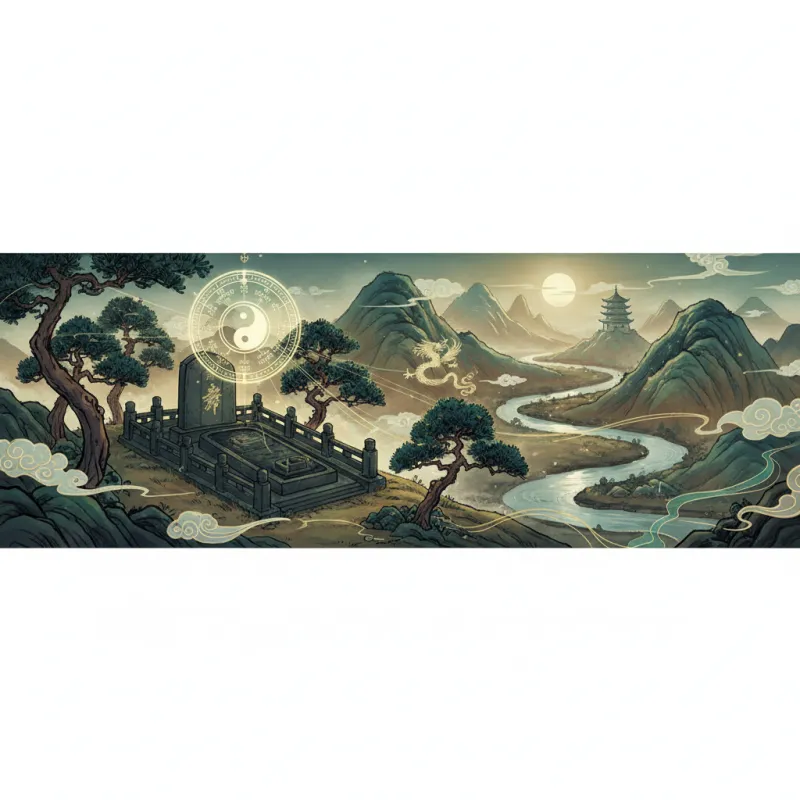
Your grandmother's grave might be more powerful than her will. In traditional Chinese thought, the location of her bones—whether they rest in a mountain hollow where water pools or on a windswept ridge—could determine whether your business thrives, your children excel in school, or your family line continues for another generation. This isn't superstition dressed up as philosophy. It's burial feng shui (阴宅风水 yīnzhái fēngshuǐ), and for over two thousand years, it shaped where Chinese families placed their dead and why they sometimes moved them.
The Dragon Beneath the Ground
Burial feng shui operates on a premise that sounds mystical but follows its own internal logic: the earth has veins of concentrated energy called dragon veins (龙脉 lóngmài), and these veins pulse with qi (气 qì) the way blood vessels carry life through a body. Find where these veins converge, where the dragon "settles" or "sleeps," and you've found a power spot—what practitioners call a dragon's lair (龙穴 lóngxué).
The earliest systematic text on this practice, the Zangshu (葬书 Zàngshū, "Book of Burial"), attributed to Guo Pu (郭璞 Guō Pú) of the Jin Dynasty (276-324 CE), opens with a statement that became doctrine: "Burial means riding the qi." Not containing it, not blocking it, but positioning the coffin so it rides the current of earth energy the way a boat rides a river. Guo Pu wrote that qi disperses when it meets wind and gathers when it meets water—hence feng shui, literally "wind-water."
What makes burial feng shui different from yang house feng shui for the living is the permanence. You can rearrange furniture, move to a new house, change your office. But once you bury someone, that location becomes a fixed transmitter, broadcasting its energetic signature to all descendants through what practitioners describe as a resonance between ancestral bones and living blood. Get it wrong, and you've cursed your lineage. Get it right, and you've secured advantages for generations.
Reading the Landscape Like a Text
A feng shui master examining potential burial sites doesn't just look at the land—they read it. The ideal site follows a formula so specific that it appears in text after text: the Azure Dragon (青龙 qīnglóng) on the left, the White Tiger (白虎 báihǔ) on the right, the Vermillion Bird (朱雀 zhūquè) in front, and the Black Tortoise (玄武 xuánwǔ) behind.
Translated from poetic imagery to topography, this means: a mountain or high ground behind the grave (the tortoise, providing protection and support), lower hills embracing the site from the left and right (the dragon and tiger, creating a sheltered "armchair" formation), and an open area in front with a view toward water or a valley (the bird, allowing qi to gather without stagnating).
The master walks the land looking for what's called "the embrace" (环抱 huánbào)—a natural formation where the landscape seems to cup the burial site protectively. They observe water flow, because water carries qi, and they want it to approach the grave in a meandering curve, not a straight rush. They check the soil, preferring earth that's neither too wet (which suggests qi is drowning) nor too dry (which suggests qi has fled). They note the vegetation, looking for lush growth that indicates concentrated life force.
During the Qing Dynasty, the Kangxi Emperor (康熙帝 Kāngxī Dì, r. 1661-1722) spent years selecting his burial site in the Eastern Qing Tombs. The location chosen—Changrui Mountain (昌瑞山 Chāngruì Shān)—embodied every principle: mountains behind, hills embracing from both sides, a river flowing in gentle curves before the site, and a view that opened toward the south. The imperial feng shui masters declared it a place where "dragon qi gathers and does not disperse." Whether or not it brought fortune to the Qing line is debatable—the dynasty fell in 1912—but the site selection process reveals how seriously even emperors took burial feng shui.
The Compass, the Calendar, and the Corpse
Selecting a site is only the first step. The burial itself must be timed and oriented with precision that would satisfy an astronomer. This is where the luopan (罗盘 luópán), the feng shui compass, becomes essential. Unlike a simple directional compass, the luopan contains up to forty concentric rings encoding information about the five elements (五行 wǔxíng), the eight trigrams (八卦 bāguà), the twenty-four mountains (二十四山 èrshísì shān), and the sixty-four hexagrams of the I Ching (易经 Yìjīng).
The master uses the luopan to determine the precise orientation of the grave—not just "facing south" but "facing 187 degrees, in the direction of the Bing (丙 bǐng) mountain." This orientation must harmonize with the deceased's birth data (their bazi 八字 bāzì, or "eight characters" derived from birth year, month, day, and hour) and with the surrounding landforms.
Then comes the burial date, selected through a process that makes Western astrology look simple. The date must avoid conflicts with the deceased's zodiac sign, harmonize with the site's directional energy, and fall during an auspicious period according to the Chinese almanac (通书 tōngshū). Some families wait months or even years for the right date, keeping the coffin in temporary storage.
I've read accounts from the Republican era (1912-1949) of families hiring multiple feng shui masters to verify each other's calculations, because the stakes felt that high. One master might declare a date auspicious; another might find a hidden conflict in the elemental interactions. The family would then negotiate between the masters' recommendations, sometimes paying for a third opinion. This wasn't paranoia—it was due diligence when you believed your children's futures hung in the balance.
When Graves Go Wrong
The flip side of burial feng shui's promise is its threat: a poorly placed grave doesn't just fail to help descendants—it actively harms them. The literature is full of case studies (whether factual or cautionary tales) linking family misfortunes to burial errors.
A grave placed where water flows away too quickly is said to cause wealth to drain from the family. A site exposed to harsh winds brings illness and early death. A location where the White Tiger (right side) is higher than the Azure Dragon (left side) supposedly causes women in the family to dominate or brings misfortune to male descendants. A grave facing a sharp mountain peak or the corner of a building—what's called a "poison arrow" (煞气 shàqì)—directs harmful qi toward the descendants.
The Qing Dynasty scholar Jiang Dahong (蒋大鸿 Jiǎng Dàhóng, 1616-1684) documented cases where families experienced sudden reversals of fortune after burials. In one account, a wealthy merchant family buried their patriarch on a site that seemed auspicious but had a hidden flaw: a underground water vein that "cut" through the grave site. Within three years, the family business collapsed, and two sons died young. They exhumed the body, reburied it in a corrected location, and—according to Jiang—the family's fortunes stabilized.
Whether these stories prove feng shui's validity or simply reflect confirmation bias and the human need to explain misfortune is beside the point. What matters is that for centuries, Chinese families believed them enough to act on them. The practice of "moving the grave" (迁坟 qiānfén) exists precisely because burial feng shui allows for correction. If a family experiences persistent bad luck, they might consult a master who examines the ancestral graves and recommends relocation.
The Politics of Burial
Burial feng shui was never just a family matter—it was political. Control over auspicious burial sites meant control over who could accumulate power. During the Ming Dynasty (1368-1644), the imperial court maintained strict regulations about who could be buried where. Commoners were forbidden from using sites with "imperial" feng shui characteristics, and violators faced severe punishment.
The Qing Dynasty took this further. After conquering China, the Manchu rulers worried that Han Chinese families might use burial feng shui to accumulate enough "dragon qi" to challenge Qing authority. They implemented policies restricting access to the most powerful sites and sometimes forced the relocation of graves that were deemed too auspiciously placed. The subtext was clear: we control the dragon veins, therefore we control the mandate of heaven.
This political dimension explains why feng shui for the dead was often more controversial than feng shui for the living. A well-placed house might bring prosperity to one family. A well-placed grave could theoretically elevate an entire lineage to power over generations. The practice contained an implicit challenge to the idea that social hierarchy was fixed.
Modern Survival and Adaptation
The Communist revolution of 1949 officially rejected feng shui as feudal superstition. During the Cultural Revolution (1966-1976), Red Guards destroyed ancestral graves and persecuted feng shui practitioners. The practice went underground, preserved in overseas Chinese communities and in rural areas where enforcement was lax.
Yet burial feng shui never completely died. In Taiwan, Hong Kong, and Singapore, it continued openly. In mainland China, it survived in modified forms and began resurging in the 1980s as economic reforms relaxed ideological controls. Today, even as China modernizes rapidly, families still consult feng shui masters for burial site selection, though the practice has adapted to contemporary constraints.
Urban cremation policies have forced innovation. Some practitioners now apply burial feng shui principles to columbarium niches, treating the niche location and orientation as they would a grave site. Others focus on ancestral tablet placement in homes or temples. The underlying belief—that proper treatment and positioning of ancestral remains affects living descendants—persists even when the physical practice changes.
In rural areas where traditional burial remains possible, the practice continues with remarkable fidelity to classical texts. I've read recent anthropological accounts from Fujian and Guangdong provinces describing burial site selections that follow the same protocols Guo Pu outlined seventeen centuries ago: reading the dragon veins, checking the four celestial animals, timing the burial according to the almanac.
Why It Still Matters
You might dismiss burial feng shui as an elaborate system built on false premises—and from a modern scientific standpoint, you'd be right that ancestral bones don't transmit fortune through mystical resonance. But that misses what the practice actually represents: a sophisticated attempt to integrate the dead into the landscape, to make geography meaningful, and to give families a sense of agency over fate.
Burial feng shui forced people to observe their environment closely, to notice patterns in topography and water flow, to think about orientation and exposure. It created a vocabulary for discussing landscape aesthetics and site selection that, stripped of its metaphysical claims, contains genuine practical wisdom about where to build and where to avoid.
More importantly, it gave families a framework for honoring ancestors that was active rather than passive. You weren't just remembering the dead—you were positioning them strategically in the landscape to benefit the living. This created an ongoing relationship between generations, mediated through geography. The grave became a point of connection, a place where past and present intersected through the medium of earth energy.
Whether the qi is real or not, the attention is real. The care in site selection, the precision in orientation, the timing of the burial—these practices forced families to slow down and treat death as something requiring thought and deliberation rather than quick disposal. In an age of industrial cremation and memorial parks where graves are arranged in efficient grids, there's something worth preserving in the idea that where we place our dead matters, that it deserves expertise and consideration.
Burial feng shui reminds us that landscape is never neutral, that every place has character and potential, and that our relationship with the dead shapes how we inhabit the world of the living. You don't have to believe in dragon veins to appreciate that.
Related Reading
- How to Choose a Burial Site
- Famous Tombs and Their Feng Shui
- Burial Feng Shui vs Modern Cremation
- Address Numerology in Feng Shui
- Feng Shui for Business: Attract Customers and Wealth
- Unlocking the Secrets of Feng Shui: Water Features in Chinese Metaphysics
Explore Chinese Culture
- Explore Daoist philosophy and practice
- Explore traditional Chinese customs
- Explore ancient Chinese cosmology