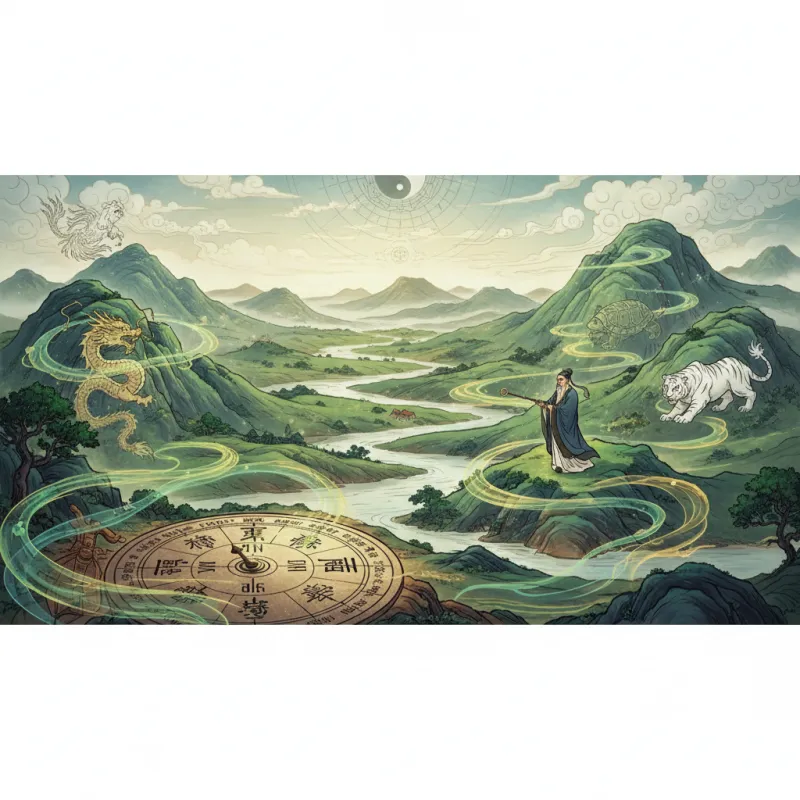
The difference between a burial site that brings prosperity and one that invites disaster can be as subtle as a shift in the mountain's shoulder or a bend in the water's flow. I've watched feng shui masters reject seemingly perfect locations because of details invisible to untrained eyes — a slight depression that collects stagnant qi, a rock formation that resembles a weapon pointed at the grave, or a water vein that flows away too quickly, taking the family's wealth with it.
Choosing a burial site according to feng shui principles isn't superstition dressed up as tradition. It's a sophisticated system of environmental analysis that Chinese practitioners have refined over two millennia. The Zangshu (葬書, Zàngshu, "Book of Burial"), attributed to Guo Pu during the Jin Dynasty (276-324 CE), established the foundational principles that masters still follow today. The text opens with a statement that cuts through centuries of accumulated mysticism: "Burial means hiding. Ride the vital qi."
Everything else flows from that premise. A burial site either captures and concentrates qi, or it doesn't. The landscape either protects the grave and channels beneficial energy toward it, or it exposes the grave to harsh forces and drains its vitality. Your ancestor either rests in a position that allows their spirit to support the living family, or they don't.
The Four Animals Formation
Every feng shui master I've met begins site selection by looking for the Siling (四靈, Sìlíng) or Four Celestial Animals formation. This isn't metaphorical. You're looking for actual landforms that correspond to four protective creatures: the Azure Dragon (Qinglong 青龍) on the left, the White Tiger (Baihu 白虎) on the right, the Vermillion Bird (Zhuque 朱雀) in front, and the Black Tortoise (Xuanwu 玄武) behind.
Stand at a potential burial site facing outward. The Black Tortoise should be a mountain or substantial hill behind you — solid, protective, blocking harsh northern winds. The Azure Dragon and White Tiger are the ridges or hills extending forward on your left and right, like arms embracing the site. The Vermillion Bird is the open space in front, ideally with a distant mountain on the horizon and water flowing gently across the view.
The classic texts specify that the Azure Dragon should be slightly higher and longer than the White Tiger. This relates to the yang nature of the dragon versus the yin nature of the tiger. In practice, I've seen masters accept sites where the tiger is stronger, but they compensate by adjusting the grave's orientation or adding symbolic elements to balance the energies.
Master Chen, the practitioner I mentioned earlier, rejected three sites in Fujian specifically because the White Tiger formation was "too aggressive" — the ridge on the right curved inward too sharply, creating what he called "tiger mouth" energy that would cause the family's descendants to face legal troubles and conflicts with authority figures. The landform literally looked like it was biting toward the grave site.
Water Flow and the Ming Tang
After identifying a promising Four Animals formation, the next critical factor is water. The Qing Nang Jing (青囊經, Qīng Náng Jīng, "Classic of the Azure Bag"), another foundational text from the Tang Dynasty, states: "Qi rides the wind and scatters, but is retained when encountering water." This principle makes water features the second most important consideration after basic landform.
The ideal burial site has what's called a Ming Tang (明堂, Míng Táng, "Bright Hall") — a relatively flat, open area in front of the grave where qi can gather and accumulate before flowing away. Water should be visible from the grave site, but not too close. It should flow gently across the view from left to right (following the dragon's direction), curve around the front of the site, and exit slowly rather than rushing straight away.
I once observed a site evaluation in Guangdong where a family had already purchased land for their grandmother's grave. The location had excellent mountain backing and balanced dragon-tiger formations. But a stream ran straight down the mountain directly toward the grave site, then dropped off a small cliff about thirty meters in front of it. The master they hired refused to approve the site. "Water coming straight at the grave is like an arrow," he explained. "Water falling away is wealth falling away. This family will make money but never keep it."
The family was devastated — they'd already paid for the land. The master suggested they could use the site if they were willing to redirect the stream with careful landscaping and build a retention pond to slow the water's exit. The cost would be substantial. They decided to sell the land and start over.
Soil Quality and Underground Conditions
The ancient texts emphasize that you're not just selecting a surface location — you're choosing where to place a body in the earth. The soil itself matters tremendously. The Zangshu specifies five colors of soil that indicate good qi: yellow, white, red, blue-green, and black. Brown, gray, or mixed muddy colors suggest poor qi or disturbed earth.
Modern practitioners add practical considerations. The soil should be firm enough to support a grave structure but not so rocky that digging becomes destructive to the surrounding landform. It should drain well but not be so sandy that it shifts. The water table should be deep enough that the grave won't flood during heavy rains.
Master Chen carried a simple tool — a hollow metal rod about a meter long. At each potential site, he would drive this rod into the ground at multiple points, pull it out, and examine the soil that came up inside it. He was checking depth, consistency, moisture, and color. At one site, he found a layer of black, foul-smelling soil about forty centimeters down. "Old battlefield or mass grave," he said immediately. "The earth here has seen violent death. It remembers." He marked that location as completely unsuitable.
Some masters also check for underground water veins using dowsing rods or other methods. The concern isn't just flooding — it's that underground water movement can drain qi away from the grave site. A location might look perfect on the surface but have water flowing directly beneath it, making it what practitioners call a "leaking" site.
Compass Readings and Directional Alignment
Once you've identified a site with good landforms, proper water flow, and suitable soil, you need to determine the precise orientation of the grave. This is where the Luopan (羅盤, Luópán), the feng shui compass, becomes essential. The compass doesn't just show cardinal directions — it divides the horizon into twenty-four mountains, each occupying fifteen degrees and associated with specific qi qualities.
The grave's orientation determines which direction the deceased "faces" and, by extension, which type of qi the grave receives and transmits to descendants. This isn't arbitrary. The orientation should harmonize with the deceased's birth data (their bazi 八字 or Eight Characters), the surrounding landforms, and the family's needs.
I've watched masters spend hours taking compass readings from a single spot, checking and rechecking measurements, consulting almanacs and calculation tables. They're looking for an orientation that avoids negative directions for the deceased's birth year while aligning with beneficial qi flows indicated by the landforms. Understanding the relationship between bazi and feng shui becomes crucial at this stage.
In the Fujian case, Mr. Chen determined that the grave should face 172 degrees (slightly east of due south) based on the patriarch's birth year, the flow of water across the site, and the position of a distant mountain peak that he identified as a "wealth star" formation. The family's stonemason had to be extremely precise — even a five-degree error would, in Mr. Chen's view, redirect the beneficial qi away from the family's descendants.
Timing the Burial
Selecting the site is only half the process. The burial itself must occur at an auspicious time. This involves consulting the Tong Shu (通書, Tōng Shū), the Chinese almanac, to find dates and times that harmonize with the deceased's birth data and the grave's orientation.
The almanac lists specific activities that are favorable or unfavorable for each day. But burial timing goes deeper than just picking a "good day for funerals." Masters calculate the interaction between the deceased's birth year, the burial year, the specific date, and even the hour. They're looking for temporal moments when the qi configuration supports the transition of the deceased's spirit and establishes a beneficial connection between the grave and the living family.
I've known families who kept a body in temporary storage for months waiting for the right burial date. This isn't considered disrespectful — it's considered essential. Burying at the wrong time can, according to practitioners, "lock in" negative qi patterns that will affect the family for generations.
The most sought-after burial times are during the Qingming (清明, Qīngmíng) festival period in early April or during specific auspicious months identified through almanac calculations. Some masters also consider the phase of the moon, the position of Jupiter, and other astronomical factors.
Grave Construction and Symbolic Elements
After selecting the site and timing, the grave's physical construction must follow feng shui principles. The shape, size, materials, and decorative elements all carry significance. Traditional Chinese graves are often horseshoe-shaped when viewed from above, with the curved back representing the protective mountain and the open front facing the Ming Tang.
The grave should be proportional to the site — not so large that it dominates and disrupts the landform, not so small that it fails to anchor the qi. The Zangshu uses the metaphor of a seed planted in soil: the grave should fit naturally into its environment, neither forcing itself into the landscape nor disappearing into it.
Stone is the preferred material because it endures and because stone itself is considered to have stable qi. The color and type of stone matter. Granite is common because it's durable and available in colors (gray, black, red) that correspond to favorable elements. Marble is sometimes used for its association with purity, though it's less weather-resistant.
Many graves include symbolic carvings — dragons, phoenixes, clouds, mountains — that reinforce the site's feng shui. These aren't mere decoration. They're visual representations of the qi patterns the grave is meant to capture and channel. A dragon carving on the left side of the grave strengthens the Azure Dragon formation. A phoenix or bird carving at the front enhances the Vermillion Bird energy.
Some practitioners also recommend placing specific items in or near the grave based on the deceased's birth elements and the site's characteristics. I've seen graves with small jade pieces, coins, or written talismans included in the construction. The purpose is always the same: to harmonize the deceased's energy with the location's energy and establish a beneficial flow toward living descendants.
Modern Challenges and Adaptations
Urban development has made traditional burial site selection increasingly difficult. In many Chinese cities, burial in the ground is no longer permitted — everyone must use columbariums or designated cemetery plots. This creates obvious problems for feng shui practitioners whose entire system is based on natural landforms and qi flow.
Some masters have adapted by applying feng shui principles to cemetery plot selection within the constraints of modern burial grounds. They look for plots with the best available landform relationships, even if those relationships are diminished compared to traditional mountain sites. A plot on slightly higher ground with trees behind it and open space in front is better than a plot in a depression or against a wall.
Others argue that columbarium burial fundamentally breaks the connection between the deceased and the earth's qi, making traditional feng shui considerations irrelevant. These practitioners focus instead on ancestral altar placement in the family home, treating that as the primary point of connection with deceased ancestors.
The most pragmatic masters I've met acknowledge the limitations while working within them. "We do what we can with what we have," one told me. "A perfect mountain site following all the classical principles is ideal. But a carefully chosen cemetery plot with good orientation and proper ritual is better than a perfect mountain site with careless burial. The family's intention and respect matter as much as the location."
The core principles remain relevant even in compromised situations: seek protection behind, openness in front, balance on the sides, and proper orientation. Whether you're selecting a mountain site in rural Fujian or a cemetery plot in urban Shanghai, these fundamentals still apply. The scale changes, the perfection becomes impossible, but the underlying logic of harmonizing the deceased with their environment persists.
Related Reading
- Burial Feng Shui vs Modern Cremation
- Burial Feng Shui: The Ancient Art of Grave Placement
- Burial Feng Shui Explained: Ancestral Graves and Family Fortune
- Famous Tombs and Their Feng Shui
- Exploring Feng Shui, I Ching, and Chinese Metaphysics in Modern Homes
- Discovering the Colors of Feng Shui and I Ching: Their Power and Symbolism
- Unlocking the Ancient Arts: Feng Shui, I Ching, and the Mysteries of Chinese Metaphysics
Explore Chinese Culture
- Explore Daoist philosophy and practice
- Explore traditional Chinese customs
- Explore ancient Chinese cosmology