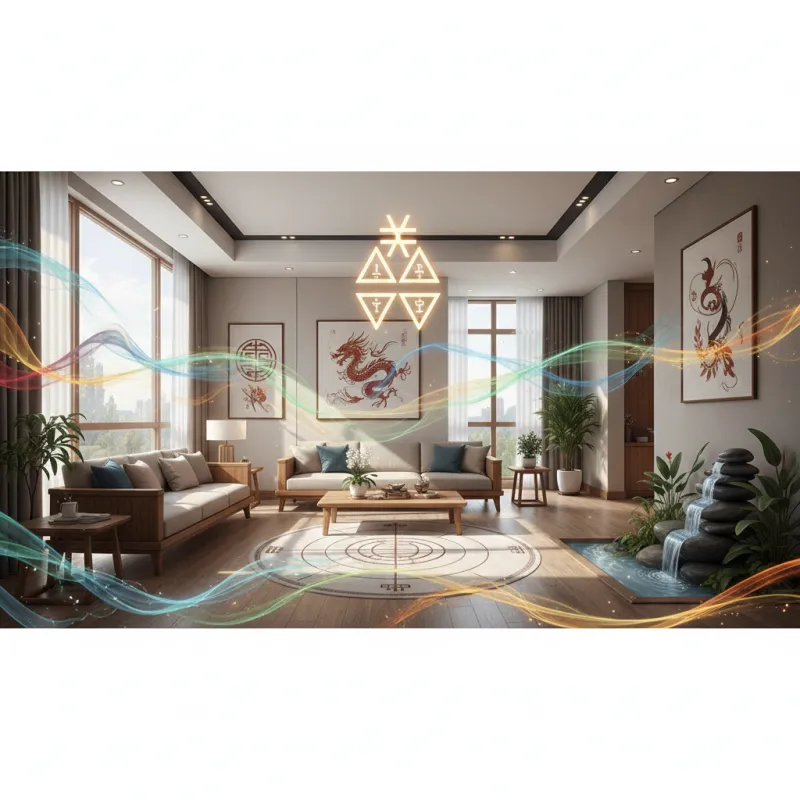
Your grandmother rearranges furniture three times before the Lunar New Year, insisting the sofa faces the "correct" direction. Your architect friend dismisses it as superstition, yet Silicon Valley executives pay consultants $10,000 to position their desks. What's happening here isn't just cultural tradition—it's the practical application of a 3,000-year-old system that treats your home as a living organism, breathing qi (氣, qì) through doors and windows, accumulating fortune in corners, and bleeding energy through misaligned hallways.
The Philosophical Foundation: Why Your Home Isn't Just Walls
Western architecture treats buildings as static containers. Chinese metaphysics sees them as dynamic energy systems. This distinction matters because it changes everything about how you approach your living space.
The core text, the Huangdi Zhaijing (黃帝宅經, Yellow Emperor's Classic of the Dwelling), written during the Han Dynasty (206 BCE–220 CE), establishes a radical premise: your home is an extension of your body. Just as acupuncture points channel qi through meridians, your home's layout channels environmental energy through rooms and corridors. Block a meridian, and you get illness. Block a home's energy flow, and you get stagnation—in career, relationships, health.
This isn't metaphor. The Zhaijing provides specific measurements: doorways should be 2.1 to 2.4 meters high (based on the ancient Chinese foot, or chi 尺), because this range corresponds to auspicious positions on the Feng Shui ruler. Too low, and you "bow" to misfortune entering. Too high, and energy dissipates before it can nourish the inhabitants. Modern practitioners still use these measurements, though they've adapted them to contemporary building codes.
The I Ching (易經, Yìjīng, Book of Changes) adds another layer: your home exists in constant flux. The 64 hexagrams don't just predict fortune—they map the transformation patterns of any system, including domestic spaces. Hexagram 37, Jiaren (家人, The Family), specifically addresses household harmony, stating "the perseverance of the woman brings good fortune." In practical terms, this means the kitchen (traditionally the woman's domain, though gender roles have evolved) should occupy the hexagram's corresponding direction—southwest in Later Heaven arrangement—to anchor family stability.
The Five Elements: Your Home's Elemental Personality
Walk into any space and you immediately sense its character. That's not subjective—it's elemental composition. The Five Elements theory (五行, wǔxíng) provides a diagnostic framework that's surprisingly precise.
Wood (木, mù) governs growth and expansion. A wood-dominant home features vertical lines, green tones, plants, and tall furniture. These spaces feel energizing but can become chaotic without metal elements to provide structure. I've seen wood-heavy homes where residents constantly start projects but never finish them—the energy keeps expanding without consolidation.
Fire (火, huǒ) brings transformation and passion. Red accents, triangular shapes, candles, and southern exposure create fire energy. Too much fire, and you get conflict and burnout. The Tang Dynasty architect Yu Hao (喻皓, 10th century CE) warned against placing kitchens (fire) directly opposite main entrances—the fire "attacks" incoming qi, creating household arguments. Modern Feng Shui consultants still cite this principle when analyzing floor plans.
Earth (土, tǔ) provides stability through square shapes, yellow and brown tones, ceramics, and low, heavy furniture. Earth-dominant homes feel grounding but can become stagnant. The solution isn't removing earth elements—it's introducing wood to "break" the earth (in the controlling cycle) and metal to "drain" it (in the generating cycle), creating movement without losing stability.
Metal (金, jīn) governs precision and clarity. White, gray, circular shapes, and metal objects create this energy. Tech companies unconsciously favor metal aesthetics—open floor plans with metal fixtures, white walls, circular meeting pods. This supports analytical thinking but can feel cold without fire elements (red accents, warm lighting) to humanize the space.
Water (水, shuǐ) represents wisdom and flow. Black and dark blue tones, wavy patterns, mirrors, and actual water features generate this element. Water-heavy homes support contemplation and creativity but can lead to isolation if not balanced with earth (to contain the water) and wood (to direct its flow).
The key insight: your home needs all five elements in appropriate proportions, not equal distribution. A home office requires more metal (clarity) and water (wisdom) than a nursery, which needs wood (growth) and earth (stability). The Bagua map helps determine which elements belong where based on the space's function and directional correspondence.
I Ching Divination: When to Renovate, When to Wait
Here's where Chinese metaphysics gets practical in ways that surprise skeptics. The I Ching isn't fortune-telling—it's pattern recognition applied to timing.
Before major home changes—renovations, moves, even furniture purchases—traditional practitioners cast hexagrams to assess timing. This sounds mystical until you understand the mechanism. The I Ching's 64 hexagrams map every possible state of change in a system. Each hexagram has a "nuclear" hexagram (the inner lines) showing the hidden dynamics, and changing lines indicating transformation points.
Let's say you're considering a kitchen renovation. You cast Hexagram 50, Ding (鼎, The Cauldron), with a changing line in the fifth position. Ding represents transformation through nourishment—appropriate for a kitchen. The fifth line (yang) changing to yin suggests the timing is ripe, but the transformation requires yielding rather than forcing. The nuclear hexagram is 43, Guai (夬, Breakthrough), indicating underlying tension that the renovation will resolve.
Practically, this means: proceed with the renovation, but don't impose your vision rigidly. Work with the space's existing structure rather than gutting everything. The breakthrough comes through adaptation, not domination.
I've watched this play out repeatedly. A client ignored an unfavorable hexagram (Hexagram 12, Pi 否, Standstill) and proceeded with a major renovation. Every contractor delayed, materials arrived damaged, and the project took twice as long as planned. Another client received Hexagram 11, Tai (泰, Peace), and their renovation completed early, under budget, with unexpected upgrades.
Coincidence? Maybe. But the I Ching's value isn't supernatural prediction—it's forcing you to examine timing, hidden factors, and your own motivations before committing resources. That alone prevents costly mistakes.
The Luopan Compass: Reading Your Home's Energy Signature
The Luopan (羅盤, luópán, Chinese compass) looks like a mystical artifact—concentric rings covered in Chinese characters, trigrams, and degree markings. It's actually a sophisticated diagnostic tool encoding multiple systems: the 24 Mountains (24 directional subdivisions), the 64 hexagrams, the Five Elements, and various time-based calculations.
Using a Luopan requires understanding that direction isn't absolute—it's relational. The compass doesn't just show north; it shows how your home's facing direction interacts with the surrounding environment's energy patterns at specific times.
The 24 Mountains divide the compass into 15-degree segments, each governed by a specific element and trigram. Your home's sitting direction (the back) and facing direction (the front) fall into specific mountains, creating an energy signature. A home sitting on Ren (壬, water element, north) and facing Bing (丙, fire element, south) has a water-fire axis—potentially conflicting, but also potentially powerful if balanced correctly.
The San Yuan (三元, Three Cycles) system adds temporal layers. We're currently in Period 9 (2024-2043), governed by the Li trigram (離, fire). Homes with south-facing orientations (Li's direction) receive enhanced energy during this period. A south-facing home that was mediocre in Period 8 (2004-2023, governed by Gen 艮, northeast) suddenly becomes auspicious in Period 9.
This explains why some homes feel "lucky" for certain owners but not others, or why a home's energy shifts over decades. The building hasn't changed—the temporal energy patterns have.
Practical Application: The Three-Layer Approach
Theory means nothing without application. Here's how to actually use these systems in your home, starting with the most accessible layer and progressing to advanced techniques.
Layer One: Elemental Balance. Walk through your home and identify the dominant element in each room. Too much of one element? Introduce its controlling element in small doses. A fire-heavy living room (red walls, triangular art, southern exposure) needs water elements—a dark blue rug, a small fountain, wavy patterns in throw pillows. Don't remove the fire; balance it. This takes an afternoon and costs almost nothing.
Layer Two: Bagua Alignment. Overlay the Bagua map on your floor plan, aligning the Career area with your front door. Each sector corresponds to a life area and element. Missing sectors indicate life areas needing attention. An apartment missing the Wealth sector (southeast, wood element) might benefit from placing a healthy plant or wooden object in the southeast corner of the living room as a symbolic anchor. This requires a floor plan and a compass, maybe an hour of work.
Layer Three: Flying Stars Analysis. This advanced technique requires calculating your home's natal chart based on construction date and facing direction. The Flying Stars (飛星, fēixīng) system maps nine types of qi moving through your home's nine sectors, changing annually and monthly. Certain star combinations bring prosperity; others bring illness or conflict. A qualified practitioner can identify which rooms to activate and which to suppress during specific time periods.
Most people need only Layers One and Two. Layer Three becomes relevant when you're making major decisions—buying property, timing renovations, or troubleshooting persistent problems that simpler adjustments haven't resolved.
The Modern Synthesis: What Actually Works
After examining hundreds of homes and tracking outcomes over years, patterns emerge. Some Feng Shui principles consistently correlate with positive results; others seem culturally specific or outdated.
What works: Energy flow principles. Homes with clear pathways, uncluttered entrances, and good natural light consistently support better outcomes for residents. This isn't mystical—it's environmental psychology confirmed by research. But Feng Shui identified these principles 3,000 years before Western psychology existed.
What works: Elemental balance. Spaces with varied textures, colors, and shapes (representing different elements) feel more comfortable and support diverse activities better than monotone environments. Again, design psychology confirms this, but the Five Elements system provides a more sophisticated framework than "add variety."
What's questionable: Rigid directional prescriptions. The insistence that beds must face certain directions or stoves must occupy specific locations often conflicts with practical constraints. The underlying principle—align with beneficial energy—remains valid, but the specific applications need cultural translation. A north-facing bed might be ideal in southern China's climate but impractical in a northern latitude where it means facing away from winter sun.
What's outdated: Gender-specific room assignments. The classical texts assign rooms based on patriarchal family structures that no longer apply. The principle—different family members need different energetic support—remains relevant, but the specific assignments need updating.
The most effective approach combines classical principles with modern understanding. Use the diagnostic frameworks (Five Elements, Bagua, I Ching patterns) to identify issues and opportunities, then apply solutions that work within contemporary constraints and values.
Living With Intention: The Real Secret
Here's what practitioners rarely admit: the most powerful aspect of Feng Shui and Chinese metaphysics isn't the specific techniques—it's the intentionality they cultivate. When you analyze your home through these frameworks, you're forced to examine how your environment affects your life, what you're prioritizing, and what you're neglecting.
The I Ching consultation before a renovation doesn't magically improve outcomes—it makes you think deeply about timing, motivations, and potential obstacles before committing resources. The elemental analysis doesn't mystically balance your space—it makes you notice what's excessive or lacking, then consciously adjust it.
This doesn't diminish these practices; it reveals their true power. They're sophisticated systems for cultivating awareness and intentionality in how you shape your environment. Whether the mechanisms are energetic, psychological, or both doesn't matter as much as the results: homes that support rather than hinder the lives lived within them.
Your grandmother rearranging furniture before the New Year isn't being superstitious—she's practicing environmental intentionality using a 3,000-year-old framework. Your architect friend dismissing it is missing the point. And those Silicon Valley executives paying consultants? They've recognized that optimizing your environment is as important as optimizing your code, even if they can't fully explain why the principles work.
The question isn't whether to believe in Feng Shui and Chinese metaphysics. The question is whether you're willing to examine your home with the same intentionality and sophistication that these systems demand. Because once you start seeing your space as a dynamic energy system rather than a static container, you can't unsee it—and you can't stop making adjustments that, mysteriously or not, seem to work.
Related Reading
- Unlocking the Secrets of Feng Shui: Water Features in Chinese Metaphysics
- Chinese Face Reading: What Your Face Reveals
- Exploring Feng Shui, I Ching, and Chinese Metaphysics: Symbols of Ancient Divination and Geomancy
Explore Chinese Culture
- Explore Daoist philosophy and practice
- Explore traditional Chinese customs
- Explore ancient Chinese cosmology