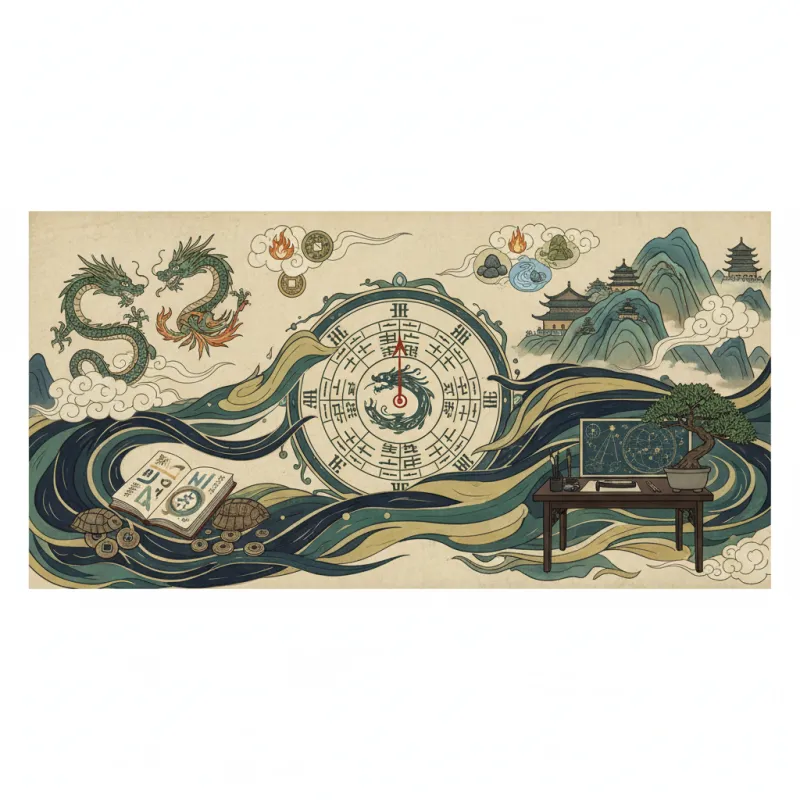
Picture this: a Han dynasty general stands at the edge of a proposed battlefield, not consulting maps or troop counts, but watching how wind moves through the valley and where water pools in the lowlands. His diviner traces patterns in the dirt—eight trigrams that will determine whether 50,000 men live or die. This isn't superstition. This is kanyu (堪舆), the ancient art of reading earth's invisible architecture, and it's been shaping Chinese civilization for over three millennia.
When Heaven and Earth Had a Language
Feng shui (风水, fēng shuǐ) didn't start as interior design advice. During the Warring States period (475-221 BCE), it was survival technology. The Zhangjiashan bamboo texts, unearthed from a tomb sealed in 186 BCE, contain the earliest known feng shui compass—not for finding north, but for locating qi (气, qì), that elusive life-force that Western translations clumsily call "energy." The ancients understood something we're only now rediscovering through quantum physics: everything vibrates, everything connects, and position matters more than we think.
The I Ching (易经, Yì Jīng), or Book of Changes, emerged from an even older practice—scapulimancy, the art of reading cracks in heated oracle bones. By the time Confucius added his commentaries around 500 BCE, this divination manual had evolved into something stranger: a philosophical operating system that treats reality as a constantly shifting pattern of 64 hexagrams. Each hexagram is built from two bagua (八卦, bā guà)—the eight trigrams representing heaven, earth, thunder, wind, water, fire, mountain, and lake. These aren't just symbols. They're a grammar for describing how change happens, which is why the I Ching has been translated more than any Chinese text except the Tao Te Ching.
The Compass That Points to Invisible Mountains
The luopan (罗盘, luó pán), or feng shui compass, looks like something from a steampunk novel—concentric rings covered in Chinese characters, trigrams, and astronomical data, sometimes featuring up to 40 layers of information. But here's what most people miss: it's not measuring magnetic north. It's measuring xiang (向, xiàng), the "facing direction" that determines how cosmic forces flow through a space. A feng shui master in the Song dynasty (960-1279 CE) would spend years learning to read these rings, correlating them with the Heavenly Stems and Earthly Branches used in Chinese astrology and bazi calculations.
The compass reveals what classical texts call dragon veins (龙脉, lóng mài)—underground currents of qi that follow mountain ridges and water courses. The entire Forbidden City in Beijing sits positioned according to these principles, its main axis aligned to channel beneficial qi from the mountains to the north. When Western architects finally measured it in the 20th century, they discovered the alignment was accurate to within a fraction of a degree—achieved without modern surveying equipment.
Divination: Reading Tomorrow in Today's Patterns
Chinese divination operates on a premise that makes Western linear causality look primitive: time isn't a straight line but a spiral, and patterns repeat at different scales. The I Ching consultation method—whether using yarrow stalks (the traditional way, taking 15 minutes per reading) or coins (the shortcut)—generates a hexagram that describes your current position in this spiral. But here's the sophisticated part: the hexagram also contains changing lines that transform it into a second hexagram, showing how your situation will evolve.
I've watched a Taiwanese I Ching master work, and the process looks nothing like fortune-telling. It's more like debugging code—identifying which line in your life's program is about to flip from yin to yang, and what that transformation means for the whole system. The Mawangdui silk texts, sealed in a tomb in 168 BCE, contain an earlier version of the I Ching with different hexagram sequences, suggesting the system was still being refined even after centuries of use.
Other divination methods branch from the same root. Qimen Dunjia (奇门遁甲, qí mén dùn jiǎ), literally "Mysterious Gates Escaping Techniques," maps the eight trigrams onto a nine-palace grid that rotates through time, used by military strategists to choose auspicious moments for battle. Liuyao (六爻, liù yáo) focuses specifically on the six lines of a hexagram, assigning them to the five elements—wood, fire, earth, metal, and water—to predict outcomes with startling specificity.
The Metaphysical Operating System
Chinese metaphysics isn't one thing—it's an ecosystem of interlocking systems. At the foundation sits wuxing (五行, wǔ xíng), the five phases or elements, which aren't substances but processes: wood grows, fire transforms, earth stabilizes, metal contracts, water flows. These phases generate and control each other in cycles that explain everything from seasonal changes to personality types to why certain colors work in certain rooms.
Layer on top the concept of yin and yang (阴阳, yīn yáng)—not opposites but complementary phases, like the crest and trough of a wave. Then add the Heavenly Stems (天干, tiān gān) and Earthly Branches (地支, dì zhī), a sexagesimal cycle that creates 60 unique combinations used to mark years, months, days, and hours. Your birth time generates four pairs of stems and branches—your bazi (八字, bā zì) or "eight characters"—which feng shui masters read like a cosmic fingerprint.
What makes this system remarkable isn't its complexity but its consistency. The same five-element relationships that explain why metal tools cut wood also explain why autumn (metal season) follows summer (fire season), and why someone born in a metal year might clash with wood-year partners. It's pattern recognition elevated to philosophy.
Symbols That Think in Circles
Western symbolism tends toward the static—a cross means Christianity, a star means excellence. Chinese metaphysical symbols are dynamic, their meanings shifting based on context, position, and relationship. The trigram Qian (乾, qián) represents heaven, but also father, metal, the northwest direction, the head, horses, and the color red. It's not that one symbol has multiple meanings; it's that these are all expressions of the same underlying pattern—the creative, initiating, yang principle.
The bagua arrangement itself comes in two versions. The Earlier Heaven sequence, attributed to the mythical emperor Fu Xi, shows the ideal, pre-manifest state of the cosmos. The Later Heaven sequence, attributed to King Wen (founder of the Zhou dynasty), shows the manifest world where we actually live. Feng shui practitioners use the Later Heaven arrangement for spatial analysis because it maps to our experienced reality, where fire (south) opposes water (north) and wood (east) opposes metal (west).
This symbolic flexibility explains why feng shui recommendations sometimes seem contradictory. A water feature might be auspicious in your north sector (water's home direction) but disastrous in your south sector (where it clashes with fire). The symbol doesn't change—the relationship does.
Ancient Wisdom, Modern Skepticism, Timeless Patterns
Does feng shui "work"? The question itself reveals a category error. Feng shui isn't a hypothesis to be tested but a language for describing spatial relationships and their psychological effects. When a feng shui master says your desk shouldn't face a wall, they're not invoking magic—they're noting that humans feel more secure with a wide visual field and a solid backing. The qi explanation and the evolutionary psychology explanation describe the same phenomenon in different vocabularies.
The I Ching's continued relevance—Carl Jung wrote extensively about it, and Silicon Valley executives consult it—suggests it's tapping into something real about pattern recognition and decision-making under uncertainty. The hexagrams function like a Rorschach test that forces you to articulate your situation clearly enough to see solutions you'd been avoiding. Whether that's divination or just good therapy depends on your metaphysics.
What's undeniable is the sophistication of these systems. They emerged from cultures that observed nature with obsessive detail for thousands of years, encoding that knowledge in symbols flexible enough to remain useful across wildly different contexts. A Han dynasty farmer and a modern Hong Kong banker can both consult the same hexagram and find relevant guidance—not because the cosmos is sending messages, but because human patterns repeat, and these symbols capture those patterns with remarkable precision.
The real magic isn't that feng shui can redirect cosmic forces or that the I Ching predicts the future. It's that three-thousand-year-old symbol systems still help people make better decisions, design more harmonious spaces, and understand their place in the larger patterns of change. That's not superstition. That's cultural technology that works.
Related Reading
- Chinese Numerology: The Lucky, the Deadly, and the Powerful
- Discovering the Colors of Feng Shui and I Ching: Their Power and Symbolism
- Rainwater Collection and Feng Shui: Catching Wealth from the Sky
Explore Chinese Culture
- Explore Daoist philosophy and practice
- Explore traditional Chinese customs
- Explore ancient Chinese cosmology