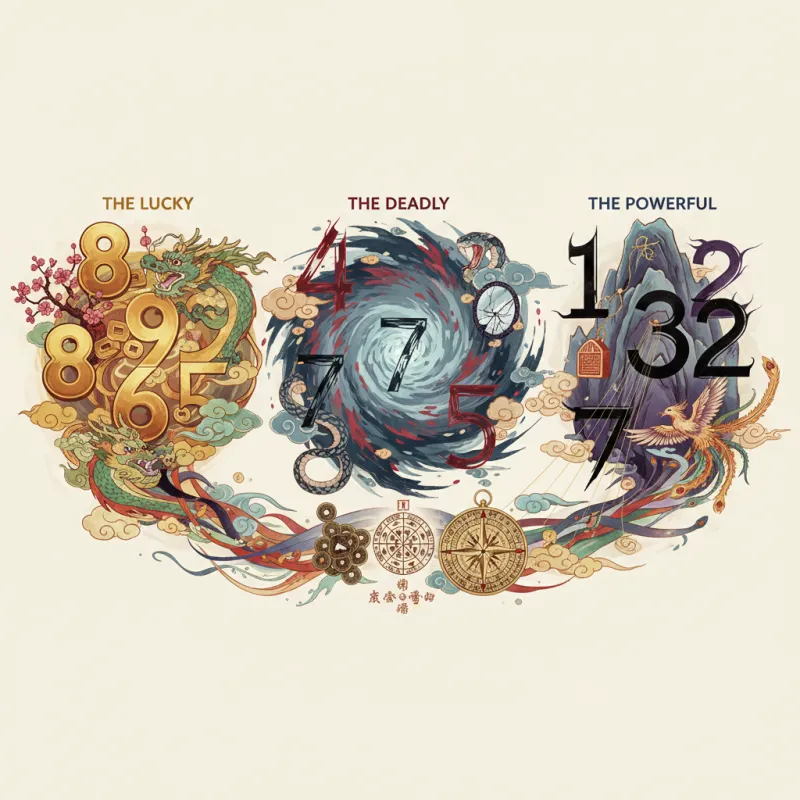
Your grandmother slips you a red envelope at Chinese New Year. You peek inside: ¥888. Not ¥900, which would be easier to count. Not ¥850, which would be a rounder discount. Exactly ¥888. She winks. "Eight brings wealth," she says, as if this explains everything. And in the logic of Chinese numerology, it does.
Numbers in Chinese culture aren't just quantities—they're omens, warnings, and blessings compressed into single syllables. The number on your apartment floor can tank its resale value by 20%. The digits in your phone number might make strangers assume you're either blessed by fortune or courting disaster. This isn't superstition confined to elderly relatives; it's a living system of meaning that shapes billion-dollar real estate markets, corporate branding decisions, and the price of license plates.
The Sound of Fortune: How Homophonic Logic Works
Chinese numerology operates on a principle that seems almost too simple to be powerful: numbers that sound like good words are good numbers. This works because Mandarin Chinese has roughly 400 syllable combinations (compared to English's 15,000+), creating a dense web of homophones—words that sound identical but mean different things.
The number eight (八, bā) sounds remarkably similar to 发 (fā), as in 发财 (fācái), "to get rich." Not metaphorically similar. Not "if you squint your ears" similar. Actually, phonetically close enough that the association feels inevitable. When the Beijing Olympics opened on 08/08/08 at 8:08:08 PM, this wasn't cute numerological theater—it was a $40 billion event staking its auspiciousness on the power of a single digit.
Six (六, liù) sounds like 流 (liú), meaning "flow" or "smooth," suggesting things will proceed without obstacles. Nine (九, jiǔ) is homophonous with 久 (jiǔ), meaning "long-lasting" or "eternal," making it the preferred number for wedding gifts and anniversary celebrations. These aren't arbitrary associations invented by fortune tellers—they're embedded in the language itself, reinforced every time someone speaks.
The system works in reverse for unlucky numbers. Four (四, sì) sounds almost identical to 死 (sǐ), "death." This isn't a subtle resemblance you need to listen carefully to catch. Say them out loud: sì, sǐ. The only difference is a tonal inflection. Many buildings in China, Hong Kong, and Singapore skip the fourth floor entirely, jumping from three to five. Some skip every floor containing a four: no 4th, 14th, 24th, 34th, or 40-49th floors. The architectural gymnastics required to avoid a single phoneme are extraordinary.
The Lucky Numbers: Eight, Six, and Nine
Eight dominates Chinese numerology with the force of a cultural obsession. In 2003, the Sichuan Airlines phone number 8888-8888 sold at auction for 2.33 million yuan—roughly $280,000 at the time—for a phone number. Not a business. Not real estate. A sequence of digits. In 2008, a Chinese businessman paid $215,000 for the license plate "F8" in Hong Kong. The number appears in corporate names, product prices (¥88, ¥888, ¥8,888), and anywhere else a business wants to signal prosperity.
The preference for eight has measurable economic effects. A 2014 study published in the Journal of Political Economy found that houses with addresses containing the number eight sold for 2.5% more than comparable houses in Vancouver's Chinese neighborhoods. The effect was even stronger for houses with multiple eights. This isn't a rounding error—it's millions of dollars in aggregate value created purely by phonetic association.
Six carries a different flavor of luck. While eight promises wealth, six promises smoothness—things going according to plan, obstacles dissolving, relationships flowing without friction. The phrase 六六大顺 (liù liù dà shùn), "double six, great smoothness," is a common blessing. You'll see it in business names, hear it in toasts, and find it in the amounts people give as gifts. ¥666 in a red envelope isn't a joke about Western devil symbolism—it's a wish for everything to proceed smoothly.
Nine's power comes from its association with longevity and the emperor. In imperial China, nine was the ultimate yang number, associated with the dragon and reserved for the emperor's use. The Forbidden City supposedly contains 9,999 rooms (it actually has fewer, but the symbolism matters more than the count). For modern purposes, nine appears in wedding gifts and anniversary celebrations. Giving ¥999 or ¥9,999 suggests you wish the couple's happiness to last forever—久久长长 (jiǔ jiǔ cháng cháng), "long, long, lasting, lasting."
The Deadly Number: Four and Its Variations
Four isn't just unlucky in Chinese culture—it's actively avoided with an intensity that reshapes physical infrastructure. The homophonic link between 四 (sì, four) and 死 (sǐ, death) is so strong that it affects everything from building design to product pricing to gift-giving etiquette.
In many Chinese hospitals, there is no fourth floor. In some buildings, there's no floor containing the number four at all. This creates surreal elevator panels: 1, 2, 3, 5, 6, 7, 8, 10, 11, 12, 13, 15... The 13th floor exists (Western superstition hasn't penetrated as deeply), but the 14th doesn't, because it contains a four. Some luxury developments take this further, eliminating all floors from 40-49, creating buildings where the 39th floor is followed by the 50th.
The economic impact is measurable and significant. Research on housing prices in Chinese communities consistently shows that units on floors containing four sell for 10-20% less than comparable units on other floors. In Hong Kong's hyper-competitive real estate market, this discount can represent hundreds of thousands of dollars. Developers know this and price accordingly, but the stigma persists.
The number 14 is particularly toxic because it sounds like 实死 (shísǐ), "certain death" or "real death." The number 24 suggests 二死 (èrsǐ), "easy to die." These aren't subtle linguistic reaches—they're immediate associations that native speakers can't unhear. Giving a gift of ¥400 or ¥4,000 would be genuinely offensive, like handing someone a greeting card with a skull on it.
Some younger, Western-educated Chinese people claim they don't believe in these associations, but their behavior often tells a different story. They might intellectually reject the superstition while still feeling uncomfortable living on the fourth floor or giving a gift of ¥444. The phonetic association runs deeper than conscious belief—it's embedded in the language itself.
Compound Numbers: When Digits Combine
The real sophistication in Chinese numerology emerges when numbers combine into multi-digit sequences. These combinations create phrases, suggestions, and meanings that go far beyond individual digits.
The number 168 (一六八, yī liù bā) sounds like 一路发 (yī lù fā), "prosperity all the way." It's an extremely popular number for business addresses, phone numbers, and license plates. In 2016, a license plate reading "168" sold for $640,000 in Hong Kong. The number 518 suggests 我要发 (wǒ yào fā), "I want to get rich"—less elegant than 168, but equally popular among entrepreneurs.
The number 520 (五二零, wǔ èr líng) sounds like 我爱你 (wǒ ài nǐ), "I love you." This has created an entirely new holiday: May 20th (5/20) has become an unofficial Valentine's Day in China, with marriage registrations spiking dramatically on that date. In 2020, May 20th fell on a Wednesday, but Chinese marriage bureaus reported record numbers of couples registering—some offices stayed open late to accommodate demand. The number 1314 suggests 一生一世 (yī shēng yī shì), "one life, one world," meaning "forever," making it another popular choice for romantic gifts.
Some combinations are more playful. The number 88 can suggest 拜拜 (bàibài), "bye-bye," borrowed from English. Young people might end a text message with "88" as a casual sign-off. The number 250 is an insult—it suggests 二百五 (èr bǎi wǔ), a term for a fool or simpleton. Calling someone "250" or giving them ¥250 would be genuinely offensive.
The number 666, despite its Western associations with the devil, is extremely positive in Chinese numerology. It suggests 溜溜溜 (liū liū liū), meaning "smooth, smooth, smooth"—everything flowing perfectly. During livestream shopping sessions on Chinese platforms, viewers spam "666" in the chat to express approval or amazement, similar to how English speakers might spam "fire" emojis.
The Five Elements and Numerical Associations
Chinese numerology doesn't exist in isolation—it intersects with the five elements system (五行, wǔxíng) that underlies much of Chinese metaphysics, including feng shui principles and bazi fortune-telling.
In this system, numbers correspond to elements: 1 and 6 relate to Water, 2 and 7 to Fire, 3 and 8 to Wood, 4 and 9 to Metal, and 5 to Earth. This creates a secondary layer of meaning beyond phonetic associations. Someone whose bazi chart shows a need for more Water element might specifically seek out phone numbers or addresses containing 1 or 6, regardless of their phonetic associations.
The number 5 occupies a special position as the central element, representing balance and the center of the cosmos. In the Luoshu magic square (洛书, Luòshū), an ancient numerical diagram, 5 sits in the center, surrounded by the other digits 1-9 arranged so that every row, column, and diagonal sums to 15. This diagram appears in feng shui applications, I Ching interpretations, and various forms of Chinese divination.
The interaction between phonetic and elemental associations can create complex evaluations. The number 4, while phonetically unlucky due to its association with death, is elementally associated with Metal, which might be beneficial for someone whose chart needs Metal energy. A skilled feng shui practitioner or bazi consultant might recommend embracing a "4" address if the elemental benefit outweighs the phonetic concern—though convincing a client to accept this requires considerable persuasion.
Numbers in Modern Chinese Life
Walk through any Chinese city and you'll see numerology in action everywhere. Real estate listings advertise "lucky number floors." Restaurants price dishes at ¥88 or ¥168 instead of round numbers. Phone companies auction premium numbers containing multiple eights for thousands of dollars. License plates with auspicious numbers command premiums that dwarf the cost of the actual vehicle registration.
This isn't a relic of pre-modern thinking that's fading with modernization—if anything, it's intensifying. As China's economy has grown, the amounts people will pay for lucky numbers have skyrocketed. The record for a license plate in China is reportedly over $10 million for a plate reading simply "8." Whether this represents genuine belief in the number's power or simply conspicuous consumption is beside the point—the cultural system that makes an "8" worth millions is very much alive.
Chinese tech companies navigate numerology carefully. Alibaba's Singles' Day shopping festival falls on 11/11—four ones suggesting "single sticks," but also suggesting unity and new beginnings. The date has become the world's largest shopping event, generating over $100 billion in sales in 2021. Tencent's WeChat uses red envelope features that let users send lucky amounts like ¥8.88 or ¥66.6 with a single tap—the app literally encodes numerological preferences into its interface.
Even Chinese people who claim not to believe in numerology often follow its rules unconsciously. They might avoid giving gifts in amounts containing four, choose wedding dates with eights and nines, or feel vaguely uncomfortable with a fourth-floor apartment—not because they consciously believe the number will cause death, but because the association is so deeply embedded in the language that it feels wrong.
The Psychology of Phonetic Meaning
What makes Chinese numerology particularly interesting is that it's not based on mystical properties attributed to numbers themselves—it's based on language. The number eight isn't inherently lucky in some cosmic sense; it's lucky because it sounds like a word that means "prosperity." This is simultaneously more rational (it's based on observable linguistic patterns) and more arbitrary (it only works in Chinese) than numerological systems based on supposed inherent properties of numbers.
This creates interesting situations when Chinese numerology encounters other languages. In Cantonese, the phonetic associations differ slightly from Mandarin, creating different lucky and unlucky numbers. The number 3 in Cantonese sounds like "alive" or "giving birth," making it more auspicious than in Mandarin. The number 2 in Cantonese can sound like "easy," adding positive associations.
Western numerology, by contrast, attributes mystical properties to numbers themselves—seven is lucky because of its supposed cosmic significance, thirteen is unlucky for reasons tied to Christian tradition and Norse mythology. These systems claim the numbers themselves carry power, independent of language. Chinese numerology makes no such claim—it's explicitly about sound, not essence.
This linguistic foundation means Chinese numerology is remarkably flexible and creative. New associations emerge as language evolves. The 520 = "I love you" association is relatively recent, emerging with text messaging culture. As Chinese internet slang develops, new numerical codes appear: 886 for "bye-bye" (bā bā liù sounds like "bye-bye-la"), 987 for "don't be angry" (jiǔ bā qī sounds like 就不气, jiù bù qì).
The system is self-reinforcing: because everyone knows eight is lucky, businesses use it to signal prosperity, which reinforces the association, which makes more businesses use it. The number becomes lucky not just because it sounds like "prosperity" but because it's universally recognized as the prosperity number. The phonetic association creates the cultural reality, which then sustains itself independent of whether any individual "believes" in it.
Related Reading
- Address Numerology in Feng Shui
- Chinese Numerology: Why 8 Is Lucky, 4 Is Death, and 9 Is Forever
- Wedding Date Selection in Chinese Feng Shui
- Phone Number Feng Shui: Why Chinese People Pay Thousands for the Right Digits
- Exploring the Interconnections of Feng Shui, I Ching, and Chinese Metaphysics
- Discover the Secrets of Feng Shui: Transforming Your Garden with I Ching and Chinese Metaphysics
- Harnessing the Power of Flying Stars in Feng Shui and I Ching
- Bedroom Feng Shui for Better Sleep
Explore Chinese Culture
- Explore Daoist philosophy and practice
- Explore traditional Chinese customs
- Explore ancient Chinese cosmology