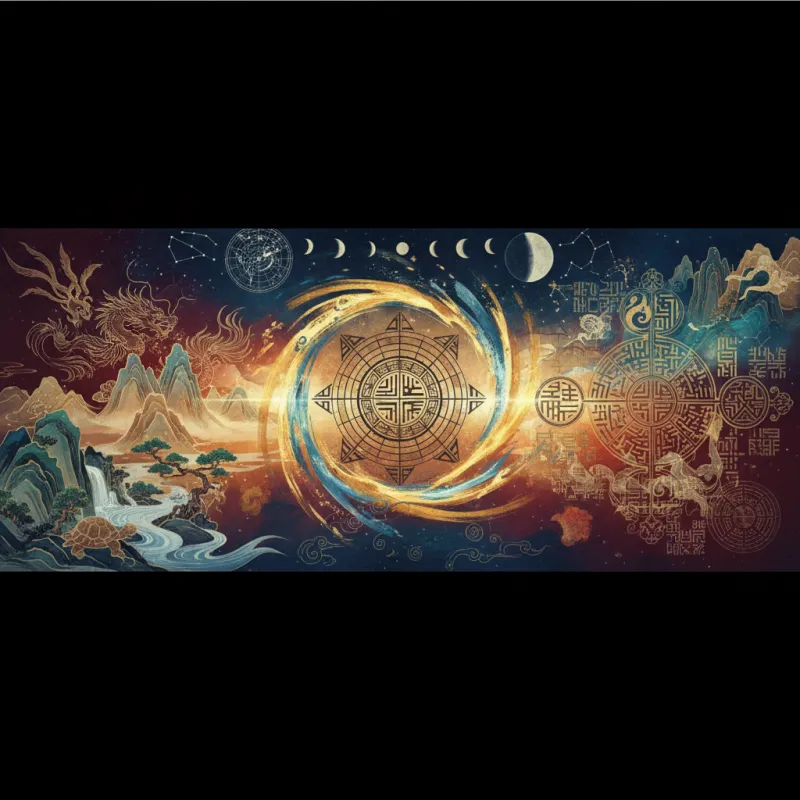
When a Tang Dynasty emperor consulted his court advisors about relocating the capital, they didn't pull out maps or census data—they opened the Yijing (易經, I Ching) and studied the mountain ridges. This wasn't superstition; it was statecraft. The interconnected systems of Feng Shui, I Ching, and Chinese metaphysics formed the intellectual backbone of imperial decision-making for over two millennia, and their logic remains surprisingly coherent once you understand the underlying framework.
The Cosmological DNA: How These Systems Share the Same Blueprint
Here's what most introductory articles miss: Feng Shui, I Ching, and the broader Chinese metaphysical tradition aren't separate practices that happen to overlap—they're different applications of the same cosmological operating system. At their core sits the concept of qi (氣, vital energy), the wuxing (五行, five elements), and the bagua (八卦, eight trigrams). Think of it like different apps running on the same smartphone OS.
The I Ching, compiled during the Western Zhou Dynasty (1046-771 BCE) but drawing on even older oracle bone traditions, established the fundamental binary language of yin (陰) and yang (陽). These aren't just philosophical abstractions—they're a sophisticated system for modeling change and transformation. When King Wen of Zhou was imprisoned by the Shang Dynasty, he reportedly spent his time arranging the 64 hexagrams into their current sequence, creating what became the world's oldest decision-making algorithm.
Feng Shui emerged later, crystallizing during the Han Dynasty (206 BCE-220 CE) when scholars like Guo Pu began systematizing geomantic principles. But it borrowed the I Ching's trigrams wholesale, mapping them onto physical space through the luopan (羅盤, feng shui compass). The eight trigrams became eight directions, each carrying specific elemental qualities and family associations. This wasn't metaphorical thinking—it was applied cosmology.
The Five Elements: The Periodic Table of Chinese Thought
If you want to understand how these systems interconnect, you need to grasp wuxing theory. Wood, Fire, Earth, Metal, and Water aren't just elements—they're phases of transformation, each with specific qualities, seasons, colors, organs, emotions, and directional associations. The shengxing (生行, generating cycle) describes how Wood feeds Fire, Fire creates Earth (ash), Earth bears Metal, Metal collects Water, and Water nourishes Wood. The kexing (克行, controlling cycle) provides the checks and balances.
This framework appears everywhere. In Bazi fortune-telling, your birth chart consists of eight characters (four pillars of year, month, day, and hour), each assigned an element. A skilled practitioner analyzes the balance and conflicts between these elements to predict life patterns. In Feng Shui, the same elemental logic determines whether a north-facing bedroom (Water element) benefits from blue decor (more Water) or requires Wood elements (plants, green colors) to channel that Water energy productively.
The I Ching integrates this through its hexagram structure. Each line position corresponds to different life aspects and elemental qualities. The bottom two lines relate to Earth, the middle two to Humanity, and the top two to Heaven—a vertical cosmology that Feng Shui mirrors in its analysis of ground-level, human-level, and roof-level energies in buildings.
Divination Mechanics: How the I Ching Became the Algorithm
Let's get specific about how the I Ching actually works, because this illuminates its relationship to other metaphysical practices. The traditional method involves 50 yarrow stalks (you use 49) and a complex sorting process that generates either a yin line (broken) or yang line (solid), repeated six times to build a hexagram. Each line has a probability weighting—young yin and young yang are stable, while old yin and old yang are "moving lines" that transform into their opposite, generating a second hexagram.
This isn't random number generation—it's a sophisticated probability engine that mirrors natural processes. The mathematician Gottfried Wilhelm Leibniz, upon encountering the I Ching in 1701, recognized its binary structure as analogous to his own binary system, the foundation of modern computing. The 64 hexagrams map perfectly to six-bit binary numbers (000000 through 111111).
What makes this relevant to Feng Shui is that both systems model dynamic equilibrium rather than static states. A Feng Shui consultation doesn't just assess current energy patterns—it predicts how they'll transform over time using xuankong feixing (玄空飛星, flying star feng shui), which tracks how the nine qi energies move through space in 20-year cycles. This temporal dimension comes directly from I Ching's emphasis on change and transformation.
The Luopan: Where Philosophy Becomes Geography
The luopan compass is where Chinese metaphysics literally meets the ground. This isn't your Boy Scout compass—it's a multi-ringed instrument containing up to 40 concentric circles of information, each encoding different layers of cosmological data. The innermost rings show the eight trigrams and 24 mountains (15-degree divisions of the compass). Outer rings incorporate the 28 lunar mansions (ershiba xiu, 二十八宿), the 60 jiazi (甲子) cycle combining the ten heavenly stems and twelve earthly branches, and various flying star calculations.
Here's where it gets interesting: the luopan is essentially a physical database of I Ching correspondences mapped onto geography. When a Feng Shui master takes a compass reading of your front door, they're not just noting "north"—they're identifying which of the 24 mountains it aligns with, which trigram governs that direction, which element dominates, and how that interacts with the building's construction date and the current time period.
The Xuankong (玄空, mysterious void) school, developed during the Qing Dynasty, takes this further by calculating how the nine qi energies "fly" through the nine sectors of a building based on its facing direction and construction period. Each 20-year period has a different ruling star, and the pattern shifts. This is pure I Ching logic applied to architecture—everything transforms, nothing remains static.
Practical Integration: How Masters Actually Use These Systems
In practice, a skilled Chinese metaphysics consultant doesn't use these systems in isolation. Let me walk you through a typical consultation scenario. A client wants to choose an auspicious date to open a new business. The practitioner would:
First, analyze the client's bazi chart to understand their elemental constitution and current luck cycle. If the client is going through a weak Metal period and the business involves communication (Metal element), that's a consideration.
Second, consult the I Ching—either through traditional divination or by analyzing the hexagram corresponding to the proposed date using the jiazi system. Each day has a hexagram association based on its position in the 60-day cycle.
Third, apply Feng Shui principles to the business location. Is the entrance in a sector that supports the business type? Does the interior layout allow qi to circulate properly? Are there sha qi (煞氣, harmful energy) features like sharp corners or oppressive beams?
Fourth, use zeri (擇日, date selection) techniques to find a day when the elemental energies align favorably with both the client's chart and the location's energy pattern. This involves checking the day's heavenly stem and earthly branch against multiple factors—the jianchu (建除) 12 officers, the 28 mansions, and various deity positions.
This integrated approach explains why Chinese metaphysics consultants undergo such lengthy training. You're not learning separate systems—you're learning different interfaces to the same underlying cosmological model. It's like learning to read the same language in different scripts.
The Modern Relevance: Why This Matters Beyond Cultural Curiosity
Here's my honest take: whether you believe qi is a real force or a useful metaphor, these systems encode sophisticated environmental and psychological insights. Feng Shui's emphasis on natural light, air circulation, and spatial proportion aligns remarkably well with modern environmental psychology research. The I Ching's structured approach to decision-making under uncertainty resembles scenario planning techniques used by contemporary strategists.
The five elements framework provides a surprisingly useful model for understanding cyclical patterns in business, relationships, and personal development. When you recognize that growth phases (Wood) naturally lead to peak activity (Fire), which requires consolidation (Earth), refinement (Metal), and rest (Water) before the next growth cycle, you're less likely to panic when things slow down or push growth when consolidation is needed.
What distinguishes Chinese metaphysics from Western systems isn't mysticism versus rationality—it's process-oriented versus object-oriented thinking. Western thought tends to focus on things and their properties; Chinese thought focuses on relationships and transformations. Both have value, and the current Western interest in systems thinking, complexity theory, and ecological models suggests we're rediscovering insights that Chinese metaphysics encoded centuries ago.
Learning the Language: Where to Start
If you're serious about understanding these interconnections, start with the I Ching itself—specifically the Richard Wilhelm translation with the forward by Carl Jung, or the more scholarly translation by Richard Rutt. Don't just read the divination texts; study the structure. Notice how the hexagrams relate to each other through line changes and nuclear trigrams.
For Feng Shui, avoid the simplified "Western Feng Shui" books that reduce everything to color schemes and crystal placements. Look for texts on classical luopan methods or the Xuankong flying star system. Stephen Skinner's work provides solid historical grounding, while Joey Yap offers accessible explanations of traditional techniques for modern practitioners.
The five elements deserve deep study through Chinese medicine theory, where their logic is most fully developed. Understanding how elements interact in the body provides intuitive grasp of how they interact in space and time.
Most importantly, recognize that these systems reward patient observation over quick application. The masters who developed these techniques spent lifetimes watching how energy patterns manifested in landscapes, buildings, and human lives. You're learning to see patterns that operate on scales from minutes to centuries—that takes time and humility.
The interconnections of Feng Shui, I Ching, and Chinese metaphysics aren't mysterious once you grasp their shared foundation. They're different tools in the same toolkit, each designed for specific applications but all drawing from the same cosmological principles. Whether you approach them as practical techniques or philosophical frameworks, they offer a remarkably coherent way of understanding change, balance, and the relationship between humans and their environment.
Related Reading
- Chinese Numerology: The Lucky, the Deadly, and the Powerful
- Wedding Date Selection in Chinese Feng Shui
- Phone Number Feng Shui: Why Chinese People Pay Thousands for the Right Digits
- Chinese Numerology: Why 8 Is Lucky, 4 Is Death, and 9 Is Forever
- Address Numerology in Feng Shui
- What Your Face Reveals: Advanced Chinese Face Reading
- Office Feng Shui: Design for Career Success
- Discovering the Colors of Feng Shui and I Ching: Their Power and Symbolism
Explore Chinese Culture
- Explore Daoist philosophy and practice
- Explore traditional Chinese customs
- Explore ancient Chinese cosmology