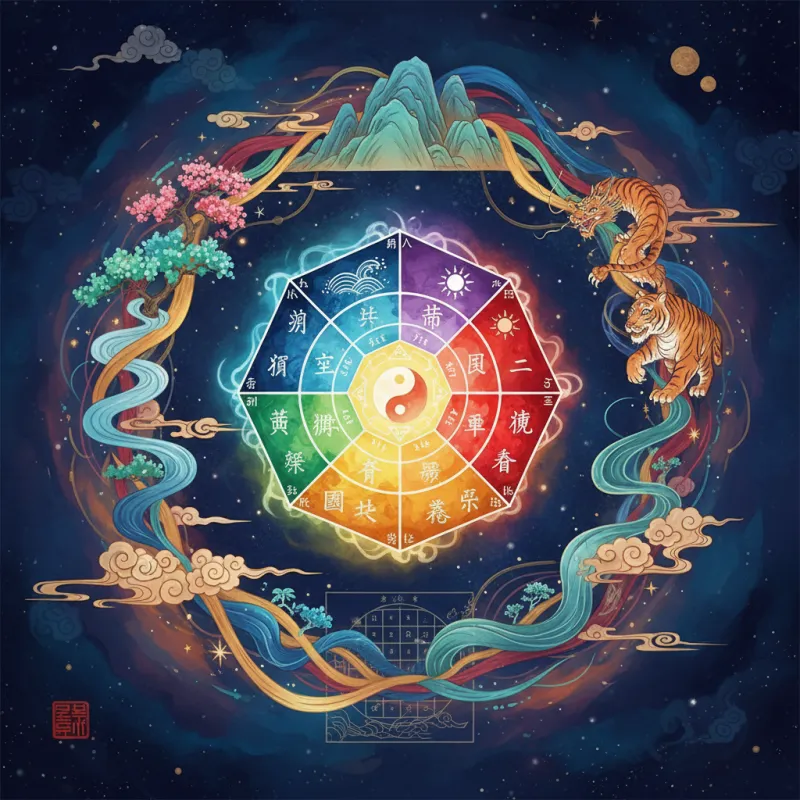
Picture this: You walk into a room painted deep crimson, and your heart rate quickens. Another room, bathed in soft jade green, and your shoulders drop, breath deepens. This isn't psychology—it's physics. The ancient masters who developed Feng Shui (風水, fēng shuǐ) and studied the I Ching (易經, Yì Jīng) understood something modern science is only now confirming: color is energy, and energy shapes reality.
When Color Became Cosmic Law
The connection between color and cosmic order didn't emerge from aesthetic preference—it came from observation. During the Warring States period (475-221 BCE), scholars noticed that certain colors appeared consistently in natural cycles. Wood burns to create fire. Fire leaves ash, which becomes earth. Earth contains metal. Metal enriches water. Water nourishes wood. This wasn't poetry; it was pattern recognition that would become the Five Elements theory (五行, wǔ xíng).
The I Ching, compiled around 1000 BCE during the Western Zhou Dynasty, took this further. Its 64 hexagrams don't just predict change—they map the energetic signatures of transformation itself. Each hexagram carries color associations that reveal the quality of qi (氣, qì) moving through a situation. When you understand these associations, you're not decorating—you're conducting energy.
The Five Elements and Their Color Signatures
Green and blue belong to Wood (木, mù), the element of spring, growth, and upward movement. In classical Feng Shui texts like the "Huangdi Zhaijing" (Yellow Emperor's Classic of House Siting), Wood colors are prescribed for eastern sectors and spaces where new ventures begin. But here's what most modern interpretations miss: Wood isn't just about plants. It's about the explosive force of a seed cracking through soil, the relentless push of bamboo through stone. When you paint a room green, you're invoking that same insistent, upward energy.
Red, orange, and bright purple pulse with Fire (火, huǒ) energy—the element of summer, expansion, and transformation. The southern sector of any space traditionally carries Fire energy, which is why imperial palaces positioned their main gates to the south, painted in vermillion red. Fire colors don't just warm a space; they accelerate time within it. Conversations move faster. Decisions come quicker. This is why traditional Chinese wedding chambers used red extensively—not for luck, but to catalyze the transformative union of two lives.
Yellow, brown, and earth tones ground us in Earth (土, tǔ) element energy. The center of the bagua map, the energetic blueprint used in Feng Shui space analysis, belongs to Earth. During the Tang Dynasty (618-907 CE), only the emperor could wear certain shades of yellow because Earth element represented the stabilizing center of civilization itself. Earth colors don't energize or calm—they anchor. They say: here is where transformation pauses to consolidate.
White, silver, and metallic tones carry Metal (金, jīn) energy—the element of autumn, contraction, and refinement. Metal cuts away excess, defines boundaries, creates precision. In the I Ching, hexagrams dominated by Metal energy often indicate times for editing, eliminating, and clarifying. Western sectors of buildings traditionally use Metal colors because that's where the sun sets, where the day's expansion gives way to evening's distillation.
Black, deep blue, and charcoal embody Water (水, shuǐ)—the element of winter, depth, and potential. Water is the most misunderstood element in Western Feng Shui practice. It's not about flow and abundance, as popular books claim. Water is about descent, mystery, the hidden. The northern sector carries Water energy, and classical texts warn against excessive Water colors there—too much can create stagnation, not flow. Water colors work best as accents, suggesting depth without drowning the space in it.
The I Ching's Color Wisdom
The I Ching approaches color differently than Feng Shui's spatial practice. Each hexagram contains two trigrams, and each trigram carries elemental—and therefore color—associations. Hexagram 30, Li (離, lí), "The Clinging Fire," is pure Fire energy: red, orange, brilliant yellow. When this hexagram appears in a reading, it's not suggesting you paint your walls red. It's revealing that the situation itself carries Fire's quality—bright, consuming, transformative, potentially dangerous.
Hexagram 29, Kan (坎, kǎn), "The Abysmal Water," pulses with deep blue and black. Ancient diviners understood that when Kan appeared, the situation required Water's qualities: patience, depth, the willingness to descend before rising. The color associations weren't decorative—they were diagnostic tools for reading the energetic signature of circumstances.
What makes the I Ching's color system profound is its emphasis on change. Unlike static color prescriptions, the I Ching shows how colors transform into each other. Hexagram 11, Tai (泰, tài), "Peace," shows Earth above Heaven—yellow earth tones grounding white celestial energy. But this hexagram changes, often into Hexagram 5, Xu (需, xū), "Waiting," which introduces Water element. The color story shifts from grounded stability to patient depth. This is how the ancients understood interior spaces—not as fixed color schemes but as evolving energetic narratives.
Practical Application: Reading Your Space
Walk through your home and notice where colors cluster. A room dominated by Fire colors (reds, oranges) will naturally accelerate energy—perfect for social spaces, problematic for bedrooms where you need rest. If you're struggling with insomnia in a red bedroom, you're not fighting psychology; you're fighting physics. The color is literally activating yang energy when you need yin.
Offices benefit from Metal element colors—whites, grays, metallics—because Metal energy supports focus, precision, and completion. But too much Metal without Wood (green, blue) creates rigidity. The classical texts recommend a 70-30 ratio: dominant Metal with Wood accents. This isn't arbitrary—it mirrors the natural cycle where Metal must eventually yield to Wood's renewal.
For spaces where you need both creativity and grounding—studios, workshops, kitchens—Earth colors (yellows, browns, terracotta) provide the stable center while allowing other elements to dance around them. The famous Song Dynasty painter Guo Xi wrote about his studio being painted in warm earth tones specifically because it allowed his mind to wander (Wood energy) while his hand remained steady (Earth energy).
The Modern Misunderstanding
Contemporary Feng Shui often reduces color to mood: red for passion, blue for calm, green for growth. This isn't wrong, but it's incomplete. The classical understanding treats color as a language of energy transformation. When you choose colors based on Five Element theory and I Ching wisdom, you're not decorating—you're programming the energetic operating system of your space.
The difference matters. Modern color psychology might suggest blue for a bedroom because it's calming. Classical Feng Shui asks: which direction does the bedroom face? What element dominates that sector? What life phase is the occupant in? A young person building a career might need Wood colors (green, blue) even in a bedroom to support growth energy. An older person seeking rest might need Earth tones to consolidate and stabilize. The I Ching would add: what hexagram describes this person's current life situation? The answer shapes the color prescription.
Color as Divination Tool
Here's something most Feng Shui practitioners won't tell you: you can use color to read a space's energy before you change it. Notice which colors naturally accumulate in a room. If someone unconsciously fills their office with red objects—red folders, red art, red accessories—Fire energy is either needed or already dominant. The I Ching principle of "observing the image" (觀象, guān xiàng) applies here. The colors that appear reveal the hexagram the space is living.
I once consulted for a couple whose marriage was struggling. Their bedroom had gradually filled with Metal element colors—white walls, silver frames, gray bedding. Metal energy cuts, separates, defines boundaries. They'd unconsciously created a space that reinforced separation rather than union. We didn't just add red (Fire) for passion, as popular Feng Shui might suggest. We introduced Earth tones (warm browns, soft yellows) to create a stable center, then added touches of Wood (soft greens) to encourage growth. The color shift didn't save their marriage—but it stopped the space from actively undermining it.
Integration: Living the Color Wisdom
The real power of Feng Shui and I Ching color wisdom isn't in following rules—it's in developing sensitivity to energy. Start noticing how colors affect your qi. Spend an hour in a room painted deep red, then an hour in a soft blue space. Don't think about it; feel it. Your body knows what the ancient texts describe.
Then experiment. Change one room's color scheme based on Five Element principles. If it's a north-facing room (Water sector), try reducing black and blue, adding some Earth tones to stabilize the Water energy. Live with it for a month. Notice what shifts—not just in mood, but in what happens in that space. Who gathers there? What conversations occur? What activities feel natural?
The I Ching teaches that change is constant, and color is one of change's most accessible languages. Your space should evolve as your life evolves. The colors that supported you five years ago might constrain you now. This is why classical Feng Shui practitioners recommended seasonal color adjustments—not repainting entire rooms, but shifting accent colors to harmonize with the year's dominant energy.
Understanding the relationship between colors and the bagua map deepens this practice, as does exploring how specific colors influence different life areas. But the foundation remains the same: color is energy, energy is change, and change is the only constant. The ancient masters who developed these systems weren't creating superstition—they were mapping reality at a level we're only beginning to appreciate.
Related Reading
- Flying Stars Feng Shui: Time-Based Energy Analysis
- Unlocking the Secrets of Feng Shui and I Ching: A Journey Through Chinese Metaphysics
- Jade in Chinese Culture: More Than a Pretty Stone
Explore Chinese Culture
- Explore Daoist philosophy and practice
- Explore traditional Chinese customs
- Explore ancient Chinese cosmology