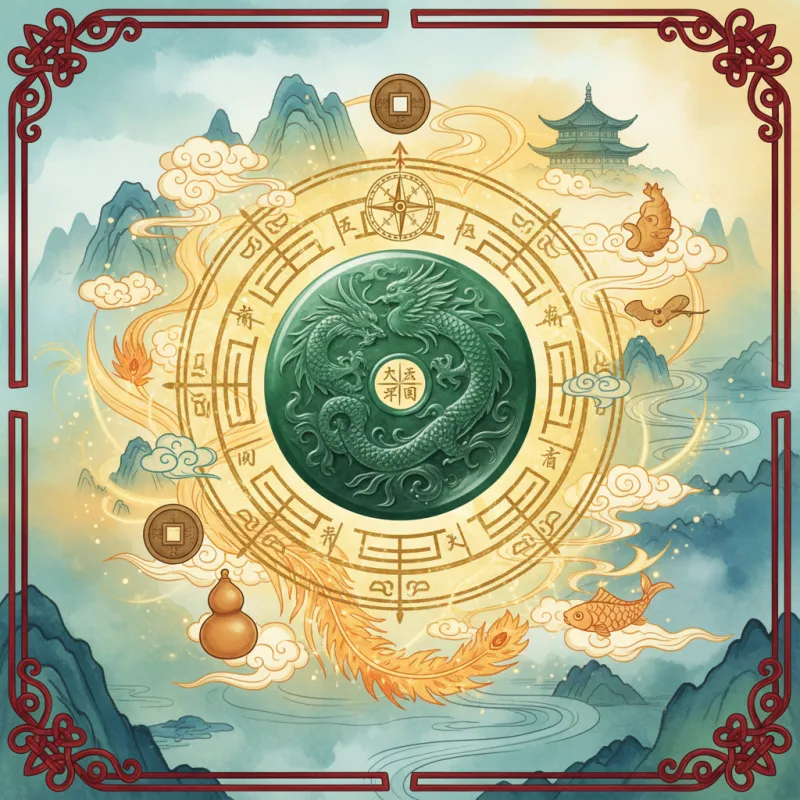
When the Qing Dynasty emperor Qianlong died in 1799, he was laid to rest clutching a jade cicada in his mouth — a tradition stretching back millennia. Not gold. Not pearls. Jade. This wasn't sentiment or superstition. In Chinese cosmology, jade (玉 yù) was believed to prevent bodily decay and guide the soul through the afterlife. The emperor's jade burial suit, assembled from over 4,000 pieces bound with gold thread, cost more than the imperial treasury could reasonably afford. But for jade, no price was too high.
Why Jade Became China's Soul Stone
Most civilizations prize what's rare. The Chinese prized what was right. Jade's value wasn't purely aesthetic — it was moral. Confucius identified eleven virtues in jade, each corresponding to an ideal human quality. The stone's luster represented benevolence (仁 rén). Its translucency showed sincerity (诚 chéng). The way it could be carved but never broken symbolized courage. When struck, jade produces a clear, lingering tone — the sound of wisdom carrying across generations.
This wasn't poetic metaphor. It was systematic philosophy. The Chinese character for jade (玉) appears in over 500 compound characters, many describing precious or beautiful things. The character for "king" (王 wáng) — three horizontal lines representing heaven, earth, and humanity connected by a vertical stroke — forms the structural base of the jade character, with just one additional dot distinguishing the ruler from the stone. The implication was clear: a true king should embody jade's virtues.
Archaeological evidence supports jade's ancient primacy. Neolithic sites like Hongshan culture (4700-2900 BCE) reveal jade dragons, discs, and ceremonial objects crafted with astonishing skill — predating bronze working by thousands of years. These weren't decorative trinkets. They were ritual instruments, status markers, and cosmic tools. The bi disc (璧 bì) represented heaven; the cong tube (琮 cóng) represented earth. Together, they formed a cosmological system carved in stone.
The Jade Emperor and Celestial Bureaucracy
In Chinese folk religion, the supreme deity isn't called the Gold Emperor or the Diamond King. He's the Jade Emperor (玉皇 Yùhuáng), ruler of heaven and coordinator of the celestial bureaucracy. This choice of title reveals everything about jade's status. The heavens themselves were imagined as jade palaces, with jade tablets recording human deeds and jade seals authorizing divine decrees.
The Jade Emperor's origin story varies, but most versions emphasize his cultivation of virtue over countless lifetimes — exactly the qualities jade represents. He doesn't rule through raw power but through moral authority, just as jade's value comes not from hardness (it ranks 6-7 on the Mohs scale, softer than quartz) but from its symbolic weight. When Daoist immortals are depicted, they often hold jade ruyi scepters (如意 rúyì) or drink from jade cups, suggesting that even transcendent beings recognize jade's supremacy.
This celestial association made jade essential in religious and imperial contexts. The Emperor of China held the Mandate of Heaven (天命 tiānmìng), and jade seals authenticated his authority. The most famous, the Heirloom Seal of the Realm, was carved from the He Shi Bi jade disc in 221 BCE. Its loss in the 10th century was considered a cosmic catastrophe, suggesting heaven had withdrawn its approval. For over a thousand years, dynasties rose and fell partly based on whether they possessed this single jade object.
Nephrite vs. Jadeite: A Modern Distinction
Here's where it gets interesting: what the Chinese called jade for 7,000 years isn't what most people buy today. Traditional Chinese jade is nephrite, a calcium magnesium silicate ranging from white to deep green to nearly black. It's tough, workable, and found in Xinjiang, Siberia, and other Central Asian sources. The Chinese called the finest white nephrite "mutton-fat jade" (羊脂玉 yángzhī yù) for its warm, creamy translucence.
Jadeite — the bright emerald-green stone most associated with jade jewelry today — didn't enter China until the 18th century, imported from Burma. It's harder, more brilliant, and can achieve that vivid "imperial green" color that commands astronomical prices. A single jadeite bangle sold at Sotheby's in 2014 for $27.4 million. But to traditionalists, jadeite is the nouveau riche cousin. Real jade, Chinese jade, is nephrite — the stone Confucius praised, the stone buried with emperors, the stone that built a civilization's moral vocabulary.
This distinction matters for feng shui applications. Nephrite's energy is considered more grounding and protective, suitable for long-term wear and generational heirlooms. Jadeite's brighter energy is more dynamic but less stable — beautiful for display, but not necessarily the stone you'd choose for a child's protective pendant or a meditation piece meant to last decades.
Jade in the Five Elements System
In Chinese metaphysics, jade occupies an interesting position within the five elements (五行 wǔxíng). Its primary association is with Wood element due to its green color and connection to growth, renewal, and spring. However, white jade connects to Metal element, representing clarity and precision. Black jade touches Water element, associated with depth and mystery. This elemental flexibility makes jade uniquely adaptable in bazi analysis and feng shui adjustments.
The Qing Dynasty scholar Xu Shen wrote that jade "is the most beautiful stone," but more importantly, he noted that jade "gathers the essence of heaven and earth." This wasn't mystical nonsense — it was an observation about jade's formation. Nephrite forms under specific conditions of pressure, temperature, and mineral composition, creating a stone that's neither purely crystalline nor purely mineral. It exists in a liminal state, which Chinese philosophers found deeply meaningful.
In practical feng shui, jade is placed in the east (Wood sector) to support family harmony and health, or in the west (Metal sector) when white jade is used to enhance children's luck and creative projects. A jade mountain carving in the north supports career advancement through the Water element connection. The stone's versatility reflects its philosophical complexity — jade isn't locked into one meaning or application.
The Jade Burial Suits: Immortality in Stone
Between the Western Han and Eastern Han dynasties (206 BCE - 220 CE), Chinese royalty were buried in full-body suits made of jade plaques sewn together with gold, silver, or copper thread. The thread's metal indicated rank: gold for emperors and empresses, silver for princes, copper for lesser nobility. These suits required thousands of precisely cut jade pieces, taking years to construct and costing fortunes that could have fed provinces.
Why? The Chinese believed jade prevented bodily decay and facilitated spiritual transformation. The Huainanzi, a 2nd-century BCE philosophical text, states: "If there is jade in the mountains, the trees will be luxuriant; if there is jade in the rivers, the water will not dry up." By extension, jade in the body would preserve life force indefinitely. The suits weren't just burial goods — they were immortality technology.
The most famous jade suit belonged to Prince Liu Sheng, discovered in 1968 in Hebei Province. His suit contained 2,498 jade pieces bound with 1,100 grams of gold wire. His wife Dou Wan's suit was similarly elaborate. Both bodies had completely decomposed, proving the technology didn't work. But the suits themselves remain masterpieces of craftsmanship and faith — physical manifestations of humanity's oldest dream, executed in China's most sacred material.
The practice was eventually banned in 222 CE by Emperor Wen of Wei, partly due to cost but also because tomb robbers were desecrating graves to steal the suits. The ban marked a shift in Chinese burial practices, but jade remained essential in death rituals. Even today, jade cicadas (symbolizing rebirth) and jade coins (for passage to the afterlife) are placed with the deceased.
Jade Carving: The Art of Patience
Unlike diamond cutting, which follows crystalline structure, jade carving is sculptural. Nephrite's interlocking fibrous structure means it has no cleavage planes — you can't split it cleanly. Instead, carvers use abrasive tools to slowly grind away material, revealing forms hidden in the stone. A complex jade carving might take years to complete. The Qing Dynasty "Jade Mountain Illustrating the Gathering of Scholars at the Lanting Pavilion" took seven years and depicts 50 figures in a landscape scene, all carved from a single 5-ton boulder.
Master carvers traditionally studied the raw jade for months before making the first cut, reading the stone's color variations, internal flaws, and natural patterns. The goal wasn't to impose a design but to discover what the jade wanted to become. This philosophy — that the artist reveals rather than creates — is fundamentally Daoist. The Daodejing says, "The sage does nothing, yet nothing is left undone." The jade carver removes stone, yet the form emerges.
Traditional subjects include dragons (power and transformation), phoenixes (renewal and virtue), fish (abundance), bats (good fortune, since "bat" 蝠 fú sounds like "blessing" 福 fú), and cabbage (representing wealth and fertility). The famous Jadeite Cabbage in Taipei's National Palace Museum, carved from a single piece of jadeite with natural color gradations, has become an icon of Chinese artistry — a humble vegetable elevated to imperial treasure through material and skill.
Wearing Jade: The Stone That Wears You Back
There's a Chinese saying: "People nourish jade for three years; jade nourishes people for a lifetime" (人养玉三年,玉养人一生 rén yǎng yù sān nián, yù yǎng rén yīshēng). The belief is that jade absorbs the wearer's qi (气 qì) over time, becoming more lustrous and translucent. Simultaneously, the jade's stable energy field influences the wearer's health and fortune. This isn't just folklore — many jade collectors report that pieces do change appearance with long-term wear, likely due to oils and heat from skin contact.
Traditional Chinese medicine attributes specific healing properties to jade. It's believed to balance bodily fluids, support kidney and heart function, and calm the nervous system. Jade rollers and gua sha tools, now trendy in Western beauty routines, have been used in Chinese medicine for centuries to improve circulation and reduce inflammation. Whether these effects are physiological or psychological is debatable, but the practice's longevity suggests some perceived benefit.
The most important rule: never wear someone else's jade, especially if it was worn during illness or misfortune. Jade is believed to absorb the wearer's experiences, both positive and negative. A jade bangle that cracks or breaks is said to have absorbed a blow meant for the wearer — it sacrificed itself for your protection. This belief makes jade deeply personal. You don't just own jade; you develop a relationship with it.
The Modern Jade Market: Beauty and Deception
Today's jade market is a minefield. The term "jade" is legally applied to both nephrite and jadeite, plus numerous simulants: serpentine, aventurine, chrysoprase, and even dyed quartzite. In Chinese markets, you'll hear about "A-grade," "B-grade," and "C-grade" jade — but these aren't quality grades. They indicate treatment level. A-grade is natural, untreated jadeite. B-grade has been chemically bleached and polymer-impregnated to improve clarity. C-grade is dyed. Only A-grade holds value long-term.
The most expensive jade is "imperial green" jadeite — a vivid, evenly distributed emerald color with high translucency. A single imperial green bangle can cost more than a house. But color can be deceptive. Dealers use tricks: strong lighting to enhance color, oil to improve translucency, even temporary dyes that fade after purchase. The traditional test — listening to the stone's ring when struck — requires years of experience to interpret correctly.
For those interested in jade's metaphysical properties rather than investment value, nephrite offers better value and arguably stronger traditional associations. A genuine nephrite bangle from Xinjiang or Siberia costs a fraction of comparable jadeite but carries the same cultural and spiritual weight. It's the stone Confucius knew, the stone emperors were buried in, the stone that actually built Chinese jade culture.
Jade's Enduring Lesson
In 2008, China chose jade as the material for Olympic medals — gold, silver, and bronze medals all incorporated jade discs. This wasn't random. It was a statement: China's greatest treasure isn't mineral wealth or technological prowess, but the values jade represents. In a world obsessed with what's newest and flashiest, jade reminds us that some things gain value through time, patience, and moral weight.
The Chinese relationship with jade offers a counter-narrative to modern materialism. Jade isn't valuable because it's rare (nephrite is relatively common) or because of marketing (unlike diamonds). It's valuable because a civilization decided that certain qualities — integrity, benevolence, wisdom, courage — deserved a physical form. They chose jade, and for 8,000 years, that choice has shaped art, philosophy, religion, and daily life.
When you hold a piece of genuine jade, you're touching that continuity. The stone in your hand might be newly carved, but it's made from the same material that Neolithic shamans used to communicate with spirits, that Confucius used to teach virtue, that emperors used to claim heaven's mandate. That's not just history. That's the weight of meaning, accumulated over millennia, compressed into stone. That's why jade is more than a pretty stone — it's a civilization's soul, made tangible.
Related Reading
- Crystals and Jade in Chinese Culture: Why Stones Matter More Than You Think
- The Feng Shui Money Frog: History, Placement, and Meaning
- Feng Shui Crystals: Which Ones to Use and Where to Place Them
- Feng Shui Plants Guide: Which Plants to Use and Where
- Harnessing Chinese Metaphysics: Feng Shui, I Ching, and Divination with Crystals
- Harmonizing Life Through Feng Shui, I Ching, and Geomancy: A Cultural Exploration
- Exploring Feng Shui, I Ching, and Chinese Metaphysics in Modern Homes
- Feng Shui for Your Office Desk
Explore Chinese Culture
- Explore Daoist philosophy and practice
- Explore traditional Chinese customs
- Explore ancient Chinese cosmology