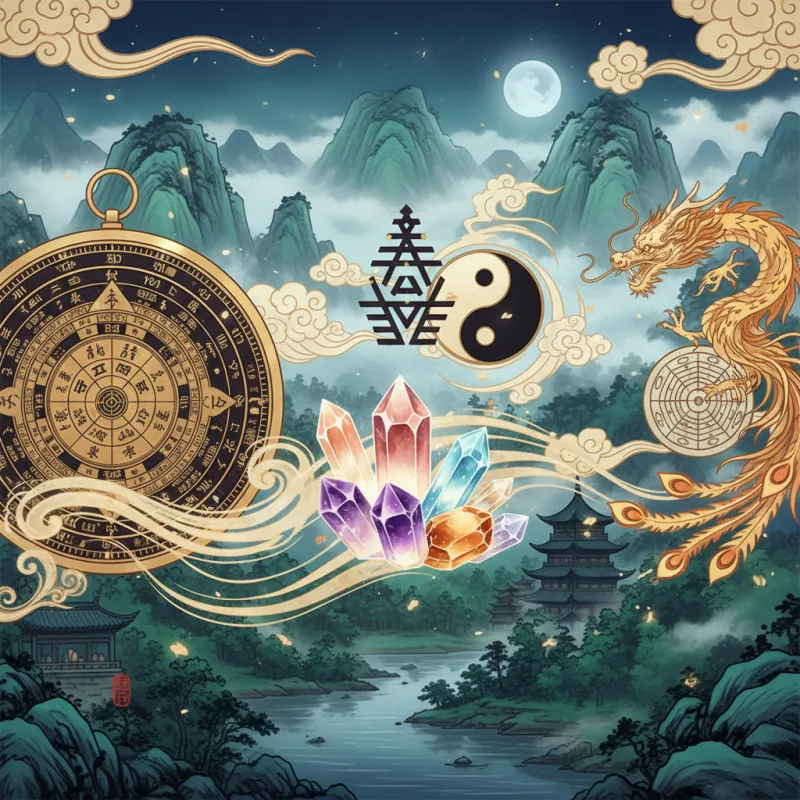
Picture this: A Tang Dynasty scholar sits before a polished jade disc, its surface catching candlelight as he traces the eight trigrams etched into its rim. He's not just admiring craftsmanship—he's reading the universe itself, using crystalline stone as a bridge between heaven and earth. This scene, repeated across millennia in countless variations, reveals something modern practitioners often miss: crystals weren't added to Chinese metaphysics as New Age accessories. They were there from the beginning, woven into the very fabric of how ancient Chinese sages understood cosmic energy.
The Jade Emperor's Legacy: Crystals in Classical Chinese Thought
When we talk about crystals in Chinese metaphysics, we're not discussing some recent fusion of Eastern and Western practices. The Shanhaijing (山海經, Classic of Mountains and Seas), compiled during the Warring States period (475-221 BCE), catalogs dozens of mineral deposits with meticulous attention to their energetic properties. Jade (玉, yù) wasn't just valuable—it was considered condensed qi (氣), life force crystallized into physical form.
The Confucian scholar Xu Shen, writing in 100 CE, defined jade in his etymological dictionary Shuowen Jiezi as "the beauty of stone, possessing five virtues." These weren't aesthetic qualities but energetic ones: warmth, clarity, resonance, durability, and the way it could be shaped without breaking. Notice how these mirror the five elements (五行, wǔxíng)? That's not coincidence. Ancient Chinese thinkers saw crystals as concentrated expressions of elemental energy, making them natural tools for working with the five elements in your space.
Feng Shui's Crystalline Foundations
Here's where most modern Feng Shui books get it wrong: they treat crystals as decorative energy boosters you can scatter around like spiritual air fresheners. Classical Feng Shui texts like the Zangshu (葬書, Book of Burial) by Guo Pu (276-324 CE) describe something far more sophisticated. Guo Pu wrote about identifying dragon veins (longmai, 龍脈) in the earth—underground energy channels—by observing mineral deposits and rock formations.
The presence of certain crystals indicated where qi accumulated or dispersed. Quartz veins marked active energy flows. Jade deposits suggested stable, nourishing qi. This wasn't superstition; it was geological observation filtered through an energetic lens. When you place a crystal in your home according to Feng Shui principles, you're theoretically creating a resonance point that interacts with these larger terrestrial energy patterns.
The Bagua (八卦, Eight Trigrams) map used in Feng Shui analysis has direct crystal correspondences that most practitioners ignore. Each trigram represents not just a direction and life area, but specific mineral formations. Qian (乾), the creative heaven trigram, corresponds to clear quartz and diamond—stones of pure yang energy. Kun (坤), the receptive earth trigram, aligns with dark, grounding stones like obsidian and black tourmaline. When you understand these classical associations, crystal placement becomes precise rather than intuitive guesswork.
The I Ching's Stone Oracles
The Yijing (易經, I Ching or Book of Changes) is typically consulted using yarrow stalks or coins, but historical records reveal a lesser-known practice: stone casting. During the Han Dynasty (206 BCE - 220 CE), diviners would use polished stones of different minerals, each corresponding to one of the eight trigrams. The stones were cast onto a marked surface, and their positions and relationships generated hexagrams.
Why stones instead of stalks? The argument was that minerals, formed over geological time scales, carried deeper temporal wisdom than plants. A piece of jade might be millions of years old, its crystalline structure encoding information about earth's transformations. This made mineral-based divination particularly suited for questions about long-term patterns and karmic cycles.
Modern practitioners can adapt this by creating a set of eight crystals, each representing a trigram. Clear quartz for Qian, obsidian for Kun, carnelian for Li (離, fire), aquamarine for Kan (坎, water), citrine for Zhen (震, thunder), amethyst for Xun (巽, wind), tiger's eye for Gen (艮, mountain), and rose quartz for Dui (兌, lake). The specific stones matter less than maintaining consistent elemental correspondences.
Divination Through Crystal Gazing: Guanshi Practices
Guanshi (觀石, "observing stones") is a divination method documented in Daoist texts from the Six Dynasties period (220-589 CE). Practitioners would meditate while gazing into polished crystal spheres or naturally reflective mineral surfaces, entering trance states to receive visions. This wasn't crystal ball fortune-telling as Western culture imagines it—the crystal wasn't showing the future like a movie screen.
Instead, the practice worked through ganying (感應), "sympathetic resonance." The crystal's ordered atomic structure was believed to resonate with the practitioner's shen (神, spirit), creating a feedback loop that amplified intuitive perception. The Daoist alchemist Ge Hong (283-343 CE) wrote in his Baopuzi that certain crystals could "clarify the three souls and stabilize the seven spirits," referring to the hun and po aspects of consciousness in Chinese psychology.
For practical application, this means crystal gazing works best as a meditative focusing tool rather than a passive scrying method. You're not waiting for images to appear; you're using the crystal's structure to organize your own intuitive impressions into coherent patterns. Understanding crystal energy properties becomes essential for choosing the right stone for different types of questions.
Bazi and Crystalline Birth Charts
Bazi (八字, Eight Characters), also called Four Pillars of Destiny, analyzes a person's birth time through the lens of the five elements. Each person has a unique elemental constitution—perhaps strong in fire but deficient in water, or excessive in wood needing metal to prune it. Classical bazi practitioners recommended lifestyle adjustments, career choices, and even marriage partners based on these elemental balances.
Crystals enter this system as elemental supplements. Someone with weak water element in their chart might benefit from wearing aquamarine or moonstone. Excess fire could be balanced with cooling stones like jade or blue lace agate. But here's the sophisticated part: the recommendations change based on the current year's elemental energy and the person's ten-year luck pillars (dayun, 大運).
This creates a dynamic system where crystal recommendations aren't static. A stone that benefits you during a wood luck pillar might be counterproductive during a metal pillar. This is why traditional Chinese metaphysics resists the Western approach of "this crystal is for love, that one is for money." The question is always: what does your energetic constitution need right now, given the temporal cycles you're moving through?
Integrating Crystal Practices with Modern Metaphysics
The challenge for contemporary practitioners is distinguishing between authentic traditional practices and modern inventions marketed as ancient wisdom. Not everything old is valuable, and not everything new is invalid, but clarity matters. When someone tells you to place a citrine in your wealth corner, ask: wealth corner according to which Feng Shui school? The xuan kong (玄空, Flying Stars) system? The bazhai (八宅, Eight Mansions) method? These give different answers.
Similarly, crystal healing as practiced in Western New Age contexts has minimal overlap with classical Chinese mineral medicine. The Bencao Gangmu (本草綱目, Compendium of Materia Medica) compiled by Li Shizhen in 1578 does list mineral medicines, but their applications are specific and often involve ingestion as prepared powders, not wearing stones or placing them in rooms.
That said, the underlying principle—that minerals carry distinct energetic signatures that can influence human qi—is consistent across traditions. The difference is in methodology and precision. Chinese metaphysics offers systematic frameworks for understanding these interactions rather than relying solely on intuitive feeling.
Practical Applications for the Modern Seeker
If you want to work with crystals through a Chinese metaphysical lens, start with your own elemental analysis. Get a bazi chart calculated (numerous online tools exist, though consulting a knowledgeable practitioner is ideal). Understand your elemental strengths and weaknesses. This becomes your baseline for crystal selection.
Next, learn the Bagua and how it maps onto your living space. Different Feng Shui schools apply it differently—some align it with compass directions, others with your entrance door. Choose one system and stick with it rather than mixing methods. Place crystals corresponding to the elemental energy of each sector, but remember: the goal isn't to maximize energy everywhere. Sometimes you want to calm an overactive area or leave a sector relatively neutral.
For divination, experiment with the eight-crystal I Ching method described earlier. Cast the stones and note which trigrams appear in which positions. Build your own interpretation system through practice rather than relying on books. The I Ching's genius is that it's a framework for organizing your own wisdom, not a fixed fortune-telling script.
Finally, maintain a practice journal. Note which crystals you're working with, the dates, and any observable effects. Chinese metaphysics is empirical in its own way—it expects results. If a practice doesn't produce noticeable shifts over time, adjust your approach. The tradition survived millennia because it worked for people, not because it sounded mystical.
The integration of crystals with Feng Shui, I Ching, and other Chinese metaphysical arts isn't about adding sparkly objects to ancient wisdom. It's about recognizing that minerals have always been part of how Chinese culture understood the relationship between matter and energy, earth and heaven, the visible and invisible dimensions of reality. When you hold a crystal with this awareness, you're not just holding a pretty stone—you're holding a piece of the earth's qi, crystallized and concentrated, ready to interact with your own energetic field in ways both subtle and profound.
Related Reading
- Crystals and Jade in Chinese Culture: Why Stones Matter More Than You Think
- Jade in Chinese Culture: More Than a Pretty Stone
- Feng Shui Plants Guide: Which Plants to Use and Where
- Feng Shui Crystals: Which Ones to Use and Where to Place Them
- The Feng Shui Money Frog: History, Placement, and Meaning
- Annual Feng Shui Cures and Enhancers: What to Place Where
- The Chinese Zodiac: Complete Guide to All 12 Animal Signs
- Chinese Breathing Techniques for Energy and Calm
Explore Chinese Culture
- Explore Daoist philosophy and practice
- Explore traditional Chinese customs
- Explore ancient Chinese cosmology