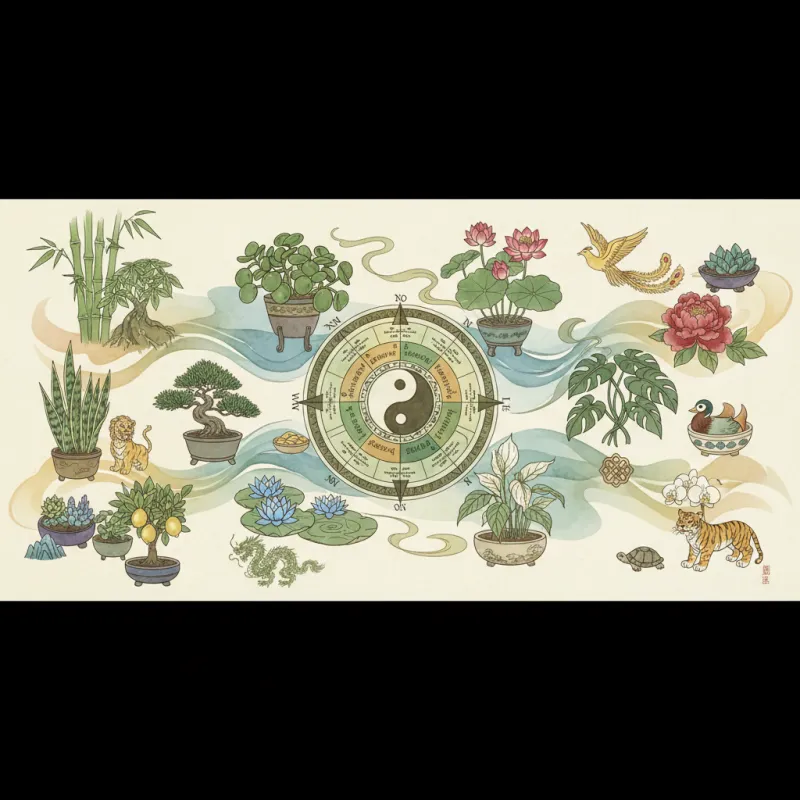
Your home is breathing wrong. Not the HVAC system — the space itself. Walk into most modern apartments and you'll feel it: sterile air, flat energy, the subtle suffocation of a place that's decorated but not alive. The fastest fix isn't an air purifier or a feng shui consultant's $3,000 bagua mirror. It's a $15 potted plant in the right corner.
Plants are the only feng shui adjustment that literally grows stronger over time. Unlike crystals that sit inert or wind chimes that just hang there, plants actively generate qi (气 qì) — they photosynthesize, release oxygen, absorb toxins, and create the wood element (木 mù) energy that every space needs to feel vital rather than stagnant. But here's what the generic feng shui blogs won't tell you: a dying succulent carries worse energy than an empty shelf, and a cactus by your bed is basically inviting sha qi (煞气 shàqì, attacking energy) to stab you while you sleep.
The difference between plants that enhance your space and plants that drain it comes down to three factors: species selection, placement according to bagua (八卦 bāguà) zones, and honest assessment of whether you'll actually keep the thing alive.
The Wood Element and Why It Matters More Than You Think
In the five elements system (五行 wǔxíng), wood represents growth, expansion, flexibility, and upward movement. It's the energy of spring, of dawn, of new projects and creative breakthroughs. The classical texts — particularly the Huangdi Neijing (黄帝内经, Yellow Emperor's Inner Canon) from around 100 BCE — associate wood with the liver and eyes, with the color green, with the east direction, and with the number 3.
Wood feeds fire and is fed by water in the productive cycle. It controls earth and is controlled by metal in the destructive cycle. This matters because if your home is heavy on metal element (white walls, metal furniture, minimalist aesthetic), adding wood plants creates balance. If you're already wood-heavy (lots of green, tall vertical lines, wooden furniture), more plants might create excess and make the space feel chaotic rather than vital.
The Song dynasty feng shui master Wang Ji (王伋) wrote in his Yangzhai Shishu (阳宅十书, Ten Books on Yang Dwellings, 1190 CE) that "living wood brings sheng qi (生气 shēngqì, generating energy) while dead wood brings si qi (死气 sǐqì, death energy)." This is why a thriving pothos vine does more for your space than an expensive wooden sculpture, and why you must remove dead or dying plants immediately.
Best Feng Shui Plants and What They Actually Do
Money plant (Epipremnum aureum) — Called golden pothos in the West, this is the jade plant's more forgiving cousin. In Cantonese it's 黄金葛 (wòhnggām got), literally "golden vine." Nearly impossible to kill, grows in water or soil, tolerates low light. Place in the wealth corner (southeast) or near the entrance to invite prosperity. The round leaves represent coins, and the trailing growth symbolizes abundance flowing into your life.
Lucky bamboo (Dracaena sanderiana) — Not actually bamboo, but the symbolism works. Called 富贵竹 (fùguìzhú, wealth and honor bamboo) in Chinese. The number of stalks matters: three for happiness, five for wealth, six for health, eight for prosperity, nine for good fortune. Never four (sounds like death, 死 sǐ). Keep in water with pebbles, place in east for health or southeast for wealth. Changes the energy faster than almost any other plant.
Jade plant (Crassula ovata) — 玉树 (yùshù, jade tree) or 发财树 (fācáishù, fortune tree). The thick, coin-shaped leaves store water and symbolize stored wealth. Place near the entrance but not directly in the doorway. Needs bright light and infrequent watering. A mature jade plant that's been in a business for years carries accumulated prosperity energy — this is why you see ancient specimens in old Chinese restaurants and family shops.
Peace lily (Spathiphyllum) — 白鹤芋 (báihèyù, white crane taro). Excellent air purifier, tolerates low light, produces white flowers that represent metal element. Place in north (career) or west (children and creativity). The broad leaves gather and hold qi, while the white blooms add clarity and precision to wood's growth energy.
Snake plant (Sansevieria trifasciata) — 虎尾兰 (hǔwěilán, tiger tail orchid). Releases oxygen at night unlike most plants. The upright, sword-like leaves create strong protective energy. Place near windows or in corners to guard against negative qi entering the space. Some practitioners avoid it in bedrooms because the sharp leaves create cutting energy, but if you have a large bedroom with stagnant corners, it's perfect for activating dead zones.
Rubber plant (Ficus elastica) — 橡皮树 (xiàngpíshù). Large, round leaves represent wealth and abundance. The substantial presence makes it ideal for filling empty corners or balancing large rooms. Place in southeast for wealth or east for health and family. Needs moderate light and doesn't like being moved once established.
Plants to Avoid and Why
Cacti and succulents with spines — The sharp needles create sha qi, attacking energy that disrupts rather than enhances. Never place near beds, seating areas, or entryways. If you love them, keep them on exterior windowsills where they guard against outside negative energy but don't affect your interior space.
Bonsai trees — Controversial in feng shui. The practice of deliberately stunting growth contradicts wood element's natural expansion. Some practitioners say they represent restricted potential and limited growth. If you have bonsai, keep them in hobby areas, not in wealth or career zones.
Dried flowers and potpourri — Dead plant material carries si qi. The Yangzhai Jiyao (阳宅集要, Essential Collection on Yang Dwellings) specifically warns against keeping dried plants indoors. If you want fragrance, use essential oils or fresh flowers that you replace regularly.
Fake plants — The debate rages, but most traditional practitioners say no. Fake plants are metal or plastic (metal element) pretending to be wood — they're literally lying about what they are. If you absolutely cannot keep real plants alive, high-quality silk plants in low-traffic areas are the compromise, but they need regular cleaning to prevent dust accumulation, which creates stagnant qi.
Thorny roses indoors — Beautiful but problematic. The thorns create small cutting energy throughout the space. Keep rose bushes outside where they can guard the perimeter. If you receive cut roses, remove all thorns before bringing them inside.
Placement by Bagua Zone
The bagua map divides your space into nine zones, each corresponding to a life area. Plant placement should consider both the zone's element and what you want to activate.
East (health and family) — Wood's home direction. This is where plants have maximum impact. Place your healthiest, most vibrant specimens here. Bamboo, jade plant, or any tall, upward-growing plant works perfectly. This zone affects family relationships and physical health, so prioritize plants that you'll actually maintain.
Southeast (wealth and abundance) — Also wood element. The classic wealth corner. Money plant, jade plant, or a small citrus tree (if you have enough light) activates prosperity energy. The key is healthy growth — a dying plant in the wealth corner is worse than nothing.
South (fame and reputation) — Fire element. Wood feeds fire, so plants here support your public image and recognition. Choose plants with red or purple flowers, or plants with pointed, upward-reaching leaves. Avoid overwatering, as excess water in the fire zone creates conflict.
North (career and life path) — Water element. Water feeds wood, so plants thrive here energetically. Peace lily or any plant that tolerates moisture works well. This zone affects your career trajectory, so choose plants that grow steadily upward rather than trailing downward.
Center (health and balance) — Earth element. Wood controls earth in the destructive cycle, so use plants sparingly here. If you do place plants in the center, choose grounding varieties with substantial presence rather than delicate or trailing types.
Avoid placing plants in the west (children and creativity) or northwest (helpful people and travel) unless you're specifically trying to control excess metal energy in those zones. Metal cuts wood, so plants struggle energetically in metal zones.
The Maintenance Reality Check
Here's what separates effective feng shui from Instagram feng shui: a dead plant carries worse energy than an empty space. The Zangfu (藏府) theory in Chinese medicine teaches that decay and stagnation breed disease. The same applies to your environment.
If you travel frequently, choose snake plants or ZZ plants (Zamioculcas zamiifolia) that tolerate neglect. If you have low light, accept it and choose pothos or peace lily rather than fighting reality with a fiddle leaf fig that will slowly die. If you forget to water, get self-watering pots or choose plants that show obvious signs of thirst before they're damaged.
Check your plants weekly. Remove dead leaves immediately. Wipe dust off broad leaves monthly — dust blocks the plant's ability to absorb light and process qi. Rotate plants quarterly so all sides receive light and grow evenly. Repot when roots emerge from drainage holes.
When a plant dies despite your care, thank it (seriously), remove it completely, and cleanse the spot with salt water before placing a new plant. Some practitioners believe plants absorb negative energy and sacrifice themselves to protect the household. Whether you believe that or not, the ritual of acknowledgment and cleansing prevents you from creating a plant graveyard corner.
Integration with Other Feng Shui Adjustments
Plants work synergistically with other feng shui tools. Pair them with crystals for wealth and abundance by placing a citrine cluster near your money plant — earth element (crystal) feeds wood element (plant) in the productive cycle. Use plants to soften harsh angles created by furniture or architecture, as the curved leaves and organic shapes counteract cutting energy.
In bedrooms, choose plants that release oxygen at night (snake plant, aloe vera) and place them at least three feet from the bed. The bedroom needs more yin (阴 yīn) energy for rest, while plants are yang (阳 yáng) and activating. Too many plants in the bedroom can make sleep restless.
For home offices, place a bamboo plant on your desk's left side (the dragon side in feng shui, representing growth and expansion). Pair it with feng shui desk setup principles to create a complete workspace that supports focus and success.
The Seasonal Consideration
Traditional feng shui follows the Chinese agricultural calendar and the changing dominance of the five elements through the year. Wood element peaks in spring (roughly February through April in the solar calendar). This is when plants have maximum energetic impact and when new plants establish most successfully.
In summer, wood feeds fire — your plants support the season's expansive, outward energy. In autumn, metal controls wood, so plants may need extra care as the energetic environment becomes less supportive. In winter, water feeds wood, but the dormant season means slower growth and less visible impact.
This doesn't mean you can't add plants in autumn or winter, but understand that their energetic contribution builds more slowly. The Song dynasty text Dili Wujue (地理五诀, Five Keys to Geography) notes that "adjustments made with the season's flow require less effort and produce greater effect."
Start Simple, Grow Gradually
If you're new to both plants and feng shui, start with one pothos in your wealth corner and one snake plant near your entrance. These two plants alone will shift your space's energy noticeably within weeks. Water the pothos when the soil feels dry an inch down. Ignore the snake plant except for monthly watering.
Watch what happens. Notice if the space feels more alive. Pay attention to whether opportunities increase or relationships improve. Feng shui works through subtle accumulation, not dramatic overnight transformation. After a month, add a third plant in your health zone (east). Build slowly, maintain consistently, and let the living wood element do what it does naturally: grow, expand, and generate the vital energy that makes a house feel like a home.
The goal isn't to create a jungle. It's to introduce enough living wood element that your space breathes properly, that qi flows rather than stagnates, and that you feel the difference between a decorated room and a truly alive environment. Three to five well-placed, well-maintained plants will accomplish more than twenty neglected ones.
Related Reading
- Harnessing Chinese Metaphysics: Feng Shui, I Ching, and Divination with Crystals
- Feng Shui Crystals: Which Ones to Use and Where to Place Them
- The Feng Shui Money Frog: History, Placement, and Meaning
- Crystals and Jade in Chinese Culture: Why Stones Matter More Than You Think
- Jade in Chinese Culture: More Than a Pretty Stone
- Kitchen Feng Shui: Cooking Up Prosperity
- The Five Elements in Interior Design
- Exploring Feng Shui, I Ching, and Chinese Metaphysics: Symbols of Ancient Divination and Geomancy
Explore Chinese Culture
- Explore Daoist philosophy and practice
- Explore traditional Chinese customs
- Explore ancient Chinese cosmology