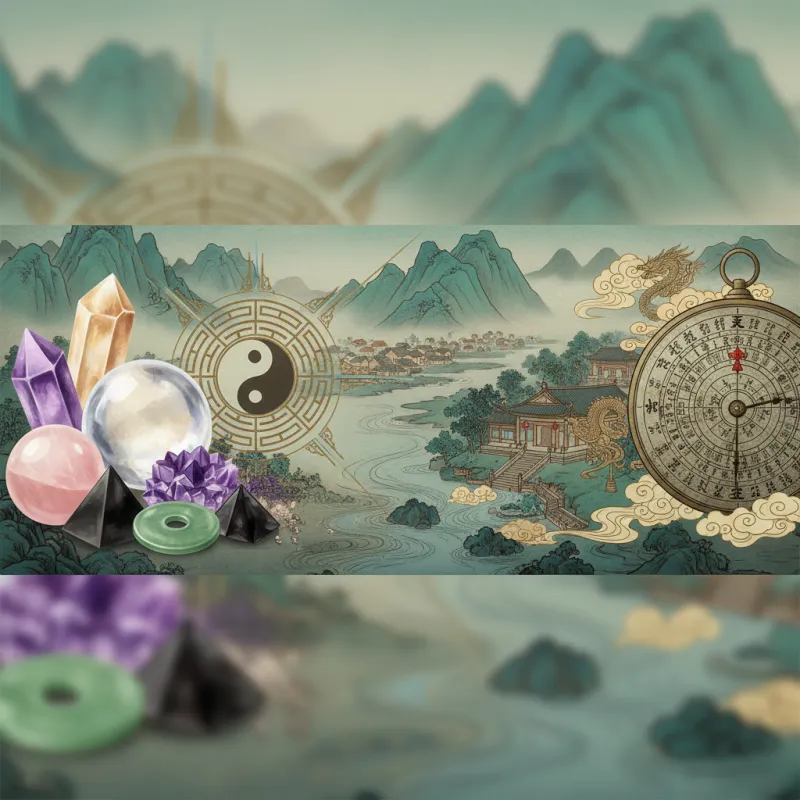
Your living room feels scattered. Energy bounces off the walls like a pinball machine, and you can't seem to settle into anything. A feng shui consultant visits, walks the space for three minutes, and places a single amethyst cluster on your coffee table. Within days, the room feels different — calmer, more cohesive, like someone turned down the volume on chaos itself. This isn't magic. It's earth element physics.
What Crystals Actually Do in Feng Shui
In feng shui (风水 fēngshuǐ), crystals function as concentrated earth element (土 tǔ) — not because they "vibrate at healing frequencies" or "align your chakras," but because they're literally compressed mineral matter formed under immense geological pressure. When you place a crystal in a room, you're introducing a dense node of earth energy that interacts with the existing five elements (五行 wǔxíng) balance of that space.
Earth element stabilizes. It slows things down, creates weight and substance, grounds excess movement. In a room dominated by fire energy (too much red, sharp angles, aggressive lighting), earth absorbs and moderates that intensity. In a space with chaotic wood energy (too many plants, vertical lines, upward-thrusting furniture), earth provides the anchoring counterbalance. This is basic five elements theory, not New Age speculation.
The key distinction: feng shui uses crystals for their elemental properties and physical presence, not for supposed metaphysical vibrations. A rose quartz isn't "the love stone" — it's a pink earth element object that happens to work well in relationship areas because earth supports metal (金 jīn), and metal governs partnership in certain bagua (八卦 bāguà) applications. The mechanism is five elements interaction, not cosmic energy transmission.
Clear Quartz: The Universal Earth Anchor
Clear quartz (水晶 shuǐjīng, literally "water crystal") is feng shui's workhorse crystal because it's pure earth element without color complications. When you need to stabilize a space without introducing additional elemental influences through color, clear quartz does the job cleanly.
Place clear quartz clusters in the center of your home — the earth position in bagua mapping. This reinforces the natural earth element of that sector and creates a stable energetic foundation for the entire dwelling. I've seen homes where the center area was a chaotic pass-through hallway (terrible feng shui, but common in modern construction) transformed by a substantial quartz cluster on a side table. The crystal doesn't "fix" the architectural problem, but it provides an earth anchor that partially compensates for the missing center.
Clear quartz spheres work differently than clusters. Spheres distribute energy evenly in all directions, making them ideal for rooms that feel directionally imbalanced — where energy seems to pool in one corner or rush toward one wall. Place a quartz sphere in the problem area, and it acts like a roundabout in traffic flow, redirecting qi (气 qì) more smoothly through the space.
For protection against negative flying stars (飞星 fēixīng), particularly the Five Yellow (五黄 wǔhuáng) and Two Black (二黑 èrhēi) — both earth element afflictions — clear quartz provides earth-to-earth mitigation. You're not "blocking" the star's energy; you're providing a stable earth presence that prevents the affliction from manifesting as chaos or illness. Think of it as adding ballast to a ship in rough seas.
Amethyst: Earth with Water Influence
Amethyst's purple color connects it to water element (水 shuǐ) through color theory, making it earth element with water characteristics. This dual nature makes amethyst particularly useful in wealth areas (southeast bagua sector) because water generates wood (木 mù), and wood is the element of growth and expansion.
Place amethyst clusters in your home office or workspace, specifically in the wealth corner of your desk (far left from where you sit). The earth element provides stability for financial matters, while the water influence encourages flow and opportunity. I'm skeptical of claims that amethyst "attracts abundance," but I've observed that people who place substantial amethyst pieces in their workspace tend to maintain better financial organization — possibly because the visual presence of the crystal serves as a constant reminder of financial intentions.
Amethyst geodes work exceptionally well in meditation spaces or bedrooms because the hollow interior creates a contained field of earth energy. The geode's cave-like structure naturally draws energy inward, promoting introspection and rest. Position a geode in the far right corner of your bedroom (relationship area) if you want to deepen intimacy — not because amethyst is "spiritual," but because the earth element supports the metal element that governs partnership, and the inward-drawing structure encourages connection rather than dispersion.
For homes with excessive fire energy (common in modern spaces with too much electronics, bright lighting, and red accents), amethyst provides earth-water cooling. The earth absorbs fire's intensity, while the water color influence further moderates heat. This is particularly effective in kitchens, where fire element naturally dominates.
Rose Quartz: Earth Supporting Metal
Rose quartz is pink earth element, and pink connects to metal element through color associations in Chinese metaphysics. This makes rose quartz ideal for relationship work — not because it's "the love stone," but because metal element governs partnerships, and earth generates metal in the productive cycle of five elements.
Place rose quartz in the far right corner of your bedroom (the relationship area in bagua mapping). Use substantial pieces — at least fist-sized — because tiny tumbled stones don't provide enough earth element presence to meaningfully affect the space. I've seen people scatter rose quartz chips around their bedroom and wonder why nothing changes. You need mass. Earth element is about weight and substance.
Rose quartz also works in the center of the home (earth position) when relationship harmony is a household-wide concern. A large rose quartz sphere or cluster in the central area supports all relationships in the dwelling — romantic, familial, roommate dynamics. The earth element provides stable foundation, while the pink-metal connection encourages the clarity and definition that metal element brings to partnerships.
For single people seeking partnership, place rose quartz in pairs rather than single pieces. This isn't symbolic magic — it's visual programming. Your subconscious registers "two" instead of "one," which subtly shifts your energetic orientation from solitary to partnered. Feng shui works partly through environmental psychology, and paired objects in relationship areas reinforce partnership intention.
Avoid rose quartz in workspaces unless you want to soften professional relationships. The metal-supporting quality can make you too accommodating in business contexts where you need stronger boundaries. For offices, stick with clear quartz or citrine.
Citrine: Earth with Fire Characteristics
Citrine's yellow-gold color connects it to fire element (火 huǒ), making it earth with fire influence. This combination makes citrine useful for wealth activation because fire generates earth in the productive cycle, and earth provides the stable foundation for accumulating resources.
Place citrine in the southeast corner of your home or office (wealth area in bagua). The fire influence stimulates activity and opportunity, while the earth element ensures that wealth accumulates rather than flowing through. Natural citrine works better than heat-treated amethyst (which most commercial "citrine" actually is) because natural citrine formed under specific geological conditions that give it genuine fire-earth balance. Heat-treated citrine is just purple amethyst that's been burned yellow — the elemental properties are forced rather than natural.
Citrine clusters work well on desks where you handle money matters — bill paying, investment management, business planning. The visual presence of the golden crystal serves as a constant reminder of financial intention, and the earth-fire combination provides both stability and momentum for wealth-building activities.
For retail businesses, place citrine near the cash register or point of sale. The fire element stimulates customer activity, while the earth element helps money stick rather than circulate out as quickly as it comes in. This is traditional feng shui practice in Chinese shops, where you'll often see citrine or golden crystals near the register alongside a wealth cat (招财猫 zhāocáimāo).
Avoid citrine in bedrooms unless you want to stimulate activity in a space meant for rest. The fire influence can create restlessness and difficulty sleeping. Bedrooms need cooling, calming energy — stick with amethyst or rose quartz for sleeping spaces.
Black Tourmaline: Earth with Water Depth
Black tourmaline is earth element with strong water characteristics due to its dark color. In five elements theory, black connects to water, making black tourmaline useful for protection and boundary-setting — water's natural function is to define edges and create separation.
Place black tourmaline near entrances to establish energetic boundaries. This isn't about "blocking negative energy" in some mystical sense — it's about creating a psychological threshold that helps you transition between outside world and home sanctuary. The dark, substantial presence of black tourmaline signals "boundary" to your subconscious, which helps you leave work stress at the door rather than carrying it inside.
Black tourmaline also works well in home offices where you need to maintain professional boundaries while working from home. Place a piece on your desk or near your workspace entrance to create psychological separation between work mode and home mode. The earth element provides stability for focused work, while the water influence helps you maintain emotional boundaries with clients or colleagues.
For homes with difficult neighbors or external sha qi (煞气 shàqì, negative energy from sharp corners, roads, or other environmental features), place black tourmaline on windowsills facing the problem direction. The crystal doesn't "block" the sha qi — it provides a stable earth presence that prevents you from obsessing over the external problem. It's environmental psychology: the physical object serves as a visual reminder that you've addressed the concern, which allows your mind to stop fixating on it.
Avoid black tourmaline in relationship areas unless you want to create distance. The water-boundary quality can make partnerships feel too separate or emotionally distant. For relationship spaces, stick with rose quartz or amethyst.
Placement Principles: Size, Position, and Intention
Crystal size matters more than most feng shui sources acknowledge. A tiny tumbled stone doesn't provide enough earth element presence to meaningfully affect a room's energy. You need substantial pieces — at least fist-sized for small rooms, larger for bigger spaces. I've seen people scatter crystal chips around their home like fairy dust and wonder why nothing changes. Earth element is about mass and weight. You need enough physical presence to create gravitational pull in the space's energy field.
Position crystals at eye level or below, never above head height. Earth element naturally sinks and grounds — placing crystals on high shelves contradicts their elemental nature. The exception is hanging crystal spheres (often called "feng shui crystals"), which are actually faceted glass balls used to disperse light and redirect qi flow. Those aren't earth element objects; they're light-manipulation tools that serve a different function entirely.
Clean crystals regularly, not because they "absorb negative energy" that needs clearing, but because dust and grime diminish their visual impact and elemental presence. Wash them with water and mild soap, then place them in sunlight for a few hours. This isn't "charging" them with solar energy — it's basic maintenance that keeps them looking substantial and intentional rather than neglected and forgotten.
Intention matters, but not in the way New Age sources suggest. You don't need to "program" crystals with your desires. Instead, the act of deliberately placing a crystal in a specific location for a specific purpose focuses your attention on that area of life. The crystal serves as a physical anchor for your intention, a constant visual reminder that keeps the goal active in your consciousness. This is practical psychology, not energy work.
For maximum effectiveness, combine crystals with other feng shui adjustments. A rose quartz in your relationship corner works better when paired with proper bed placement, paired objects, and removal of single-person imagery. Citrine in your wealth area works better alongside organized finances, clear career goals, and removal of clutter. Crystals support feng shui work; they don't replace it.
What Doesn't Work: Common Crystal Mistakes
Wearing crystal jewelry for feng shui purposes misunderstands how earth element functions. Crystals work through their stable, stationary presence in a space — moving them around on your body all day contradicts their grounding nature. If you want portable feng shui, carry a small mirror (metal element for clarity) or a red string (fire element for protection). Leave earth element crystals where they belong: anchoring specific locations.
Crystal grids and geometric arrangements are Instagram aesthetics, not feng shui. Traditional feng shui doesn't arrange crystals in sacred geometry patterns or create elaborate crystal mandalas. These practices come from Western crystal healing traditions, which operate on completely different principles than Chinese five elements theory. If you enjoy creating crystal grids, fine — but don't confuse them with feng shui practice.
"Charging" crystals under full moons, burying them in salt, or smudging them with sage are New Age practices unrelated to feng shui. Traditional feng shui treats crystals as earth element objects that need basic physical cleaning, nothing more. The elaborate cleansing rituals come from Western appropriation of indigenous practices mixed with modern metaphysical beliefs. They won't hurt anything, but they're not feng shui.
Assigning specific "healing properties" to different crystals (carnelian for courage, lapis for wisdom, etc.) is Western crystal healing, not feng shui. In feng shui, crystals are categorized by their five elements properties — color, shape, density — not by supposed metaphysical vibrations. A blue crystal is water-influenced earth element; what matters is how that elemental combination interacts with your space's existing five elements balance, not whether the crystal "resonates with your throat chakra."
The biggest mistake: expecting crystals to do the work for you. Placing a citrine in your wealth corner won't make money appear if you're not taking practical financial action. Putting rose quartz in your bedroom won't create a relationship if you never leave the house. Crystals support and reinforce your intentions by providing stable earth element presence in key areas, but they're tools that enhance your efforts, not magical solutions that replace them.
For more on balancing five elements in your space, see Five Elements Theory. If you're working with specific bagua areas, check out Bagua Mapping for proper sector identification.
Related Reading
- Crystals and Jade in Chinese Culture: Why Stones Matter More Than You Think
- Feng Shui Plants Guide: Which Plants to Use and Where
- Harnessing Chinese Metaphysics: Feng Shui, I Ching, and Divination with Crystals
- Jade in Chinese Culture: More Than a Pretty Stone
- The Feng Shui Money Frog: History, Placement, and Meaning
- Harmonizing Your Kitchen: The Role of Feng Shui and I Ching in Culinary Spaces
- Exploring Feng Shui, I Ching, and Chinese Metaphysics: Symbols of Ancient Divination and Geomancy
- Kitchen Feng Shui: Cooking Up Prosperity
Explore Chinese Culture
- Explore Daoist philosophy and practice
- Explore traditional Chinese customs
- Explore ancient Chinese cosmology