Your living room has seven throw pillows, three plants, and a coffee table you spent two weeks choosing. Everything matches. The Pinterest board came to life. So why does the space feel like it's holding its breath?
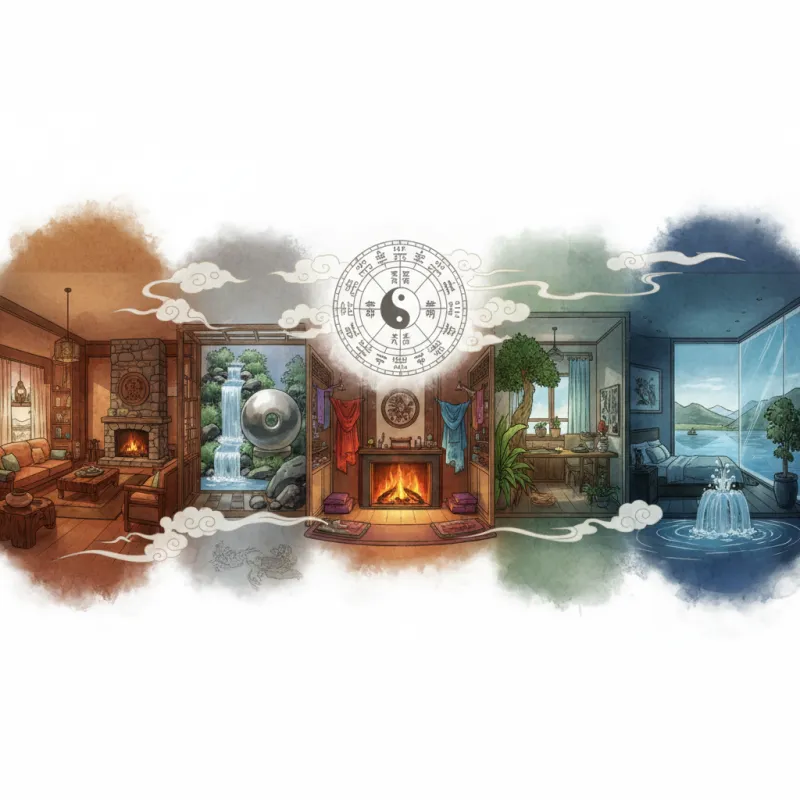
The answer might be hiding in a design framework that predates the Renaissance by two millennia. The five elements system (五行 wǔxíng) — Wood, Fire, Earth, Metal, and Water — isn't just feng shui philosophy. It's a sophisticated method for understanding how materials, colors, shapes, and textures interact in physical space. And unlike most design trends that cycle through every decade, this one has been stress-tested for over 3,000 years.
The Elements Aren't Metaphors
Here's where most Western interpretations go wrong: they treat the five elements as symbolic concepts rather than observable qualities. Wood (木 mù) isn't "like a tree" — it describes the actual characteristics of vertical growth, expansion, and flexibility. Fire (火 huǒ) isn't a candle metaphor — it's the quality of upward movement, transformation, and radiance that you can see in pointed shapes, bright colors, and reflective surfaces.
The Huangdi Neijing (黄帝内经), compiled during the Warring States period (475-221 BCE), describes these elements as phases of transformation rather than static categories. This distinction matters in design. A wooden chair isn't just "Wood element" — it can express Metal qualities if it's angular and minimalist, or Water qualities if it has flowing curves. The material is one factor; the form, color, and context determine the elemental expression.
Traditional Chinese craftsmen understood this intuitively. The furniture from the Ming Dynasty (1368-1644) demonstrates elemental balance without announcing it. A huanghuali wood chair combines Wood material with Metal precision in its joinery, Earth stability in its weight, and Water flow in its curved back splat. No element dominates. The result feels complete.
Wood: The Vertical Principle
Walk into a room with tall bookshelves, vertical striped wallpaper, and columnar floor lamps. You'll feel the space pulling your eye upward, creating a sense of growth and possibility. That's Wood element in action — not because trees are involved, but because the design expresses upward expansion.
Wood governs vertical lines, rectangular shapes, and the color spectrum from green to teal. But it's the quality of growth that defines it. A room heavy in Wood element feels aspirational, sometimes restless. Think of a startup office with standing desks, tall plants, and floor-to-ceiling windows. The energy supports new projects and forward momentum. It's terrible for sleep.
The material itself carries meaning too. Bamboo flooring, rattan furniture, and cork walls all introduce Wood's flexibility and resilience. But so does a tall ceramic vase (Earth material expressing Wood form) or a vertical metal sculpture (Metal material with Wood orientation). The element interactions matter more than the literal materials.
Fire: Transformation and Peak Energy
Fire is the only element that can't exist without consuming something else. In design terms, this translates to drama, focal points, and spaces that demand attention. A room with strong Fire element won't let you ignore it.
The classic Fire indicators are obvious: red and orange colors, triangular and pointed shapes, lighting fixtures, and actual fireplaces. But Fire also appears in unexpected places. A gallery wall of family photos creates Fire energy through personal connection and emotional heat. A room with multiple mirrors multiplies light and creates the transformative quality Fire represents. Animal prints and leather furniture carry Fire's intensity.
The Qing Dynasty (1644-1912) palace interiors used Fire element strategically. The emperor's throne room featured red pillars, pointed roof lines, and elaborate lighting — all Fire expressions meant to convey authority and transformation. But the private quarters balanced this with cooler elements. Too much Fire in a living space creates anxiety and conflict. I've seen relationships improve after clients removed excessive red accents from bedrooms.
Fire needs fuel but also containment. In the five element cycle, Wood feeds Fire while Earth contains it. A room with Fire-heavy design (bright colors, angular furniture, dramatic lighting) benefits from Earth element grounding — think textured rugs, clay pottery, or horizontal surfaces that anchor the energy.
Earth: The Stabilizing Center
Earth element is the design equivalent of a deep breath. It's horizontal lines, square shapes, and the entire spectrum of browns, tans, and yellows. More importantly, it's the quality of stability, nourishment, and centeredness.
A room dominated by Earth element feels safe, sometimes to the point of stagnation. Low-slung furniture, terracotta tiles, stone countertops, and earth-tone textiles all contribute. So do square coffee tables, horizontal artwork, and anything that emphasizes width over height. The energy settles rather than rises.
Traditional Chinese homes placed Earth element at the center — literally. The main hall often featured a square table, yellow or brown tones, and ceramic or stone objects. This wasn't arbitrary. In five element theory, Earth occupies the center position, mediating between the other four elements. A space with strong Earth element can absorb and balance extremes.
Modern minimalism accidentally recreates Earth element principles. The neutral palettes, natural materials, and emphasis on horizontal planes all express Earth qualities. But without other elements to provide contrast, these spaces can feel heavy or dull. Earth needs Metal's precision or Wood's upward movement to stay dynamic.
Metal: Precision and Refinement
Metal element is where Western design and five element theory align most clearly. Clean lines, circular shapes, white and metallic colors, and actual metal materials all express Metal's quality of contraction, precision, and clarity.
A Metal-heavy room feels sharp, organized, and sometimes cold. Think of a modern kitchen with stainless steel appliances, white cabinets, and circular pendant lights. The energy is efficient and focused. It's excellent for workspaces and areas requiring concentration. It's harsh for spaces meant for relaxation or creativity.
The Song Dynasty (960-1279) aesthetic embraced Metal element in its ceramics and furniture design. The famous Ru ware ceramics featured pale blue-green glazes and refined forms — Metal element expressed through Earth materials. The scholars' studios of this period balanced Metal's precision with Wood's growth and Water's flow, creating spaces that supported both intellectual work and artistic contemplation.
Metal in design isn't just about materials. It's about the quality of refinement and distillation. A room with carefully edited belongings, where every object has clear purpose and placement, expresses Metal energy even if no actual metal appears. The KonMari method, popular in recent years, is essentially a Metal element approach to organizing space.
Water: Flow and Depth
Water is the most misunderstood element in Western design applications. People add fountains and aquariums, thinking they've introduced Water element. But Water's essential quality is downward flow, depth, and the ability to take any shape. It's expressed through irregular curves, dark colors (especially black and deep blue), and reflective surfaces.
A room with strong Water element feels contemplative, mysterious, sometimes melancholic. Low furniture, dark walls, mirrors, glass, and flowing fabrics all contribute. So do irregular shapes that resist geometric classification — think of an organic-shaped coffee table or a wall with undulating curves.
The classical Chinese gardens of Suzhou, developed primarily during the Ming and Qing dynasties, demonstrate Water element mastery. The spaces use actual water features, but also winding paths, irregular rocks, and carefully placed windows that frame views like paintings. The energy flows rather than directs. You explore rather than march through.
Water element in interior design requires careful handling. Too much creates depression and stagnation. But the right amount adds depth and sophistication. A bedroom with one dark accent wall, curved furniture, and soft lighting has Water's contemplative quality without its heaviness. The key is balance with other elements — Water needs Earth to contain it and Metal to give it structure.
Balancing Elements in Real Spaces
The five element system becomes practical when you understand the generating and controlling cycles. Wood feeds Fire, Fire creates Earth (ash), Earth yields Metal, Metal collects Water (condensation), and Water nourishes Wood. This generating cycle (相生 xiāngshēng) explains why certain combinations feel harmonious.
The controlling cycle (相克 xiāngkè) is equally important: Wood parts Earth, Earth dams Water, Water extinguishes Fire, Fire melts Metal, and Metal cuts Wood. This isn't about conflict — it's about balance through limitation. A room with excessive Wood energy (too vertical, too green, too restless) benefits from Metal element to provide structure and definition.
I've watched designers intuitively apply these principles without knowing the terminology. They'll add a round mirror (Metal) to a room with too many vertical elements (Wood). They'll introduce a textured rug (Earth) to ground a space with too much glass and metal (Metal and Water). They're working with the same patterns Chinese craftsmen codified thousands of years ago.
The most successful interiors balance all five elements without letting any single one dominate. Look at traditional Japanese tea rooms, which evolved from Chinese five element principles. Wood in the structure, Fire in the hearth, Earth in the clay walls and ceramics, Metal in the precise proportions, and Water in the flowing space and dark tones. The result feels complete because nothing is missing.
Applying Elements to Modern Spaces
Start by identifying which elements already dominate your space. A room with white walls, metal furniture, and circular shapes is Metal-heavy. It needs Wood (vertical plants, rectangular art) or Water (dark accents, flowing curtains) to soften the precision. A room with earth tones, low furniture, and square shapes is Earth-dominant. It needs Fire (lighting, pointed shapes) or Metal (white accents, circular objects) to add energy and definition.
The element compatibility between materials and forms matters more than strict adherence to traditional associations. A glass vase (Metal material) with an irregular shape expresses Water. A metal sculpture with vertical lines expresses Wood. Understanding the qualities each element represents lets you work with what you have rather than buying new furniture.
Pay attention to how spaces feel at different times of day. Morning light might emphasize Fire element, while evening shadows bring out Water. Seasonal changes affect elemental balance too — winter naturally increases Water and Metal, while summer amplifies Fire and Wood. Adjusting textiles, lighting, and accessories with the seasons maintains balance without requiring major changes.
The goal isn't perfect elemental distribution. It's creating spaces that support their intended use. A home office benefits from Metal and Wood — precision and growth. A bedroom needs Water and Earth — depth and stability. A dining room wants Fire and Earth — transformation and nourishment. Let function guide your elemental choices.
This design system has survived three millennia because it describes something real about how humans experience space. The vocabulary might be unfamiliar, but the principles are universal. Balance, proportion, contrast, harmony — we've been pursuing these qualities in our environments since we first arranged stones around a fire. The five elements just give us a more sophisticated map for getting there.
Related Reading
- The Five Elements Are Not Elements (And Why That Matters)
- The Five Phases: Understanding Wu Xing as Movement, Not Material
- The Fire Element: Passion, Fame, and Summer
- Five Elements Theory: The Foundation of Chinese Philosophy
- The Water Element: Wisdom, Career, and Winter
- Chinese Numerology: Why 8 Is Lucky, 4 Is Death, and 9 Is Forever
- Kitchen Feng Shui: Cooking Up Prosperity
- Feng Shui for Your Home and Office: Practical Tips That Actually Work
Explore Chinese Culture
- Explore Daoist philosophy and practice
- Explore traditional Chinese customs
- Explore ancient Chinese cosmology