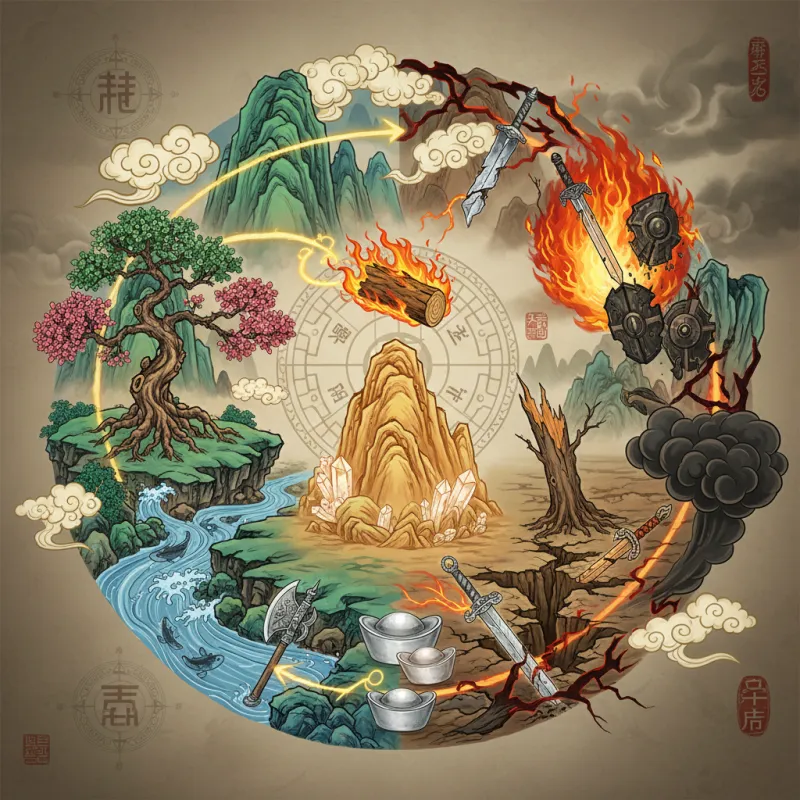
You walk into a room and immediately feel uneasy. The colors clash, the energy feels stuck, nothing flows. Your friend walks into the same room and feels energized, creative, ready to work. What's the difference? Element compatibility. Your personal element is being attacked by the room's dominant element. Your friend's element is being nourished. This isn't mysticism — it's the mathematical precision of the productive and destructive cycles (生克 shēngkè), the engine that powers every interaction in Chinese metaphysics.
The Productive Cycle: How Elements Feed Each Other
The productive cycle (相生 xiāngshēng, literally "mutual generation") describes how one element creates, nourishes, or strengthens another. This isn't metaphorical. In classical texts like the Huangdi Neijing (黄帝内经, Yellow Emperor's Inner Canon, circa 100 BCE), these relationships were observed in nature first, then applied to medicine, agriculture, and eventually feng shui.
Wood feeds Fire. Burn a log and you'll understand this viscerally. Wood doesn't just tolerate fire — it sacrifices itself to create it. In a bazi chart (八字 bāzì), if your day master is Fire and you're weak, adding Wood element people, colors, or directions to your life literally fuels your energy. I've seen Fire-weak clients transform after moving their desk to the east (Wood direction) and adding green plants. Within weeks, their creative output doubled.
Fire creates Earth. When fire burns completely, it leaves ash — earth. Ancient Chinese alchemists observed this and understood that transformation, not destruction, was the key. In feng shui practice, if your home's center (Earth position) feels dead or stagnant, adding Fire element — reds, triangular shapes, lighting — activates the Earth energy. The Qing dynasty feng shui master Shen Zhu Reng (沈竹礽, 1849-1906) wrote extensively about using Fire to "wake up" Earth sectors in his Shen's Flying Stars (沈氏玄空学).
Earth produces Metal. Dig into the ground and you find ore, minerals, metal. This relationship teaches us about refinement and concentration. Earth's diffuse energy becomes Metal's precise, cutting force. In a person's chart, if Metal is their favorable element but weak, surrounding themselves with Earth element support — yellows, browns, ceramics, square shapes — gradually builds their Metal strength. It's slower than direct Metal supplementation, but more stable.
Metal generates Water. Leave metal outside overnight and dew condenses on its surface. Metal's cool, contracting nature draws moisture from the air. The Lüshi Chunqiu (吕氏春秋, Master Lü's Spring and Autumn Annals, 239 BCE) describes this as Metal "sweating" Water. In practice, if you need more Water element but adding actual water features feels too aggressive, add Metal instead. White and gold colors, round shapes, metal wind chimes — these indirectly boost Water through the productive cycle.
Water nourishes Wood. Every gardener knows this. Water makes plants grow, trees flourish, forests expand. But here's what most feng shui books miss: Water doesn't just feed Wood, it also controls Wood's direction. Too much water and Wood floats away, rootless. The right amount and Wood grows strong and directed. When I analyze homes where the Wood sector (east or southeast) feels chaotic or overgrown with clutter, I often find excessive Water element nearby — too many mirrors, too much blue, actual water features. The solution isn't removing Water entirely, but balancing it.
The Controlling Cycle: Necessary Restraint
The controlling cycle (相克 xiāngkè, "mutual restraint") gets a bad reputation. People hear "destructive" and think negative. Wrong. Control is necessary. Without restraint, elements grow wild, imbalanced, pathological. The Shangshu (尚书, Book of Documents, circa 6th century BCE) describes this as "the way of heaven" — growth must be checked, or it becomes cancerous.
Wood penetrates Earth. Tree roots break through soil, crack foundations, split rocks. Wood doesn't destroy Earth — it controls it, shapes it, prevents Earth from becoming too dense and immobile. In feng shui, if your home's Earth sectors (center, northeast, southwest) feel heavy, stagnant, or depressing, the cure is often Wood element. Add plants, wooden furniture, vertical lines, the color green. I've seen bedrooms in the southwest (Earth position) transform from oppressive to peaceful simply by adding a tall wooden bookshelf.
Earth dams Water. Soil absorbs water, mud stops floods, dikes control rivers. Without Earth's restraint, Water spreads everywhere, becomes stagnant, loses direction. The ancient hydraulic engineer Li Bing (李冰, 3rd century BCE) built the Dujiangyan irrigation system using this principle — Earth channels controlling Water's power. In bazi analysis, if someone has too much Water element (multiple Water stems and branches), they often feel emotionally overwhelmed, directionless, depressed. The remedy? Strengthen Earth element through diet, colors, directions, even career choices in Earth-related fields.
Water extinguishes Fire. Obvious, right? But the subtlety matters. Water doesn't eliminate Fire — it controls Fire's tendency to spread, consume, burn out. A Fire-strong person (multiple Fire elements in their chart) often burns too hot — manic energy, insomnia, inflammation, anger. They don't need less Fire; they need Water's cooling control. I worked with a client whose bazi showed extreme Fire excess. She was a successful entrepreneur but couldn't sleep, had chronic inflammation, and her relationships burned out quickly. We added Water element to her bedroom (blues, wavy patterns, a small fountain) and her life stabilized within months.
Fire melts Metal. Metal's rigid structure becomes liquid under Fire's heat. This isn't destruction — it's transformation, refinement. Blacksmiths use Fire to shape Metal into tools, weapons, art. In feng shui, if Metal element becomes too harsh, too cutting, too rigid in a space, Fire element softens it. The west and northwest (Metal positions) can feel cold and unwelcoming when Metal dominates. Adding reds, triangular shapes, or lighting warms these areas without eliminating Metal's beneficial qualities.
Metal cuts Wood. Axes chop trees, saws cut lumber, blades trim branches. Metal's precision controls Wood's tendency to expand endlessly. The Guanzi (管子, circa 4th century BCE) describes this as "Metal's duty to prune." In practice, if Wood element runs wild in a space — too many plants, too much green, excessive vertical energy — the room feels chaotic and unfocused. Adding Metal element (whites, grays, round shapes, actual metal objects) brings order without killing the growth energy.
Reading Element Relationships in Real Spaces
Theory means nothing without application. Let's diagnose some common scenarios using element compatibility.
Scenario 1: The Dead Living Room
You walk into a living room that feels lifeless despite expensive furniture. The dominant colors are beige and brown (Earth). The shapes are mostly square (Earth). The materials are stone and ceramic (Earth). This is Earth excess — too much stability becomes stagnation. The productive cycle tells us Earth produces Metal, so the room is draining itself trying to generate Metal that isn't there. The controlling cycle tells us Wood controls Earth. The cure? Add Wood element. Green plants, wooden coffee table, vertical artwork, even books (Wood element in feng shui). Within days, the room breathes again.
Scenario 2: The Anxious Bedroom
A bedroom painted entirely in blues and grays (Water and Metal). Metal furniture, round mirrors, flowing curtains. The person sleeping here reports anxiety, restless sleep, feeling emotionally flooded. This is Water excess supported by Metal (Metal generates Water). The controlling cycle shows Earth dams Water. Add Earth element: yellows, browns, square shapes, ceramics, even a Himalayan salt lamp (Earth). The Water energy becomes channeled instead of overwhelming.
Scenario 3: The Angry Office
An office with red walls (Fire), triangular artwork (Fire), excessive lighting (Fire), and a south-facing window (Fire direction). The person working here is productive but burns out quickly, gets angry easily, can't sustain effort. Fire excess. The controlling cycle shows Water extinguishes Fire. But adding Water directly (blues, wavy shapes, fountains) might feel too aggressive. Use the productive cycle instead: add Wood element (green, plants, wooden desk). Wood feeds Fire in a controlled way, giving Fire something to consume besides the person's energy.
Personal Element Compatibility: Why Some Rooms Drain You
Here's what most feng shui books won't tell you: element compatibility isn't just about the room. It's about the interaction between your personal element (determined by your bazi day master) and the room's dominant element. This is where bazi analysis becomes essential.
If your day master is Wood and you work in a Metal-dominant office (white walls, metal furniture, west-facing), you're being cut down daily. Metal controls Wood. You'll feel criticized, restricted, unable to grow. The solution isn't changing offices — it's adding Water element to your personal space. Water nourishes Wood and exhausts Metal (Metal generates Water, weakening itself). A small fountain on your desk, blue accessories, wavy patterns — these create a buffer.
If your day master is Fire and you live in a Water-dominant home (blues, blacks, wavy patterns, north-facing), you're being extinguished. Water controls Fire. You'll feel depressed, unmotivated, cold. Add Wood element to your bedroom and personal spaces. Wood nourishes Fire and exhausts Water (Water generates Wood, weakening itself). Green plants, wooden furniture, vertical artwork — these restore your energy.
The Ming dynasty physician Zhang Jiebin (张介宾, 1563-1640) wrote in his Leijing (类经, Classified Canon) that "knowing your element and its relationships is knowing your fate." He wasn't being mystical. He meant that understanding which elements support you and which attack you allows you to structure your environment for success instead of fighting against it daily.
The Indirect Path: Using Productive Cycles for Subtle Cures
Sometimes the direct approach is too strong. If you need more Fire but adding reds and triangles feels aggressive, use the productive cycle. Add Wood instead. Wood feeds Fire gradually, naturally. This is the "mother element" approach — nourishing through the productive cycle rather than direct supplementation.
The Yijing (易经, I Ching, circa 9th century BCE) describes this as "the gentle way" (柔道 róudào). When hexagram 57 (巽 Xùn, the Gentle) appears, it counsels indirect influence, gradual penetration, working with natural cycles rather than forcing change. This is exactly how the productive cycle functions in feng shui.
If you need more Earth but adding yellows and squares feels heavy, add Fire. Fire creates Earth through transformation. If you need more Metal but adding whites and rounds feels cold, add Earth. Earth produces Metal through concentration. If you need more Water but adding blues and waves feels overwhelming, add Metal. Metal generates Water through condensation. If you need more Wood but adding greens and verticals feels chaotic, add Water. Water nourishes Wood through growth.
I've found this indirect approach works better for about 70% of clients. Direct element supplementation can feel jarring, especially if someone's chart shows that element as unfavorable in certain contexts. The productive cycle allows you to build the element you need while respecting the existing energy structure.
Advanced Compatibility: The Combination and Transformation Patterns
Here's where element compatibility gets sophisticated. Certain element combinations don't just interact — they transform into something new entirely. The Ziping Zhenzhen (子平真诠, The True Interpretation of Ziping, 1844) by Shen Xiaozhan (沈孝瞻) details these transformation patterns.
When Wood and Fire combine in specific proportions, they create a "bright wood" pattern (木火通明 mùhuǒ tōngmíng) — intelligence, clarity, literary talent. When Water and Wood combine properly, they create a "floating wood" pattern (水木清华 shuǐmù qīnghuá) — elegance, refinement, scholarly achievement. These aren't just poetic descriptions. They're observable patterns in both bazi charts and physical spaces.
I analyzed a writer's study once that had this Water-Wood combination naturally: north-facing window (Water direction), wooden desk and shelves, green plants, blue accents. The writer had published three novels in five years. When she moved to a new home and set up her study with Fire-Metal elements instead (south-facing, metal desk, red accents), her productivity crashed. We rebuilt the Water-Wood pattern in her new space and within months she was writing again.
The controlling cycle also creates transformation patterns. Metal and Fire in conflict (Fire melts Metal) can create either chaos or refinement, depending on proportion and context. Too much Fire and Metal is destroyed. Balanced Fire and Metal create the "forge" pattern (火炼金 huǒ liàn jīn) — transformation through pressure, refinement through challenge. This is why some people thrive in high-pressure environments while others collapse.
Practical Diagnosis: The Three-Question Method
When analyzing any space for element compatibility, I use three questions:
1. What element dominates?
Look at colors, shapes, materials, directions. Count them. If you see mostly reds, triangles, and south-facing windows, Fire dominates. If you see mostly blues, waves, and north-facing windows, Water dominates. Most spaces have a clear dominant element once you know what to look for.
2. What element is missing or weak?
The five elements should ideally all be present in some proportion. A space with no Wood element (no plants, no green, no vertical lines, no east/southeast orientation) will feel rigid and lifeless. A space with no Metal element (no whites, no rounds, no metal objects, no west/northwest orientation) will feel chaotic and unfocused. The missing element often explains the space's primary problem.
3. What element does the occupant need?
This requires knowing their bazi day master and favorable elements. A Fire-weak person in a Water-dominant room is being attacked. A Metal-strong person in a Fire-dominant room is being refined (which might be good or bad depending on whether Metal is favorable or unfavorable in their chart). The interaction between personal element and environmental element determines whether the space supports or drains the person.
These three questions, applied systematically, will diagnose 90% of feng shui problems more accurately than any compass reading or flying star calculation. Element compatibility is the foundation. Everything else is refinement.
The Timing Factor: Elements Change With Seasons and Years
Element compatibility isn't static. The dominant element of any space shifts with seasons, years, and even times of day. Spring brings Wood energy. Summer brings Fire. Late summer brings Earth. Autumn brings Metal. Winter brings Water. This is why the same room can feel different in different seasons.
The Lüshi Chunqiu organized its entire structure around this seasonal element cycle, with specific chapters for each season's element and its corresponding activities, foods, directions, and practices. The ancient Chinese didn't fight seasonal element changes — they harmonized with them.
In practical terms, this means your feng shui adjustments should shift seasonally. In winter (Water season), boost Fire and Wood elements to balance the cold. In summer (Fire season), boost Water and Metal elements to balance the heat. This isn't complicated. In winter, add reds and greens to your space. In summer, add blues and whites. Small adjustments that honor the seasonal element cycle create harmony instead of fighting against natural rhythms.
The year's element also matters. 2024 is a Wood Dragon year (甲辰 jiǎchén). Wood element is strong this year. If your personal chart shows Wood as unfavorable, you'll need more Metal element this year to control the excess Wood. If Wood is favorable, this is your year to expand, grow, and take risks. Understanding annual element cycles allows you to time major decisions and adjust your environment accordingly.
Beyond Decoration: Element Compatibility in Relationships and Career
Element compatibility extends far beyond room arrangement. It explains why certain people energize you and others drain you. Why certain careers feel natural and others feel like constant struggle. Why some cities feel like home and others feel hostile.
If your day master is Water and your partner's day master is Earth, Earth dams Water — they control you. This can be stabilizing if you need structure, or suffocating if you need freedom. If your day master is Fire and your business partner's day master is Water, Water extinguishes Fire — they restrain your enthusiasm. This can be balancing if you tend toward mania, or depressing if you need support.
The Tang dynasty prime minister Li Linfu (李林甫, died 753 CE) was notorious for surrounding himself with Fire-element officials when his own chart showed strong Metal. Fire melts Metal — he kept himself in check through his staff choices. Whether this was conscious feng shui practice or intuitive understanding, the element compatibility was precise.
In career choices, working in an industry that matches your favorable element creates effortless success. Fire-favorable people thrive in media, entertainment, marketing, anything involving visibility and transformation. Water-favorable people excel in research, strategy, anything involving flow and adaptation. Wood-favorable people succeed in growth industries, education, anything involving expansion and development. Metal-favorable people dominate in finance, law, anything requiring precision and cutting through complexity. Earth-favorable people build in real estate, agriculture, anything involving stability and foundation.
I've watched clients struggle for years in careers that opposed their element, then switch to element-compatible fields and succeed within months. The work didn't get easier — it got natural. That's the difference element compatibility makes.
Related Reading
- The Five Elements in Interior Design
- Five Elements Theory: The Foundation of Chinese Philosophy
- The Five Phases: Understanding Wu Xing as Movement, Not Material
- The Fire Element: Passion, Fame, and Summer
- The Water Element: Wisdom, Career, and Winter
- Annual Feng Shui Cures and Enhancers: What to Place Where
- The I Ching: The World's Oldest Book of Wisdom (And How to Actually Use It)
- Harnessing the Power of Flying Stars in Feng Shui and I Ching
Explore Chinese Culture
- Explore Daoist philosophy and practice
- Explore traditional Chinese customs
- Explore ancient Chinese cosmology