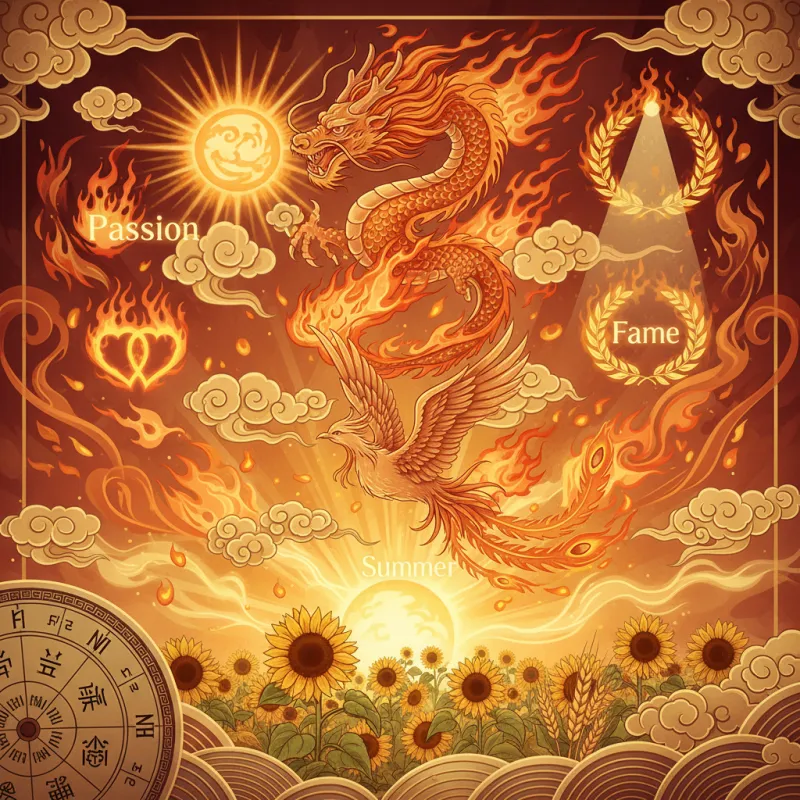
Picture a summer afternoon in the Forbidden City, where vermillion walls blaze under the midday sun, their color chosen not for aesthetics alone but to channel the transformative power of fire itself. The emperors understood what modern practitioners sometimes forget: fire (火, huǒ) isn't merely about warmth or light—it's the element that separates the mediocre from the magnificent, the forgotten from the famous.
The fire element occupies a peculiar position in Chinese metaphysical thought. Unlike water, which flows and adapts, or wood, which grows steadily, fire demands attention. It consumes, transforms, and—most critically—it cannot be ignored. This is why classical texts like the Huangdi Neijing (黄帝内经, Yellow Emperor's Inner Canon) associate fire with the heart, the organ that ancient Chinese medicine considers the "emperor" of the body. Your heart doesn't negotiate or compromise; it either beats with vitality or it doesn't.
The Directional Power of South
In the Later Heaven arrangement of the Bagua (后天八卦, hòutiān bāguà), fire occupies the southern position—and this isn't arbitrary symbolism. Stand in any traditional Chinese courtyard facing south, and you'll understand immediately. The sun reaches its zenith in the southern sky, delivering maximum yang energy. This is why imperial thrones always faced south, why the most important rooms in classical architecture opened southward, and why feng shui practitioners still prioritize southern exposures for spaces requiring high energy and visibility.
The trigram Li (離, lí) represents fire in the I Ching, composed of two yang lines embracing a single yin line at its center. This structure reveals something profound about fire's nature: it appears solid and powerful on the outside, but requires emptiness at its core to burn. Think of a candle flame or a roaring furnace—both need hollow space to sustain combustion. This is why people with strong fire energy often seem confident and radiant externally while harboring surprising vulnerability within.
Summer's Peak and the Heart Connection
The Lüshi Chunqiu (吕氏春秋, Master Lü's Spring and Autumn Annals), compiled around 239 BCE, explicitly links fire to the height of summer, specifically the period around the summer solstice. This isn't just about temperature. Summer represents the moment when yang energy reaches its absolute maximum before beginning its inevitable decline toward yin. Everything in nature expresses itself fully—flowers bloom without restraint, fruits ripen, animals display their most vibrant colors.
In bazi (八字, eight characters) analysis, people born during fire-dominant periods or with strong fire in their charts often exhibit what classical texts call "ming" (明, brightness). This manifests as natural charisma, the ability to attract attention without effort, and an almost magnetic quality that draws others into their orbit. I've observed that individuals with prominent fire in their natal charts rarely struggle with obscurity—their challenge is usually managing the attention they inevitably receive.
The heart connection runs deeper than metaphor. Traditional Chinese medicine teaches that the heart houses the shen (神, spirit or consciousness), and fire element imbalances directly affect mental clarity and emotional stability. Too much fire creates mania, scattered thinking, and what we might now call anxiety. Too little fire results in depression, lack of motivation, and social withdrawal. The Shanghan Lun (伤寒论, Treatise on Cold Damage Disorders), written by Zhang Zhongjing during the Han Dynasty, contains numerous formulas specifically designed to regulate heart fire.
Fame, Recognition, and the Li Trigram
Here's where fire element theory gets interesting for modern practitioners. The Li trigram doesn't just represent fire—it specifically governs reputation, fame, and how others perceive you. This is why the southern sector of any space, whether a home, office, or even a city, relates directly to recognition and social standing. The classical feng shui text Yangzhai Sanshe (阳宅三要, Three Essentials of Yang Dwellings) emphasizes that the southern area must remain clear, bright, and unobstructed for occupants to achieve their full potential in public life.
I find it telling that in traditional Chinese theater, the most important actors always entered from stage south (the audience's left), while minor characters entered from stage north. The southern entrance carried the fire element's association with prominence and importance. Similarly, in classical Chinese painting, the most significant figures or elements typically appear in the composition's southern or upper portions, bathed in implied sunlight.
The connection between fire and fame isn't about vanity—it's about visibility serving purpose. A lighthouse fire guides ships to safety. A beacon fire warns of approaching danger. The fire element asks: what are you illuminating, and for whom? People with balanced fire energy understand that recognition should serve something beyond ego. They become teachers, performers, leaders, or public figures who use their visibility to benefit others.
Colors, Shapes, and Material Expressions
Fire manifests through specific visual and material qualities that feng shui practitioners can leverage. The primary colors are red (红, hóng), purple (紫, zǐ), and orange (橙, chéng)—but not just any shades. Classical texts specify that fire colors should be bright and clear, not muddy or dark. A deep burgundy doesn't carry the same fire energy as a clear vermillion. This is why imperial robes used cinnabar-based reds rather than darker alternatives.
The shape associated with fire is the triangle or pyramid—anything that points upward and culminates in a sharp apex. This reflects fire's natural tendency to rise and concentrate energy at a single point. In architecture, this principle appears in pagoda roofs, temple spires, and the peaked caps worn by officials. Even the flame-shaped windows in some traditional buildings serve to concentrate and direct fire energy.
Materials that embody fire include anything that produces light or heat: candles, lamps, electronics, and—in modern contexts—screens and displays. But here's a subtlety often missed: fire also includes materials derived from animals, particularly feathers, leather, and wool. Why? Because animals represent the most yang, active form of life, and their products carry that energetic signature. This is why a leather chair or wool rug can enhance fire energy in a space, even without being red or triangular.
Balancing Fire in Your Environment
The Zhouyi (周易, I Ching) teaches that every element contains the seed of its opposite, and fire demonstrates this principle dramatically. Too much fire creates what classical texts call "fire poison" (火毒, huǒ dú)—manifesting as conflict, burnout, inflammation, and destructive behavior. I've consulted on offices where excessive fire energy (all red décor, southern exposure, triangular furniture, bright lighting) created environments where employees constantly argued and turnover was astronomical.
The antidote isn't to eliminate fire but to balance it with water element qualities: curves instead of angles, darker colors alongside bright ones, and incorporating actual water features. The principle of mutual production (相生, xiāng shēng) suggests that wood feeds fire while fire produces earth, so introducing wood elements can strengthen fire sustainably, while earth elements can moderate fire's intensity by absorbing its energy.
For individuals with weak fire in their bazi charts, the classical recommendation involves strengthening fire through environmental adjustments. This might mean choosing southern-facing homes, incorporating more red in clothing, or pursuing careers that involve public speaking, performance, or leadership. The Siku Quanshu (四库全书, Complete Library of Four Treasuries) contains numerous case studies of officials who enhanced their fire element to improve their political fortunes—though results varied based on their overall elemental balance.
Fire Element Personalities and Life Paths
People with dominant fire in their elemental constitution exhibit recognizable patterns. They're typically extroverted, expressive, and emotionally transparent—what you see is generally what you get. They make natural performers, salespeople, politicians, and anyone whose success depends on personal charisma. The Tang Dynasty poet Li Bai (李白, 701-762 CE) exemplifies fire personality: brilliant, passionate, dramatic, and ultimately consumed by his own intensity.
But fire types face specific challenges. They can burn too hot, exhausting themselves and others. They may prioritize recognition over substance, becoming more concerned with appearing successful than actually achieving meaningful goals. The Daodejing (道德经, Tao Te Ching) warns against this tendency: "The flame that burns twice as bright burns half as long." Fire personalities must learn sustainable pacing, something that doesn't come naturally to their temperament.
In relationships, fire people bring excitement and passion but can also bring drama and instability. They pair well with wood types (who fuel their energy) and earth types (who ground their intensity), but may clash with water types (who dampen their enthusiasm) or other fire types (creating competitive dynamics). Understanding these patterns through five element theory can prevent countless interpersonal conflicts.
Seasonal Practices and Fire Cultivation
The classical Chinese calendar divides summer into specific periods, each with practices designed to harmonize with fire energy. The period from the summer solstice through early August represents peak fire, when yang energy reaches its maximum. Traditional practices during this time include rising early, staying active during daylight hours, and engaging in social activities—all ways of aligning with fire's outward, expansive nature.
Interestingly, classical texts also recommend moderating fire during its peak season. The Bencao Gangmu (本草纲目, Compendium of Materia Medica), compiled by Li Shizhen in the Ming Dynasty, suggests consuming cooling foods during summer to prevent fire excess: bitter melon, cucumber, watermelon, and green tea. This isn't about suppressing fire but about preventing it from becoming pathological.
For modern practitioners, summer offers an ideal time to pursue fire-related goals: launching public projects, seeking promotions, expanding social networks, or developing creative works. The environmental fire energy supports these endeavors naturally. Conversely, trying to force fire-related activities during winter (water season) requires swimming against the current—possible but unnecessarily difficult.
The fire element ultimately teaches us about transformation, visibility, and the courage to be seen. It asks us to burn brightly enough to illuminate not just ourselves but the path for others. Whether you're adjusting your home's feng shui, analyzing your bazi chart, or simply trying to understand your own nature, recognizing fire's role provides insight into one of the most dynamic forces in Chinese metaphysical thought. The question isn't whether you have fire—everyone does—but whether you're using it to warm or to burn, to illuminate or to consume.
Related Reading
- Five Element Compatibility: The Productive and Destructive Cycles
- The Five Elements in Interior Design
- The Wood Element: Growth, Creativity, and Spring
- The Five Phases: Understanding Wu Xing as Movement, Not Material
- Color Theory in Feng Shui: Why Red Means Luck and White Means Death
- Exploring the Interconnections of Feng Shui, I Ching, and Chinese Metaphysics
- The Bagua: Eight Symbols That Explain Everything
Explore Chinese Culture
- Explore Daoist philosophy and practice
- Explore traditional Chinese customs
- Explore ancient Chinese cosmology