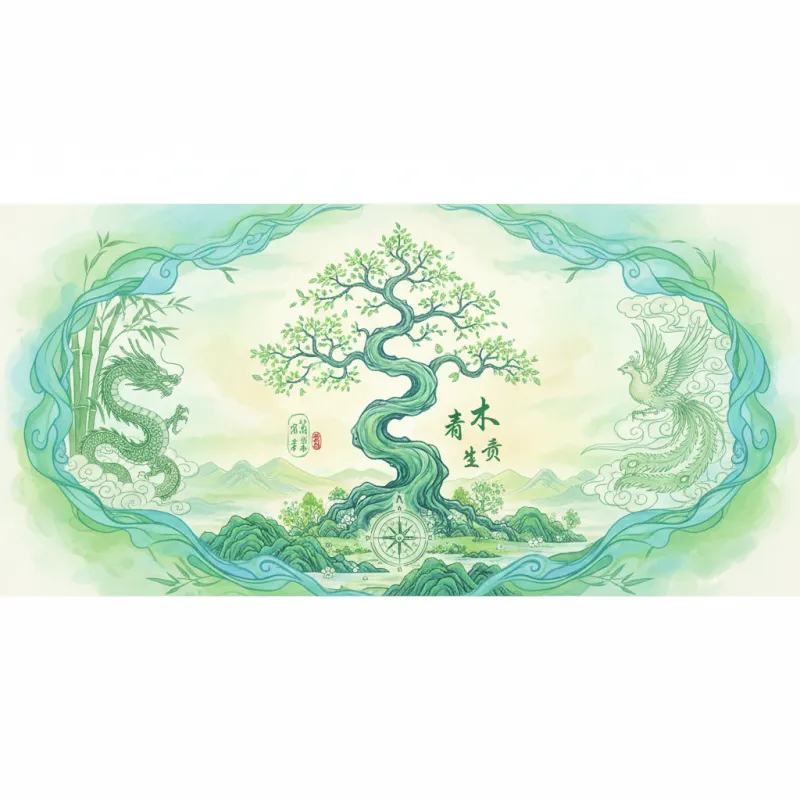
Picture a bamboo shoot breaking through frozen ground in late February. Yesterday, nothing. Today, a green spear pushing upward with such force it can crack concrete. This is 木 (mù), the Wood element—not the dead timber of a fallen tree, but the irrepressible surge of life itself.
The Living Force of Mù
When the Han Dynasty scholar Dong Zhongshu systematized the Five Elements theory in the 2nd century BCE, he didn't choose Wood arbitrarily. He observed that wood possesses a unique quality among the elements: it's the only one that grows. Fire consumes, Metal contracts, Water flows, Earth stabilizes—but Wood expands. It reaches upward toward heaven and downward into earth simultaneously, embodying the Chinese concept of 生发 (shēngfā), the generative force that propels all living things forward.
This isn't mere poetic metaphor. In classical Chinese medicine, the Wood element governs the liver and gallbladder, organs associated with planning, decision-making, and the smooth flow of qi throughout the body. When your Wood energy is balanced, you wake up with ideas, you see possibilities, you move through obstacles like water finding its path. When it's blocked, you experience the frustration of a seed that cannot sprout—anger, resentment, and stagnation.
The ancient text Huainanzi (compiled around 139 BCE) describes Wood as the element of the East, the direction of sunrise and new beginnings. This isn't coincidental geography. The Chinese observed that spring arrives from the eastern provinces first, that weather patterns move west to east, that the sun's daily rebirth occurs in the East. Wood became synonymous with initiation, with the courage to begin.
Spring's Architecture: How Wood Manifests in Time
The connection between Wood and spring runs deeper than simple seasonal association. In the traditional Chinese calendar, spring doesn't begin on a fixed date but with 立春 (lìchūn), "the establishment of spring," which falls around February 4th when the sun reaches 315° longitude. This is when Yang energy begins its ascent after winter's Yin dominance—and Yang rising is Wood's signature movement.
Watch what happens in nature during this transition. Trees don't gradually warm up; they explode. Cherry blossoms in Kyoto go from bare branches to full bloom in less than a week. This sudden, dramatic expansion is Wood's essential character. The element doesn't believe in half-measures. It's the entrepreneur launching the startup, the artist beginning the canvas, the writer facing the blank page. Wood energy says: now.
In bazi analysis, people born in spring months or with strong Wood in their charts often display this initiatory quality. They're the ones who start movements, who can't sit still, who see a problem and immediately begin solving it. The Tang Dynasty poet Du Fu, born in spring with a chart dominated by Wood, wrote over 1,400 poems—his creative output was literally unstoppable, even during war and exile.
The Creative Paradox: Flexibility and Strength
Here's what Western interpretations often miss: Wood is simultaneously the most flexible and most persistent element. Bamboo bends in typhoon winds that snap rigid structures, yet bamboo roots can break through stone foundations. This dual nature appears throughout Chinese philosophy as 柔中带刚 (róu zhōng dài gāng)—"softness containing hardness."
The I Ching hexagram most associated with Wood is Hexagram 42, 益 (Yì), "Increase." The image shows wind and thunder together—wind representing Wood's flexibility, thunder its explosive growth potential. The judgment reads: "It furthers one to undertake something. It furthers one to cross the great water." This is Wood's essential message: movement, expansion, and the courage to venture into unknown territory.
In practical Feng Shui application, this means Wood energy isn't just about placing plants in your space (though that helps). It's about creating conditions for growth. A room with Wood energy has clear pathways, vertical elements that draw the eye upward, and most importantly, space for expansion. The Qing Dynasty Feng Shui master Shen Zhu wrote that Wood "abhors confinement"—it needs room to unfold, whether that's physical space or mental freedom.
Wood in the Generative Cycle: Feeding Fire, Drawing from Water
The Five Elements don't exist in isolation; they form a complex web of relationships. In the 生 (shēng) or generative cycle, Water nourishes Wood, and Wood feeds Fire. This sequence reveals profound insights about creativity and growth.
Water's nourishment of Wood explains why rest and reflection (Water qualities) precede creative breakthroughs. The Song Dynasty poet Su Shi described his writing process as "storing water in winter to release in spring"—he would read, contemplate, and absorb during fallow periods, then experience explosive creative output when Wood energy activated. Modern neuroscience confirms this pattern: the brain's default mode network (active during rest) is essential for creative insight.
Wood feeding Fire means that growth naturally leads to transformation and expression. A tree grows (Wood) to eventually produce flowers and fruit (Fire). An idea develops (Wood) to become a finished work (Fire). But here's the crucial point: if you try to skip the Wood phase and jump straight to Fire, you get burnout. The contemporary obsession with "hustle culture" is essentially trying to sustain Fire without sufficient Wood—it's unsustainable because there's no root system, no structural growth to support the blaze.
The 克 (kè) or controlling cycle adds another layer: Metal cuts Wood, and Wood controls Earth. This means that while Wood represents growth, it needs Metal's pruning to avoid wild, undirected expansion. Every gardener knows this—unpruned growth becomes chaos. Similarly, Wood's control over Earth represents how growth requires breaking through stability, how new ideas must disrupt established patterns.
Cultivating Wood Energy: Beyond Houseplants
Yes, living plants enhance Wood energy in a space—but not all plants equally. The Yangzhai Shishu (Yang Dwelling Ten Books), a Ming Dynasty Feng Shui text, specifies that Wood energy comes from 生长之木 (shēngzhǎng zhī mù), "growing wood," not dead or dying plants. That half-dead succulent on your desk isn't helping.
For genuine Wood cultivation, consider:
Vertical elements: Tall bookshelves, floor-to-ceiling curtains, columnar furniture. Wood's energy moves upward. The reason traditional Chinese architecture features prominent vertical pillars isn't just structural—it's energetic. These elements activate the upward-reaching quality of Wood.
Green and blue tones: Not because these colors "represent" Wood, but because they affect human psychology in ways that align with Wood qualities. Research shows green environments enhance creative thinking and reduce mental fatigue—exactly Wood's domain.
Eastern exposure: If you're choosing which room to use as a creative workspace, favor east-facing spaces. The morning sun carries Wood's initiatory energy. The Qing Dynasty scholar Li Yu wrote that he could only write poetry in his eastern study because "the rising sun brings rising thoughts."
Rectangular shapes: Wood's shape is the tall rectangle, the column, the tower. Compare this to Earth's square, Fire's triangle, Metal's circle, and Water's wave. When arranging furniture or choosing artwork, rectangular forms strengthen Wood energy.
When Wood Becomes Overwhelming: The Shadow Side
Every element has its excess, and Wood's shadow appears as aggression, rigidity, and reckless expansion. The Huangdi Neijing (Yellow Emperor's Classic of Medicine) warns that excessive Wood energy manifests as anger, headaches, and tendon problems—the body literally becomes too tense, too driven, too yang.
Historical examples abound. The First Emperor of Qin, whose chart showed extreme Wood dominance, conquered all rival states and unified China—but his relentless expansion bankrupted the empire and led to its collapse within years of his death. Wood without restraint becomes tyrannical.
In personal life, Wood imbalance shows up as the inability to rest, the compulsion to always be starting new projects, the frustration when growth doesn't happen fast enough. Modern startup culture often exhibits pathological Wood energy—constant pivoting, endless expansion, growth at all costs, until the whole structure collapses from lack of foundation.
The remedy isn't to suppress Wood but to balance it with Metal's refinement and Water's depth. The Daodejing verse 76 captures this perfectly: "When alive, humans are soft and flexible. When dead, they are hard and rigid. When alive, plants are soft and tender. When dead, they are withered and dry. Therefore the hard and rigid are companions of death. The soft and flexible are companions of life."
Living in Harmony with Wood's Rhythm
The deepest teaching of the Wood element isn't about decoration or even personal development—it's about timing. The Chinese concept of 时机 (shíjī), "the right moment," recognizes that growth has its season. You cannot force spring to arrive early, nor can you extend it indefinitely.
This wisdom appears throughout Chinese strategic thinking. The Sunzi Bingfa (Art of War) emphasizes knowing when to advance and when to consolidate. The I Ching repeatedly counsels patience, waiting for the right moment to act. Wood energy, properly understood, isn't about constant growth—it's about explosive growth at the right time, followed by periods of consolidation.
In your own life, this means recognizing your personal spring seasons—those periods when energy is high, ideas flow, and obstacles seem surmountable. These are your Wood times. Use them fully, but don't expect them to last forever. Summer (Fire), autumn (Metal), and winter (Water) will follow, each with their own gifts and requirements.
The bamboo doesn't grow steadily throughout the year. It spends months developing its root system underground, invisible, apparently dormant. Then, in a matter of weeks, it shoots upward at speeds that seem impossible—some species grow three feet in a single day. This is Wood's true nature: patient preparation followed by unstoppable emergence.
When you align with this rhythm rather than fighting it, you tap into the same force that splits rocks, greens deserts after rain, and turns a single seed into a forest. That's the power the ancient Chinese recognized in 木—not just an element, but the fundamental impulse of life itself to expand, create, and become.
Related Reading
- The Five Elements in Interior Design
- Five Element Compatibility: The Productive and Destructive Cycles
- The Five Elements Are Not Elements (And Why That Matters)
- The Five Phases: Understanding Wu Xing as Movement, Not Material
- Yin and Yang in Health: The Balance That Keeps You Well
- Unlocking Office Harmony: The Role of Feng Shui and I Ching in Modern Workspaces
- The Lo Shu Square: The Magic Number Grid Behind Feng Shui
Explore Chinese Culture
- Explore Daoist philosophy and practice
- Explore traditional Chinese customs
- Explore ancient Chinese cosmology