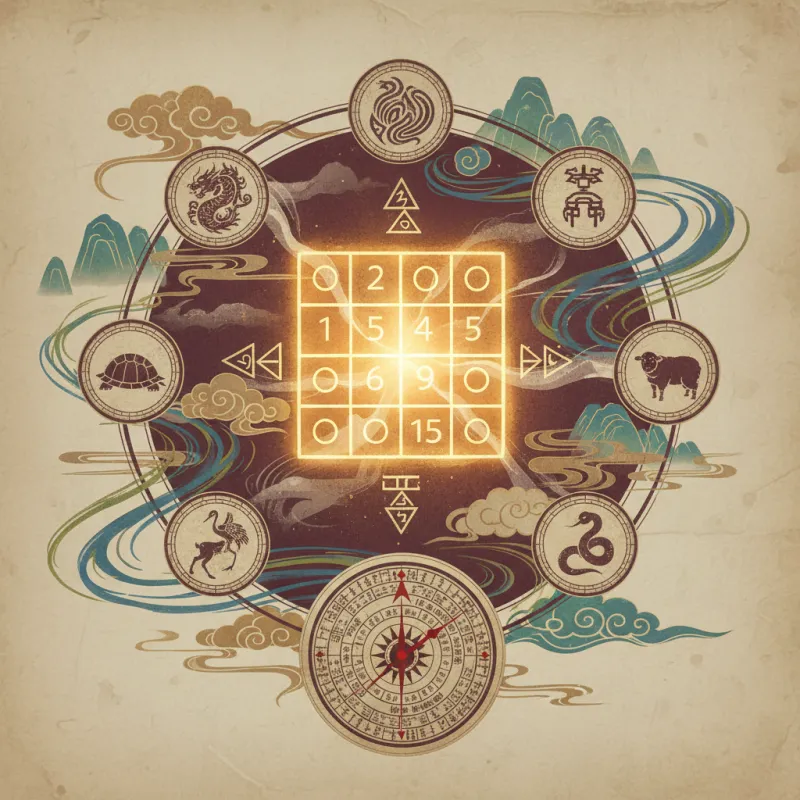
Picture this: You're standing in a feng shui master's office, watching them overlay a transparent grid on your home's floor plan. They're muttering numbers, marking sectors, calculating something that looks like ancient magic. What they're actually doing is applying a 4,000-year-old mathematical pattern that a Chinese emperor supposedly saw on a turtle's back. Sounds absurd, right? Except this pattern — the Lo Shu Square — is a legitimate mathematical oddity that predates Sudoku by millennia and forms the backbone of nearly every feng shui calculation you'll ever encounter.
The Mathematical Miracle on a Turtle Shell
The legend goes like this: Around 2800 BCE, during the reign of Emperor Yu the Great (大禹 Dà Yǔ), the Yellow River was flooding catastrophically. Yu was desperately trying to control the waters when a turtle emerged from the Luo River (洛河 Luò Hé) with a peculiar pattern of dots on its shell. The pattern formed a 3x3 grid where each row, column, and diagonal added up to exactly 15.
4 9 2 3 5 7 8 1 6
Here's what makes this mathematically special: This is a third-order magic square, and it's the only possible arrangement of numbers 1-9 where every row, column, and diagonal produces the same sum (excluding rotations and reflections). The Chinese didn't just stumble upon a pattern — they found the pattern. Mathematicians call this the "normal magic square of order 3," and it has unique properties that Western mathematics wouldn't formally describe until the 16th century.
The number 15 itself carries significance. In Chinese numerology, 15 represents the number of days in each phase of the lunar cycle. The sum of all nine numbers (1+2+3+4+5+6+7+8+9) equals 45, which reduces to 9 — the number of completion in Chinese cosmology. The center number is always 5, representing the Earth element and the center of the Bagua, the eight-sided symbol that maps the Lo Shu Square onto physical space.
From River Turtle to Feng Shui Foundation
The Lo Shu Square didn't stay a mathematical curiosity. By the Han Dynasty (206 BCE - 220 CE), scholars had integrated it into the cosmological framework that would become feng shui. Each number in the square was assigned to one of the eight trigrams (八卦 bāguà) from the I Ching, plus the center position.
Here's the mapping that changed everything:
- 1 (North): Kan trigram (坎 kǎn) - Water element, career, life journey
- 2 (Southwest): Kun trigram (坤 kūn) - Earth element, relationships, receptivity
- 3 (East): Zhen trigram (震 zhèn) - Wood element, family, new beginnings
- 4 (Southeast): Xun trigram (巽 xùn) - Wood element, wealth, wind
- 5 (Center): No trigram - Earth element, health, balance
- 6 (Northwest): Qian trigram (乾 qián) - Metal element, helpful people, leadership
- 7 (West): Dui trigram (兑 duì) - Metal element, children, creativity
- 8 (Northeast): Gen trigram (艮 gèn) - Earth element, knowledge, stillness
- 9 (South): Li trigram (离 lí) - Fire element, fame, illumination
This wasn't arbitrary. The arrangement follows the Later Heaven Sequence (后天八卦 hòutiān bāguà), which represents the world of change and manifestation — the physical reality we inhabit. This contrasts with the Earlier Heaven Sequence (先天八卦 xiāntiān bāguà), which represents the ideal, pre-manifest state of the universe. When feng shui practitioners analyze your home, they're using the Later Heaven arrangement because they're working with the material world, not the cosmic blueprint.
Flying Stars: The Lo Shu Square in Motion
The most sophisticated application of the Lo Shu Square is the Flying Star system (玄空飞星 xuánkōng fēixīng), which treats the nine numbers as energies that move through space and time. This is where feng shui gets genuinely complex and where most Western interpretations fall apart.
In Flying Star feng shui, each of the nine numbers becomes a "star" with specific characteristics that change based on the time period. The current Period 9 (2024-2043) means that the number 9 star is considered the most auspicious, while other stars take on different qualities depending on their position and the year. Practitioners calculate which stars "fly" into which sectors of your home based on:
- The facing direction of your building
- The construction or move-in date
- The current year, month, and even day
- The interaction between different stars in the same sector
This creates a dynamic map where the energy of your home shifts constantly. A bedroom that was perfect in 2020 might be problematic in 2025 because different stars have flown into that sector. This is why serious feng shui consultants don't give one-time advice — they provide annual updates based on the changing star positions.
The math gets intricate. Each star moves through the grid in a specific pattern that mirrors the Lo Shu arrangement. The sequence goes: center (5) → northwest (6) → west (7) → northeast (8) → south (9) → north (1) → southwest (2) → east (3) → southeast (4) → back to center. This isn't random; it follows the numerical order while tracing a path through the grid that maintains the mathematical relationships.
The Five Elements Dance
The Lo Shu Square also encodes the relationships between the Five Elements (五行 wǔxíng) — Wood, Fire, Earth, Metal, and Water. Look at the arrangement again:
- Water (1): North
- Earth (2, 5, 8): Southwest, Center, Northeast
- Wood (3, 4): East, Southeast
- Metal (6, 7): Northwest, West
- Fire (9): South
This isn't just categorization. The positions reflect the productive cycle (生 shēng) and controlling cycle (克 kè) of the elements. Water (1) in the North feeds Wood (3, 4) in the East and Southeast. Wood feeds Fire (9) in the South. Fire produces Earth (2, 8) in the Southwest and Northeast. Earth generates Metal (6, 7) in the Northwest and West. Metal produces Water, completing the cycle.
The controlling cycle is equally embedded: Water (1) controls Fire (9) — they're opposite on the grid. Fire controls Metal (6, 7). Metal controls Wood (3, 4). Wood controls Earth (2, 5, 8). Earth controls Water. Every relationship is spatially encoded in the square's geometry.
This is why feng shui practitioners obsess over element balance. If your front door is in the North (Water sector, number 1) and you paint it red (Fire element), you're creating a Water-Fire clash that's mathematically encoded in the Lo Shu structure. It's not superstition; it's following the relational logic that the square makes explicit.
Bazi and the Lo Shu Connection
The Lo Shu Square also intersects with Chinese astrology, particularly the Four Pillars of Destiny (四柱命理 sìzhù mìnglǐ), commonly called Bazi (八字 bāzì). Your Bazi chart calculates your elemental composition based on your birth date and time, producing a profile of your personal energy.
Here's where it gets interesting: Feng shui practitioners who know what they're doing will cross-reference your Bazi chart with the Lo Shu arrangement of your home. If you're a strong Fire person (lots of Fire element in your chart) and you sleep in the South sector (Fire, number 9), you might be getting too much of your dominant element, creating imbalance. Conversely, if you're weak in Water and your office is in the North (Water, number 1), that sector might support your deficiency.
This integration isn't universal — different schools of feng shui have different opinions on how much weight to give personal astrology versus the building's inherent energy. But the principle is sound: the Lo Shu Square provides a spatial framework that can be personalized based on individual elemental needs.
The I Ching's Numerical Shadow
The connection between the Lo Shu Square and the I Ching (易经 Yìjīng) runs deeper than the trigram assignments. The I Ching's 64 hexagrams are built from combinations of eight trigrams, and those eight trigrams map directly onto the Lo Shu positions (excluding the center).
When you consult the I Ching using the traditional yarrow stalk or coin method, you're generating numbers that correspond to specific hexagrams. Some I Ching numerology systems assign numerical values to hexagrams based on their Lo Shu positions, creating a bridge between divination and spatial analysis.
The Plum Blossom numerology system (梅花易数 méihuā yìshù), developed by the Song Dynasty scholar Shao Yong (邵雍), explicitly uses the Lo Shu arrangement to interpret I Ching readings. You calculate numbers based on the time of consultation, map them onto the Lo Shu grid, and derive hexagrams from their positions. This transforms the I Ching from a purely symbolic system into a mathematical one, where the Lo Shu Square acts as the computational engine.
Why This Matters for Your Home
All of this theory collapses into practical application when you're trying to arrange your furniture or choose a paint color. The Lo Shu Square gives feng shui practitioners a consistent framework for making recommendations. When someone tells you to put a water fountain in the North corner of your living room, they're not making it up — they're applying the Water element (number 1) to its corresponding Lo Shu position.
The problem is that most popular feng shui advice strips away the mathematical foundation and leaves you with vague suggestions about "energy flow" and "chi." But the Lo Shu Square is precise. It tells you exactly which element belongs in which sector, how those sectors interact, and how time-based factors (like Flying Stars) modify the baseline energy.
If you're serious about applying feng shui, you need to understand that you're working with a system that's fundamentally mathematical. The Lo Shu Square isn't decorative symbolism — it's the calculation engine. Every sector of your home corresponds to a number, an element, a trigram, and a life area. The relationships between these factors are fixed by the square's geometry.
This is why authentic feng shui consultations involve floor plans, compasses, and calculations. The practitioner is mapping the Lo Shu Square onto your physical space, determining which stars are flying through which sectors, and analyzing how your personal elements interact with the building's inherent structure. It's architecture meets astrology meets mathematics, all grounded in a pattern that supposedly appeared on a turtle's back 4,000 years ago.
Whether Emperor Yu actually saw a magical turtle is irrelevant. What matters is that someone, somewhere in ancient China, discovered a unique mathematical arrangement and built an entire cosmological system around it. That system has survived for millennia because it provides a consistent, replicable framework for analyzing space and time. The Lo Shu Square is the proof that feng shui, at its core, isn't mysticism — it's applied mathematics dressed in mythological clothing.
Related Reading
- Compass School vs. Form School: Two Approaches to Feng Shui
- The Bagua: Eight Symbols That Explain Everything
- The Bagua Map Explained: Your Feng Shui Floor Plan Guide
- Bagua Mirror: The Most Misunderstood Feng Shui Tool
- Exploring Feng Shui, I Ching, and Chinese Metaphysics in Modern Homes
- Feng Shui Color Symbolism: The Hidden Meanings Behind Every Hue
- Kitchen Feng Shui: Cooking Up Prosperity
Explore Chinese Culture
- Explore Daoist philosophy and practice
- Explore traditional Chinese customs
- Explore ancient Chinese cosmology