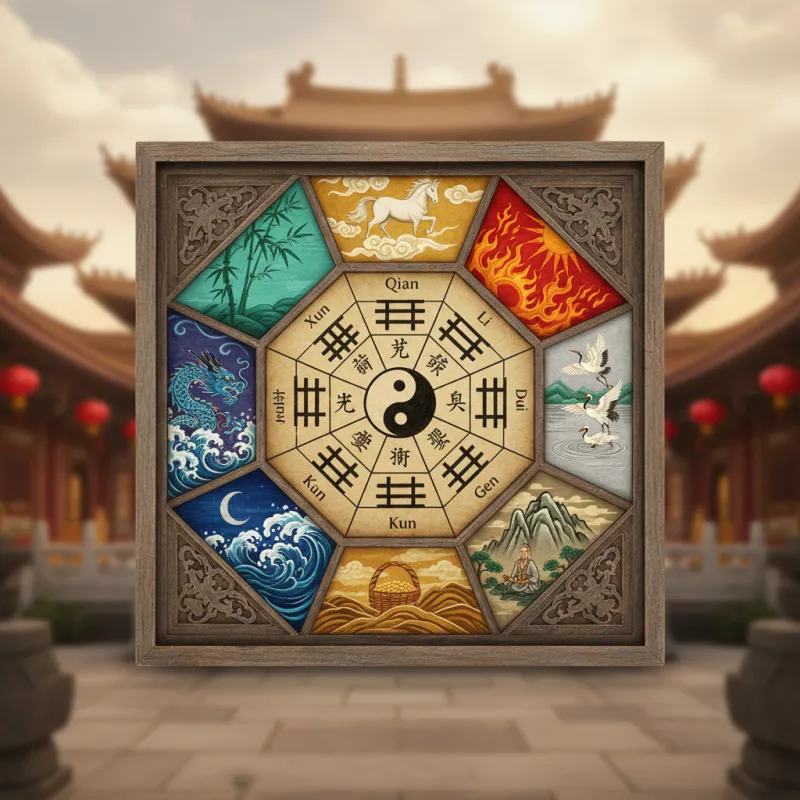
You stand at your front door, floor plan in hand, wondering why your career feels stuck despite your best efforts. What if the answer isn't in your resume, but in the invisible energy map overlaying your home? The Bagua map (八卦, Bāguà) transforms any floor plan into a diagnostic tool for life itself—but only if you know how to read it correctly.
What the Bagua Map Actually Is
The Bagua map isn't some New Age invention—it's rooted in the I Ching (易經, Yìjīng), China's oldest divinity text dating back over 3,000 years. Each of the eight trigrams (卦, guà) represents a fundamental force of nature: heaven, earth, thunder, wind, water, fire, mountain, and lake. When the Han Dynasty scholar Jing Fang (京房, 77-37 BCE) began correlating these trigrams with compass directions, he created the foundation for what would become the Bagua map we use today.
Think of it as an energetic blueprint. Just as architects use floor plans to understand a building's physical structure, Feng Shui practitioners overlay the Bagua to understand its energetic structure. Each sector corresponds to a life area—not because ancient masters arbitrarily decided so, but because they observed patterns over centuries. Homes with blocked north sectors consistently showed career stagnation. Southeast corners filled with clutter correlated with financial struggles. The Bagua map codifies these observations.
The map comes in two main schools: the Compass School (罗盘派, Luópán Pài) uses actual cardinal directions, while the Form School (形势派, Xíngshì Pài) aligns the map relative to your front door. I prefer the Compass School for its precision—your front door might face south, but north is still north, and water energy still accumulates there regardless of your entrance.
The Nine Sectors Decoded
The Bagua divides space into eight outer sectors plus a central ninth area, the Tai Chi (太极, Tàijí), representing health and balance. Here's what each sector governs:
North - Kan (坎): Career and life path. Water element. This sector relates to your professional journey and sense of purpose. The ancient text Shuō Guà Zhuàn (说卦传) describes Kan as "the abysmal," representing life's challenges and the flow that carries you through them. Colors: black, dark blue, charcoal. Enhance with actual water features, mirrors, or undulating shapes.
Northeast - Gen (艮): Knowledge, self-cultivation, spirituality. Earth element. Gen means "keeping still, mountain"—the place where you retreat to study and reflect. During the Tang Dynasty, scholars positioned their studies in the northeast corner of their homes. Colors: blue, green, earth tones. Boost with books, crystals, and meditation spaces.
East - Zhen (震): Family, ancestors, new beginnings. Wood element. Zhen translates as "the arousing, thunder"—the explosive energy of spring growth and family vitality. This sector connects you to your lineage and health. Colors: green, teal. Activate with family photos, plants, and wooden furniture.
Southeast - Xun (巽): Wealth, abundance, prosperity. Wood element. Xun means "the gentle, wind"—wealth that accumulates gradually, like wind filling a sail. The Qing Dynasty merchant class obsessively enhanced their southeast corners. Colors: purple, green, gold. Strengthen with healthy plants (never dried flowers), water features, and symbols of abundance.
South - Li (离): Fame, reputation, recognition. Fire element. Li translates as "the clinging, fire"—your light in the world, how others perceive you. This isn't about ego; it's about your contribution being seen and valued. Colors: red, orange, bright tones. Energize with lighting, candles, triangular shapes, and awards or recognition.
Southwest - Kun (坤): Love, relationships, partnerships. Earth element. Kun means "the receptive, earth"—the nurturing, feminine energy that bonds people together. Whether you're single or partnered, this sector affects all relationships. Colors: pink, red, earth tones. Enhance with pairs of objects, romantic imagery, and rose quartz.
West - Dui (兑): Children, creativity, joy. Metal element. Dui translates as "the joyous, lake"—the playful, creative energy of children and artistic expression. This sector governs both actual children and your creative "children" (projects, ideas). Colors: white, metallics, pastels. Activate with children's artwork, creative projects, and metal objects.
Northwest - Qian (乾): Helpful people, travel, blessings. Metal element. Qian means "the creative, heaven"—the energy of mentors, benefactors, and divine assistance. In traditional Chinese homes, this was the patriarch's position. Colors: white, gray, metallics. Strengthen with images of mentors, travel photos, and religious or spiritual symbols.
Center - Tai Chi (太极): Health, grounding, unity. Earth element. This is where all energies converge. Keep it open and uncluttered—a blocked center creates stagnation throughout your entire life. Colors: yellow, earth tones. Maintain with open space and grounding elements.
How to Actually Apply the Bagua Map
Here's where most people stumble. They print a Bagua diagram, hold it over their floor plan, and wonder why nothing changes. The map isn't magic—it's a diagnostic tool that reveals where energy flows and where it stagnates.
First, get an accurate floor plan. Include every room, closet, and alcove. If you're using the Compass School method (which I recommend), take a compass reading at your front door. Stand facing outward and note the direction. That determines how you orient the Bagua over your floor plan.
Missing sectors are common in modern homes. If your floor plan isn't a perfect square or rectangle, you'll have missing areas. A missing southeast corner? Your wealth sector is literally absent from your home's energy field. You can remedy this by placing a mirror on the interior wall to energetically "complete" the space, or by adding a light, plant, or crystal in that area to anchor the energy.
Protruding sectors are equally significant. If your bedroom juts out in the southwest (relationship sector), your love life likely dominates your thoughts—for better or worse. A protruding north sector can indicate someone whose career overshadows everything else.
The bathroom problem deserves special mention. Bathrooms drain energy—that's their function. A bathroom in your wealth sector (southeast) symbolically flushes money away. You can't move the bathroom, but you can minimize the damage: keep the toilet lid down, keep the door closed, place a mirror on the outside of the bathroom door to energetically "remove" it from that sector, and add plants or crystals inside to slow the draining energy.
Common Bagua Mistakes That Sabotage Your Efforts
I've seen people spend thousands on Feng Shui cures while making fundamental errors. The most common? Treating the Bagua like a superstition rather than an energy map. Placing a fountain in your wealth corner won't help if that corner is piled with broken objects and unpaid bills. The Bagua reveals problems; you must address the underlying energy, not just add symbolic objects.
Another mistake: applying the Bagua to individual rooms instead of the entire home. Yes, you can use a Bagua map for a single room, but the home's overall Bagua takes precedence. Your bedroom's wealth corner matters less than your home's wealth corner.
The "front door debate" confuses many practitioners. Some insist the front door always falls in the knowledge, career, or helpful people sectors (north, northeast, or northwest). This is the Form School approach, which aligns the Bagua relative to your entrance. It's valid, but I find the Compass School more accurate because it respects actual directional energies. Your front door's direction matters, but it doesn't override the fundamental energy of north being north.
Color obsession is another trap. Yes, each sector has associated colors, but you don't need to paint your south wall red or your north wall black. Subtle accents work—a red pillow in the fame sector, a black vase in the career sector. Feng Shui should enhance your life, not turn your home into a color-coded nightmare.
Integrating the Bagua with Other Feng Shui Principles
The Bagua map doesn't exist in isolation. It works alongside other Feng Shui principles, particularly the Five Elements (五行, Wǔxíng) and the concept of chi flow (氣, qì). Each Bagua sector has an associated element, and you can use the productive cycle of elements to enhance that sector.
For example, your career sector (north) is water element. Water is produced by metal in the five elements cycle, so adding metal objects—a metal desk organizer, a silver frame—strengthens your career sector. Water is weakened by earth (earth dams water), so avoid heavy earth elements like large crystals or pottery in this area.
The Bagua also interacts with your personal Kua number (卦数, Guàshù), calculated from your birth date. Your Kua number determines your favorable and unfavorable directions. Ideally, your bedroom falls in one of your favorable Bagua sectors and faces one of your favorable directions. This creates a powerful alignment between the space's energy and your personal energy.
Beyond the Basics: Advanced Bagua Applications
Once you understand the fundamental Bagua map, you can apply it at multiple scales. Master practitioners analyze the Bagua of the property (land), the home, individual rooms, and even desks. Each layer reveals different information.
The property's Bagua shows how your home sits within the larger energy field. A house positioned in the wealth corner of its lot has different energy than one in the knowledge corner. The neighborhood's Bagua matters too—living in the wealth sector of your city creates different opportunities than living in the career sector.
Timing adds another dimension. The Flying Stars system (飛星, Fēixīng) overlays time-based energy patterns onto the Bagua map. Each year, month, and day, different energies "fly" into different sectors, creating temporary enhancements or challenges. This explains why your career might suddenly flourish even though you haven't changed your home—the annual Flying Star may have brought beneficial energy to your career sector.
The Bagua map isn't a quick fix or a decorating scheme. It's a sophisticated diagnostic tool that reveals the energetic structure of your space and, by extension, your life. Used correctly, it shows you exactly where energy flows freely and where it stagnates, giving you a clear roadmap for creating the life you want. The map is ancient, but the energy it describes is as real today as it was three thousand years ago.
Related Reading
- The Bagua: Eight Symbols That Explain Everything
- The Lo Shu Square: The Magic Number Grid Behind Feng Shui
- Compass School vs. Form School: Two Approaches to Feng Shui
- Bagua Mirror: The Most Misunderstood Feng Shui Tool
- Annual Feng Shui Cures and Enhancers: What to Place Where
- Harnessing the Power of Flying Stars in Feng Shui and I Ching
- Crystals and Jade in Chinese Culture: Why Stones Matter More Than You Think
Explore Chinese Culture
- Explore Daoist philosophy and practice
- Explore traditional Chinese customs
- Explore ancient Chinese cosmology