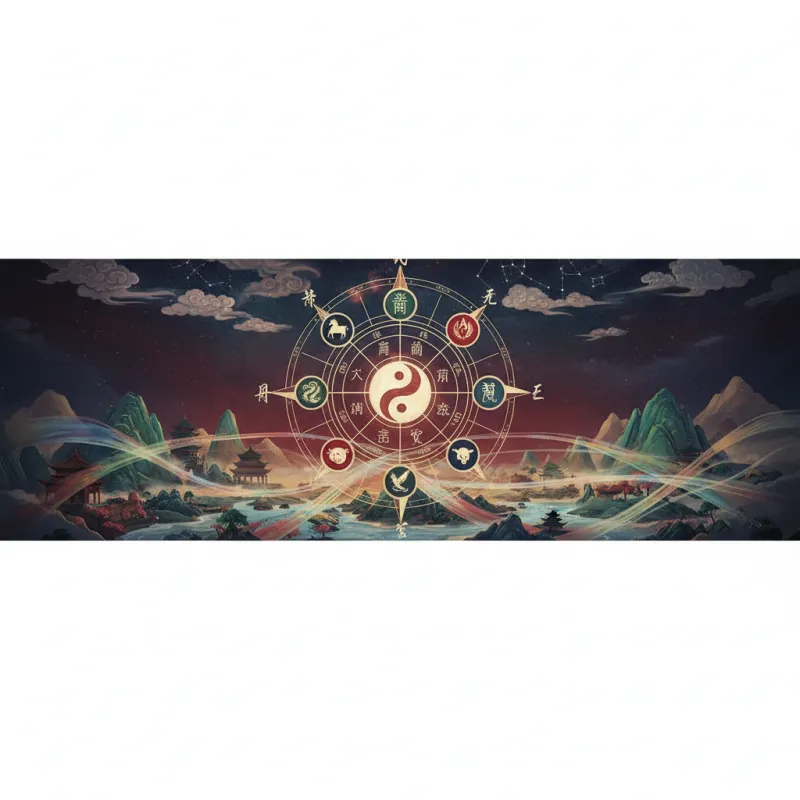
You're standing in a Beijing courtyard in 1070 CE, watching the philosopher Shao Yong arrange stones on the ground. He's not playing a game. He's demonstrating how the entire universe can be encoded in eight three-line symbols — and how those symbols predict everything from weather patterns to the rise and fall of dynasties. This is the bagua (八卦, bāguà), and it's been explaining reality for over three thousand years.
What the Bagua Actually Is
The bagua is an octagonal diagram containing eight trigrams — each trigram is three horizontal lines stacked vertically, with each line either solid (yang) or broken (yin). That gives you eight possible combinations, and ancient Chinese philosophers decided these eight patterns map perfectly onto the fundamental forces that drive existence.
This isn't feng shui decoration. The bagua predates feng shui by centuries. It appears in the Yijing (易經, I Ching) — the Book of Changes — which was already ancient when Confucius studied it in the 5th century BCE. The trigrams were supposedly revealed to the legendary Fu Xi when he saw them on the back of a dragon-horse emerging from the Yellow River, though the historical reality is that they evolved from Shang dynasty divination practices around 1200 BCE.
Each trigram represents a natural phenomenon, a family member, a direction, a season, an organ, a color, an animal, and about fifty other correspondences that Chinese philosophers have been arguing about for millennia. The genius is that these aren't random associations — they form an interconnected system where everything relates to everything else through the five elements and yin-yang dynamics.
The Eight Trigrams and Their Meanings
Qian (乾) ☰ — Three solid lines. Heaven, father, northwest, late autumn, metal element, the head, horses, the color white. This is pure yang energy at maximum strength — creative force, leadership, initiation. In the Yijing, Qian is the first hexagram, representing the dragon ascending. When this trigram appears in your home's bagua layout, it governs helpful people, travel, and patriarchal authority.
Kun (坤) ☷ — Three broken lines. Earth, mother, southwest, late summer, earth element, the abdomen, cattle, the color yellow. Pure yin — receptive, nurturing, yielding but ultimately supporting everything. The second hexagram in the Yijing. This position relates to relationships, marriage, and feminine energy. The Tang dynasty physician Sun Simiao associated Kun with the spleen and digestive system.
Zhen (震) ☳ — Solid line below two broken lines. Thunder, eldest son, east, spring, wood element, the feet, dragons, green. Sudden movement, arousal, shock. Think of spring thunderstorms that wake the earth. In feng shui applications, Zhen governs family, ancestors, and new beginnings. The Song dynasty scholar Zhu Xi wrote that Zhen represents "the first stirring of yang energy after winter's stillness."
Xun (巽) ☴ — Broken line below two solid lines. Wind, eldest daughter, southeast, early summer, wood element, the thighs, chickens, light green. Gentle penetration, like wind entering through cracks. This trigram relates to wealth, prosperity, and the subtle influences that accumulate over time. The Xuan Kong Flying Stars system pays special attention to Xun's position because it governs financial luck.
Kan (坎) ☵ — Broken line between two solid lines. Water, middle son, north, winter, water element, the ears, pigs, black. Danger, the abyss, but also wisdom gained through hardship. Water flows downward and fills the lowest places — it's associated with career and life path. The Ming dynasty novel Journey to the West uses Kan symbolism extensively when the monk Xuanzang crosses rivers and faces water demons.
Li (離) ☲ — Solid line between two broken lines. Fire, middle daughter, south, summer, fire element, the eyes, pheasants, red. Clarity, illumination, beauty, but also attachment and clinging (fire needs fuel). This position governs fame, reputation, and recognition. The Qing dynasty architect's manual Gongcheng Zuofa Zeli specifies that important buildings should face Li direction to "capture the light of recognition."
Gen (艮) ☶ — Solid line above two broken lines. Mountain, youngest son, northeast, late winter/early spring, earth element, the hands, dogs, light yellow. Stillness, meditation, boundaries, keeping still. Mountains mark limits and provide perspective. Gen relates to knowledge, self-cultivation, and spiritual practice. Buddhist temples in China are traditionally built in Gen positions when possible.
Dui (兌) ☱ — Broken line above two solid lines. Lake, youngest daughter, west, autumn, metal element, the mouth, sheep, white. Joy, pleasure, communication, exchange. Lakes reflect and contain — this trigram governs children, creativity, and completion. The poet Li Bai (701-762 CE) frequently used Dui imagery when writing about wine, conversation, and artistic inspiration.
The Two Arrangements That Changed Everything
Here's where it gets interesting: there are two different ways to arrange these eight trigrams around the octagon, and they mean completely different things.
The Earlier Heaven (先天八卦, xiāntiān bāguà) arrangement, attributed to Fu Xi, shows the universe in its ideal, pre-manifest state. Qian (heaven) sits opposite Kun (earth) at the top and bottom. This is the theoretical model — perfect balance, pure potential. It's used for burial feng shui and understanding cosmic principles. The Song dynasty philosopher Shao Yong spent decades meditating on this arrangement and developed a mathematical system that supposedly predicted historical cycles.
The Later Heaven (後天八卦, hòutiān bāguà) arrangement, attributed to King Wen of Zhou (1152-1056 BCE), shows the universe as we actually experience it — in motion, in time, in the messy reality of seasons and change. Li (fire) moves to the south, Kan (water) to the north, and the trigrams follow the cycle of the year. This is the arrangement used in feng shui applications for homes and buildings because it maps onto lived experience.
The difference matters enormously. Use Earlier Heaven when you're thinking about eternal principles or ancestral matters. Use Later Heaven when you're arranging furniture or choosing where to build. Mixing them up is like using a star chart when you need a road map.
How the Bagua Actually Works
The bagua isn't just eight isolated symbols — it's a dynamic system where each trigram transforms into others through the addition or subtraction of yang and yin lines. This is how the Yijing generates its 64 hexagrams: stack two trigrams, and you get a six-line figure that describes a specific situation and its likely development.
For example, stack Qian (heaven) over Kun (earth), and you get hexagram 11, Tai (泰), which means "peace" or "prosperity" — heaven and earth in proper relationship. Reverse them — Kun over Qian — and you get hexagram 12, Pi (否), "obstruction" — things are upside down, communication is blocked.
The Ming dynasty scholar Lai Zhide (1525-1604) developed the Xuan Kong Da Gua system, which uses trigram transformations to predict how energy moves through buildings over time. His methods are still used by professional feng shui practitioners, though most won't explain them to casual students because they take years to master.
Why This Still Matters
Walk into any Chinese home, and you'll likely see a bagua mirror above the door or a bagua-shaped feng shui compass on the shelf. But the bagua's influence goes far beyond decoration. Traditional Chinese medicine uses the trigrams to understand organ relationships. Martial artists study bagua zhang (八卦掌), a fighting style where practitioners walk in circles, embodying each trigram's energy. The I Ching remains one of the world's most-consulted divination texts.
The bagua endures because it does something remarkable: it provides a complete symbolic language for describing change, relationship, and pattern. Whether you believe the universe actually operates according to eight fundamental forces or see the bagua as a sophisticated metaphorical system, it offers a way to think about how things connect and transform.
The physicist Niels Bohr kept a bagua diagram in his study. When asked why, he reportedly said he didn't believe it worked — but he'd heard it worked whether you believed in it or not. That's probably apocryphal, but it captures something true: the bagua has survived three millennia not because it's mystical, but because it's useful. It gives you a framework for seeing patterns you'd otherwise miss.
Stand in your home's center and imagine the eight directions radiating outward, each carrying its own energy and meaning. That's the bagua — not magic, but a very old and very sophisticated way of organizing reality into something you can work with.
Related Reading
- The Bagua Map Explained: Your Feng Shui Floor Plan Guide
- Bagua Mirror: The Most Misunderstood Feng Shui Tool
- The Lo Shu Square: The Magic Number Grid Behind Feng Shui
- Compass School vs. Form School: Two Approaches to Feng Shui
- Exploring Feng Shui, I Ching, and Chinese Metaphysics: Symbols of Ancient Divination and Geomancy
- Kitchen Feng Shui: Cooking Up Prosperity
- Five Elements in Body and Home
Explore Chinese Culture
- Explore Daoist philosophy and practice
- Explore traditional Chinese customs
- Explore ancient Chinese cosmology