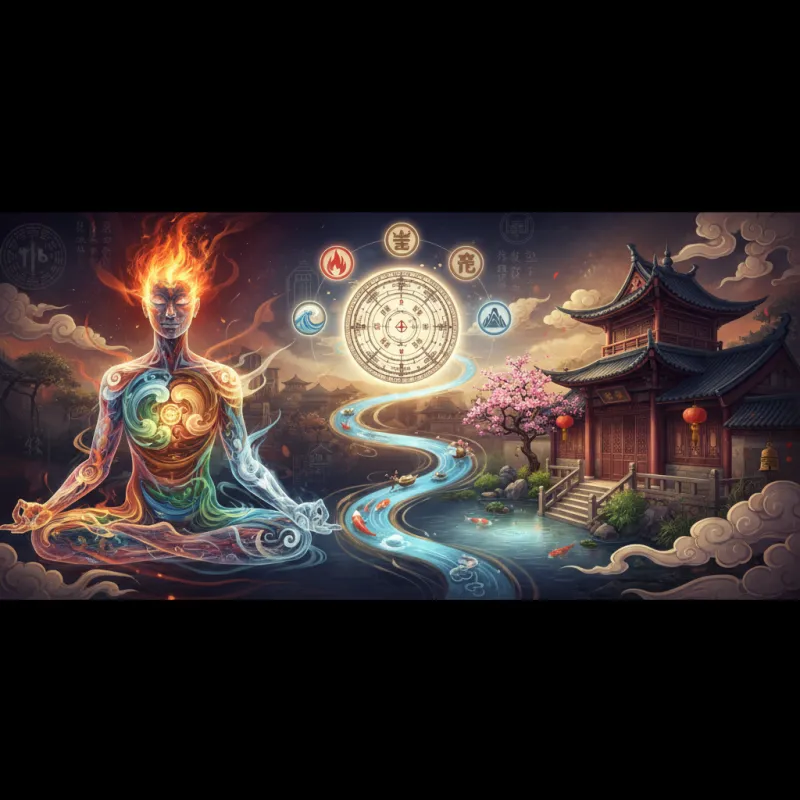
Your grandmother's house probably had better feng shui than your apartment, and she didn't even know what feng shui was. She just knew that the kitchen shouldn't face the bedroom door, that you don't put mirrors across from the bed, and that certain rooms felt "off" no matter how you arranged the furniture. What she understood intuitively, Chinese medicine has been mapping systematically for three thousand years: energy moves through spaces and bodies according to the same patterns.
The Five Elements system — 五行 (Wǔ Xíng) — gets butchered in translation more than any other Chinese concept. Walk into a Western bookstore and you'll find books calling it "Five Elements," as if the ancient Chinese were trying to build a periodic table. But 行 (Xíng) doesn't mean "element" in the Aristotelian sense. It means "to walk," "to move," "to act." The character itself shows a crossroads — movement in multiple directions. The Five Xing are five phases of transformation, five patterns of how energy (氣, Qì) moves through any system, whether that system is a human liver or a living room.
This isn't metaphor. It's pattern recognition at the highest level. The same principles that govern how your spleen processes dampness also govern how your basement handles moisture. The reason your bedroom feels stagnant has the same root cause as why you wake up with brain fog. Once you see the patterns, you can't unsee them.
Wood: The Expanding Phase
木 (Mù) is the phase of expansion, growth, and upward movement. In the body, Wood governs the liver (肝, Gān) and gallbladder (膽, Dǎn) — the organs that plan, decide, and push energy outward. The liver stores blood at night and releases it during activity, like a general deploying troops. When Wood is balanced, you wake up with clear vision and decisive energy. When it's blocked, you get the 4 AM rage-wake, the kind where you replay every argument you've ever lost.
In the home, Wood corresponds to the east and to vertical, upward-reaching forms. This is why traditional Chinese homes placed ancestral tablets in the east — the direction of sunrise, new beginnings, family lineage extending forward. Modern feng shui practitioners will tell you to put plants in the east corner, which isn't wrong, but misses the deeper point. Wood energy is about potential becoming actual. It's the difference between a seed (potential) and a sprout (actualization).
I've seen apartments where every room felt cramped despite adequate square footage. The problem was always the same: no vertical space, no room for energy to rise. Low ceilings, horizontal furniture arrangements, everything pushing downward. The residents inevitably complained of depression and lack of motivation — Wood energy completely suppressed. The fix isn't complicated: tall bookshelves, vertical art, plants that grow upward rather than trailing down. You're not decorating. You're creating pathways for Qi to move the way it needs to move.
The Wood organs are particularly sensitive to constraint. Liver Qi stagnation (肝氣鬱結, Gān Qì Yù Jié) is probably the most common pattern I see in modern urban dwellers, and it correlates perfectly with living in spaces that have no room to breathe. Small apartments, cluttered rooms, no access to nature — these aren't just aesthetic problems. They're creating the same energetic pattern in your space that manifests as irritability, menstrual irregularities, and digestive issues in your body.
Fire: The Ascending Phase
火 (Huǒ) is pure yang, the phase of maximum expansion and upward movement. In the body, Fire governs the heart (心, Xīn) and small intestine (小腸, Xiǎo Cháng), plus the pericardium and triple burner in the expanded system. The heart houses the Shen (神) — consciousness, awareness, the light behind your eyes. When Fire is balanced, you're present, joyful, connected. When it's excessive, you're manic, scattered, can't sleep. When it's deficient, the lights are on but nobody's home.
Fire corresponds to the south, to summer, to the peak of yang. In traditional Chinese architecture, the main hall faced south to capture maximum sunlight — not just for warmth, but because the heart of the home should align with the Fire direction. The emperor sat facing south. The dead were buried facing south so their spirits could absorb yang energy. This wasn't superstition. It was sophisticated understanding of how orientation affects energy.
In modern homes, the Fire area is your living room, your gathering space, the room where consciousness congregates. I've been in houses where the living room was dark, cold, tucked away in a corner — and the residents were invariably disconnected from each other, each person isolated in their own room. The heart of the home was weak, so the hearts of the people weakened. Compare this to homes where the living room is bright, warm, central — these families actually talk to each other.
The relationship between Fire and Water is particularly crucial in both body and home. The heart (Fire) and kidneys (Water) must communicate — what Chinese medicine calls the 心腎相交 (Xīn Shèn Xiāng Jiāo), the mutual exchange between heart and kidneys. When this exchange breaks down, you get insomnia, anxiety, the feeling of being simultaneously wired and exhausted. In the home, this manifests as having the kitchen (Fire) and bathroom (Water) in conflict — directly opposite each other, or sharing a wall, or the toilet pointing at the stove. These aren't arbitrary taboos. They're observations about what happens when Fire and Water energies clash instead of communicate.
Earth: The Stabilizing Phase
土 (Tǔ) is the center, the phase of transformation and stability. In the Five Phase cycle, Earth is the pivot point — the late summer transition between the yang phases (Wood, Fire) and the yin phases (Metal, Water). In the body, Earth governs the spleen (脾, Pí) and stomach (胃, Wèi), the organs that transform food into Qi and blood. The spleen is called the "root of post-heaven Qi" — everything you are after birth depends on your spleen's ability to extract energy from food and distribute it.
Earth corresponds to the center of the home, and to the southwest in the eight-direction system. This is why traditional Chinese homes had a central courtyard — the Earth element literally at the center, open to the sky, stable and grounding. Modern apartments have no center. You walk in and you're immediately in a hallway, or a kitchen, or a living room. There's no place to land, no energetic ground. People living in these spaces often have weak digestion and chronic worry — the two primary symptoms of Spleen Qi deficiency (脾氣虛, Pí Qì Xū).
The Earth element is about boundaries and transformation. The spleen transforms food into usable energy; the stomach receives and breaks down. In the home, Earth areas should be where transformation happens — the dining room, the kitchen, the places where raw ingredients become meals, where family members come together and separate. When these areas are chaotic, cluttered, or neglected, you'll see digestive issues, overthinking, inability to nourish yourself properly.
I knew someone who had chronic bloating and food sensitivities despite trying every elimination diet. Her kitchen was a disaster — piles of mail on the counter, broken appliances, no clear workspace. We didn't change her diet. We cleared her kitchen, created distinct zones for prep and cooking, removed everything that didn't belong. Her digestion improved within a week. The external chaos was creating internal chaos. The spleen couldn't transform because the space of transformation was blocked.
Metal: The Contracting Phase
金 (Jīn) is the phase of contraction, condensation, and inward movement. In the body, Metal governs the lungs (肺, Fèi) and large intestine (大腸, Dà Cháng) — the organs that take in the pure and release the impure. The lungs govern Qi itself, controlling the rhythm of expansion and contraction that keeps you alive. When Metal is balanced, you breathe deeply, your boundaries are clear, you know what to keep and what to let go. When it's weak, you're vulnerable to every passing cold, you hold onto grief, you can't release.
Metal corresponds to the west, to autumn, to the setting sun. In the home, Metal areas are about refinement and letting go — closets, storage areas, bathrooms. These are the spaces where you decide what stays and what goes. The large intestine does this for your body; your closet does this for your life. And just like chronic constipation indicates an inability to release physically, a cluttered closet indicates an inability to release emotionally.
The connection between grief and the lungs is one of Chinese medicine's most precise observations. Unresolved grief literally sits in the chest, restricting breath, creating that tight, heavy feeling. In the home, this manifests as west-facing rooms that feel heavy, oppressive, hard to breathe in. I've seen this pattern repeatedly: someone loses a parent, stores all their belongings in the west room, develops chronic respiratory issues within months. The grief is stored in the space, and the space affects the body.
Metal is also about value and worth — what's precious enough to keep. The lungs extract the pure Qi from air; you extract the valuable from your possessions. Hoarding is a Metal imbalance, an inability to discern value, to let go of what's no longer needed. The solution isn't just therapy. It's also addressing the Metal areas of the home, creating systems for release, making space for the new by releasing the old.
Water: The Descending Phase
水 (Shuǐ) is maximum yin, the phase of storage, depth, and downward movement. In the body, Water governs the kidneys (腎, Shèn) and bladder (膀胱, Páng Guāng) — the organs that store essence (精, Jīng) and control the body's deepest reserves. The kidneys are called the "root of pre-heaven Qi" — the constitutional energy you inherited from your parents. Everything about your fundamental vitality traces back to kidney energy.
Water corresponds to the north, to winter, to the depths. In the home, Water areas are bathrooms, basements, any place where energy descends and is stored. These should be the quietest, most yin parts of the house. When they're not — when the bathroom is bright and active, when the basement is the main living area — you see kidney depletion patterns: chronic fatigue, lower back pain, premature aging, reproductive issues.
The modern epidemic of kidney deficiency (腎虛, Shèn Xū) correlates perfectly with how we've designed our living spaces. We've eliminated yin. Everything is bright, active, stimulating. We have no dark, quiet, restful spaces. We've turned basements into rec rooms and bathrooms into spas. We've removed the places where Water energy can settle and accumulate. Then we wonder why everyone is exhausted, why fertility rates are dropping, why people in their thirties feel fifty.
Water is also about fear and wisdom. The kidneys house willpower (志, Zhì) — the deep determination that comes from having reserves to draw on. When Water is strong, you have courage rooted in depth. When it's weak, you have anxiety rooted in depletion. In the home, this shows up as basements that feel scary or threatening — damp, dark, but in a menacing way rather than a restful way. The Water area has become corrupted, and it manifests as fear.
The Generating and Controlling Cycles
Understanding the Five Phases individually is useful. Understanding how they interact is transformative. There are two primary cycles: the generating cycle (生, Shēng) and the controlling cycle (克, Kè).
The generating cycle flows like this: Wood feeds Fire, Fire creates Earth (ash), Earth contains Metal, Metal enriches Water (minerals), Water nourishes Wood. Each phase supports the next. In the body, this means your liver (Wood) supports your heart (Fire), your heart supports your spleen (Earth), and so on. In the home, it means the east area should support the south area, the south should support the center, and so on.
When the generating cycle is broken, you see deficiency patterns. A weak spleen (Earth) will eventually weaken the lungs (Metal) because Earth generates Metal. In the home, this might look like a neglected dining room (Earth) leading to problems in the west bedroom (Metal) — the person sleeping there gets sick frequently, can't let go of old relationships, hoards possessions.
The controlling cycle provides checks and balances: Wood controls Earth (roots break up soil), Earth controls Water (dams), Water controls Fire, Fire controls Metal (melts), Metal controls Wood (axe cuts tree). Each phase keeps another phase from becoming excessive. In the body, your liver (Wood) regulates your spleen (Earth) — this is why stress (Liver Qi stagnation) causes digestive issues (Spleen dysfunction). In the home, having too much Earth energy (clutter, heaviness, stagnation) can be controlled by introducing Wood energy (vertical elements, plants, upward movement).
The pathological version of the controlling cycle is called "overacting" (相乘, Xiāng Chéng). This is when one phase attacks another instead of regulating it. Liver overacting on Spleen is the classic pattern: chronic stress completely destroying digestion. In the home, this looks like the east area (Wood) overwhelming the center (Earth) — maybe a huge tree blocking all light to the main living space, or the home office (Wood energy of growth and planning) taking over the dining room (Earth energy of nourishment and gathering).
Practical Application: Reading Your Space
Here's how to actually use this: Walk through your home and identify which areas correspond to which phases. East is Wood, south is Fire, center is Earth, west is Metal, north is Water. Notice what's happening in each area. Is it cluttered, empty, broken, thriving? Then notice what's happening in your body. Do you have liver issues? Check your east area. Lung problems? Look at your west area. Kidney depletion? What's going on in the north?
The correlations are often startlingly precise. I've seen people with chronic gallbladder issues who had a broken window in the east room. People with heart palpitations who had a dark, cold south-facing living room. People with kidney stones who had a flooded basement. The body and the space mirror each other because they're both expressions of the same energetic patterns.
The fix isn't always obvious, and it's rarely just about adding the "right" element. You don't solve a Fire deficiency by painting everything red. You solve it by understanding why Fire energy isn't flowing properly. Is Water overcontrolling it? Is Wood not generating it? Is the space itself blocking the natural flow of yang energy?
Sometimes the solution is structural: opening up a wall, adding a window, changing the orientation of furniture. Sometimes it's about clearing: removing clutter, fixing broken items, cleaning out stagnant areas. Sometimes it's about addition: bringing in plants, adjusting lighting, creating vertical space. The key is understanding the pattern, not applying a formula.
Beyond Decoration
The Five Phases system isn't interior design advice. It's a diagnostic framework for understanding how energy moves through any system. Your body is a system. Your home is a system. The patterns are the same.
This is why traditional Chinese medicine practitioners would visit a patient's home. They understood that you can't fully treat someone without understanding their environment. A person with Spleen Qi deficiency living in a damp basement apartment needs more than herbs — they need to move. Someone with Liver Qi stagnation in a cluttered, cramped space needs more than acupuncture — they need to clear their environment.
Modern medicine has completely lost this understanding. We treat bodies as if they exist in isolation, as if the spaces we inhabit have no effect on our physiology. But your grandmother knew better. She knew that some houses make you sick and some houses make you well. She knew that how you arrange your space affects how you feel in your body. She just didn't have the language of the Five Phases to explain why.
The Five Phases give you that language. They let you see the patterns connecting your chronic headaches to your cluttered east room, your insomnia to your overheated south bedroom, your digestive issues to your chaotic kitchen. Once you see the patterns, you can work with them. You can arrange your space to support your body instead of undermining it.
This isn't about achieving perfect feng shui or balancing all five elements in every room. It's about understanding that energy moves, that it moves according to patterns, and that those patterns show up everywhere — in your organs, in your rooms, in the seasons, in the directions. Work with the patterns instead of against them, and both your body and your home will thank you.
For more on how these principles apply to health, see Chinese Medicine Fundamentals and Understanding Qi and Blood.
Related Reading
- Qi Energy Explained: What It Is and Why It Matters
- The Meridian System: Energy Highways in Your Body
- Yin and Yang in Health: The Balance That Keeps You Well
- Feng Shui and TCM Connection
- Harmonizing Your Kitchen: The Role of Feng Shui and I Ching in Culinary Spaces
- How to Prepare Your Home for the New Feng Shui Year
- The Fire Element: Passion, Fame, and Summer
Explore Chinese Culture
- Explore Daoist philosophy and practice
- Explore traditional Chinese customs
- Explore ancient Chinese cosmology