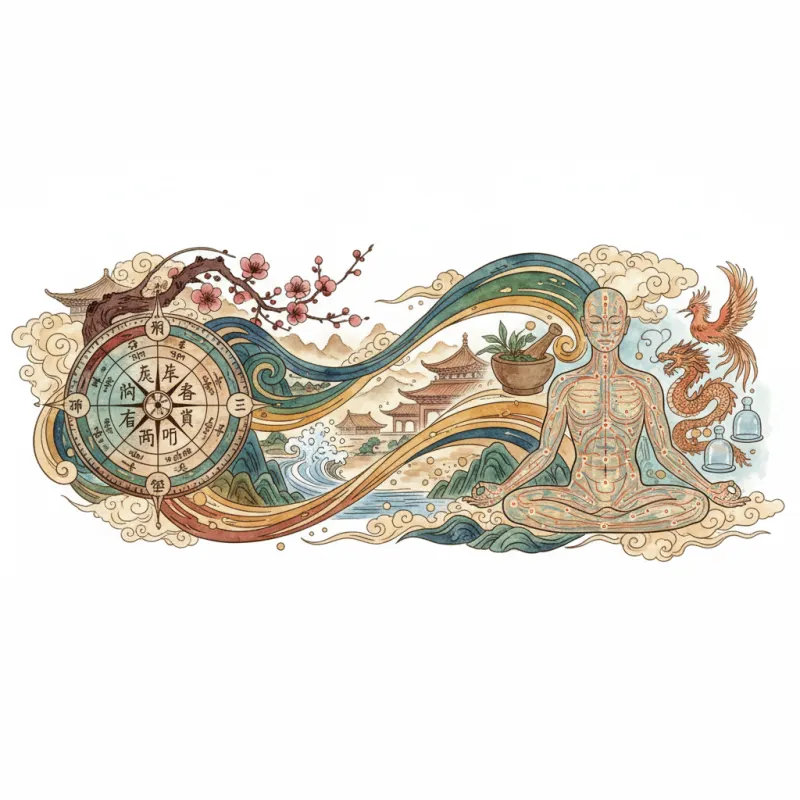
A doctor in Chengdu once told me something that stopped me mid-sentence. We were discussing a patient's chronic fatigue, and he gestured to the cramped, windowless room where she worked eight hours a day. "Look at her environment," he said. "Her qi is stagnant because her space is stagnant. I can give her herbs, but if she doesn't fix that room, she'll be back in three months." Then he added: "中医治人,风水治屋,道理一样" (Zhōng yī zhì rén, fēng shuǐ zhì wū, dào lǐ yī yàng) — "Chinese medicine treats the person, feng shui treats the house. The principle is the same."
That conversation changed how I understood both disciplines. Traditional Chinese Medicine and feng shui aren't distant cousins who happen to share some vocabulary. They're twins, born from the same philosophical womb, speaking the same language, operating on identical principles. The human body is a landscape. The landscape is a body. In Chinese thought, this isn't poetic metaphor — it's structural reality, documented in texts spanning two millennia.
The Common Root: Qi, Yin-Yang, and Five Elements
Both TCM and feng shui rest on three foundational concepts that emerged during the Warring States period (475-221 BCE) and were systematized in texts like the Huangdi Neijing (黄帝内经 Huángdì Nèijīng, The Yellow Emperor's Classic of Internal Medicine) and the Zhouyi (周易 Zhōuyì, Book of Changes).
First: qi (气 Qì), the vital energy that animates all things. In TCM, qi flows through meridians in the body. In feng shui, it flows through the environment. The character itself originally depicted vapor rising from cooking rice — something simultaneously material and immaterial, visible and invisible. When qi flows smoothly, there's health. When it stagnates, pools, or rushes too quickly, there's disease or misfortune.
Second: yin-yang (阴阳 Yīn-Yáng), the dynamic interplay of complementary opposites. In the body, organs are classified as yin (solid, storage-oriented like liver and kidneys) or yang (hollow, transformation-oriented like stomach and intestines). In a building, north-facing rooms are yin (cooler, darker), south-facing are yang (warmer, brighter). Health and harmony require balance, not the elimination of one in favor of the other.
Third: wuxing (五行 Wǔxíng), the Five Elements or Five Phases — Wood, Fire, Earth, Metal, Water. These aren't static substances but dynamic processes that generate and control each other in predictable cycles. In TCM, each element corresponds to organ systems, emotions, seasons, and flavors. In feng shui, they correspond to directions, colors, shapes, and materials. A TCM practitioner might treat liver qi stagnation (Wood element) by nourishing the kidneys (Water, which generates Wood). A feng shui consultant might activate a stagnant career area (Water element in the north) by adding Metal element features (which generates Water).
The diagnostic logic is identical. Both systems ask: Where is the imbalance? What's excessive? What's deficient? What's the generating or controlling relationship that can restore equilibrium?
Diagnostic Parallels: Reading the Body, Reading the Space
When a TCM doctor examines a patient, they're reading a text. Tongue color and coating, pulse quality at three positions and three depths, facial complexion, voice tone, body odor — each is a character in a diagnostic language refined over centuries. The Shang Han Lun (伤寒论 Shāng Hán Lùn, Treatise on Cold Damage), written by Zhang Zhongjing around 220 CE, describes hundreds of pattern combinations with the precision of a field guide to birds.
A feng shui practitioner does the same thing with a building. They read the landform, the water flow, the building's orientation, the arrangement of rooms, the quality of light, the placement of doors and windows. They're looking for the same things a doctor looks for: blockages, deficiencies, excesses, disharmony.
Consider sha qi (煞气 Shà Qì), or "killing qi" — harsh, attacking energy. In feng shui, this might be a sharp corner pointing at your front door, a long straight corridor aimed at your bedroom, or a T-junction road rushing toward your house. In TCM, sha qi manifests as pathogenic factors that attack the body: wind-cold invading the exterior, damp-heat accumulating in the lower burner, liver yang rising to the head. The vocabulary is the same because the phenomenon is the same: aggressive energy disrupting normal flow.
Or take stagnation (滞 Zhì). In the body, qi stagnation causes pain, bloating, irritability, irregular menstruation. The classic TCM saying goes: "通则不痛,痛则不通" (Tōng zé bù tòng, tòng zé bù tōng) — "If there's free flow, there's no pain; if there's pain, there's no free flow." In a space, stagnation shows up as clutter, dark corners, rooms that feel heavy or oppressive, areas no one wants to enter. The solution in both cases? Restore movement. A TCM doctor might prescribe herbs that move qi and blood, like Chuan Xiong (川芎 Chuān Xióng, Sichuan lovage root). A feng shui consultant might recommend clearing clutter, improving lighting, or adding a water feature to activate stuck energy.
The Neijing states: "气血冲和,万病不生" (Qì xuè chōng hé, wàn bìng bù shēng) — "When qi and blood are harmonious and flowing, ten thousand diseases cannot arise." Replace "qi and blood" with "environmental qi" and you have the central principle of feng shui.
The Body as Landscape, the Landscape as Body
Chinese medical texts routinely describe the body using geographical metaphors. The Nanjing (难经 Nán Jīng, Classic of Difficult Issues), compiled around the 1st century CE, calls the kidneys the "gate of life" (命门 Mìng Mén), the source from which all other organs draw vitality — like a mountain spring feeding rivers below. The heart is the "emperor" residing in the "upper palace." The spleen is the "central earth" that transforms and transports, like fertile soil in a valley.
This isn't decorative language. It reflects a genuine conceptual mapping. The Huangdi Neijing explicitly compares the body's twelve primary meridians to twelve rivers, the eight extraordinary vessels to eight great waterways. When a doctor needles Zusanli (足三里 Zú Sān Lǐ, Stomach 36), they're not just stimulating a point — they're dredging a channel, ensuring smooth flow through the digestive "landscape."
Feng shui texts return the favor, describing landscapes in anatomical terms. Mountains are the bones of the earth. Rivers are its blood vessels. Vegetation is its hair. The Zangshu (葬书 Zàng Shū, Book of Burial), attributed to Guo Pu in the 4th century CE, states: "气乘风则散,界水则止" (Qì chéng fēng zé sàn, jiè shuǐ zé zhǐ) — "Qi disperses when riding the wind, stops when encountering water." This is identical to how TCM describes qi in the body: it needs containment and direction, not dissipation.
The famous feng shui concept of the "four celestial animals" — Azure Dragon (east), White Tiger (west), Vermilion Bird (south), Black Tortoise (north) — maps directly onto the body's protective qi layers. The Black Tortoise represents the back and kidneys, the body's foundational support. The Vermilion Bird represents the heart and chest, the body's expressive, outward-facing aspect. The Dragon and Tiger represent the left and right sides, the balance of yin and yang. An ideal building site has these four features in proper relationship, just as a healthy body has its organ systems in proper relationship.
Practical Applications: Treatment Strategies
The treatment principles overlap so completely that traditional practitioners often worked in both domains. The Ming Dynasty physician Li Shizhen (李时珍 Lǐ Shízhēn, 1518-1593), famous for his Bencao Gangmu (本草纲目 Běncǎo Gāngmù, Compendium of Materia Medica), also wrote about environmental influences on health. He understood that prescribing herbs without considering a patient's living environment was like bailing water from a boat without plugging the leak.
Consider someone with chronic respiratory issues — frequent colds, asthma, weak voice. A TCM diagnosis might identify lung qi deficiency (肺气虚 Fèi Qì Xū). The treatment would include herbs to tonify lung qi, like Huang Qi (黄芪 Huáng Qí, astragalus root) and Ren Shen (人参 Rén Shēn, ginseng). But a complete approach would also examine their environment. Is their bedroom in the west (Metal direction, corresponding to lungs)? Is that area cluttered or poorly ventilated? Is there mold or dampness? Are they sleeping under a beam that "presses" on the chest? Addressing both the internal and external dimensions produces better, more lasting results.
Or take someone with digestive problems — bloating, irregular appetite, loose stools. TCM might diagnose spleen qi deficiency (脾气虚 Pí Qì Xū). Herbs would include Bai Zhu (白术 Bái Zhú, white atractylodes) and Fu Ling (茯苓 Fú Líng, poria). But feng shui would ask: What's happening in the center of their home (Earth element, corresponding to spleen)? Is it cluttered, dark, or chaotic? Is the kitchen (where food is transformed, like the spleen transforms nutrients) clean and well-organized? Is there good natural light in eating areas?
The Yijing (易经 Yì Jīng, Book of Changes) provides the philosophical foundation for this integrated approach. Hexagram 63, Jiji (既济 Jì Jì, After Completion), warns that even when things are in order, vigilance is required to maintain balance. Hexagram 64, Weiji (未济 Wèi Jì, Before Completion), reminds us that imbalance is the natural state — harmony requires constant adjustment. This applies equally to maintaining health in the body and harmony in the environment.
Seasonal and Directional Correspondences
Both systems organize their understanding through the same seasonal and directional framework, rooted in the Five Elements. This isn't arbitrary symbolism — it reflects observable patterns in nature and human physiology.
Spring (Wood element, east direction) is the season of growth and expansion. In TCM, the liver and gallbladder are most active, and problems like irritability, headaches, and menstrual irregularities often worsen. In feng shui, the east sector of a home or office corresponds to health and family. Activating this area with plants, the color green, or wooden objects supports the Wood element. The Neijing advises: "春三月,此谓发陈" (Chūn sān yuè, cǐ wèi fā chén) — "The three months of spring are called the period of beginning and development." Both body and environment should support this outward, upward movement.
Summer (Fire element, south direction) is the season of maximum yang. The heart and small intestine are most active. In feng shui, the south sector relates to fame and recognition. Both systems emphasize the importance of not overheating — excessive Fire can damage yin fluids in the body or create oppressive, agitated energy in a space. The solution? Balance Fire with Water element features, ensure good ventilation, use cooling colors.
Late summer (Earth element, center) is the transition season. The spleen and stomach are most active, and digestive issues often arise. In feng shui, the center of a space should be open and uncluttered, allowing qi to distribute evenly to all areas. The Earth element provides stability and nourishment — in the body through proper digestion, in the environment through a calm, grounded center.
Autumn (Metal element, west direction) is the season of gathering inward and letting go. The lungs and large intestine are most active. Grief and sadness, the emotions associated with Metal, may surface. In feng shui, the west sector relates to children and creativity. Both systems emphasize the importance of release — the lungs release carbon dioxide, the large intestine releases waste, and a well-functioning space releases what's no longer needed through regular clearing and cleaning.
Winter (Water element, north direction) is the season of storage and rest. The kidneys and bladder are most active, and the body's deepest reserves are called upon. In feng shui, the north sector relates to career and life path. Both systems emphasize conservation — don't deplete your reserves, ensure adequate rest, protect your foundational energy. The Neijing states: "冬三月,此谓闭藏" (Dōng sān yuè, cǐ wèi bì cáng) — "The three months of winter are called the period of closing and storing."
Understanding these correspondences allows for sophisticated interventions. If someone has kidney yang deficiency (cold extremities, low back pain, frequent urination), you might look at the north sector of their home. Is it cold, dark, or neglected? Adding warm colors, improving lighting, or placing symbols of vitality there supports the treatment from the environmental side.
Modern Relevance: Integration, Not Superstition
Western medicine often dismisses both TCM and feng shui as pre-scientific superstition. This misses the point entirely. These systems aren't primitive attempts at modern biomedicine or physics. They're sophisticated frameworks for understanding pattern, relationship, and dynamic balance — domains where reductionist science often struggles.
Recent research has begun validating aspects of both systems, though often without acknowledging the source. Studies on circadian rhythms confirm that organ systems have peak activity times, matching the TCM "organ clock." Research on environmental psychology demonstrates that spatial arrangement, lighting, and color affect mood, productivity, and health — core feng shui principles. The emerging field of psychoneuroimmunology shows that stress (often caused by environmental factors) directly impacts immune function, bridging the internal and external in ways Chinese medicine has always understood.
The value isn't in proving every traditional claim with modern instruments. It's in recognizing that these systems offer a different kind of knowledge — relational, contextual, holistic. They ask different questions: not "what's the mechanism?" but "what's the pattern?" Not "what's the isolated cause?" but "what's the web of relationships?"
A friend who practices both acupuncture and feng shui consultation told me she sees her work as "treating the whole field." The patient isn't separate from their environment. The body isn't separate from the space it inhabits. Health emerges from the entire system, not from isolated interventions. This perspective, far from being outdated, may be exactly what modern medicine needs as it grapples with chronic diseases that resist simple pharmaceutical solutions.
Practical Integration: A Unified Approach
If you're dealing with a health issue, consider both dimensions. Work with a qualified TCM practitioner for the internal aspect — herbs, acupuncture, dietary therapy. But also examine your environment. Where do you spend most of your time? How does that space feel? Is it cluttered, dark, or oppressive? Does it support the kind of energy you need?
For sleep problems, yes, consider herbs like Suan Zao Ren (酸枣仁 Suān Zǎo Rén, sour jujube seed) to nourish heart blood. But also look at your bedroom. Is it in a quiet location? Is the bed positioned so you can see the door without being directly in line with it? Are there electronics creating electromagnetic fields? Is the room too bright, too cluttered, or too stimulating?
For low energy, yes, consider herbs like Dang Shen (党参 Dǎng Shēn, codonopsis) to tonify qi. But also examine your workspace. Is it well-lit with natural light? Is your desk positioned to give you a sense of support and command? Is the space organized in a way that supports focus and flow?
The Daodejing (道德经 Dào Dé Jīng, Classic of the Way and Virtue) states: "人法地,地法天,天法道,道法自然" (Rén fǎ dì, dì fǎ tiān, tiān fǎ dào, dào fǎ zì rán) — "Humans model themselves on Earth, Earth models itself on Heaven, Heaven models itself on the Way, and the Way models itself on Nature." This is the philosophical foundation of both TCM and feng shui: we're part of a larger pattern, and health comes from aligning with that pattern, not fighting against it.
The doctor in Chengdu was right. Chinese medicine treats the person, feng shui treats the house, and the principle is the same. Both are branches of a single tree, rooted in the understanding that qi flows through everything, that balance is dynamic not static, and that health emerges from harmony between inner and outer, body and environment, microcosm and macrocosm. Understanding this connection doesn't just deepen your appreciation of either system — it opens up a more complete, more effective approach to health and wellbeing.
For more on how these principles apply to specific health concerns, see Chinese Medicine and the Five Elements and Seasonal Living According to TCM.
Related Reading
- The Meridian System: Energy Highways in Your Body
- Qi Energy Explained: What It Is and Why It Matters
- Yin and Yang in Health: The Balance That Keeps You Well
- Five Elements in Body and Home
- Reflecting Harmony: The Role of Mirrors in Feng Shui and I Ching Divination
- Rainwater Collection and Feng Shui: Catching Wealth from the Sky
- Compass School Feng Shui: When Direction Becomes Destiny
Explore Chinese Culture
- Explore Daoist philosophy and practice
- Explore traditional Chinese customs
- Explore ancient Chinese cosmology