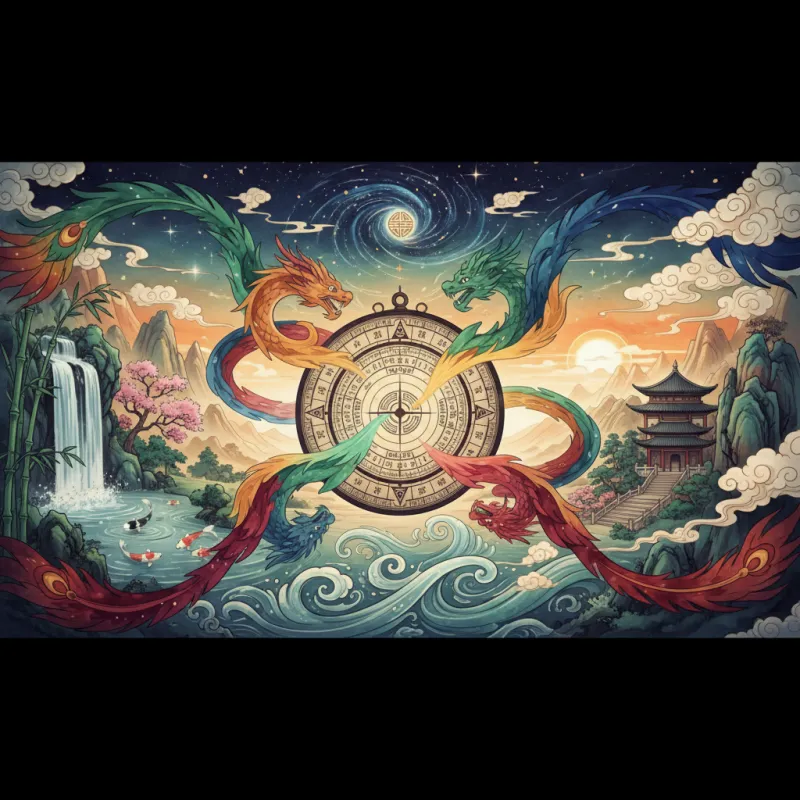
You're standing in an empty apartment, watching a feng shui master slowly rotate a brass disc covered in cryptic Chinese characters. He mutters numbers under his breath, checks his watch, asks your birth date again. Finally, he taps the disc and announces: "Your bed must face 127 degrees southeast. Not 120. Not 135. Exactly 127." You think he's joking. He's not.
This is the Compass School of feng shui (理气派, lǐqì pài), where a single degree of orientation can mean the difference between prosperity and bankruptcy, health and illness, harmony and divorce. While the Form School reads mountains and rivers like a landscape painter, the Compass School treats your home like a mathematical equation where direction, time, and cosmic energy converge into precise, unforgiving calculations.
The Luopan: A Compass That Measures Destiny
The luopan (罗盘, literally "net plate") looks like someone glued an astronomy textbook onto a compass. The basic model has 8-12 concentric rings. Professional versions have 36 or more. Each ring encodes a different layer of information: the Eight Trigrams (八卦, bāguà), the 24 Mountains (二十四山, èrshísì shān), the 28 Lunar Mansions (二十八宿, èrshíbā xiù), the 60 Jiazi cycle (六十甲子, liùshí jiǎzǐ), and systems so obscure that even experienced practitioners debate their meanings.
At the center sits a magnetic needle floating in liquid, just like a regular compass. But unlike a hiking compass that simply points north, the luopan's needle aligns with one of 24 directional sectors, each spanning exactly 15 degrees. These aren't arbitrary divisions—they correspond to the 12 Earthly Branches (地支, dìzhī) and 8 of the 10 Heavenly Stems (天干, tiāngān), creating a directional language that links space to the Chinese calendar system.
The earliest luopan-like devices appeared during the Han Dynasty (206 BCE - 220 CE), but the instrument reached its mature form during the Song Dynasty (960-1279 CE), when Neo-Confucian scholars became obsessed with correlating cosmic patterns. Wang Ji (王洁), a Song Dynasty feng shui master, standardized many of the ring systems still used today. His innovation was treating direction not as a simple bearing but as a temporal coordinate—a way to capture the specific quality of qi flowing from each direction at each moment in time.
The 24 Mountains: Where Space Becomes Specific
The 24 Mountains system divides the 360-degree circle into 24 sectors of 15 degrees each. But these aren't just numbered positions—each has a name, an elemental association, and a yin-yang polarity. The south isn't just "south"—it's divided into Bing (丙, Fire Yang), Wu (午, Fire Yang), and Ding (丁, Fire Yin). Each subdivision carries different implications for what you should place there and who should occupy that space.
This granularity matters because Compass School practitioners believe that qi flows differently through each of these 24 channels. Facing your front door toward Wu (the middle 15 degrees of south) might bring recognition and fame, while facing it toward Bing (the first 15 degrees of south) could bring aggressive energy and conflict. The difference? Just 7.5 degrees of rotation.
Western practitioners often simplify this to eight directions (N, NE, E, SE, S, SW, W, NW), which makes traditional Compass School masters wince. It's like reducing a piano to eight keys and wondering why the music sounds wrong. The 24 Mountains system exists precisely because ancient practitioners observed that qi doesn't flow in neat 45-degree chunks—it shifts in quality every 15 degrees, creating a spectrum of energetic signatures around the compass rose.
Flying Stars: When Time Enters the Equation
If the 24 Mountains system seems complex, Flying Stars feng shui (飞星派, fēixīng pài) takes it to another level by adding time as a variable. This method, which emerged during the Qing Dynasty (1644-1912), calculates how the energy of each direction changes over time—not just seasonally, but across 20-year periods, annual cycles, and even monthly shifts.
The system is based on the Nine Stars (九星, jiǔxīng), numbered 1 through 9, each associated with an element, a trigram, and specific types of fortune or misfortune. These stars "fly" through the nine sectors of a building according to mathematical patterns derived from the Luoshu magic square (洛书, Luòshū)—the legendary 3x3 grid that supposedly appeared on the back of a turtle emerging from the Luo River during the reign of Emperor Yu around 2200 BCE.
A Flying Stars consultation requires three pieces of information: the building's facing direction (measured to the degree), the construction or move-in date, and the current time period. From these, the practitioner calculates which stars occupy which sectors, how they interact with the building's inherent energy, and what this means for the occupants. A sector that was auspicious in Period 7 (1984-2003) might become problematic in Period 9 (2024-2043) as different stars take residence.
This is why Compass School feng shui can seem absurdly specific. It's not enough to know that southeast is generally good for wealth—you need to know whether the wealth star is actually in your southeast sector during this 20-year period, whether it's being supported or undermined by the annual and monthly stars, and whether your personal birth data harmonizes with that directional energy. Miss any variable, and your carefully positioned wealth bowl might as well be a decorative paperweight.
Eight Mansions: Personalizing Direction
The Eight Mansions method (八宅派, bāzhái pài) adds another layer by calculating your personal auspicious and inauspicious directions based on your birth year. This system divides people into East Group or West Group, with four favorable and four unfavorable directions for each person.
The calculation uses your Gua number (卦数, guàshù), derived from your birth year and gender. If you're an East Group person (Gua 1, 3, 4, or 9), your favorable directions are north, south, east, and southeast. West Group people (Gua 2, 6, 7, or 8) thrive facing west, northwest, southwest, and northeast. The theory holds that sleeping, working, and eating while facing your favorable directions accumulates beneficial qi, while facing unfavorable directions gradually depletes your energy.
This creates practical dilemmas. What if you're East Group but your Flying Stars chart says your best wealth sector is in the west? What if you're married to someone from the opposite group? Traditional masters have various strategies for resolving these conflicts—prioritizing the household head's directions, using the building's inherent energy as the primary factor, or employing remedies to mitigate unfavorable orientations. Modern practitioners sometimes throw up their hands and admit that perfect feng shui is impossible; the goal is optimization, not perfection.
The Compass School in Practice
Walk into a traditional Compass School consultation and you'll see the master taking measurements with almost obsessive precision. They'll check the facing direction from multiple points, account for magnetic declination, note the exact degree reading, and cross-reference it with multiple ring systems on the luopan. They'll ask for construction dates, renovation dates, move-in dates. They'll calculate, recalculate, consult reference books filled with tables and diagrams.
This precision has a purpose. In Compass School theory, a 5-degree error in measuring your facing direction could place you in an entirely different Mountain, changing the entire analysis. A mistake in the construction date could assign the wrong Period stars to your home. The system's complexity isn't arbitrary—it reflects a worldview where cosmic energy operates according to precise mathematical laws, and human fortune depends on aligning with those laws down to the degree.
The challenge is that this precision often conflicts with practical reality. Modern buildings rarely face exactly north, south, east, or west. Magnetic north shifts over time. Urban environments create electromagnetic interference that affects compass readings. And most people don't know the exact hour their building was completed, let alone the precise moment the roof was sealed or the door was hung—details that some schools consider crucial for accurate calculations.
Why the Compass School Dominates Modern Practice
Despite—or perhaps because of—its complexity, the Compass School dominates contemporary feng shui practice, especially in Hong Kong, Taiwan, and Singapore. There are several reasons for this dominance.
First, it provides definitive answers. While Form School analysis can be subjective (does that building look like a tiger or a dragon?), Compass School calculations produce specific, measurable recommendations. Your door should face 142 degrees. Your desk should be in the northwest corner. Your bedroom should avoid the northeast. This definitiveness appeals to clients who want clear action items, not poetic interpretations of landscape energy.
Second, it works in urban environments where Form School principles are harder to apply. You can't change the mountain behind your apartment building or redirect the river flowing past your office tower. But you can adjust your facing direction, rearrange your furniture, and choose which rooms to occupy. The Compass School gives urban dwellers agency in environments where natural landforms are absent or obscured.
Third, it creates professional mystique. A Form School analysis might take an hour of observation and discussion. A Compass School consultation involves specialized tools, complex calculations, and reference to texts that most clients can't read. This technical complexity justifies higher fees and positions the practitioner as an expert with rare knowledge—not just someone with good intuition about spatial arrangement.
The irony is that many of the most respected historical feng shui texts, including the Qing Dynasty classic "Entering Earth's Eye" (入地眼全书, Rùdì Yǎn Quánshū), emphasize that Form School principles should take precedence. The Compass School, they argue, is for fine-tuning after the major landscape factors are correct. But in modern practice, the relationship has often reversed, with Compass School calculations driving decisions and Form School considerations becoming secondary—if they're considered at all.
The Skeptic's Question
Here's what bothers critics: if Compass School feng shui is so precise, why do different masters using the same tools and methods often reach different conclusions? Why do some schools use the magnetic north reading while others adjust for true north? Why do some systems prioritize the building's facing direction while others emphasize the sitting direction? Why does one master say your wealth corner is in the southeast while another insists it's in the northwest?
The honest answer is that Compass School feng shui isn't a single unified system—it's a collection of related but sometimes contradictory methods that evolved over centuries in different regions, each claiming authority from ancient texts that are themselves ambiguous or incomplete. The 24 Mountains are standard, but how you apply them varies by school. Flying Stars calculations follow consistent mathematical patterns, but which patterns to use and how to interpret them remains debated.
This doesn't necessarily invalidate the entire approach. Traditional Chinese medicine also has multiple schools with different diagnostic methods and treatment protocols, yet many patients report benefits. The question isn't whether Compass School feng shui is "true" in a scientific sense, but whether its framework provides a useful way to think about spatial orientation, temporal cycles, and environmental energy—and whether following its recommendations produces tangible improvements in people's lives.
What's undeniable is that the Compass School transformed feng shui from an intuitive art into a technical discipline, creating a systematic language for discussing how direction and time interact with human fortune. Whether you believe that language describes objective reality or represents an elaborate cultural metaphor, it remains one of the most sophisticated systems ever developed for thinking about how humans orient themselves in space and time—one degree at a time.
Related Reading
- The Compass School of Feng Shui: Mathematics, Not Magic
- Flying Stars Explained Simply
- How to Read a Luopan: The Chinese Feng Shui Compass
- Eight Mansions vs Flying Stars: Which System Should You Use?
- Exploring Feng Shui, I Ching, and Chinese Metaphysics in Bazi Practice
- Feng Shui Aquarium Fish: Types, Numbers, and Placement Rules
- Bagua Mirror: The Most Misunderstood Feng Shui Tool
Explore Chinese Culture
- Explore Daoist philosophy and practice
- Explore traditional Chinese customs
- Explore ancient Chinese cosmology