You walk into two rooms in the same house. Same paint, same furniture style, same lighting. But one feels right — you want to linger, work there, think there. The other? You can't wait to leave. Your realtor calls it "flow." Your friend calls it "vibes." A Flying Stars practitioner calls it what it actually is: measurable energetic differences between spatial sectors that shift according to temporal cycles.
Flying Stars feng shui — Xuán Kōng Fēi Xīng (玄空飞星) — has been cursed with a reputation for complexity. Masters guard their calculation methods. Books make it sound like you need a PhD in Chinese cosmology. Students get lost in charts, numbers, and conflicting interpretations. But strip away the mystique, and you're left with something almost embarrassingly simple: different areas of your space hold different energetic qualities, and those qualities change over time. That's the entire system. Everything else is just learning to read the map.
The name itself tells you what's happening. Xuán Kōng (玄空) translates as "mysterious void," but it's not mystical nonsense — it refers to the invisible dimensions of time and space. Fēi Xīng (飞星) means "flying stars," because the energy patterns don't sit still. They move, sector to sector, year to year, following mathematical patterns that were codified during the Tang Dynasty (618-907 CE) and refined through the Song (960-1279 CE). This isn't New Age invention. It's a calculation system that's been stress-tested across thirteen centuries of Chinese architecture, from imperial palaces to merchant houses.
The Grid: Your Space as Nine Sectors
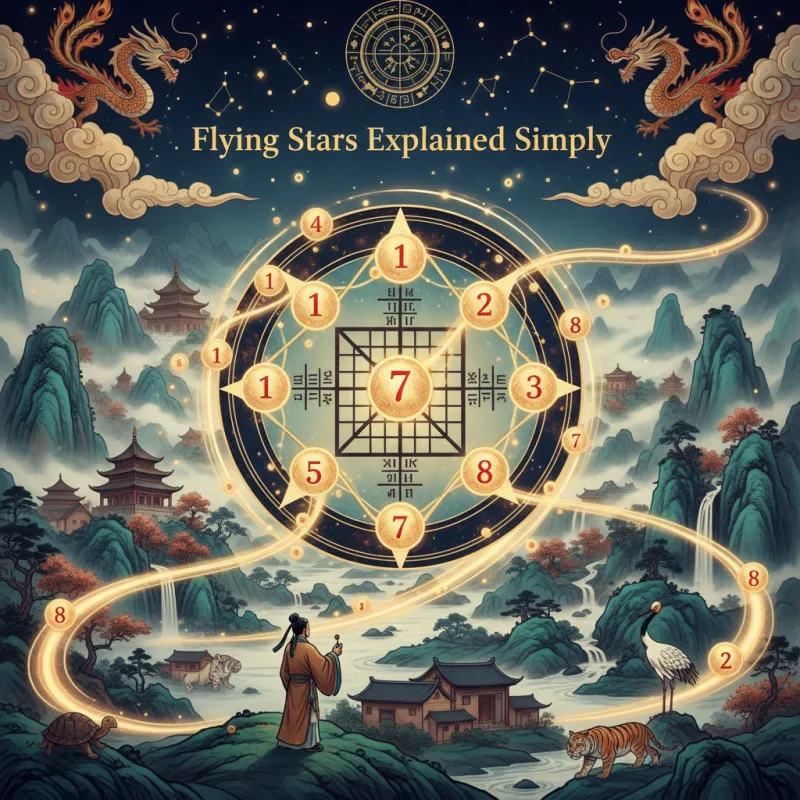
Take your floor plan. Now imagine a tic-tac-toe grid laid over it — nine equal squares. In Flying Stars, each square is a gōng (宫, "palace"), and each palace has its own energetic signature. The center palace is called zhōng gōng (中宫). The eight surrounding palaces correspond to the eight trigrams of the I Ching: Qián (乾, northwest), Kūn (坤, southwest), Zhèn (震, east), Xùn (巽, southeast), Kǎn (坎, north), Lí (离, south), Gèn (艮, northeast), and Duì (兑, west).
This isn't arbitrary. The eight trigrams represent fundamental forces — heaven, earth, thunder, wind, water, fire, mountain, lake — and their directional associations come from the Hòu Tiān Bā Guà (后天八卦, "Later Heaven Sequence"), which describes the world of change and manifestation. The Earlier Heaven Sequence shows ideal cosmic order; the Later Heaven Sequence shows how energy actually moves through lived space. Flying Stars uses the latter because it's dealing with real buildings where real people sleep, work, and argue.
Each palace gets assigned numbers — typically three of them, which practitioners call "stars." These numbers (1 through 9) represent different types of qì (气, energy). The number 1 star relates to water energy, career, and wisdom. The number 2 star connects to earth energy and can indicate illness or relationship issues depending on context. The number 8 star, especially powerful in the current Period 8 (2004-2024), represents wealth and prosperity. The number 5 star is the troublemaker — it's called Wǔ Huáng (五黄, "Five Yellow") and is associated with disasters, obstacles, and misfortune when activated.
Time Periods: The 180-Year Cycle
Here's where Flying Stars separates itself from simpler feng shui systems: it accounts for time. Not just "this year is bad for the north corner," but a sophisticated temporal framework based on the Sān Yuán (三元, "Three Cycles") system.
The full cycle spans 180 years, divided into three 60-year cycles (Upper, Middle, Lower), each subdivided into nine 20-year periods. We're currently in Period 8, which runs from 2004 to 2024. In February 2024, we enter Period 9, and the entire energetic map of every building shifts. The number 9 star — associated with fire, fame, and the Lí trigram (south) — becomes the dominant force. Buildings with good south-facing orientations will suddenly have better feng shui. Buildings that thrived in Period 8 might struggle unless their layout happens to align with Period 9 energetics.
This is why a Flying Stars analysis includes your building's construction date or most recent major renovation. A house built in 1995 (Period 7) has a different base chart than one built in 2010 (Period 8), even if they're identical floor plans facing the same direction. The "birth chart" of the building locks in at construction, then interacts with annual and monthly star movements. It's like astrology for architecture — the natal chart matters, but so do the transits.
The Sān Yuán system itself derives from the Yì Jīng (易经, I Ching) and its 64 hexagrams, which can be organized into temporal cycles. The connection between the 180-year cycle and the I Ching's structure isn't coincidental — both systems attempt to map the rhythms of change itself. The I Ching says "the only constant is change." Flying Stars says "yes, and here's the schedule."
The Three Types of Stars
Every palace in your home contains three numbers, and understanding what they represent is crucial:
1. The Base Star (Sitting Star / Mountain Star): This is called shān xīng (山星) and relates to people, health, and relationships. It's tied to the "sitting" direction of your building — the direction opposite your main entrance. If your front door faces south, your building "sits" north. The mountain star governs the stability and wellbeing of occupants. A strong mountain star in your bedroom supports health and harmonious relationships. A weak or afflicted one can correlate with illness, conflict, or loneliness.
2. The Facing Star (Water Star): Called shuǐ xīng (水星), this governs wealth, career, and material success. It's determined by your building's facing direction — where the main entrance or the most active yang energy enters. The facing star is why feng shui practitioners obsess over door orientation. A building with an auspicious facing star in the entrance sector during the current period can see dramatic improvements in income and opportunity. Get it wrong, and you're swimming upstream financially.
3. The Period Star (Time Star): This is yùn xīng (运星), the base number that reflects the period when the building was constructed or last renovated. It sets the foundational energy pattern that the other stars interact with. You can't change this without major renovation — it's baked into the structure.
These three stars interact in each palace, creating combinations that practitioners interpret. A palace with mountain star 8, water star 8, and period star 8 (called "triple 8") is considered extremely auspicious in Period 8 — good for both wealth and health. A palace with mountain star 5 and water star 2 (the "5-2" combination) is considered dangerous, associated with illness and misfortune, especially for women and digestive issues.
Annual and Monthly Stars: The Moving Pieces
The base chart of your building doesn't change (unless you renovate), but two additional layers of stars "fly" through your space on annual and monthly cycles:
Annual Stars change every Chinese New Year (usually early February). Each year, a different number takes the center palace, and the other eight numbers arrange themselves in a specific pattern around it. In 2024, the number 4 star sits in the center. The number 5 (Five Yellow, remember — the troublemaker) lands in the southeast. The number 2 (illness star) flies to the south. Practitioners track these movements and recommend adjustments: don't renovate the southeast in 2024, keep the south sector quiet, activate the north where the auspicious 8 star visits.
Monthly Stars follow the same logic but change every lunar month. They add another layer of precision. If you're planning a major event — signing a contract, starting construction, getting married — a Flying Stars master will check not just the annual stars but the monthly ones to find the optimal timing and location within your space.
This is where Flying Stars becomes genuinely complex and where it overlaps with Chinese astrology and date selection. The annual and monthly stars interact with your building's base chart and with each other. A palace that's neutral in the base chart might become problematic when the annual 5 star flies in. Or a weak palace might get temporarily boosted by a visiting 8 star. Practitioners spend years learning to read these layered interactions.
Why It Works (Or Why People Think It Does)
The skeptical explanation: Flying Stars is a sophisticated system for paying attention to your environment. By dividing your space into sectors and assigning them qualities, you become more conscious of how you use each area. The temporal element forces regular reassessment. You notice patterns. You make adjustments. The system works because it makes you think about your space systematically.
The traditional explanation: qì (气) is real, measurable (at least by those trained to perceive it), and follows mathematical patterns. The Flying Stars system maps these patterns. The numbers aren't arbitrary — they correspond to actual energetic frequencies that interact with human consciousness and physiology. The reason the system has survived thirteen centuries isn't superstition; it's because practitioners observed consistent correlations between star combinations and life outcomes.
The middle path: whether or not you believe in qì as a literal force, spatial arrangement affects human psychology and behavior. Rooms with certain orientations get more natural light, better air flow, different acoustic properties. The Flying Stars system might be encoding practical architectural wisdom in numerical form. The "illness star" in a damp, north-facing room might simply reflect that damp, dark spaces promote mold and depression. The "wealth star" in a bright, active entrance might reflect that businesses with welcoming, well-lit entrances attract more customers.
What's undeniable: people who apply Flying Stars principles often report changes. Businesses see revenue shifts after adjusting their entrance orientation. Couples report relationship improvements after moving their bedroom to a different sector. Chronic health issues sometimes resolve after avoiding afflicted areas. Correlation isn't causation, but the correlations are frequent enough to keep the system alive.
The Practical Application
Here's what a basic Flying Stars consultation looks like:
The practitioner takes your address and uses a luópán (罗盘, feng shui compass) to determine your building's precise facing direction — not just "north" but something like "352 degrees." This precision matters because a few degrees can shift which star chart applies. They note your building's construction or renovation date to determine its period. They draw your floor plan and overlay the nine-palace grid.
Then comes the calculation. Using established formulas (which vary slightly between different Flying Stars lineages — the Wú Cháng Pài (无常派) and Zhāng Xīn Yán (章仙颜) schools have different approaches), they determine which numbers sit in which palaces. They analyze the combinations, looking for auspicious and afflicted areas. They check the annual and monthly stars for the current time period.
Finally, they make recommendations. These usually fall into three categories:
Activation: Place moving water (fountains, aquariums) or active yang elements (lights, electronics, high-traffic areas) in sectors with auspicious water stars to "activate" wealth energy.
Suppression: Keep afflicted sectors (especially those with the 5 or 2 stars) quiet, still, and yin. Don't renovate there. Don't place your bed or desk there. Use metal elements to "exhaust" earth-element afflictions.
Avoidance: Simply don't use certain sectors for important activities during certain time periods. If the annual 5 star lands in your home office, work somewhere else that year if possible.
The recommendations are specific, actionable, and time-bound. This isn't "put a crystal in the corner for good vibes." It's "the 5-2 combination in your northwest bedroom during 2024 creates a health risk, especially for the eldest male; consider sleeping in the southeast room until February 2025, or at minimum place six metal coins under the bed to mitigate the earth element affliction."
The Learning Curve
Can you learn Flying Stars yourself? Yes, but it takes commitment. The basic concept is simple. The calculation methods are learnable. But the interpretation — reading the interactions between base stars, annual stars, monthly stars, and the specific context of a building and its occupants — that's where decades of experience matter.
Many practitioners study for years before taking clients. They learn the number combinations and their traditional meanings. They study case histories. They practice on their own homes and friends' spaces. The best ones also understand classical Chinese philosophy, the I Ching, the five elements theory, and how Flying Stars integrates with other feng shui systems like Eight Mansions and landform analysis.
The math itself isn't difficult — it's mostly addition and pattern recognition. The challenge is holding multiple variables in mind simultaneously and knowing which factors matter most in a given situation. It's like chess: the rules are simple, but mastery takes a lifetime.
For most people, a basic understanding is enough. Know that your space has different energetic sectors. Know that these change over time. Know that the current period (8, soon to be 9) and the annual stars create opportunities and challenges. Pay attention to how you feel in different areas of your home. Notice if certain rooms consistently correlate with certain experiences. That awareness alone puts you ahead of 95% of the population.
And if you want to go deeper — if you're planning a major renovation, buying property, or just fascinated by the system — find a reputable practitioner. Preferably one who learned from a traditional lineage, who can show you the calculations (not just give you mysterious pronouncements), and who's willing to explain their reasoning. Flying Stars isn't magic. It's a map. And like any map, it's most useful when you understand what the symbols mean.
Related Reading
- The Compass School of Feng Shui: Mathematics, Not Magic
- How to Read a Luopan: The Chinese Feng Shui Compass
- Eight Mansions vs Flying Stars: Which System Should You Use?
- Compass School Feng Shui: When Direction Becomes Destiny
- Unlocking the Ancient Arts: Feng Shui, I Ching, and the Mysteries of Chinese Metaphysics
- Discovering the Colors of Feng Shui and I Ching: Their Power and Symbolism
- Discover the Secrets of Feng Shui: Transforming Your Garden with I Ching and Chinese Metaphysics
Explore Chinese Culture
- Explore Daoist philosophy and practice
- Explore traditional Chinese customs
- Explore ancient Chinese cosmology